લેબલ Daphne Merkin સાથે પોસ્ટ્સ બતાવી રહ્યું છે. બધી પોસ્ટ્સ બતાવો

17 સપ્ટેમ્બર, 2018

Everyone seems to be telling her story at long last, so here — after "decades of silence" — comes Soon-Yi Previn.

New York Magazine has the big story. The author is Daphne Merkin (her name has been commented on many times, so spare me) who has been friends with Woody Allen for 40+ years and pronounces herself "mystified" by his "almost Aspergian aloneness" and "genuine diffidence." Here's some material from the second half of the article, about the relationship between Woody and Soon-Yi. I'll get to
Both of them are vague on how and when their friendship turned sexual — “It was 25 years ago,” she says... "and to the best of my memory I came in from college on some holiday and he showed me a Bergman movie, which I believe was The Seventh Seal, but I’m not positive. We chatted about it, and I must have been impressive because he kissed me and I think that started it. We were like two magnets, very attracted to each other.”....

“I know this is no justification,” she goes on, sitting across from me, her back ramrod straight. (“Posture,” she says quietly to Allen whenever he begins to slump. “I married her for her posture,” he quips.) “But Mia was never kind to me, never civil. And here was a chance for someone showing me affection and being nice to me, so of course I was thrilled and ran for it. I’d be a moron and an idiot, retarded” — she pauses here, mindful that this is one of her mother’s words for her — “if I’d stayed with Mia.” She adds, as if to set the record straight, “I wasn’t the one who went after Woody — where would I get the nerve? He pursued me. That’s why the relationship has worked: I felt valued. It’s quite flattering for me. He’s usually a meek person, and he took a big leap.”....

“I was madly in love with him,” she announces. It sounds completely heartfelt and as though it just happened yesterday. “Completely attracted to him, physically and sexually. I know he’d said that I’d meet someone in college, but I’d already decided. I came to realize how understanding he was and what a sweet person he was. He grew on me.” In an email she sends me, she slightly revises the scenario, showing a different side of herself, one in which she comes across less as the vulnerable, virginal girl she was than as a charming flirt: “I think Woody liked the fact that I had chutzpah when he first kissed me and I said, ‘I wondered how long it was going to take you to make a move.’ From the first kiss I was a goner and loved him.”...

The couple have two adopted children (two judges investigated each adoption, as is routinely done, and okayed them) because of Soon-Yi’s strong convictions about the narcissism inherent in having biological children. “I could definitely have children,” she says, “but I was never interested. I find it the height of vanity and very egocentric. I don’t need kids out there who have similar traits to me and look similar to me and Woody. Why is one’s DNA so special? Why would one keep on breeding when there are so many kids out there who need a loving home?”...
Now that the girls are grown... the couple are more close-knit — you might call it symbiotic — than ever. Allen describes how they spend their time together as “parallel play,” which makes Soon-Yi laugh. “Parallel play,” she repeats. “Yes, I think you’re right..."

... I ask Soon-Yi whether she thinks she’s been reshaped by her husband. “Reshaped?” she asks. “I mean, he’s given me a whole world, a whole world that I wouldn’t have had access to. So if you mean that way, then yes.”...
Lots more in the article. I've skipped most of it. I'll go back to the get-Mia things later.

ADDED: Maybe I'll stick with my original skipping of the get-Mia stuff. I'm seeing this:

6 જાન્યુઆરી, 2018

"What happened to women’s agency? That’s what I find myself wondering as I hear story after story of adult women..."

"... who helplessly acquiesce to sexual demands. I find it especially curious given that a majority of women I know have been in situations in which men have come on to them — at work or otherwise. They have routinely said, 'I’m not interested' or 'Get your hands off me right now.' And they’ve taken the risk that comes with it."

Writes Daphne Merkin in a NYT op-ed.

I don't quite get it. The stories of rape and sexual harassment that have been making the news are not of women "who helplessly acquiesce to sexual demands." We're hearing of women who have said things like "I’m not interested" and "Get your hands off me right now" and have "taken the risk that comes with it," and they've lost out. Their advancement was impaired and presumably other women got advantages. And I would not say that those other women — who are not coming forward — just "helplessly acquiesce[d] to sexual demands." You don't know what was in their mind. They may have self-helpingly acquiesced. That's agency too.

Other parts of this op-ed make more sense:
And what exactly are men being accused of? What is the difference between harassment and assault and “inappropriate conduct”?... I think this confusion reflects a deeper ambivalence about how we want and expect people to behave. Expressing sexual interest is inherently messy and, frankly, nonconsensual... whether it happens at work or at a bar. Some are now suggesting that come-ons need to be constricted to a repressive degree. Asking for oral consent before proceeding with a sexual advance seems both innately clumsy and retrograde, like going back to the childhood game of “Mother, May I?” We are witnessing the re-moralization of sex, not via the Judeo-Christian ethos but via a legalistic, corporate consensus.

20 એપ્રિલ, 2012

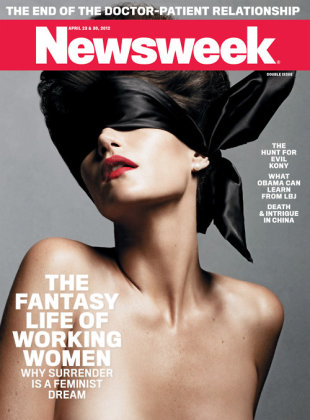
Have you seen the cover of Newsweek?

5 or 10 years ago, it was a routine, almost daily practice for me to wander around a bookstore and so I always knew what was on the covers of the usual magazines like Newsweek. You could catch my eye. Nowadays, my daily glancing about is done on line, and crafty editors can't grab me with striking covers. But I did notice this:


Now, that's really silly. Who is this "working woman"? I guess by "working woman," Newsweek means a fashion model. And for all the striving to convey sexuality, the particular woman — with her plank chest and clothes-hanger shoulders — epitomizes abstemiousness, not lust of any kind. Anyway, had I seen that on the newsstand, I would have laughed at the embarrassingly striving effort to lure me into checking out the article. Don't I want to know "Why Surrender Is a Feminist Dream"? Uh, no. I was with the radical feminists back in the late 1980s/early 1990s when it seemed very important to take "The Story of O" seriously. And to despise Katie Roiphe, by the way. Who is the author of the Newsweek cover story, though her name isn't on the cover.

Why did the feminists attack Roiphe back then? The daughter of a famous feminist, she'd come out with a book "The Morning After: Fear, Sex and Feminism" when she was only 26, undermining the work of feminists who'd strained to expand the category of behavior to which the term "rape" attaches:
Writing for The New Yorker, Katha Pollitt delivered a scathing review of The Morning After, writing, "It is a careless and irresponsible performance, poorly argued and full of misrepresentations, slapdash research, and gossip. She may be, as she implies, the rare grad student who has actually read 'Clarissa,' but when it comes to rape and harassment she has not done her homework."
Oh, but that was nearly 20 years ago. I haven't been keeping track of Katie Roiphe since then, though I see I have a tag for her. I don't remember mentioning her on the blog before, but obviously I have. Anyway, she's getting cranked through the Tina-Brownified Newsweek that I'm not going to read, but I did notice the Virginia Heffernan attack on Roiphe's cover story:
Tina, my onetime boss, from whom in the late 1990s I learned the dark arts of buzz production...
Were vibrators involved?
... loves to seduce and betray female writers. And she's got skills. As she once proudly told the editorial team at her short-lived magazine Talk, she likes to ask lady writers to deliver humiliating "personal histories" that feature self-loathing and lurid intimate disclosures, on the promise that they can publish anonymously.

Once the droning, predictable, scandalous articles are done—Daphne Merkin likes to be spanked!!!!!—Tina appeals to the writer's vanity. The article is terse and fearless and elegant! You're Joan Didion! (always Joan Didion). You must put your name on this!

Disgrace. You want to know about gender politics during this trumped-up "war on women"? That's one way power is wielded between women—the alpha girl feigns sympathy to get her henchwoman to confess or act out and then sits back and sneers—and it's no joke. 
I'm cutting a lot here. Please read the whole thing. Roiphe, per Heffernan, "sneers" at the "older, suburban, possibly Midwestern woman" who is titillated by this popular new porn book "Shades of Grey," and this supposedly entertaining sneering is leveraged by Roiphe's own sexual confessions:
Tina has forced Roiphe into this uncomfortable pose, and in public (does any woman really want to boast, "I'm more twisted and accustomed to sexual violence than anyone!"), and Roiphe comparably trusses up Newsweek readers. Over a series of bad-faith and gibberish paragraphs, she sets up the reader as a hayseed who is turned on by lite porn because she's never seen how they do it in Berlin or whatever; or—worse still—so unsuccessfully feminine and so outside of the charmed circle of female literary power that she's satisfied by regular guys who don't hit her. 
The real sadism, it seems, comes from the powerful editor (Brown) who once oppressed Heffernan, who longs to get the upper hand at long last. Now, that's lurid (but not at all sexy, unless you're way more into the world of publishing newsrags than I am).

Anyway, I'm reading Heffernan, because I wandered by Slate this morning and saw a piece that successfully caught my eye with the title "Why Is Virginia Heffernan Being Sexist Toward Katie Roiphe?" It was written by a character with the silly name J. Bryan Lowder. He says:
Heffernan suggests that Roiphe has been “humiliated” by the article, but, by my reading, it’s the former who’s actually out to humiliate the latter in some twisted form of victim-blaming. It’s as if Heffernan is saying, “Tina Brown editorially raped you, Katie Roiphe, so why don’t you just slink away in disgrace!”
Key words: by my reading. Heffernan had her reading and you, J. Bryan, have yours. And your reading is that her reading is not the right reading. Readings, readings, readings. If it's all readings, we can choose which one to read, can't we? And Heffernan is more readable. And she's got the inside experience with Brown. Meanwhile — I just got to the end of J. Bryan's cryin' and I see he's "a former student and research assistant of Roiphe’s." Ha. I stand by my choice of readings.

22 ઑક્ટોબર, 2006

"I blame it all on lip gloss."

Writes Daphne Merkin:
I believe there is something irrevocably ruinous about a culture in which women are expected to go around with their lips in a permanent state of shiny readiness, a perennial Marilyn Monroe moue of glistening sexual receptivity, hinting at the possibility that they, like Monroe, sleep fetchingly in the nude.
Click on the link at your own risk. It's long, name-dropping, and philosophicalish.

Is "philosophicalish" a word? You might well ask, as, indeed, I did. And in this wonderful world that contains Google, I found 421 uses of the word, including one by D.H. Lawrence, describing his own writing in "Reflections on the Death of a Porcupine and Other Essays":
This volume contains what Lawrence himself called "philosophicalish" essays written in the decade 1915-25. The topics range from politics to nature, from religion to education; the tone from lighthearted humor to mordant wit, to spiritual meditation. For all these contrasts, however, the essays share many of the underlying themes of the mature Lawrence: "Be thyself" could be the volume's motto. As far as possible, this edition restores what Lawrence wrote before typists, editors, and compositors made the extensive alterations that have been followed in all previous editions of the texts--on occasion entire passages removed by mistake or for reasons of censorship have been recovered.
Required observation: Lawrence was a blogger!

Irresistible chance connection: The same issue of the NYT that contains the Merkin essay that led me to talk about D.H. Lawrence, also has this piece about D.H. Lawrence's bohemian New Mexico, which leapt immediately to mind because I had looked longingly at this photo of his desk in front of a window:


I need to move my desk in front of a window, you're thinking. Aren't you?

Or are you thinking: What exactly is a "merkin"? Or:


Did you steal my lip gloss???