18 మే, 2025
Every man for himself.
18 నవంబర్, 2023
"Some people call these ‘folk songs.' Well, all the songs that I’ve heard in my life was folk songs. I’ve never heard horses sing none of them yet!"
Incidentally, the Alexander Hamilton who said "There were Folks killed in 1723" is not the Alexander Hamilton who co-wrote the Federalist Papers. It was some other guy with the same name.
And I see at the link that the other Alexander Hamilton was not an American, but a Scot. So that must be Scottish terseness. And I am retrospectively less reminded of Ilhan Omar.
19 ఫిబ్రవరి, 2022
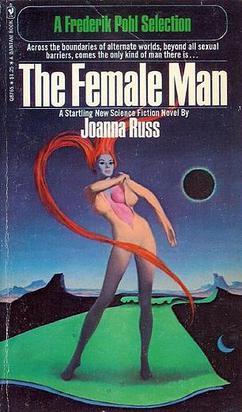
Feminist book cover from 1975.
The Female Man... was originally written in 1970 and first published in 1975 by Bantam Books. [Joanna] Russ was an avid feminist.... The novel follows the lives of four women living in parallel worlds that differ in time and place. When they cross over to each other's worlds, their different views on gender roles startle each other's preexisting notions of womanhood. In the end...
Spoiler alert!
... their encounters influence them to evaluate their lives and shape their ideas of what it means to be a woman. The character Joanna calls herself the “female man” because she believes that she must forget her identity as a woman in order to be respected (p. 5). She states that “there is one and only one way to possess that in which we are defective … Become it” (p. 139). Her metaphorical transformation refers to her decision to seek equality by rejecting women's dependence on men.
Metaphorical transformation. But the book cover seems to depict the physical peeling away of the female form. The browser is enticed to imagine something surgical.
Now, why was I reading that? I became interested in the word "munch" because I encountered an author who kept using the word "munch" as a replacement for "eat." I wondered if I had ever even once — in the entire 18-year history of this blog — used the word "munch."
A search of my archive turned up 7 posts — 5 of which have "munch" in the sense of the artist Edvard "The Scream" Munch.
One is a stray reference to the Girl Scout cookie Thank U Berry Munch. (I'm imagining an Obama inner monologue, there's a reference to marijuana, and so there's a nudge to think about "the munchies.")
The 7th post was part of my "Gatsby" project: "I know many of you don't like or don't get the 'Gatsby' project, in which we isolate and munch on a single, possibly turgid, sentence from 'The Great Gatsby,' more or less every day around here on the Althouse blog."
Why "munch" there? There's no actual eating. It's an eating metaphor, really a chewing metaphor. Indeed, the dictionary definition of "munch" stresses the the chewing — the mouth action — and not anything further along in the digestive process: "To eat (food) with a continuous and noticeable chewing action; to eat eagerly and audibly, or with evident enjoyment; to make a snack of."
That's from the OED — where I go to get my definitions, mainly because I love the lists of historical examples and where I found one that ended with the title that got me to that book cover:
a1425 (▸c1385) G. Chaucer Troilus & Criseyde (1987) i. 914 Some wold monche [v.rr. muchche, mucche, muche, meche] her brede alon, lying in bed and make hem for to grone....
1600 W. Shakespeare Midsummer Night's Dream iv. i. 31 I could mounch your good dry Oates.
1905 Baroness Orczy Scarlet Pimpernel xviii. 172 She partook of this frugal breakfast with hearty appetite. Thoughts crowded thick and fast in her mind as she munched her grapes.
1975 J. Russ Female Man 175 Munched chips, crackers, saltsticks, what-not.
25 ఏప్రిల్, 2021
"'I didn’t come here to be insulted,' she murmured at one point, and Roth burst out laughing. 'But of course you did, he said. We all did.'"
"'That’s what I want carved on my gravestone. Philip Roth. He came here to be insulted.'"
From "Excerpt: Novelist Philip Roth’s Unsettled Marriage to Claire Bloom 'God, I’m fond of adultery,' Roth liked to say. 'Aren’t you?'" by Blake Bailey (Vulture).
That's from an excerpt from the Philip Roth biography we've been talking about, the one the publisher has been withholding because of allegations about the biographer. I've been reading about this book — have read several articles — and blogged it more than once. This morning, my readings brought me around to the subject of Claire Bloom, and I got to the point of blogging the quote above before I realized what I was reading was the writing of the accused man, the biographer — Blake Bailey. Strange!
Claire Bloom and Philip Roth sound like an awful pair. I don't know if I want to read about them. I considered buying Claire Bloom's memoir, "Leaving a Doll's House," but it's not available on Kindle. I'll keep her at a distance, as the star of one of my all-time favorite movies, "Limelight."
As for Philip Roth, it seems better to encounter him through his novels, and in fact, I'm reading one of his novels, "The Human Stain." When I blogged about the biography yesterday, I ran into a quote from that book, and it was fine enough to send me to Amazon to download the text and the audio.
Here, I highlighted one quote so far. It's all one sentence:
My point is that by moving here I had altered deliberately my relationship to the sexual caterwaul, and not because the exhortations or, for that matter, my erections had been effectively weakened by time, but because I couldn’t meet the costs of its clamoring anymore, could no longer marshal the wit, the strength, the patience, the illusion, the irony, the ardor, the egoism, the resilience—or the toughness, or the shrewdness, or the falseness, the dissembling, the dual being, the erotic professionalism—to deal with its array of misleading and contradictory meanings.
Sure, you can diagram it. I'll start: point | is....
ADDED: The OED defines "caterwaul" as "The cry of the cat at rutting time. Also transferred. Any similar sound." It could be modernized into "catwail," but it's an old word, first seen in English in this sentence: "If the cattes skyn be slyk and gay, forth she wil, er eny day be dawet, To schewe hir skyn, and goon a caterwrawet." That's Chaucer. Circa 1386.
FROM THE EMAIL: Nancy sends this, from a NYT article on Leaving a Dollhouse:
''He's tense; she's tense,'' Gore Vidal said from his home in Ravello, Italy. ''Each is neurotic. They were together 17 years; it couldn't have been all that bad.'' Like most of the couple's friends, Mr. Vidal is trying to distance himself from the memoir. ''It's always best to stay out of other people's divorces,'' he said. ''And their civil wars.''
Very funny and true!
7 జులై, 2020
"Hunter S. Thompson was an idol of mine. I believe he has a very famous quote that says I don't condone the use of drugs or alcohol to anyone..."
Said Johnny Depp, quoted in "I decided to divorce Amber Heard when she defecated in our bed: Johnny Depp calls his ex-wife a 'narcissistic sociopath' who attacked HIM and denies ever hitting her at blockbuster libel court showdown" (Daily Mail).
Was Chaucer an opium addict? That's my first question. You?
15 జనవరి, 2020
"Chicken feet are popular in traditional regional Chinese cooking and are served as snacks to go with alcohol, in cold dishes, in soups or as the main dish."
From a Bloomberg News item about a container of 23.94 tons of "American chicken feet" that went through Chinese customs yesterday, "potentially heralding the start of a new trading era between the two countries just days before they sign a long-awaited trade deal."
We're told that the Chinese refer to chicken feet as "phoenix claws" and we're also shown a graph that refers to them as "chicken paws," so I'm inferring that's the official governmental term.
I looked up "paw," because it's a word I'd only use for the feet of furry mammals (or jocosely for the hands of a human being), so I'm surprised to see that the oldest use of "paw" in English (according to the OED) is, in fact, " The foot or claw of a bird; the foot or claw of a dragon."
c1450 (▸c1380) G. Chaucer House of Fame 541 This egle..with hys grymme pawes stronge..Me..he hente.
6 జూన్, 2019
Trump is "really unpopular" and "deep underwater" in some states he needs for 2020.
Did Vox read my attack on the word "deeply" (here, yesterday)? Well, "deep underwater" does seem to fit with the childish "really unpopular."
And the truth is, "deep" is an adverb, which is one more reason to be irritated by "deeply." The OED finds "deep," the adverb, all the way back to the year 1000. Chaucer used it — "And swore so depe to hire to be trewe." Shakespeare used it — "That Fooles should be so deepe contemplatiue." Pope used it — "A little Learning is a dang'rous Thing; Drink deep, or taste not the Pierian Spring." Let's keep going! There's Oliver Goldsmith — " To tie him up..from playing deep." Sir Walter Scott — "An hundred dogs bayed deep and strong." Charles Lamb — "The reason..scarcely goes deep enough into the question."
And yet the OED itself calls "deep," the adverb, obsolete when qualifying an adjective (which is what is going on with "deep underwater"). There's an exception for adjectives for colors. It sounds wrong to say "She wore a deeply blue dress" and right to say "She wore a deep blue dress" (even though we might logically think that the dress was deep). "Deep" as an adverb modifying a verb isn't wrong. Would you say "We went deep into the forest" or "We went deeply into the forest"? "Deeply" has pretty much taken over, but John Milton wrote (in "Paradise Lost"):
Oh, conscience! into what abyss of fearsYes, Trump is still President, still not impeached, and still — don't we all know? — likely to win in 2020. He's gathering strength there in the abyss, deep underwater, whatever those paltry polls have to say.
And horror has thou driven me; out of which
I find no way, from deep to deeper plunged!
28 మార్చి, 2015
"Clean Reader — an e-reader app designed to ferret out, and block, profanity in novels and nonfiction..."
Blogger — and romance novel aficionado — Jennifer Porter has drawn up a rundown of the common replacements for words the app deems profanity. Among some of the noteworthies: from "whore" to "hussy," from "badass" to "tough" and, somewhat confusingly, from "vagina" to "bottom."ADDED: "Chaucer used 'Belle Chose' (Pretty Thing) and 'Quondam' (Whatever) in The Canterbury Tales."
28 ఫిబ్రవరి, 2015
"So" is the new "well."
So, having conceived of that title for a blog post on a topic that has been stewing on the back burner of my mind, I googled those words and found them in a 2010 essay by Anand Giridharadas (in the NYT) called "Follow My Logic? A Connective Word Takes the Lead":
“So” may be the new “well,” “um,” “oh” and “like.” No longer content to lurk in the middle of sentences, it has jumped to the beginning, where it can portend many things: transition, certitude, logic, attentiveness, a major insight....Giridharadas traces the tic to 1990s-era Silicon Valley, where software-oriented minds visualize "conversation as a logical, unidirectional process — if this, then that."
One can dredge up ancient instances of “so” as a sentence starter. In his 14th-century poem “Troilus and Criseyde,” Chaucer launched a verse with, “So on a day he leyde him doun to slepe. ...” But for most of its life, “so” has principally been a conjunction, an intensifier and an adverb.
What is new is its status as the favored introduction to thoughts, its encroachment on the territory of “well,” “oh,” “um” and their ilk.
This logical tinge to “so” has followed it out of software. Compared to “well” and “um,” starting a sentence with “so” uses the whiff of logic to relay authority. Whereas “well” vacillates, “so” declaims....Too phallocratic? Well... I'm saying "well" like a person of the 80s... consider the theory of the linguist Galina Bolden, who's done scholarly writing on the topic of "so":
She believes that “so” is also about the culture of empathy that is gaining steam as the world embraces the increasing complexity of human backgrounds and geographies.And then there's Michael Erard, author of "Um...: Slips, Stumbles, and Verbal Blunders, and What They Mean":
To begin a sentence with “oh,” she said in an e-mail message, is to focus on what you have just remembered and your own concerns. To begin with “so,” she said, is to signal that one’s coming words are chosen for their relevance to the listener.
The ascendancy of “so,” Dr. Bolden said, “suggests that we are concerned with displaying interest for others and downplaying our interest in our own affairs.”
The rise of “so,” he said via e-mail, is “another symptom that our communication and conversational lives are chopped up and discontinuous in actual fact, but that we try in several ways to sew them together — or ‘so’ them together, as it were — in order to create a continuous experience.”So it is written...
20 మార్చి, 2014
Why interviews with Obama are done standing up.
Isn't it nice of the reporters to take suggestion?
Did you know that the oldest meaning for the English word "suggestion" — according to the (unlinkable) OED — is "Prompting or incitement to evil; an instance of this, a temptation of the evil one"? ("Deedly synne hath first suggestion of the feend." Chaucer, Parson's Tale 1386)
That meaning is obsolete now, but nevertheless interesting. I went looking up the word because I thought of "taking suggestion" in terms of hypnosis. The hypnosis meaning — which goes back to the late 19th century — is "The insinuation of a belief or impulse into the mind of a subject by words, gestures, or the like; the impulse or idea thus suggested." I think that's about right for the effect of Obama's people on the reporters.
What can be done to wake these people from their hypnotic state?
1. Tell them they are becoming more and more awake at each count and begin slowly counting from one to a predetermined number.
2. Tell them to "get up" or "wake up". If they don't, repeat step 1.
3. If there are still problems, remember that the participant may either be actually asleep, or simply is being stubborn about getting up out of the trance.