Art Spiegelman లేబుల్‌తో ఉన్న పోస్ట్‌లను చూపుతోంది. అన్ని పోస్ట్‌లు చూపించు

2 మే, 2022

"He was coming from another planet. He was reporting from something no one was seeing."

"Out of a group of idiosyncratic people, he was the most idiosyncratic. He was so interior that he made comics grow up.” 

Said Art Spiegelman, quoted in "Justin Green, Who Put Himself Into His Underground Cartoons, Dies at 76/'Binky Brown Meets the Holy Virgin Mary, his epic autobiographical story of Catholic guilt and neurosis, 'made comics grow up,' a colleague said" (NYT). 

The first page of Mr. Green’s book shows Binky naked, his hands bound and his feet shackled, confessing: “O, my readers, the saga of Binky Brown is not intended solely for your entertainment, but also to purge myself of the compulsive neurosis which I have serviced since I officially left Catholicism on Halloween, 1958.” 

Binky’s misadventures begin when, as a boy, he breaks a statue of the Virgin Mary while playing baseball inside his house. The book takes him through young manhood, as he deals with bullies, nuns (“fascistic penguins,” in his words), priests, fears stoked by supernatural church doctrines that are “asserted as empirical fact,” his impure thoughts and his sexuality.

It's just by chance that I've begun the day writing about the Weather Underground and underground comics. To mark this accidental theme, I'll show you this definition of "underground" from the OED:

29 జనవరి, 2022

"So as Spiegelman read the record from the board’s meeting, he focused on their stated issues with stark imagery, as well as strong language."

"Spiegelman’s mother died by suicide when he was 20, and in 'Maus,' he depicts how his father discovered her lifeless body, unclothed in a bathtub. Spiegelman also laughs in reaction to a board member bringing up the author’s past comics contributions to Playboy magazine when assessing the anthropomorphic nudity in 'Maus,' which includes stripped-down concentration camp prisoners. Spiegelman acknowledges that the voices who spoke at the meeting weren’t 'monolithic by any means.' One instructional supervisor spoke of “Maus” as an anchor book to begin teaching the Holocaust to children: 'I am very passionate about history, and I would hate to rob our kids of this opportunity.' The member also noted: 'Mr. Spiegelman did his very best to depict his mother passing away.'"

From "Art Spiegelman sees the new ban of his book ‘Maus’ as a ‘red alert’" (WaPo).

Background: "A school district in Tennessee banned the use of 'Maus,' a Pulitzer-winning graphic novel about the Holocaust, in its middle school classes, citing the work’s profanity and nudity in a 10-to-0 vote. As leaders in conservative areas across the country push for more control over the way history is taught, the McMinn County school board expressed concern that the expletives in 'Maus' were inappropriate for eighth-graders. Members also said Art Spiegelman’s illustrations showing nudity — which depict Holocaust victims forced to strip during their internment in Nazi concentration camps — were improper."

27 ఫిబ్రవరి, 2019

Books with talking animals as characters that are written for adults.

I went looking for this because, in the comments to a post about Meade saying he found Kirsten Gillibrand "rabbity," Bob Boyd said, "Meade's right and it occurs to me, if Gillibrand gets the nomination, Althouse may finally be forced to read 'Watership Down.'"

I reacted, "When's the last time I read a book with animals for characters? I did contemplate rereading 'Animal Farm,' but that aside, unless I was reading with a child, I can't picture it happening.... And I mean talking animals that are the main characters, not stuff like a guy goes looking for his lost cat (which I did read recently — 'The Wind-Up Bird Chronicle')."

So I easily found this list of 11 quite respectable books written for adults and featuring talking animals. #1 is the one I thought of on my own, "Animal Farm."

There's also Mikhail Bulgakov's "Master and Margarita" — with a "hog-sized talking cat... who sneers and snickers and entertains the Devil, pistol in paw, as they wreak havoc in Bulgakov’s Moscow." "Maus," which I have read. And "Kafka on the Shore," by the author of "The Wind-Up Bird Chronicle," Haruki Murakami:
It’s not that the cats in this novel can talk to just anyone; it’s that Nakata can talk to them—though that’s not to say they always entertain him, or that he can always understand them, not when they’re telling him things like “it’s a tuna, to the very end” and “Kawara’s shouting tied.” Or, let’s put it this way: some cats are more intelligible than others. 
"Kafka on the Shore" has been on my list of books I'm going to read soon, so I have to withdraw my snooty response to Bob Boyd. But I'm no more ashamed of being snooty than a cat is, and I'm never going to read that "Watership Down" thing.

8 జనవరి, 2015

What dishonor to the dead of Charlie Hebdo, a journal devoted to the opposite of repression!

"Their crime isn't explained by cartoons or religion. Plenty of people read Charlie Hebdo's cartoons and managed to avoid responding with mass murder," writes Ezra Klein. "As my colleague Max Fisher wrote about the magazine's wonderful cover, 'Love is Stronger Than Hate':
Part of Charlie Hebdo's point was that respecting these taboos strengthens their censorial power. Worse, allowing extremists to set the limits of conversation validates and entrenches the extremists' premises: that free speech and religion are inherently at odds (they are not), and that there is some civilizational conflict between Islam and the West (there isn't).
Here's the "Love Is Stronger Than Hate" cover, which is funny because it's selling love while still making a lot of people mad (and grossed out):


I'm grossed out, and I'm very pro-gay (as you know). Here's how Fisher interprets the cover (which ran after Charlie Hebdo had published some cartoons depicting Muhammad):
Yes, the slobbery kiss between two men is surely meant to get under the skin of any conservative Muslims who are also homophobic...
Oh, good Lord, you don't have to be conservative Muslim and homophobic or even conservative or Muslim or homophobic for that cover to bother you. In fact, the cover would be worse — by comic standards — if it only disturbed the conservative Muslims who are also homophobic. The graphic depiction of slobber makes the intent to unsettle everybody quite clear.

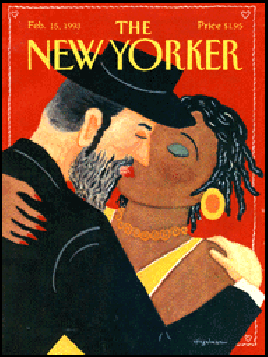
For comparison purposes, here's the great New Yorker cover by Art Spiegelman to which I assume the Charlie Hebdo cover deliberately alludes:


That cover — which relates to discord between black people and Hasidic Jews in Crown Heights in 1993 — came in for criticism at the time, though Spiegelman had presented it as the dream that "beyond the tragic complexities of modern life... it might really be true that 'All you need is love.'" Now, imagine the image with wide open mouths in a clench and outpourings of saliva. That would radically change the message, from one that gives benevolent, modern people a thrill of warmth and sparkles of inspiration to one that challenges just about everyone — swamping some with disbelief or outrage and reducing others to a puddle of hilarity.

Comics are complex! I don't think Ezra Klein and Max Fisher see that (or maybe they just don't want to admit it). "Complex" is a word that Ezra Klein uses in his last paragraph, which is a call to simplicity:
These murders can't be explained by a close read of an editorial product, and they needn't be condemned on free speech grounds. They can only be explained by the madness of the perpetrators, who did something horrible and evil that almost no human beings anywhere ever do, and the condemnation doesn't need to be any more complex than saying unprovoked mass slaughter is wrong.
So... murder is evil and murderers are crazy. Why should we not look any more closely at what happened? What is the basis for saying that only madness can explain the murders? I don't even understand the sense of saying that if only madness explains something, our response "doesn't need to be any more complex" than saying what was done was wrong. If it's only madness, where's the compassion for the mentally ill? Where are the plans for identifying and treating mental illness?

Ironically, Klein's recommendation that we only say murder is wrong reveals that he doesn't think it's only madness. It's something he feels compelled to repress.

What dishonor to the dead of Charlie Hebdo, a journal devoted to the opposite of repression!

31 ఆగస్టు, 2014

"Mickey Mouse is not a mouse. If you look very closely at him, you can see that he wears gloves."

"Mice do not have the capability, nor the desire, to put gloves on their hands. He also is depicted wearing a pair of shorts with large buttons, which a mouse would be unable to fasten given its mental limitations, not to mention the fact that it has claws without opposable thumbs. Furthermore, the viewer should not be misled into thinking that Mickey is a mouse because he uses the name 'Mouse.' This is merely Mr. Mouse’s surname, and is not intended to confer any mouselike qualities upon him. If you met a man who was named, say, Alan Bird, you would not assume that he was a member of the avian family, even if he happened to have a beak instead of the traditional mouth-and-nose combination seen in most humans, would you? Obviously, Mr. Mouse is simply a man with a loving wife, Mrs. Mouse (a female human), and a normal Homo sapiens existence, just like the rest of us. He even owns a dog called Pluto! How many mice do you know who own dogs?"

Reaction to "Hello Kitty is not a cat..."

ADDED: There! This is the post that pushed me over the line to make a Hello Kitty tag. Going back into the archive to do the necessary retrospective tagging, I find 4 other posts:

1. January 3, 2006: "Cute!" looked at Natalie Angier's "The Cute Factor." She said:
Experts point out that the cuteness craze is particularly acute in Japan, where it goes by the name "kawaii" and has infiltrated the most masculine of redoubts. Truck drivers display Hello Kitty-style figurines on their dashboards....

Behind the kawaii phenomenon, according to Brian J. McVeigh, a scholar of East Asian studies at the University of Arizona, is the strongly hierarchical nature of Japanese culture. "Cuteness is used to soften up the vertical society," he said, "to soften power relations and present authority without being threatening."
Watch out for cute.

2. June 24, 2007: "Is it wrong to tattoo your dog?"
On the positive side: The dog was under anesthesia. On the negative side: It was a tattoo of a cat, and not just any cat -- Hello Kitty.
Yeah, I need to update that, with the news that Hello Kitty is known to be not a cat, but a little girl. Good news for that dog. Also at that old post: links to the Hello Kitty Hell blog and the Hello Kitty text, which I might want to re-take to try to get a better score, i.e., better than self-centered and evil.

(From the anti-Hello Kitty blog, Hello Kitty Hell, found via Metafilter.)

(And take the Hello Kitty test, which is cute and which told me people must think I'm self-centered and evil.)

3. July 17, 2013: "Does anyone in the Bible ever say 'hello'?" Somehow the last paragraph of this post is:
"Heil Hitler" is translated as "Hail Hitler." It's not "Hello Hitler," which seems edgily absurd. You could sing it to the tune of "Hello, Dolly," which has a comma, I might note, unlike Hello Kitty.
By the way, I put my fascism tag on this post after writing about the 2006 post.

4. April 25, 2014: "Avril Lavigne picked a bad week to go all racist." Someone at Vox had written:
"RACIST??? LOLOLOL!!!," Avril tweeted. "I love Japanese culture...." In her defense, this kind of makes sense. Japanese pop does have a pretty camp vein running through it, one that "Hello Kitty" apes.
And I said:
"Hello Kitty" apes? I love those 3 words together, because I can picture "Hello Kitty" Apes... just like I can picture "King Kong" Kitties, but do not market a product called King Kong Kitties. That would be racist.
King Kong is not an ape. He is a... I want to say: He is a little boy. But I google "is King Kong fascist." That turns up a lot, including a book called — I know — "Sartre and Adorno: The Dialectics of Subjectivity," which quotes Theodor Adorno:
"While appearing as a superman, the leader must at the same time work the miracle of appearing as an average person, just as Hitler posed as a composite of King Kong and the suburban barber."
AND: I considered googling "Is Mickey Mouse fascist," but switched to "did Hitler like Mickey Mouse." I found many references to the Art Spiegelman's "Maus," a graphic memoir about his father, a Holocaust survivor, in which the father's memories have the Jewish characters drawn as mice and the Nazis as cats. The second volume of "Maus" begins with a quote from a German newspaper article from the mid-1930s:
Mickey Mouse is the most miserable ideal ever revealed.... Healthy emotions tell every independent young man and every honorable youth that the dirty and filth-covered vermin, the greatest bacteria carrier in the animal kingdom, cannot be the ideal type of animal.... Away with Jewish brutalization of the people! Down with Mickey Mouse! Wear the Swastika Cross!
ALSO: Here's "A Guide For the Purrplexed/How Maimonides explains the Hello Kitty controversy":
“Know that likeness is a certain relation between two things and that in cases where no relation can be supposed to exist between two things, no likeness between them can be represented to oneself,” the old master wrote in his Guide For the Perplexed. “Similarly it behooves those who believe that there are essential attributes that may be predicated of the Creator—namely, that He is existent, living, possessing power, knowing, and willing—to understand that these notions are not ascribed to Him and to us in the same sense. According to what they think, the difference between these attributes and ours lies in the former being greater, more perfect, more permanent, or more durable than ours, so that His existence is more durable than our existence, His life more permanent than our life, His power greater than our power, His knowledge more perfect than our knowledge, and His will more universal than our will.”

And that, of course, is wrong, because God is nothing like man. He hasn’t a face or a temper or anything else we might recognize....

To paraphrase Maimonides, it behooves those who were outraged this week over Sanrio’s revelation and who believe that there are essential attributes that may be predicated of Hello Kitty—namely, that She is existent, living, possessing power, knowing, and willing—to understand that these notions are not ascribed to Her and to us in the same sense.

20 నవంబర్, 2013

"Of course all this dorky revolutionary-aesthete chatter about tearing down barriers and storming citadels is meant to get museum-goers’ pulses racing."

"After which everybody will be too revved up to notice that Art Spiegelman is constitutionally incapable of making a single mark with any power."

TNR's Jed Perl is very jazzed up about trashing Art Spiegelman.

14 జులై, 2008

Everybody's talking about The New Yorker... and balls!

The power of cartoons! After devoting an hour to updating my post on the Barry Blitt cover, I go over to Memeorandum to see what else people are blogging about right now, and I see that everybody's talking about that New Yorker cover. I'm actually going to get around to reading that long, apparently well-researched article inside the magazine, the one about whatever it is Barack Obama did to rise to power inside that political mystery that is Chicago, but — as Art Spiegelman once said

Comics "go directly to the id.''


Kick us in the id and we cry out instantly. It will take us a while to do the background reading. Meanwhile, we bloggers will do the foreground writing.

Here's Michelle Malkin, reacting to Obama's reaction: "Grow a pair, Obama."

And Kevin Drum is all at first I thought it was kinda funny....
But at the risk of seeming humorless, that reaction didn't last too long. Maybe it's because this kind of satire just doesn't work, no matter how well it's done. But mostly it's because a few minutes thought convinced me it was gutless. If artist Barry Blitt had some real cojones...
What is this fascination with balls? Jesse Jackson wants to cut Obama's, which presumes their existence. Michelle Malkin thinks they don't exist. Kevin Drum thinks they don't exist on Blitt — they've been oblitterated — though they may somehow exist in fake — or un-Spanish — form. But if Blitt had had real cojones...
... he would have drawn the same cover but shown it as a gigantic word bubble coming out of John McCain's mouth — implying, you see, that this is how McCain wants the world to view Obama. But he didn't. Because that would have been unfair.
Uh... no... because it would have been absurdly cluttered, stupid looking, and hard to draw. Not to mention clunkily literal and no fun at all. Blitt lacks balls because he assumes we have brains?

Drum speculates about what would have happened if his dopey mouth-bubble idea had appeared as a New Yorker cover:
And McCain would have complained about it. And for some reason, the risk that a failed satire would unfairly defame McCain is somehow seen as worse than the risk that a failed satire would unfairly defame Obama.

So: gutless. And whatever else you can say about it, good satire is never gutless.
It's gutless because Obama and not McCain was the one to get mad? Why does Drum even think that makes sense? Surely, The New Yorker's readers overwhelmingly favor Obama. To offend McCain would be stroking their id.

All I can think is that Drum feels threatened by McCain's anger and unthreatened by Obama's anger. Is he still talking about balls?

13 జులై, 2008

So here's the new New Yorker cover.


Get it?

Obama says:
"I have no response to that."
The campaign adds:
The New Yorker may think, as one of their staff explained to us, that their cover is a satirical lampoon of the caricature Senator Obama's right-wing critics have tried to create. But most readers will see it as tasteless and offensive.

And we agree.

The artist is Barry Blitt, and I have to say that I think the cover is a hilarious spoof of the fears and lies about Obama. Michelle and Barack are in the Oval Office, doing a celebratory fist bump. There's an Osama Bin Laden portrait on the wall and a burning flag in the fireplace. He's a Muslim and she's a revolutionary. Of course, Obama has to push it aside and can scarcely laugh about it.

Or, maybe, I don't know... maybe it would work to laugh. He's been awfully uptight about things lately. And laughing conveys the instant recognition that it's absurd. Why be surly about it? McCain's supposed to be the cranky guy...

IN THE COMMENTS: ricpic says:
Fears and lies my foot!

The dead on truth about these two America haters.

Congrats Blitt.

And congrats to the Hillary camp inside The New Yorker.
It's that last line that's making me frontpage this.

ADDED: Taylor Marsh asks whether The New Yorker would treat John McCain the same way:
Picture a drawing showing a very old man in a wheelchair, his hospital gown adorned with medals... babe of a wife pushing him, as his first wife wipes drool off of McCain's mouth... while Cindy McCain stops to open packages from Chanel. No, I didn't think so either.

Wait. Who's the "babe of a wife" if not Cindy? I don't get the specifics, but I see the point. I think it would be out of bounds because it would be so unappealing. The New Yorker doesn't put drooling disabled persons on the cover. And the Michelle and Barack image has a transgressive, radical chic edge to it, that I suspect excites the magazine's audience.

IN THE COMMENTS: Christopher Althouse Cohen said (about Obama):
He's always been dead serious about everything. Has he ever said anything funny?
Perhaps not. Did you notice how unamused he looked in that interview in which his daughters were so lighthearted? Remember when he got pissy about Maureen Dowd saying that his ears stick out? ("I just want to put you on notice... I was teased relentlessly when I was a kid about my big ears.") His supporters may picture him bringing a youthful spirit into the White House, but look at him. He's actually quite stodgy and censorious. Turn off that television.

Now, this will constitute the "turning the page" that people seem to want so badly, since George Bush likes to joke around. The George Bush page was pushing the envelope. (Is that a mixed metaphor?) I still can't get my mind around the picture of him saying "Goodbye from the world's biggest polluter" and then "punch[ing] the air while grinning widely, as the rest of those present including Gordon Brown and Nicolas Sarkozy looked on in shock."

Victoria writes:
[Obama] doesn't poke fun at himself, doesn't use a light touch in his speeches, doesn't seem relaxed at the podium EVER.

It's gotten so that I wonder how he will acquit himself at the annual Smith Dinner....

I can't imagine, simply cannot for a second imagine Obama making fun of his background, his race, or mention his pastor and his rants during the Al Smith dinner.

What a dour, touchy time we will have, if he's elected.
Blake said:
Nah. He'll be the Margaret Dumont to our Marx Brothers.

He'll have a terrible time, tho'.
Good point! He'll be great fun for the comedians. He's a perfect straight man.

Paco Wové said:
When I saw it, I rolled my eyes and thought, Oh, God, it's the New Yorker trying to be all transgressive again....

Oh, yeah, remember all the mileage they got out of this:


From an interview with Spiegelman:
Q: [O]nyour controversial 1993 Valentine's Day New Yorker cover in which, during the conflict between Hasidim and African Americans in Brooklyn, you portray a Hasidic man and a black woman embracing. Values and worlds colliding, meeting.

AS: It didn't come as a shock to me that this got people to sit up and take notice. I'm interested in visual signs...

Q: How does that apply to the New Yorker cover?

AS: The signs are highly recognizable. The sign for Hasid is clear and unavoidable, without the usual anti-Semitic physiognomy that goes with it. The sign for African-American woman is equally unavoidable, without entering into Aunt Jemima stereotypes or anything of the kind. Then there's this other sign that has to do with the Valentine's Card-the kiss, the field of red with the lacy decoration around it, all of it weaving together separate meanings. The irony is you have these two groups that are at each other's throats at each other's lips instead. That's supposed to conjure up carnality and yet Valentine's Day, the image of Valentine's Day, isn't about carnality but a kind of benign romantic love. All those things course through this image and the impossibility of it is what's so entertaining for me. What got people most upset that week was not other magazines with the usual S&M imagery-chains and whips, leather and hurt-but something quite benign on the surface, playing with signs. Reverend Dougherty, a representative of the black community in Crown Heights, was very upset I used a black woman: one more time, he said, a white man was oppressing a black woman. Why didn't I have a black man and a Hasidic woman, he asked on the radio. Maybe he's a good reverend, I don't know, but he's a rotten art director. A Hasidic man is a lot easier to recognize than a woman with a handkerchief on her head. In terms of visual signs you've got one thing that works and one thing that doesn't. Even more important, I answered him, if I had used a black man and Hasidic woman, you'd be complaining I was once again showing the black man as a rapist and defiler of white woman. This shows me the problem has nothing to do with the signs being shown but the reverberation of those signs in people's heads. The same thing happened in op-ed articles. There was an op-ed in the New York Times in which a woman who was very upset about the New Yorker cover writes about the Jew's lascivious lips. Another person, equally upset in the Washington Post, described the Jew's prim lips. Now you know I can't draw lips that are simultaneously lascivious and prim; I'm limited.

Q: Sure you can.

AS: I did. I just drew lips.

Speaking of reading the signs, and back to the comments, George says:
He's wearing a dress.

She's in pants.

And if you hold the cover up to a mirror, it reads 'Rekroy Wen' which means "Kill Whitey" in Tshivenda, the language of Barack's homeland.

The cover date "July 21" is the anniversary of the founding the KIPRP, the Kenyan Islamic People's Revolutionary Party.

He's also crushing the throat of a bald eagle.

Wake up, America!!

22 జూన్, 2008

What are the new classics?

Entertainment Weekly does a very nice job of ranking the new classics — movies, TV, etc. — from the last 25 years. From the movie list:
1. Pulp Fiction (1994)
7. Hannah and Her Sisters (1986)
10. Moulin Rouge (2001)
11. This Is Spinal Tap (1984)
12. The Matrix (1999)
13. GoodFellas (1990)
14. Crumb (1995)
15. Edward Scissorhands (1990)
16. Boogie Nights (1997)
17. Jerry Maguire (1996)
18. Do the Right Thing (1989)
19. Casino Royale (2006)
23. Memento (2001)
24. A Room With a View (1986)
32. Fight Club (1999)
33. The Breakfast Club (1985)
34. Fargo (1996)
44. The Player (1992)
77. Sid and Nancy (1986)
91. Back to the Future (1985)
From the TV list:
1. The Simpsons, Fox, 1989-present
2 The Sopranos, HBO (1999-2007)
3 Seinfeld, NBC (1989-98)
5 Sex and the City, HBO (1998-2004)
6 Survivor, CBS (2000-present)
12 South Park, Comedy Central (1997-present)
14 The Daily Show, Comedy Central (1996-present)
17 The Office (U.K. version), BBC2 (2001-03)
18 American Idol, Fox (2002-present)
21 Roseanne, ABC (1988-97)
22 The Real World, MTV (1992-present)
28 The Larry Sanders Show, HBO (1992-98)
30 Late Show With David Letterman, CBS (1993-present)
38 Beavis and Butt-head, MTV (1993-97)
39 Six Feet Under, HBO (2001-05)
43 Late Night With Conan O'Brien, NBC (1993-present)
45 Curb Your Enthusiasm, HBO (2000-present)
49 Twin Peaks, ABC (1990-91)
55. Pee-wee's Playhouse, CBS (1986-90)
63. Mystery Science Theater 3000, Comedy Central (1989-96), Sci Fi (1997-99)
64. The Osbournes, MTV (2002-05)
69. The Colbert Report, Comedy Central (2005-present)
75. Project Runway, Bravo (2004-present)
79. The Comeback, HBO (2005)
83. Absolutely Fabulous, BBC2 (1992), BBC1 (1994-2004)
From the book list:
4. The Liars' Club, Mary Karr (1995)
5. American Pastoral, Philip Roth (1997)
7. Maus, Art Spiegelman (1986/1991)
11. Into Thin Air, Jon Krakauer (1997)
28. Naked, David Sedaris (1997)
33. The Year of Magical Thinking, Joan Didion (2005)
66. A Supposedly Fun Thing I’ll Never Do Again, David Foster Wallace (1997)
72. The Curious Incident of the Dog in the Night-Time, Mark Haddon (2003)
(The book list is heavily weighted toward fiction.)

From the style list:

1. Madonna at the MTV Video Music Awards (1984)
2. Sarah Jessica Parker in the opening credits of Sex and the City (1998)
3. Michael Jackson in the ''Thriller'' video (1983)
4. Sharon Stone at the Oscars (1996)
5. Kurt Cobain and grunge style (1991)
7. Amy Winehouse's frocks, bold bras, and sky-high bouffant (2007)
13. Tom Cruise's Ray-Bans and tighty whities in Risky Business (1983)
16. Courtney Love's vintage slip dresses, Mary Janes, and home-grown dye jobs (1995)
17. The leather trenches and Neo-style shades in The Matrix (1999)
48. The goth look of Robert Smith and the Cure (1987)
From the tech list:
3. TiVo (1999)
4. iPod (2001)
5. YouTube (2005)
7. Digital Video Cameras for Consumers (1995)
9. Satellite-Radio Stations (2001)
From the video games:
1. Tetris (1985)
Ha ha. Sorry, I'm old!

From the stage list:
21. Hedwig and the Angry Inch (1998)
Sorry, I've seen a lot of these — the most expensive of these cultural pleasures — and didn't like them very much.

Romantic gestures (these aren't numbered for some reason):
• John Cusack blasts Peter Gabriel outside Ione Skye's window in 1989's Say Anything...
• Ewan McGregor breaks into ''Your Song'' while wooing Nicole Kidman in 2001's Moulin Rouge (2001).
• After her beloved Pedro (Marco Leonardi) dies making love to her in Like Water for Chocolate, Tita (Lumi Cavazos) eats matches, literally igniting her inner flame and burning her whole ranch to the ground.
Movie posters (pictured here):
The Devil Wears Prada
The 40 Year-Old Virgin
Jungle Fever
The Silence of the Lambs
Death scenes:
• Steve Buscemi + a woodchipper + the pure white snow of 1996's Fargo = arguably the most hilarious ooky death on film.
• Mel Gibson, sans intestines, bellows ''Freeeeedommmmmm!'' in Braveheart (1995).
• Warring exes Michael Douglas and Kathleen Turner fall to their doom on a chandelier in 1989's The War of the Roses.
• Jack telling Rose not to say her goodbyes before freezing to death in Titanic (1997).
• Lucy Liu losing her head to Uma Thurman's blade in Kill Bill Vol. One (2003).
More lists at the link, but I'll stop here.

28 మే, 2006

Audible Althouse #51.

A fresh, new podcast. Stream it here. Subscribe:

Ann Althouse - Audible Althouse

I talk about comics, especially Popeye:

Popeye menu

There's some stuff about the "Masters of American Comics" show at the Milwaukee Art Museum and Art Spiegelman writing about cartoons in Harper's Magazine. Then there's that list of conservative rock songs and Pete Townsend's reaction to "Won't Get Fooled Again" being on it. I talk a bit about Bob Dylan. (The Paul Simon song I can't quite remember is "Night Game.")

There's some exciting violence involving a spider that occurs early on in this podcast. And the whole thing ends with a discussion of cool. And Kookie.

27 మే, 2006

"We're emenies on account of we both loves Olive Oyl."

Said Popeye, wondering why Curly wanted him to come over, in an old E.C. Segar comic I was reading today at the Milwaukee Art Museum, which has a big, cool exhibition called "Masters of American Comics."

I'd been looking at comics art for about half an hour, working my way through the Winsor McKay and Lyonel Feininger comics, and got to the Segar stuff, and that line of Popeye's made me laugh out loud. And then I was doubly amused to realize that was the first laughter I'd heard at this huge exhibition of comics. I stayed for another hour, and I think I laughed one or two other times, but I never heard anyone else laugh. It was like a church in there. Is this the effect of museums or did the curators choose the very comics that were least likely to make you laugh? Fantasy and surrealism loomed large. So did serious comics like "Maus." And a lot of the humor was the sort of thing that you appreciate intellectually and don't giggle over. Like:
And with insipid porcine vapidness he lapses into somniverous oblivion.
That's a caption in a "Krazy Kat" comic, as a pig goes to sleep.

"S'turbil" = It's terrible, in Krazy Kat dialect. She also says "Jee-Wizzil." I find all of that amusing, but you'd only laugh out loud at that sort of thing in a social situation, where you were interested in elevating the mood of the people you're with. In the museum setting, everyone's floating along in his own little reverie.


Hmmm.... I see there were no women artists in this exhibition, and there were 15 male artists. I'm surprised, not because I think there is a woman who deserved to be in this group. (Winsor McCay, George Herriman, Lyonel Feininger, E.C. Segar, Frank King, Chester Gould, Milton Caniff, Charles M. Schulz, Will Eisner, Jack Kirby, Harvey Kurtzman, R. Crumb, Art Spiegelman, Gary Panter, and Chris Ware.) I'm surprised because I would have thought curators would feel uneasy about a show with that many artists that lacked even one woman. Thanks for not patronizing me.


Anyway, it's an excellent show, well worth the trip to Milwaukee if you're roughly in the area. It will be there until August 13th.

And, in case you don't know, the museum itself is quite the architectural marvel:

Milwaukee Art Museum

Milwaukee Art Museum

26 మే, 2006

Art Spiegelman on the Muhammad -- and other -- cartoons.

I want to write something about Art Spiegelman's piece in the June issue Harper's Magazine, and it's frustrating not to be able to link to it. I hate to think I've reached the point where I feel that it's not worth reading things I can't link to. Remember that Kevin Kelly piece from a couple week's ago about how, in the future, everything would need to be on line to matter? I feel myself falling into that future. If Art Spiegelman wrote an article in Harper's that I can't link to, is that like Art Spiegelman thinking his own private thoughts or muttering to himself when he's walking alone on a deserted beach?

But I did go over to Borders and pick up a paper copy of the magazine, which was worth doing not so much because it reprints the notorious Muhammad cartoons from the Danish newspaper Jyllands-Posten, but because of the luscious reprints of some cartoons from the 19th and early 20th centuries. These old cartoons are brilliantly drawn and politically vicious. What is the point of beginning the article with these images? Spiegelman writes:
Cartoon language is mostly limited to deploying a handful of recognizable visual symbols and clichés. It makes use of the discredited pseudoscientific principles of physiognomy to portray character through a few physical attributes and facial expressions. It takes skill to use such clichés in ways that expand or subvert this impoverished vocabulary. Cartoonists like Honoré Daumier, Art Young, and George Grosz were masters of insult and were rewarded for their transgressions: Daumier was imprisoned for ridiculing Louis-Phillippe; Art Young, the Socialist editor of The Masses, was tried for treason as a result of his anti-World War I cartoons; and George Grosz was tried variously for slander, blasphemy, and obscenity before fleeing Germany as the Nazis rose to power.
Spiegelman goes on to criticize the Muhammad cartoons: most of them are not well drawn, they lack a discernable message, and -- in his view -- they fail to "speak truth to power." Cartoons are important: why aren't they better? Quite aside from the issue of stirring up religious fundamentalists by depicting Muhammad, there's the problem of decline in cartooning, an argument you pick up almost instantly upon looking at the old cartoons Spiegelman has chosen.
Hard-hitting cartoons have mostly been replaced by topical laffs in gag-cartoon format or by decorative "Op-Ed" style illustrations whose meanings are often drowned in ambiguous surrealism.
"Rancorous visual satire" is in short supply these days. Spiegelman wants more of it. I agree.

10 సెప్టెంబర్, 2004

Censoring Spiegelman.

Art Spiegelman, promoting "In the Shadow of No Towers," his new book about September 11th, gave an interview this morning on NPR'S "Morning Edition." I've long been a fan of Spiegelman's, because of Maus and Raw, and I am willing to accept a lot of honest self-revelation from someone who experienced the World Trade Center attacks from within ten blocks of the site, but he struck a bad note when he complained about The New Yorker's rejection of the comic strips that ultimately became his new book. (The audio link at the NPR site is not yet available, so I cannot produce a verbatim quote.) In these comics, he portrayed himself as feeling equally threatened by terrorism and by President Bush after September 11th. Although publishers in what he called "Old Europe" accepted the comic strips, The New Yorker would not. This, he said, was "censorship." What writer feels so important that he can call a rejection from The New Yorker censorship?! There is no more desirable placement for writing or comics in this country! You had to go to "Old Europe" to publish? Was there no other place to publish in all of the United States? Was your work published in the equivalent of The New Yorker in Europe? You equate Bush's policies with terrorism, and then when that overdramatization proves unappealing, you equate a rejection from The New Yorker with censorship, further overdramatizing.

UPDATE: Bad link fixed. Sorry. There is a glitch in Blogger. The audio is available at the link now too.

FURTHER UPDATE: I've corrected the title of Spiegelman's book. It is, I'm afraid, "No Towers," not "Two Towers."