લેબલ Andy Kaufman સાથે પોસ્ટ્સ બતાવી રહ્યું છે. બધી પોસ્ટ્સ બતાવો

9 એપ્રિલ, 2024

"[T]he burgeoning Nads were young Republicans. They had gathered at the Capitol Hill Club to drink cheap beer..."

"... in a room decorated with porcelain elephant statues and photographs of President Dwight D. Eisenhower and Sen. John McCain, and listen to a well-built man with a five o’clock shadow and an Australian accent tell them that '"nasty women" are coming for two things: your mind and your testicles!' In some ways, Adams’s shtick is conventionally conservative: He’s Christian, he’s very concerned about there being only two genders, he rails against 'woke.' In other ways, his version of MAGA manhood is so over-the-top, so uncanny that it almost seems like performance art.... He writes about how if your wife is 'high-maintenance' then you’re a 'loser' no matter how hot she is. And about his love of steak. 'Alpha males don’t care about time changes, we wake up at 4AM every single morning regardless of the circumstances,' he wrote on X last month, a few days after the clocks sprang forward for daylight saving time. '64oz tomahawk ribeyes aren’t going to eat themselves!' Is Nick Adams serious?... 'You remember Andy Kaufman?; Adams’s hired security guard told me, referring to the late comedian who was famous for never breaking character.... 'This is not a character,' Adams told me. 'This is not a bit. It’s not trolling. Anyone who thinks this is not me, that I don’t eat steak, that I don’t drink ice-cold domestics, that I don’t repel woke beer, they’re wrong. They’re absolutely wrong.”

Writes Ben Terris, in "The deeply silly, extremely serious rise of ‘Alpha Male’ Nick Adams/Meet the Trump-backed raconteur who is teaching America’s young men the art of being hard to deal with" (WaPo, free access link).

"Nads" = Nick Adams Disciples.

I hadn't heard of Nick Adams until this article. The issue of when a comedian is "serious" is kind of intriguing. I don't think the point of reference should be Andy Kaufman. It should be Andrew Dice Clay. I already lived through that. Another thing I lived through was the TV show "The Rebel." Don't reuse a name that already means something to some people who still roam through the west.

ADDED: As pointed out by William in the comments, there's also Nick Adams, the Hemingway fictional character. I don't have a problem with this new Nick Adams adopting the name in a reference to those stories from a century ago, just as I'd accept a comedian who called himself Hamlet or Captain Ahab. "Nick Adams" was taken as a showbiz name back in the 1950s, and I don't like seeing it reused. 

6 જુલાઈ, 2020

"Why do none of Trump’s ‘jokes’ feel like jokes?"

A column by Richard Zoglin in WaPo. And if you're jumping to answer the question with something like they're not funny to people who hate Trump or who are the butt of his jokes, you're wrong. Zoglin — author of "Elvis in Vegas: How the King Reinvented the Las Vegas Show" and "Hope: Entertainer of the Century" — has something way more interesting and — as far as comedy matters go — erudite.

Zoglin looks at some important Trump jokes/"jokes": 1. "When you do testing to that extent, you’re going to find more people, you’re going to find more cases. So I said to my people, ‘Slow the testing down, please,’ ”  2. (about Hillary's emails) "Russia, if you’re listening,” 3. (about police putting arrestees in squad cars) “Don’t be too nice,” 4. whatever he said about injecting disinfectant, and 5. challenging Secretary of State Rex Tillerson to an IQ test.

Zoglin says Trump is using an "avant-garde and subtle" form of humor!
Trump’s chief model, it seems to me, is the deadpan performance-art comedy of people such as Andy Kaufman and Sacha Baron Cohen. They created elaborate put-on characters, like Kaufman’s obnoxious lounge-lizard Tony Clifton or Cohen’s blundering Kazakh journalist, Borat.

The key to pulling off this sort of comedy is to stick with the ruse, to stay in character, to dupe the audience for as long as possible....

Trump, the Tony Clifton of presidents, has proved equally adept at sustaining the put-on. He never breaks character. He never laughs at his own jokes (or anyone else’s, for that matter). On those rare occasions when he feels compelled to backtrack from an especially ridiculous comment, he does so with a scripted monotone of can’t-miss-it insincerity.

[Some things Trump says] make sense only as performance art. And in that respect, Trump is peerless. Even Tony Clifton and Borat couldn’t keep their acts running for four years straight.
If you buy the theory that Trump is doing performance art... what a great artist!

24 ફેબ્રુઆરી, 2019

"One of the worst things to happen in America in the last two years is, surely, the birth and spread of the phrase 'nothing burger.'"

"It is used by President Trump’s supporters whenever Robert Mueller issues anything, including the many times he’s issued things that are, quite clearly, something burgers, with lots of shocking and damaging information that implicates people close to the President in something that seems like potential collusion with Russia or other possibly related crimes. [The Paul Manafort sentencing memo], Mueller’s longest, can be seen, by avid followers of his investigation, as not only an exquisitely built nothing burger but a commentary on our age and our expectations—at least, as it relates to the question of collusion during the 2016 election. Andy Kaufman could have hardly done so good a job at tweaking our deepest hunger."

Writes Adam Davidson in The New Yorker in "Robert Mueller’s Nothing-Burger Sentencing Memo on Paul Manafort."

Help me understand what Davidson was picturing when he wrote "Andy Kaufman could have hardly done so good a job at tweaking our deepest hunger." Presumably, he thinks Andy Kaufman did a really good job of tweaking our deep hungers, but which hungers? When? Can you dig up any clips of Kaufman that show him excelling at tweaking deep hungers? Outstripping Andy Kaufman — in Davidson's idea is Robert Mueller — right? — not the "avid followers" of the investigation. The "avid followers" are the audience for Mueller, and Mueller, like Kaufman, is seen as putting on a show for aficionados.

We, the audience, sit expectantly, wanting something from the showman, but he  withholds, even as he maintains our rapt attention. We keep watching, because he's captured our attention, but Mueller has captured our attention because we hope/fear he's got something devastating on Trump. The "deepest hunger" Davidson is thinking about is for the destruction of Trump. How is that like what Andy Kaufman did when — to name 2 examples of Kaufman playing with audience expectations — he did a show that consisted of nothing but singing all the verses of "99 Bottles of Beer on the Wall" or he stood on stage and read the entire text of "The Great Gatsby"?

There was no "deep hunger" that Kaufman was tweaking. He was tweaking the shallow hunger — borne of ticket-buying and seat-sitting — that there will be a show. When will this get funny? The joke is that it will never get funny. It will just go on like this. It's the nothing. The joke's on you for expecting something conventional and the only way to squirm out of your predicament is to realize it before the other people sitting around you not understanding that I'm never going to give you what you're dumb enough to want.

Am I approaching the enigma of the Mueller/Kaufman comparison?


ADDED: Davidson is surely wrong that the term "nothingburger" was born in the last 2 years! The OED traces the term all the way back to 1953. The official definition is: "A person or thing of no importance, value, or substance. Now esp.: something which, contrary to expectations, turns out to be insignificant or unremarkable."

Maybe Davidson — a fan of Kaufman's? — really is doing comedy. I must admit I laughed a lot while reading it out loud last night. He can't really mean that the phrase "nothing burger" is "One of the worst things to happen in America," so that's the tip-off, right? I'm overthinking this. I know!

But he could be serious. Aside from the mistake of believing the term got born during the Trump administration, he could genuinely believe it's one of the worst things to happen in America in the last 2 years. All he'd need is a long "worst things" list. You could have a list of "The 1 Million Worst Things to Happen in the Last 2 Years," and then some irritating word could be on it.

3 જુલાઈ, 2018

"This is the definition of art that has always most excited me: the feeling of being taken to the boundary of the universe, then beyond that boundary..."

"... into the surrounding darkness, and you’re the first person to ever be there. It’s not an experience that happens very often, but I’m willing to wait. I’ve never been someone who’s enjoyed music in general, or contemporary fiction in general, or films in general, or theater in general. I feel I’m standing on the runway waiting for the next big one to come in, carrying some of that outer darkness with it."

Said the writer Mark Haddon, commenting on the liner notes to the Miles Davis album "Bitches Brew," which read: "it’s not more beautiful, just different. a new beauty. a different beauty. the other beauty is still beauty. this is new and right now it has the edge of newness and that snapping fire you sense when you go out there from the spaceship where nobody has ever been before."

Haddon (the author of "The Curious Incident of the Dog in the Night-Time") is quoted in "Art Should Be Uncomfortable/For the writer Mark Haddon, Miles Davis’s seminal jazz album Bitches Brew is a reminder of the beauty and power of challenging works" (The Atlantic, May 2016). The liner notes were written by Ralph J. Gleason.

I'm reading that article after googling "art should make you uncomfortable" — which is a phrase I wrote at the end of the post "The brown spot." I was moved to google my own words because my statement was challenged — "So that is a crucial component of art: making the viewer uncomfortable?" — and because I didn't think what I was saying was at all original. Perhaps I thought I could find some authority to back me up.

My challeger, the commenter Loren W Laurent, added "A conveyance of joy is thus outside of what art should do?" I answered: "Joy should make you uncomfortable. After a short while, you need to come down and want to move back to normal. If your brain doesn't work like that, you have a problem. You can't go about your life in a state of ecstasy."

Additional "comfortableness" topics I just got into a long conversation about:

1. Comedy. Should comedy make us uncomfortable? Doesn't the best comedy comedy make us uncomfortable? One criticism I have of the Kathy Griffin concert I saw in Chicago last Thursday is that the audience was treated as an in group, with shared values, and Griffin never challenged them. She only attacked people out there beyond the enclave of the theater. She had been exiled, so I understand her motivation, but she asked nothing from the audience except that they commit to her and be on her side, against those others out there. The audience adulated her, and she dished adulation back at them. It was a rally. I thought it was ironic: She hates Trump, but her show was like the stereotype of a Trump rally (more than an actual Trump rally is like that stereotype). I prefer comedians who makes their own fans uncomfortable. Andy Kaufman. Lenny Bruce. Etc.

2. Religion. I thought of Jesus:
“Do not think that I have come to bring peace to the earth; I have not come to bring peace, but a sword. For I have come to set a man against his father, and a daughter against her mother, and a daughter-in-law against her mother-in-law; and one’s foes will be members of one’s own household. Whoever loves father or mother more than me is not worthy of me; and whoever loves son or daughter more than me is not worthy of me; and whoever does not take up the cross and follow me is not worthy of me. Those who find their life will lose it, and those who lose their life for my sake will find it."
3. Politics.

3 જૂન, 2018

Not-Funnyites converge on a hipster homophobe.

Yesterday, responding to a NYT article about the supposed new trend of "gaysploitation," I offered the term "hipster homophobia" (like "hipster racism") to refer to some uses of homophobia that don't count as bad but work as casual and cool and perhaps even affectionate. I said:
But watch out, especially if you're the wrong kind of person. We've seen "hipster racism" (how'd that work out?), and I'm inclined to call this "hipster homophobia." Make sure you're wearing your "hipster" shield! But you can't make sure, because it's not hip to fret about security. And never forget: this is The Era of That's Not Funny. And the Not-Funnyites know how to strip you of your livelihood in just about exactly one day. To be hip, you must be loose and casual about your ironic interface with the world. If you're not already poor and beyond any interest in building a career, step away from the fun new game of "gaysploitation."
And now, today, I've stumbled into "Disney remixer Pogo can’t walk back his homophobic comments on YouTube." I had to get up to speed on what a "Disney remixer" is. It's not some job at Disney, the media giant, it's independent recording, using Disney audio, and producing results like this...


... which is truly fun and delightful and perfectly nice. That video, from 11 years ago, has over 20 million views, and AV Club had a piece, 5 years ago, "Pogo’s 'Alice' is the Internet’s nostalgia fixation at its most enchanting." Here's a Reddit discussion of it that includes a lot of reminds me of the time I took LSD.

Here's another example of Pogo's sweet video pleasantry:


It seems simultaneously edgy and cushiony soft. Mmm... just like I feel when I think I'm so hip and I can say... anything. And you'll get me. Because you know I'm cool, and you'd be stupid or stiff if you didn't understand the amorphous hipster place whence I originate.

But this is The Era of That's Not Funny. And the Not-Funnyites know how to strip you of your livelihood in just about exactly one day.

So, back to the piece in The Verge.
Earlier this week, a wildly homophobic video surfaced where [Nick] Bertke [AKA Pogo] states that he views “gays as an abomination” and cheers the 2016 massacre at the gay nightclub Pulse. Faced with immediate backlash, the musician is now trying to walk his statements back, claiming the internet “has taken the video very far out of context and proportion.”

In the video, which was filmed in 2016, Bertke addresses why he chose the username “Fagottron” for his YouTube channel. “I’ve always had a very thorough dislike of homosexuals,” he says. “I’ve never liked a grown man acting like a 12-year-old girl. I’ve always found that to be quite disgusting.” The video has since been taken down, though mirrors of it remain on YouTube. He adds that his “subtle” username is a way for him to “express to the world that I view gays as an abomination.”
Here's that video. I've watched it. You watch it and catch whatever nuance you can:


It's "hipster homophobia," isn't it? To my ear, he's a confident guy who thinks he's cool and can tweak and trigger uptight dumb people. Here he is, after he's come under the attack of the Not-Funnyites and after it's not funny for him anymore because he must find a way to repent or die:


At one point, he mentions Andy Kaufman. Fortunately, for Andy Kaufman, he's already dead or he would be murdered.

28 ડિસેમ્બર, 2017

"'Nobody ever came from nowhere more completely,' Welles says, drawing a big studio-audience laugh..."

"... with this description of not just Latka but Kaufman as well. Asked how he came up with such a distinctive character voice, Kaufman says only that he 'grew up in New York, and you hear a lot of different voices in New York' ('You don't hear that one,' replies Welles). He also cites the accents of a high-school friend from South America and a college roommate from Iran."

Open Culture (via Metafilter) about this 1982 interview (in which Andy Kaufman seems almost to hypnotize Orson Welles into doing all the talking):


Welles was obviously not a natural interviewer, and he did not — despite how this looks — have his own talk show. Orson Welles was a very common talk show guest in his later years, and on this occasion he was subbing for the regular host, a man who was a natural interviewer, Merv Griffin.

I wish I could show you a wonderful example of Merv interviewing Orson in which you'd see comfort and pleasure replace awkwardness and confusion, but — like the way Andy Kaufman wanted to do wrestling — Orson Welles wanted to do magic tricks:


But wouldn't we all be better off quitting our career — whatever it is — and becoming a magician? 

And if you were reading this blog in its 5th week, maybe you'll realize why I'm nudging you like that. Here, from February 23, 2004:
I saw Get to Know Your Rabbit when it was shown, pre-release, in 1971, to a test audience in Ann Arbor, Michigan. I and it seemed like everyone else in that theater experienced it as the funniest movie we had ever seen. Somehow, even though it was directed by Brian De Palma and has Orson Welles in its cast, it fell into oblivion. I still have never come close to laughing as much at a movie as I did that night....
Here's Orson Welles schooling Tommy Smothers in showbiz magic:

14 મે, 2016

"By the way Ann, is the 'ludicrous distraction' part of your cruel neutrality schtick?"

Asks walter in the comments to last night's post "Are you following the ludicrous distraction of 'John Miller' and 'John Barron'?"

First, that word: "schtick." I would have chosen the spelling "shtick." But I'm looking at the OED, which gives the main spelling as "shtik," validates both walter's and my spelling, and also accepts "schtik." So basically, you can do anything you want with "c"s in that word.

According to the OED, "shtick" (which is U.S. slang with a Yiddish origin (meaning "piece" or "play")) has 2 meanings. The first is "An act or stage routine; a joke, a ‘gag’" or "a patter, a ‘line’; a gimmick or characteristic style." Example: Saul Bellow, "Herzog" 1964, "‘Let's cut out all the shtick,’ said Gersbach. ‘Let's say you're a crumb.’"

The second meaning is less derogatory and surprisingly bland: "A particular area of activity or interest, a sphere or ‘scene.’" (Hey, nobody says "that's my scene" anymore.) Example: 1976   Publishers Weekly 15 Mar. 55/2: "A husband trying to puzzle out his woman, women-God-bless-them in general, and the whole female shtick."

So I accept "cruel neutrality schtick." It's my scene. I have to check the material under the tag to remember everything I've done with it. Here's the best recent examination of the phenomenon, from last January: "Why I quit watching the debate halfway through and woke up the next morning identifying strongly with Cruel Neutrality."

That explains a lot more than I'm in the mood to spell out now. I'll just say that those of us in the Cruel Neutrality scene are not forswearing all opinion. And it's certainly not abstention from cutting attacks. How else could it be cruel? The neutrality part is my instinctive, lifelong point of view — distanced and averse to everything political.

And yet I keep looking. I'm a rubbernecker. And part of what I'm cruelly neutral toward is the press, and my opinion of the story about the 25-year-old "John Miller" phone call was, indeed, that it was a ludicrous distraction. It takes us back to a much younger Donald Trump, prankishly putting on a reporter who figured out it was him and published her story under the title "Trump Says Goodbye Marla, Hello Carla . . . And a Mysterious PR Man Who Sounds Just Like Donald Calls to Spread the Story." The reporter, Sue Carswell first thought "It’s so weird that Donald hired someone who sounds just like him," and then she consulted the big gossip columnist of the day, Cindy Adams, who said, "Oh, that’s Donald."

These days, Carswell says: "This was so farcical, that he pretended to be his own publicist. Here was this so-called billion-dollar real estate mogul, and he can’t hire his own publicist. It also said something about the control he wanted to keep of the news cycle flowing with this story, and I can’t believe he thought he’d get away with it." But he did get away with it! He got away with it the way Andy Kaufman got away with Tony Clifton. We knew it was him but he kept doing it, and continuing, with commitment, when everyone already knows, is part of the... shtik.


From the comments at that YouTube, from 2 months ago: "Donal Triump is Tony Clifton!!!" Yeah, I know. Spelling. Back to the spelling topic. But you see my point. There is a lot of comedy happening through Donald Trump. He's been an entertainer for a long time. The extent to which the entertainment is interwoven with the love life, the real estate moguling, and the politics is a big, crazy, unfathomable mystery. The most ludicrous thing about the WaPo story is that it seems to think it's getting the better of Trump, bringing him down, but it's inflating him, blowing him up, as he's sending us up.

I mean, read the transcript. It's hilarious:
John Miller:  He was so set up with that.  You know, Madonna called and what happened -- I mean, I don’t know if you want to listen to this.

Interviewer:  No, I do.

John Miller:  Do you?  Do you have a second?

Interviewer:  Yeah, obviously.
To my ear, that's prodding the interviewer to laugh and say "Come on, Mr. Trump, I know it's you." She didn't do that, I suspect, because she was seriously interested in extracting the story, the gossip about Madonna that would serve her interest. And WaPo is telling the story to serve its interest. But the whole damned thing, going back to the 1980s, has served Donald Trump's interest. 

23 ઑક્ટોબર, 2015

Dead comedians on tour: Andy Kaufman and Redd Foxx, the holograms.

Alki David, the billionaire behind Hologram USA made the announcement and said his company is "working with other estates of famous funny guys and funny girls, these just happened to be amenable estates who see the vision."
Mr. David said that the hologram shows... say, Andy Kaufman lip-syncing the “Mighty Mouse” theme on... “Saturday Night Live”....

Noting that Malcolm X had known Foxx before his stand-up fame and described him as “the funniest dishwasher on this earth,” Mr. David said, “We’re going to have a scene with Malcolm X. We’re going to have various notable names featuring in his story.”...

The company is preparing holographic versions of Billie Holiday to perform at the Apollo Theater in Harlem, and of Whitney Houston for a worldwide concert tour next year..... “There are an awful lot of dead celebrities,” [David] said. “There are an awful lot of dead people with a lot of followers. The fresher the memory, the bigger the star.”...
Bonus red meat for pedants: The director of the licensing agency said that the dead celebrities "literally come back from the dead."

I'm hesitating to publish this because it's pretty obvious that David wants to provoke those who find this kind of entertainment disgusting. It's a virality strategy, and it gets out the word for the kind of people who do think it's cool to have the illusion of somebody they love come back from the dead (and don't give a damn about the right and wrong uses of "literally").

So I'm going to distance myself. Oh, the absurdity of "amenable estates who see the vision" and the sad comic deafness of the phrase "famous funny guys and funny girls." They're dead. They're not funny at all. And Malcolm X isn't funny dead or alive.

12 માર્ચ, 2013

"While they remembered her sincere Christian beliefs, some wondered whether Victoria Jackson, Tea Partier, was some sort of Andy Kaufman-style performance art."

"'A lot of people in show business think I’ll pull off my mask and say, "Ha-ha! I tricked you! Of course I won’t be a stupid conservative Christian,"' says Jackson."
“She seems to take it seriously while not taking it that seriously,” says Sweeney Blum. “She clearly likes the laughs and she likes getting the laughs enough that she doesn’t mind being laughed at, while at the same time, she truly seems to like the things she’s saying. Every time I have an encounter with Victoria, I have so much thinking to do afterwards.”

25 જાન્યુઆરી, 2013

I was so tired when I wrote last night's "Gatsby" post.

It was a real struggle with that sentence:
There was dancing now on the canvas in the garden; old men pushing young girls backward in eternal graceless circles, superior couples holding each other tortuously, fashionably, and keeping in the corners — and a great number of single girls dancing individualistically or relieving the orchestra for a moment of the burden of the banjo or the traps.
You might say I wrestled with that sentence. The commenters — whom I read this morning, after I conked out and slept for 10 hours — helped me make the connection to wrestling. Terry said: "The key phrase, I think, is 'on the canvas.'" That affects how you think of the men pushing the young girls, the gracelessness, and the tortuously. Dancing is like wrestling here. In the "Gatsby" project, we look into one sentence, in isolation, but I just looked back into the text to get a better picture of that canvas, which I took to be a way to transform lawn into dance floor. I get to this sentence:
At least once a fortnight a corps of caterers came down with several hundred feet of canvas and enough colored lights to make a Christmas tree of Gatsby’s enormous garden.
So let that be today's sentence. Lots of Cs: corps, caterers came, canvas, colored, Christmas. Christmas replacing the garden evokes the New Testament supplanting the Old. From the Garden of Eden to the salvation of Christ. By the way, that is the sentence just before the "crowded hams" sentence that made me angry 3 days ago.

I'll leave you to untangle the strands of colored lights that festoon the Christmas tree sentence, because I need to get back to what people said about yesterday's sentence. I must say I laughed out loud when McTriumph said:
Professor Ann, your first thought was musicians using the girls as instruments? You should write a novel, "Fifty Shades of Banjo."
And then betamax3000 introduced Naked Andy Kaufman Robot. Betamax has done this "naked robot" routine before, but the Andy Kaufman iteration blew my mind, because I was still admiring Terry's wrestling insight, with men wrestling/dancing with woman, and then to bring up Andy Kaufman — when Kaufman not only had a comic act that was about wrestling with women, but he had a routine that consisted of taking the stage and reading, in its entirety, "The Great Gatsby." But it's not as if betamax3000 just said, "Hey, this is so Andy Kaufman — the wrestling and 'The Great Gatsby.'" No, betamax did a series of comments that twisted the "Gatsby" text into things that would be said by the Naked Andy Kaufman Robot:
I have pushed many women gracelessly backwards on canvas. It has been both tortuous and fashionable, leaping high from the corners of the ring onto the contestant below: in that moment there is Truth, Sweat and Cheers. Many people assume the urge to wrestle women is sexual. As a wrestler of women I can definitively say that this is untrue. Mostly. In the main it is about the defining moment of being Superior, of recognition of the Pinner and the Pinnee.
A few moments on Etiquette.

A sportsman never uses the Banjo or the Traps on a female wrestler. While he is allowed to use the Piledriver it is not to be done from a height greater than a women's modest skirt: below the knees only, gentlemen.

Danny DeVito did not understand. He would ask "Andy, why don't you stop wrestling women?" and I would reply "Danny, why don't you stop being so short and disheveled?"

Shirt tucked or not, in the ring Danny would've been able to stand as tall as his Courage would allow him to be, but -- sadly --he did not understand.

Tony Danza would argue "I'm a boxer. What would be so different if I boxed women?"

I could only shake my head. He did not comprehend the difference between wrestling and fighting. A punch is anger, but only through grappling do we experience the common ground between the sexes: the canvas ring is where the true colors are painted, like a woman's red nails or a man's 1969 orange Camaro.

I once wrestled a woman who smelled of avocado. In the midst of our grappling a moment was frozen as that scent overpowered my senses, psychically and spiritually. Was the avocado Fear or Power? How could I pin this woman down, this woman who smelled of avocado? How could I keep her soul and buttocks confined beneath me when the Avocado was everywhere? In the end I won the match, but the avocado defeated me on a far grander level.

Every woman has the Avocado inside her -- this, a true wrestler knows -- knows and respects...
And:
The first time I wrestled a woman was practically a religious experience. At the end I laid on the canvas pinned, defeated and euphoric: through my bell-rung eyes I saw God through the rafters wink at me. I do not remember her name but I remember the look of Victory in her eyes and how I peed a little.
And:
Women have soft elbows. When you are elbowed in the solar plexus by a woman it is different than a man's elbow: there is Understanding. There is Forgiveness.
And:
When pinned between a woman's headstrong knees a man has no choice but to understand: it is the Silent Conversation, and the chafing will heal.
And:
To repeat: wrestling a woman is not sexual. Excitement is for the Soul and the Arms and the Thighs, not the Loins. To have an erection in the ring is to give the Devil a Handle.
There's more, but enough of the quoting of the Naked Andy Kaufman Robot. Let's turn to the wonderful commenter Chip Ahoy, crisply quipping:
Later, following the death of Gatz, the same canvas was turned over to modern dance.


But that didn't last. The dancers, bored of dancing set off in pairs to the beach, to break up and pair off again and break up and pair off.

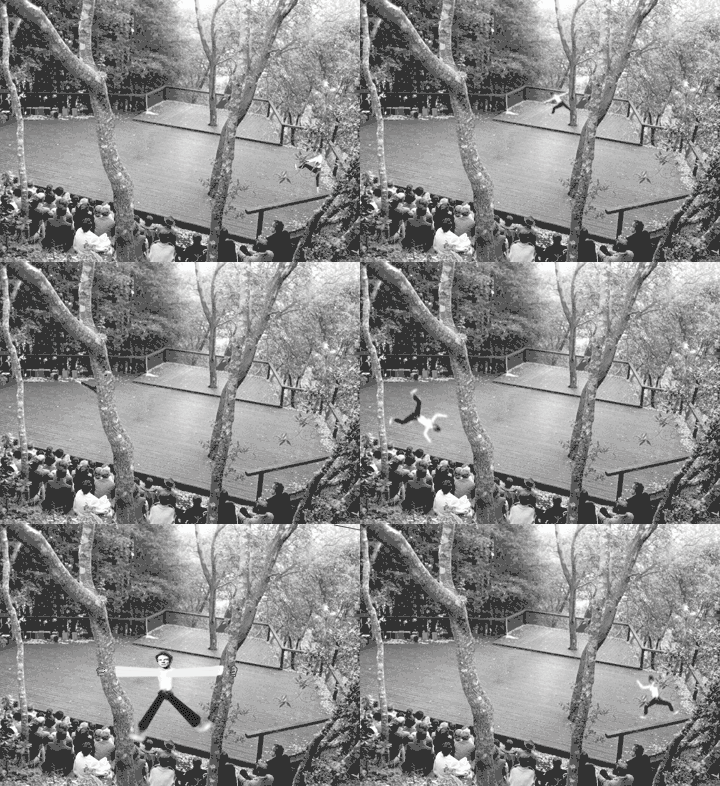
I remember that modern dance GIF. It was back in 2009, when I wrote about "Lawrence Halprin... 'the tribal elder of American landscape architecture'" whose wife was a dancer who, he said, "could not be contained by a rectangle," so he built her a dance deck that was the "odd, improvised shape" you see in the photo. Back then Chip Ahoy said:
I too knew that my wife could not be contained on a rectangular deck for she is uncontainable, so I improvised with an deck area that could be danced on several levels. The outer levels tilt so that anything placed on them slide off toward the center, and built with portals that promise escape but all lead circuitously back to the main dance area, rather like a hamster habitat. I rounded the edges and varied the angles for nature has few straight lines and fewer right angles and my wife is nature personified, and that made the whole deck railing more difficult, you see, which I then electrified because I knew she would make several attempts at an over-the-rail vault. The deck areas are also surrounded by a moat that I populated with piranhas that I feed regularly by dropping in a steak so they're veritably trained to converge en mass, along with back up electric eels and those really gross blood-sucking slugs, all to discourage wandering beyond the safety of boundaries I set forth with my architecture. The deck itself is fitted with sprinklers at its farthermost points that spray a mist with power hose force to warn the little sylph-like dancing scamp whenever her dance gives the appearance of breaking loose or she nears the end of her retractible chain.
And then Chip proceeded to animate a dancer for the odd, improvised dance deck.

And now, it's your turn to dance. Dance all night in the comments, backward in eternal graceless circles, tortuously, fashionably, individualistically.

1 જાન્યુઆરી, 2013

"Every Friday five crates of oranges and lemons arrived from a fruiterer in New York..."

"... every Monday these same oranges and lemons left his back door in a pyramid of pulpless halves."

I warned you I was going to do this. Come on. Play along. (And, no, I wasn't thinking about Andy Kaufman when I dreamed this up. It was all a riff on that Baz Luhrmann trailer for the new "Great Gatsby" movie.)

So, now, let's talk about oranges and lemons. The phrase "oranges and lemons" appears twice in the sentence, unchanged, even as the oranges and lemons themselves are changed. That's the whole action of the sentence, the transformation of oranges and lemons in one form into oranges and lemons in another form. Here they are on Friday, in crates, and here they are on Monday in "a pyramid." That is, they have become, in that alluded-to time period  — the weekend — a pile of garbage. But the pile is called "a pyramid," A pyramid! We're called upon to think of the grand erections of pharaohs, in comparison to crates from the lowly little character with the silly-sounding occupation "fruiterer."

Are the crates even stacked up? There's the absurd and obviously false notion that the fruit has been improved by whatever it was that went on in that house over the weekend. That absurdity calls upon us to think about the people who arrived and left, the people who ate all that fruit. But of course, they didn't eat it. They drank it. The pulp was extracted for use in alcoholic mixtures, and if the fruit emerged from the weekend as "pulpless halves," then, we may infer, so did the people. We don't hesitate to keep calling them human, yet we see the inaptness of calling the mere rinds "lemons and oranges." Even if you could conceptualize the big pile of rinds as a pyramid, you'd easily perceive it as garbage. Since that perception is easy, we have energy left to think about what is more difficult. Who are these people?

28 એપ્રિલ, 2010

"You're the first friend from television I ever had."

"And probably the closest, I think."

(That's not really the clip I intended to find, but I got sidetracked. I was looking for something from 1954 to go with this obit for Allen Swift.)

28 જાન્યુઆરી, 2009

"Either [Joaquin] Phoenix is perpetrating an elaborate Andy Kaufman-style hoax...or he's truly lost his marbles."

Either he's lost his marbles, or someone has spilled the marbles. So, what's happening with Joachin (who looks ridiculous these days in a big beard and recently performed 3 rap songs in a Vegas nightclub and fell off the stage)? And also, how did we ever get started using "marbles" to symbolize mental things: sanity and secrets. Everyone has his own personal marbles — "his marbles" — which we only mention when we think they may have been lost. It's always "lost," too. You don't spill your personal marbles. Even if someone has a sudden, public mental breakdown, we don't say: "Oh, no, he's spilling his marbles." So there are those personal marbles — his marbles, your marbles — and then there are "the marbles." These are shared marbles, even though we never say "our marbles" — Don't spill our marbles — or "their marbles." They're just the marbles. These our secrets, and I suppose we like the image of secrets as something round and spillable that we carry around. And we never just lose these marbles. It's always spill — perhaps because a spill is there to be seen, making a mess. Whereas the lost marbles of sanity are nowhere to be seen. "He's lost his marbles." "Oh, really? Have you looked around for them?" They are really nowhere at all. They've ceased to exist. Now, it must be said, that the #1 slang definition for "marbles" is "testicles." So, I've got to think that that the idea of losing your marbles or spilling your marbles traces back to testicles. "Spilling the marbles" — don't expose what should be kept covered. And your sanity? I know the etymology of the word "hysterical" is:
1615, from L. hystericus "of the womb," from Gk. hysterikos "of the womb, suffering in the womb," from hystera "womb" (see uterus). Originally defined as a neurotic condition peculiar to women and thought to be caused by a dysfunction of the uterus. Hysterics is 1727; hysteria, abstract noun, formed 1801.
So there is this notion that your sanity depends on your sexual parts. Don't lose your marbles! Anyway, sorry to confront you with testicles so early in the morning. And I hope Joachin is okay... and that he would shave. IN THE COMMENTS Graham Powell said:
I find it hard to believe that the #1 euphemism for "marbles" is "testicles"as I have heard people refer to nuts, balls, stones, cojones, huevos, etc. etc., but NEVER marbles.
My response:
I said "the #1 slang definition for 'marbles' is 'testicles,'" not "the #1 slang definition for 'testicles' is 'marbles.'" It doesn't work both ways!
Graham continues:
Interesting side note: The "testicles" tag brings up a truly shocking number of posts.
Apparently Graham is new around here. And easily shocked! Did you notice that I made a penis joke in the new Bloggingheads?

26 એપ્રિલ, 2005

"American Idol" -- songs of the past few years.

The "theme" tonight is songs of the past few years, and with only six contestants left, we're going to while away the extra minutes going back to their home towns and hearing what the townsfolk have to say about how fine a person their favorite son/daughter is.

First we go back to a one-stop-light town in Oklahoma to learn that Carrie Underwood loves fuzzy-wuzzy wittle kwitters and has a mom who tears up just saying Carrie is a good girl. Said good girl trots out in tight jeans and bleats an endless, featureless country thing that involves long-held notes and that teeter-tottering dance done in a spread-legged, bent-kneed stance that the camera forces us to view from the least small-town, mom-pleasing angle. Still, it's all very chaste. And dreadful. Randy takes ten minutes telling her she was off-pitch. Paula murmurs incoherently, but seemingly in agreement. Simon -- acknowledging the ABC exposé in the offing -- says "I don't think anything you say tonight is going to make much difference, to be honest with you," then adds, "Mind you, that applies to every week."

Before the commercial, we see Bo Bice, wearing a dashiki and sunglasses, which makes me think he's decided to go a little Constantine and not take himself so seriously. Back from the break, we see Clay Aiken's in the audience. He has nothing much to say. He's "nervous." Next to him is a woman with black hair in a bun who makes a big point of turning her head away from him. Does that mean she's with him or not with him?

We learn Bo's from a small town in Alabama. He's got a house, a girlfriend, and parents named Nancy and Earl. He seems to be just the complete southern, rocker boy. There's a startling picture of him as a very skinny, guitar-playing teenager. I don't recognize this song either. Some generic rock thing. Randy and Paula praise his authenticity, which ties to the lyrics of that song I don't know.

Vonzell Solomon is from Fort Myers, Florida. She delivers mail and does karate. We see her music teacher and her two handsome brothers who are wearing big T-shirts with Vonzell pictures on them. The brother wearing the baby Vonzell picture breaks down and cries trying to say how much he loves his sister. Another song I don't know. She doesn't seem up to the range and loses some low notes entirely, but she does that end-high-and-big thing. Actually, it was pretty awful. I think she's going home this week. Randy and Paula seem to love it though. Simon? "I have a horrible feeling that wasn't as good as [Randy and Paula] thought." Yes. Too bad. I (heart) Vonzell, but I think she's going, unless Anthony or Scott falters -- which is a decent possibility.

Heather Locklear is here, with her daughter Ava. Ryan Seacrest asks Ava if she's "a big fan of the show" and she pauses: "um..." Good lord, the little girl is still a human being! She's thinking about whether it's true! She has yet to be absorbed into the vast mind of celebritydom. Fight it, Ava! Fight it! "Say yes," they tell her, and she says "yes!" Ava! Fight it! There's still hope!

Anthony Federov is from a small town in Pennsylvania, but originially from Ukraine. We see his parents Natalia and Vladimir, and Vladimir has an old boom box on his lap and he presses "play" to let us hear a recording he made of the first time Baby Anthony sang. You might think I'm totally inured to sentiment on this show by now and that I'm going to say something snide, but I'll admit that at this point, I broke down and cried!

Vladimir is almost like an Andy Kaufman imitation: "He's singin' about long, long time ago." And here's the impossibly blond and blue-eyed sweet boy, aged maybe five, standing in front of a Christmas tree. The baby voice is still playing, and now we see Vladimir wiping tears from his eyes as the camera closes in on him. Natalia (sounding like a Meryl Streep imitation): "He's our dream. His dream: our dream. I can't believe, our dream came true." Now we see the dream boy, sitting on the stage. He, too, sings a song I don't know. Face it, I don't know any of the songs of the last few years.

"I surrender"? He hits a big high note and I just want Vladimir and Natalia to be happy. Ack! This is all so sincere! Apparently, that was a Celine Dion song. Simon says: "You're a very brave man. I personally hated it." See, that's why I love Simon. His point -- basically the same point he made to Carrie -- is he hates that kind of music, but there are voters out there who love it and they'll love you.

"Fans of pouting, stay where you are. That nice freak boy is live after the break." Freak boy? Rewind! Oh, Greek boy. It's Constantine. So Scott goes last: what does that mean? Either Scott has something great this week, and they really do mean to slough off Vonzell, or they are hanging Scott out to dry.

Finally, somebody from someplace big. Constantine Maroulis, born in NYC. His father [ADDED: brother, probably] is the coolest looking guy, like somebody Egon Schiele would draw. I want to draw Constantine's dad. Constantine's dad reminds me of my father. [YET MORE: I "watched it back" and can tell you that guy who looked so much older than Constantine, but so much younger than Constantine's mother, was definitely Constantine's brother.]

Constantine, too, sings a song I don't know. He's dressed in black, wearing various chains, and he keeps kicking his foot at the low-angle camera. Let it be said, at this point, I am completely for Constantine. The question isn't whether he embodies what "American Idol" is, but that "American Idol" must embody whatever it is he is. He's completely serious and completely not serious at the same time. I love that! The judges crab about the performance. What?

Finally, Scott Savol. He's from Shaker Heights, Ohio. Aw, big Scott was a cute kid who sang "I Saw Mommy Kissing Santa Claus." You can tell from the clips Scott is the one with the poorest, hardest life. They try to put a nice slant on that, but you can tell it wasn't nice. His mom says: "He's the average Joe." Most moms go at least a few levels higher with the praise, even when there's nothing special at all.

Another song I don't know. I guess I haven't listened to new things in the last few years. It's another bland, featureless song, and within a few notes I feel they've put Scott in the last position to hang him out to dry. Scott will go home this week. A sigh of relief for Vonzell. Let's hear the judges try to bury him. Simon: "I'd pack your suitcase."

So, it will be goodbye to Scott this week. The others in the bottom three? Vonzell. Who else? I guess that's the really interesting question to be answered tomorrow night. Regular readers know who I want to see there.