The new tag: Frugality. This morning's post about the "stingy challenge" in Chinese social media pushed me over the line. I went back into the archive and found 10 old posts that deserved the "frugality" tag — Remember the FIRE movement? Voluntary houselessness? "Financial Secrets of the Amish"? Remember when Scott Walker branded himself with Kohl's? Do you care about Sir Jeffery Amherst? Is Mr. Money Mustache still around? Remember me seeing "potential for resurrecting the old division-of-labor model in which one spouse earns a good income and the other contributes in kind, unpaid, saving many expenses and keeping the couple's tax-bracket low"? Want to know how frugality links the "Xi jacket" to the "Mao suit"? How Salon tried to make us hate Trump for his cheapness? It's all there, under the "frugality" tag.
The old tag: "Written strangely early in the morning." There's no earliness in the morning that can be strange anymore. I used to think it strange to put up the first post in the 4-o'clock hour, but now, it would only be strange if I put up the first post before midnight, and that wouldn't be "morning" yet — no "a.m." The last post in this once-important tag was January 23, 2022 — "Why Ayn Rand is trending on Twitter under the heading 'Sports.'" — published at 3:10 a.m. Yes, that seemed notably early, 3 years ago. But now, when I wake up, feeling refreshed after what seems like a long sleep, and I look at the iPhone hoping it's not too early — which wouldn't be strange at all — I'm pleased if I see it's at least 3 a.m. Yesterday, when I looked — ready to leap out of bed — it was only 12:35 a.m. There are so many old posts with that tag! Here's the first one, in my first year of blogging, 2004: "Did you see that the first post today has a 4:33 a.m. timestamp? And yesterday's was 5:02? My two-hour 8 a.m. class has completely transformed my biorhythms, apparently. I was already a morning person, but this is a bit eerie. At least the NYT is already here at that hour...." That was 20 years ago, back when "the NYT" referred to a folded paper concoction stuffed in a blue plastic bag.
Showing posts with label Amish. Show all posts
Showing posts with label Amish. Show all posts
November 30, 2024


October 11, 2024
Garnering Amish votes.
I'm reading "The famously secluded Amish are the target of a Republican campaign to drum up Pennsylvania votes for Trump" (WaPo):
Amish PAC aims to garner more votes for President Trump in 2020 in a state both the president and the Democrats are desperate to win. Amish people tend to align strongly on policy with Republicans.... But making voters out of the Amish, who forgo television and the Internet and believe fiercely in the separation of their religious community from government intrusion, may be a steep goal....
A quote from Ben Walters, who co-founded Amish PAC: “The Amish care about religious liberty, business regulation, abortion and judges. Those are four things that the Amish overwhelmingly support President Trump over whoever the Democratic candidate is. We talk a lot more about issues than we do about candidates."
A quote from an Amish woman: "I think Trump — who’s Trump? He’s the president, right? — he’s doing pretty good. Just from what I hear people say, he’s trying to improve things."
October 11, 2021
"There’s three things the Amish don't like. And that's government— they won't get involved in the government..."
"... they don't like the public education system— they won't send their children to education — and they also don't like the health system — they rip us off. Those are three things that we feel like we're fighting against all the time. Well, those three things are all part of what Covid is.... When [the Amish] take communion, they dump their wine into a cup and they take turns to drink out of that cup.... The first time they went back to church, everybody got coronavirus.... It’s a worse thing to quit working than dying. Working is more important than dying. But to shut down and say that we can't go to church, we can't get together with family, we can't see our old people in the hospital, we got to quit working? It's going completely against everything that we believe. You're changing our culture completely to try to act like they wanted us to act the last year, and we're not going to do it.... Oh, we're glad all the English people got their Covid vaccines. That's great... good for you... Us? No, we're not getting vaccines.... We all got the Covid, so... all the Amish know we got herd immunity. Of course we got herd immunity!... We think we’re smarter than everybody. We shouldn’t be bragging, but we think we did the right thing."
Said Calvin Lapp, an Amish man, interviewed by Sharyl Attkisson, quoted in "How Amish Communities Became The First To Achieve Covid 'Herd Immunity' Without Higher Death Rate, Shutdown, Masks, Or Vaccines" (RCP).
July 4, 2021
"The Swartzentruber Amish do not have running water in their homes, at least as most would understand it."
"Water arrives through a single line and is either pumped by hand or delivered by gravity from an external cistern.
In 2013, Fillmore County adopted an ordinance requiring most homes to have a modern septic system for the disposal of gray water. Responding to this development, the Swartzentruber Amish submitted a letter explaining that their religion forbids the use of such technology and “ ‘asking in the name of our Lord to be exempt’ ” from the new rule. Instead of accommodating this request or devising a solution that respected the Amish’s faith, the Minnesota Pollution Control Agency filed an administrative enforcement action against 23 Amish families in Fillmore County demanding the installation of modern septic systems under pain of criminal penalties and civil fines. Faced with this action, the Amish filed their own declaratory judgment suit... But the Amish also offered an alternative. They offered to install systems that clean gray water in large earthen basins filled with wood chips that filter water as it drains...."
Wrote Justice Gorsuch, concurring in Amos Mast v. Fillmore County, where the Supreme Court granted cert., vacated the judgment, and remanded the case for consideration in light of Fulton v. Philadelphia.
At Reason, Josh Blackman, in "Justice Gorsuch Sketches The Post-Fulton Roadmap in Amish Septic System GVR," says: "I think Justice Gorsuch has sketched a three-part roadmap for Free Exercise Clause claims after Fulton. Lower courts, take notice."
April 21, 2018
"Each winter, for close to a century now, hundreds of Amish and Mennonite families have travelled from their homes in icy quarters of the U.S. and Canada to Pinecraft, a small, sunny neighborhood in Sarasota, Florida."
"Arriving on chartered buses specializing in the transportation of 'Plain people' from areas such as Lancaster, Pennsylvania, and Holmes County, Ohio, they rent modest bungalows and stay for weeks, or sometimes months, at a time. It’s vacation.... [W]ithout barns to raise or cows to milk or scrapple to prepare, the typically stringent rules of Anabaptist life are somewhat suspended in Pinecraft.... Earrings, usually forbidden, can be seen glittering from beneath white bonnets, and houses are outfitted with satellite dishes. Horses and buggies are nowhere to be seen, but adult-sized tricycles abound. Swimming, volleyball, and shuffleboard are encouraged; ice-cream cones are a nightly ritual."
"Where the Amish Go on Vacation" is a colorful photo essay at The New Yorker.
I'm interested in:
1. The Amish, who seem to have pared down their lives to the essentials, still maintain a need to travel. Is it because travel is essential (in a way that applies to all or us) or because their lives are so restricted that they have a special need for periodic variation?
2. How do people who keep horses and cows ever leave their farm? Is it easier for the Amish, because there's a system of covering for each other when they take these Amish vacations? When I consider getting just one dog, I think of it making travel much more difficult (but perhaps that's because I'm pretty averse to travel, and I need to worry that if I added a strong anti-travel factor to my life, I'd never leave home).
3. The New Yorker doesn't seem to be looking down (or up) at the Amish. Maybe you'll disagree (assuming you can get to the photographs at this mostly subscription site). It's seems to be just a subject for photography. Look, this exists. Our camera is pointed at something you're not looking at. But maybe that's my subjectivity, looking at The New Yorker.
4. One of the benefits of limiting your life is that you preserve the potential to get great pleasure from things as simple adult-sized tricycles, swimming, volleyball, shuffleboard, and ice-cream cones.
"Where the Amish Go on Vacation" is a colorful photo essay at The New Yorker.
I'm interested in:
1. The Amish, who seem to have pared down their lives to the essentials, still maintain a need to travel. Is it because travel is essential (in a way that applies to all or us) or because their lives are so restricted that they have a special need for periodic variation?
2. How do people who keep horses and cows ever leave their farm? Is it easier for the Amish, because there's a system of covering for each other when they take these Amish vacations? When I consider getting just one dog, I think of it making travel much more difficult (but perhaps that's because I'm pretty averse to travel, and I need to worry that if I added a strong anti-travel factor to my life, I'd never leave home).
3. The New Yorker doesn't seem to be looking down (or up) at the Amish. Maybe you'll disagree (assuming you can get to the photographs at this mostly subscription site). It's seems to be just a subject for photography. Look, this exists. Our camera is pointed at something you're not looking at. But maybe that's my subjectivity, looking at The New Yorker.
4. One of the benefits of limiting your life is that you preserve the potential to get great pleasure from things as simple adult-sized tricycles, swimming, volleyball, shuffleboard, and ice-cream cones.
December 29, 2016
"Amish Say Horse Diapers Violate Their Religious Freedom."
Lawsuit filed.
I know, you may be thinking: Does an approach to interpreting the Bible that causes you to see a rule against putting a diaper on your horse not also forbid you to file a lawsuit?
For reference, on the subject of bringing lawsuits, here is 1 Corinthians 6:1-7:
I know, you may be thinking: Does an approach to interpreting the Bible that causes you to see a rule against putting a diaper on your horse not also forbid you to file a lawsuit?
For reference, on the subject of bringing lawsuits, here is 1 Corinthians 6:1-7:
When one of you has a grievance against a brother, does he dare go to law before the unrighteous instead of the saints? Do you not know that the saints will judge the world? And if the world is to be judged by you, are you incompetent to try trivial cases? Do you not know that we are to judge angels? How much more, matters pertaining to this life! If then you have such cases, why do you lay them before those who are least esteemed by the church? I say this to your shame. Can it be that there is no man among you wise enough to decide between members of the brotherhood, but brother goes to law against brother, and that before unbelievers? To have lawsuits at all with one another is defeat for you. Why not rather suffer wrong? Why not rather be defrauded?As for excrement, here's Deuteronomy 23:13:
... and you shall have a stick with your weapons; and when you sit down outside, you shall dig a hole with it, and turn back and cover up your excrement.
July 15, 2016
"The law Pence signed — a Religious Freedom Restoration Act (RFRA) — has been around since President Bill Clinton approved a federal version of the law in 1993."
"Traditionally, RFRAs were used to protect religious minorities, including the Amish and Muslims. But as conservatives have lost battles over LGBTQ rights (particularly same-sex marriage), they have turned to religious freedom laws in an attempt to carve out methods to continue allowing discrimination."
From a Vox article titled "Mike Pence for Donald Trump's vice president? It's an extra awful choice for LGBTQ rights" that at least tries to reconcile the recent denouncement of RFRAs with the 1990s bipartisan support for religious freedom exemptions.
It's funny to say "Traditionally" when you're talking about legislation that's only been around for a couple decades, and if you make a law like that it has to treat all religious the same. You can't favor one religion over another! You can't pick and choose and be sentimental about the Amish and politically correct about the Muslims and then turn around and reject the principle of exemptions when they're demanded by groups that you like seeing get pushed around.
But there is some reason to judge politicians by what they think they are doing — by their motivations — and not by what the legislation they produce will actually do when its language is applied in real cases and constrained by constitutional law. Back in the 90s, people weren't talking about using religion as a basis for avoiding complying with anti-discrimination laws. And last year, in Indiana, they were.
I'm interested in seeing how these attacks on Mike Pence will play out. People don't seem to do very well at understanding RFRA and the constitutional law that surrounds it. But Bill Clinton is such a central character. As I wrote last year:
From a Vox article titled "Mike Pence for Donald Trump's vice president? It's an extra awful choice for LGBTQ rights" that at least tries to reconcile the recent denouncement of RFRAs with the 1990s bipartisan support for religious freedom exemptions.
It's funny to say "Traditionally" when you're talking about legislation that's only been around for a couple decades, and if you make a law like that it has to treat all religious the same. You can't favor one religion over another! You can't pick and choose and be sentimental about the Amish and politically correct about the Muslims and then turn around and reject the principle of exemptions when they're demanded by groups that you like seeing get pushed around.
But there is some reason to judge politicians by what they think they are doing — by their motivations — and not by what the legislation they produce will actually do when its language is applied in real cases and constrained by constitutional law. Back in the 90s, people weren't talking about using religion as a basis for avoiding complying with anti-discrimination laws. And last year, in Indiana, they were.
I'm interested in seeing how these attacks on Mike Pence will play out. People don't seem to do very well at understanding RFRA and the constitutional law that surrounds it. But Bill Clinton is such a central character. As I wrote last year:
And the late Justice Scalia — whose empty seat figures so prominently in the election — is a central character. He wrote the constitutional law opinion that rejected religious exemptions and triggered the legislative response that was RFRA.
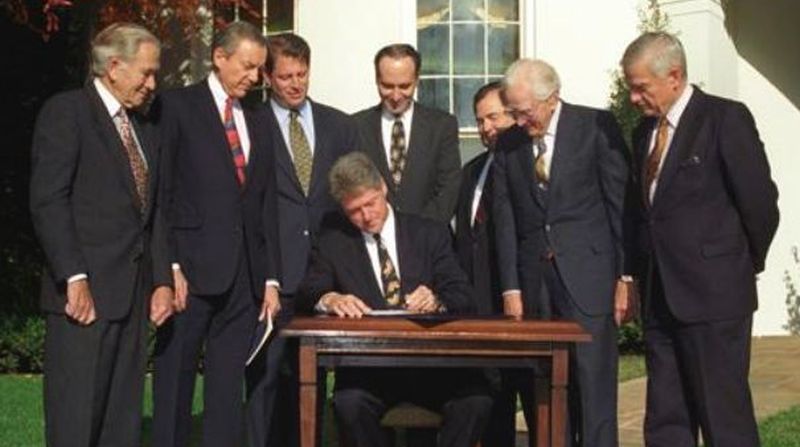
Look at how pleased Bill Clinton was to sign what was then perceived as important civil rights legislation.
August 30, 2014
"If the hate-crimes law is used to punish intra-religious crimes, it could change from a shield to protect minorities into a weapon against them."
"Religious groups whose beliefs pervade their whole world view see everyone in terms of religion. Any assault they commit might be considered a federal crime," writes Noah Feldman, defending the 6th Circuit's reversal of the conviction in the Amish beard-cutting case.
The defendants in the Amish case asked the appellate court to rule that the law never applies to intra-religious disputes. This might have made sense as a matter of policy, but not as a legal matter in the case at hand. As the law is written, it covers hate crimes by co-religionists. The court instead pragmatically restricted the law’s reach to cases where a religious motive predominates.How do we know when people are co-religionists? Seemingly co-religionists have been attacking each other for thousands of years. Some of the worst disputes are over the scope of the religion — who's the heretic? — and the outsider's perception that they're in the same religion ignores the nature of the fight. Is it the same religion or different? It would be unwise to interpret the federal hate crime statute to force judges and juries to determine whether criminal defendants and their victims belong to the same religion. It's too close to having trials about religious orthodoxy. That's not what we do in America.
August 29, 2014
The 6th Circuit reverses the hate-crime conviction of 15 Old Order Amish for cutting off the beards of Amish men and hair of Amish women.
Marty Lederman criticizes the court:
Lederman assumes the court is right about that but buys the government's argument that the error was harmless.
A critical part of the majority's decision is based upon its conclusion that the evidence did not necessarily prove that the victims' religion was a but-for cause of the assaults. That conclusion strikes me as untenable — indeed, deeply disturbing in its implications....The criminality of the assaults is obvious, but is it a federal crime, a "hate crime" under 18 U.S.C. § 249(a)(2)(A)? It is if it's done "because of the actual or perceived . . . religion . . . of [that] person." The problem is that the trial judge's instructions translated that into a need to find that the victims' religion was "a significant motivating factor," but the appellate court said religion needs to be the "but-for" cause (that is, without this motivation, the act would not have taken place).
[T]he assaults... came in the wake of a profound rift within this particular Amish community. [The Bishop of the Bergholz community, Samuel] Mullett had excommunicated several church members for challenging his leadership.... Mullett was angry.... The series of assaults then followed, under Mullett's direction. The victims were all Amish individuals who were apostates in Mullett's view.... As the court notes, Amish men do not trim their beards, and Amish women do not cut their hair, "as a way of symbolizing their piety, demonstrating righteousness and conveying an Amish identity.
Lederman assumes the court is right about that but buys the government's argument that the error was harmless.
Based solely on the undisputed facts described in Judge Sutton's opinion... it appears to be clear that at least some of the victims--those who were excommunicated or who left voluntarily, at a minimum--would not have assaulted but for the fact that Mullett viewed them as heretical. (Mullet said that beard and hair cuttings would stop people from being “Amish hypocrites.”) And that's true even if the particular assailants were motivated in the first instance by other factors, such as interfamilial disputes or anger about nonreligious actions of the victims....
[And] isn't it plain beyond any doubt that the victims' religion was a but-for cause of the type of bodily injury that occurred here — the cutting of beards and hair? The assailants obviously chose to use that very unusual form of assault because the hair and beards were of deep religious significance to the victims — indeed, to strike at a fundamental component of their religious identity, by deliberately imparting a tangible, humiliating public sign that the victims were religious outcasts.
June 27, 2014
"How to save $400,000, raise 14 children and buy a $1.3 million farm."
"Financial secrets of the Amish."
It’s this incredible bone-deep thrift, which is not really stinginess. It’s a generous frugality. They will go to great lengths to re-use, re-cycle and re-purpose. They don’t do it to be green, they do it to be thrifty.Here's the book: "Money Secrets of the Amish: Finding True Abundance in Simplicity, Sharing, and Saving."
April 19, 2014
Lady keeping chickens in the backyard in her posh NYC neighborhood seems to think the rules don't apply to her...
... because: 1. She bought the chickens from a place recommended by Martha Stewart, 2. These aren't ordinary chickens but a bantam Easter egger (with blue eggs), black copper marans (supposedly loved by French chefs), silkies, and a Belgian bearded d’uccle, 3. The coop cost $2,500 and was built by some Amish people, 4. She feeds the chickens "organic soy-free feed and... fresh vegetables," 5. She believes (and is telling the world) that her daughter Scarlett is "developing faster than her peers" and thus needs a "hormone-free diet" (and the NYT conveys this concern to us without mentioning that that "all eggs in commercial egg production in the United States" come from hens that "are not given hormones").
The New York Times, for all its leftish sentimentalism, panders absurdly to the elite class. The linked article could be a humor piece, but it's not. It's a human (and chicken) interest story for aging, soft-(boiled)-headed female readers.
BONUS: The NYT fawns over extremely wealthy young people.
The New York Times, for all its leftish sentimentalism, panders absurdly to the elite class. The linked article could be a humor piece, but it's not. It's a human (and chicken) interest story for aging, soft-(boiled)-headed female readers.
BONUS: The NYT fawns over extremely wealthy young people.
November 30, 2013
"Our belief is the natural stuff will do just as much as that stuff if it's God's will."
Says the Amish man, who is hiding his daughter, who has lymphoblastic lymphoma.
"If we do chemotherapy and she would happen to die, she would probably suffer more than if we would do it this way and she would happen to die."Right after that, in the linked Daily News article, there's a photograph of a horse-drawn hay wagon. I don't think they "took off... for Central America" by power of horse. And this sounds less like religion than like an ordinary, unscientific belief in alternative medicine.
A court last month sided with the children’s hospital and appointed a guardian to make medical decisions for Sarah. Days before the ruling, the family took off from the small Amish community in Spencer, Ohio and headed for Central America to pursue holistic methods at a natural cancer treatment center.
December 17, 2012
"A new reality TV show has revealed the underworld of the seemingly modest Amish community of Pennsylvania..."
"... complete with prostitutes, blackmail and assault rifles."
The Discovery Channel's 'Amish Mafia' follows Lebanon Levi and his fellow thugs as they attempt to maintain order in the insular religious community of Lancaster, beneath the veil of the supposedly idyllic lifestyles.Sounds like a fictional comedy show... and I feel like I've seen this before in a Weird Al video. (Video after the jump.)
August 29, 2012
August 8, 2012
"People before would stare at them because they’re different."
"I hope now, they’ll look at them with eyes of compassion because their hearts are broken."
A mass killing directed toward a particular religious group has the power to change how the [attacked] congregation views the outside world, says David Weaver-Zercher, a professor of American Religious History at Messiah College in Grantham, Pa., and author of “Amish Grace: How Forgiveness Transcended Tragedy,” a study of the 2006 attacks against an Amish school in Nickel Mines, Pa.
November 23, 2011
October 7, 2011
The problem of Amish-on-Amish violence.
The Daily Mail reports:
Men and sometimes women from a group of families disavowed by mainstream Amish have terrorized a half-dozen or more fellow Amish.So... they're looking for hair?
In Holmes County, a group of 27 men allegedly burst into a home and cut the hair off men and women inside and cut the beards off the men.
Holmes County Sheriff Timothy Zimmerly told The Wheeling News Register the victims included a 13-year-old girl and a 74-year-old man....
Detectives in the area were said to be gathering evidence from buggies and horse trailers believed to have been used in connection with the assaults.
Jefferson County Sheriff Fred Abdalla said there was a similar incident in Trumbull County three weeks ago.I know what you're thinking: A guy named Mullet wants hair cuts? But if you click the link and find his picture, you'll see it's business on top, party underneath.
He said hair from the victims was brought back to Jefferson County to prove to Sam Mullet, the bishop of the Bergholz group, that Mullet's orders concerning the hair cutting was being followed.
March 12, 2004
Amish day at the Times--Rumpspringa! (Apparently, I think it is my job to detect repetitions.) First, there's this description of Johnny Depp in a movie review by Elvis Mitchell headlined, "Beware of Amish Hitmen and the Anxiety of Influence":
(The movie is just some thriller, not about the Amish at all--and Mitchell manages to refer to Popeye and Danger Mouse too, and I will be waiting for random recurrences of these characters.)
The second is the pathetic story "Man Charged After Snack Cakes Stolen" (why report it at all?):
The third is this correction, surely the Correction of the Day:
Dressed ominously in a big-brimmed black hat and a work shirt buttoned to the neck — he looks like an Amish hitman — Shooter drawls menacingly,"You stole my book."
(The movie is just some thriller, not about the Amish at all--and Mitchell manages to refer to Popeye and Danger Mouse too, and I will be waiting for random recurrences of these characters.)
The second is the pathetic story "Man Charged After Snack Cakes Stolen" (why report it at all?):
Robert Lee McKiernan, 35, of Cedar Rapids, was arrested Tuesday after an incident in which authorities say he stole a box of Hostess Ho Hos and a box of Cinnamon Crumb Cakes from a barn at an Amish farm near Hazleton, in northeast Iowa.
The third is this correction, surely the Correction of the Day:
An article in The Arts on March 4 about a planned UPN reality show tentatively called "Amish in the City" misspelled the Pennsylvania Dutch term for a rite of passage in which some teenagers experiment with the outside world. Authorities on Amish tradition use various renditions of the dialect, but the most common version is rumspringa, not Rumpspringa.
Subscribe to:
Comments (Atom)


 Posts
Posts


