"Put simply, the case against Perry points to an aspect of his political persona that is well known in Texas but has too often been overlooked in the national portrayal of Perry."
From a piece at The New Republic titled "The Charges Against Rick Perry Are Thin. But They Are Also Clarifying." It's by Alec MacGillis, who's written numerous TNR articles about Scott Walker, including "The Unelectable Whiteness of Scott Walker" (which is the only one I took the trouble to read and blog about).
ADDED: Thin but clarifying is like fake but accurate.
Alec MacGillis लेबलों वाले संदेश दिखाए जा रहे हैं. सभी संदेश दिखाएं
Alec MacGillis लेबलों वाले संदेश दिखाए जा रहे हैं. सभी संदेश दिखाएं
18 अगस्त 2014


19 जून 2014
Emerging trend: Democrats insinuating that Republican politicians are gay.
I'm saying this is a trend to watch, because I'm seeing the second example of something within one week.
Last weekend, I noticed that the Alec MacGillis hit piece on Scott Walker in The New Republic, which was mostly racial politics, had some material that I believe was intended to float the rumor that Scott Walker is a closeted gay man.
And today, here's CNN reporting that Former Montana Gov. Brian Schweitzer recently said in an interview:
Anyway, why would Schweitzer say something so stupid? It makes no sense. Should non-gay people be talking about their "gaydar"? Who brags about 60-70% gaydar? That seems like a high fail rate. And if he's not himself looking for sexual adventures, how does he know whether he's right or not, especially as he's purporting to detect gayness in men who are not openly gay? And, worst of all, if he thinks Southern men are just effeminate, doesn't that imply that Cantor would fall within the 30-40% who set off Schweitzer's gaydar but are not gay? I guess Schweitzer — who admits he knows he's just blurting crap out — just wanted to say that Cantor seems gay and then to take it back by saying, oh, but he's Southern, and Southern men always seem gay to me — which gratuitously insults both Southern men and gay men (and, in a way, women!).
How could Schweitzer go that badly wrong? Where did all that come from. Here's my suspicion. He operates with a backroom culture where people really do talk like that. The idea of floating the rumor that a Republican politician is gay comes up all the time, as does the idea that Southern men seem gay because they are effeminate. But the strategy would be to say something that puts the idea in our head without actually saying it. It's not the talking point, but the secret notes behind the talking point. Schweitzer just blurted out the secret notes.
Schweitzer seems to be really dumb. The trick is to do it in a smart way, so it's deniable and the person calling you on it seems delusional or weird. For example, back in 2005, I blogged about how I thought that the NYT tried to create the impression that Supreme Court nominee John Roberts was gay. I pointed to a lot of things about the NYT's presentation, including a photo layout that included Roberts wearing plaid pants. I got pushed back, ridiculed for talking about plaid pants. The NYT had the deniability it sought if, in fact, it sought to put that idea in my head.
This is a technique that requires some skill and subtlety, so if there is an idea in that Democratic Party backroom to screw up Republicans with gay rumors, they'd better take care who they let into that room. They've got to keep that kind of strategizing in the closet. They'd better have some good radar about who's too dumb/inarticulate to work that game. They've got to filter out the Schweitzers.
Meanwhile, you've got MacGillis (on Walker) and the writers and editors who put together that John Roberts piece. These are people who are capable of playing a subtler game, and that's the game I'm watching... in case it's really happening.
I need a good tag for this trend watch, but for now I'll revive the old "plaidgate."
ADDED: I think Obama used this technique on Romney back in April 2012.
AND: I've decided to make the new tag "homophobia politics."
Last weekend, I noticed that the Alec MacGillis hit piece on Scott Walker in The New Republic, which was mostly racial politics, had some material that I believe was intended to float the rumor that Scott Walker is a closeted gay man.
And today, here's CNN reporting that Former Montana Gov. Brian Schweitzer recently said in an interview:
"If you were just a regular person, you turned on the TV, and you saw Eric Cantor talking, I would say — and I'm fine with gay people, that's all right — but my gaydar is 60-70 percent."Now, I had to Google Schweitzer's name to find out that he's a Democrat, so that CNN article is also an example of another much more well-documented trend: mainstream media omitting the party affiliation of a Democrat who says or does anything bad or stupid (or submerging the party affiliation under enough boring paragraphs that it's as good as omitted).
"Don't hold this against me, but I'm going to blurt it out. How do I say this ... men in the South, they are a little effeminate... They just have effeminate mannerisms."
Anyway, why would Schweitzer say something so stupid? It makes no sense. Should non-gay people be talking about their "gaydar"? Who brags about 60-70% gaydar? That seems like a high fail rate. And if he's not himself looking for sexual adventures, how does he know whether he's right or not, especially as he's purporting to detect gayness in men who are not openly gay? And, worst of all, if he thinks Southern men are just effeminate, doesn't that imply that Cantor would fall within the 30-40% who set off Schweitzer's gaydar but are not gay? I guess Schweitzer — who admits he knows he's just blurting crap out — just wanted to say that Cantor seems gay and then to take it back by saying, oh, but he's Southern, and Southern men always seem gay to me — which gratuitously insults both Southern men and gay men (and, in a way, women!).
How could Schweitzer go that badly wrong? Where did all that come from. Here's my suspicion. He operates with a backroom culture where people really do talk like that. The idea of floating the rumor that a Republican politician is gay comes up all the time, as does the idea that Southern men seem gay because they are effeminate. But the strategy would be to say something that puts the idea in our head without actually saying it. It's not the talking point, but the secret notes behind the talking point. Schweitzer just blurted out the secret notes.
Schweitzer seems to be really dumb. The trick is to do it in a smart way, so it's deniable and the person calling you on it seems delusional or weird. For example, back in 2005, I blogged about how I thought that the NYT tried to create the impression that Supreme Court nominee John Roberts was gay. I pointed to a lot of things about the NYT's presentation, including a photo layout that included Roberts wearing plaid pants. I got pushed back, ridiculed for talking about plaid pants. The NYT had the deniability it sought if, in fact, it sought to put that idea in my head.
This is a technique that requires some skill and subtlety, so if there is an idea in that Democratic Party backroom to screw up Republicans with gay rumors, they'd better take care who they let into that room. They've got to keep that kind of strategizing in the closet. They'd better have some good radar about who's too dumb/inarticulate to work that game. They've got to filter out the Schweitzers.
Meanwhile, you've got MacGillis (on Walker) and the writers and editors who put together that John Roberts piece. These are people who are capable of playing a subtler game, and that's the game I'm watching... in case it's really happening.
I need a good tag for this trend watch, but for now I'll revive the old "plaidgate."
ADDED: I think Obama used this technique on Romney back in April 2012.
AND: I've decided to make the new tag "homophobia politics."
17 जून 2014
"Scott Walker is the closest person the Republican Party has to an early favorite..."
"... and not simply because of Chris Christie’s nosedive from grace or because Jeb Bush is still waffling about his intentions," writes The New Republic, in email seeking subscribers and flaunting its big hit piece on Walker, "The unelectable whiteness of Scott Walker/journey through the poisonous, racially divided world that produced a Republican star."

Click to enlarge.
The email continues:
But the email does proceed as if TNR is simply concerned that uninformed Republicans may make a mistake:
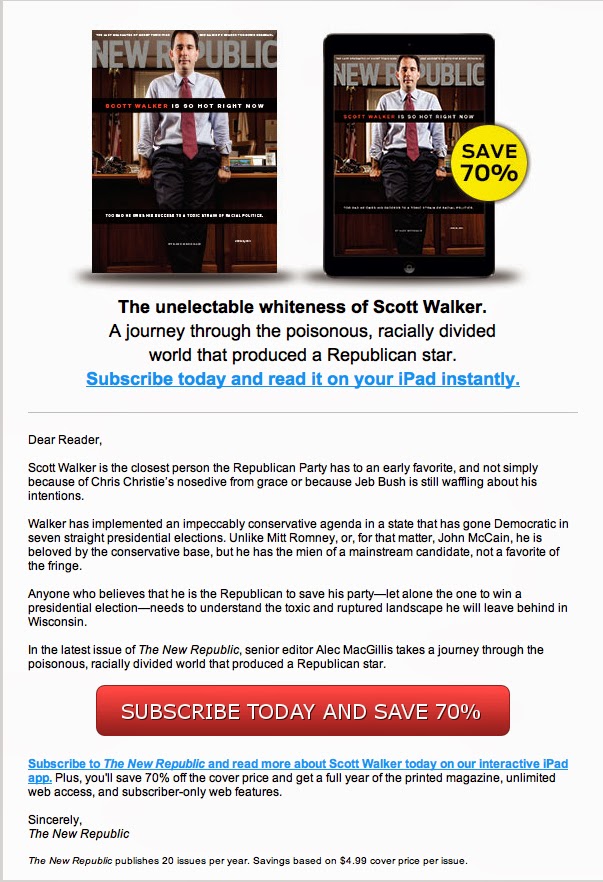
Click to enlarge.
The email continues:
Walker has implemented an impeccably conservative agenda in a state that has gone Democratic in seven straight presidential elections. Unlike Mitt Romney, or, for that matter, John McCain, he is beloved by the conservative base, but he has the mien of a mainstream candidate, not a favorite of the fringe.That's damned close to a confession that the people at TNR see Walker as a big threat and are acting on the motivation to take him down while they can, to portray him as toxic and untouchable to would-be donors.
But the email does proceed as if TNR is simply concerned that uninformed Republicans may make a mistake:
Anyone who believes that he is the Republican to save his party—let alone the one to win a presidential election—needs to understand the toxic and ruptured landscape he will leave behind in Wisconsin.TNR is trying to help.
In the latest issue of The New Republic, senior editor Alec MacGillis takes a journey through the poisonous, racially divided world that produced a Republican star.
15 जून 2014
About that "Brady Bunch" fanfic in The New Yorker and how I almost feel as though I am bullying The New Republic at this point.
The June 30 issue of The New Republic just popped up on its own in my iPad. I only noticed because I was in my magazine-reading app finishing reading a story called "Here's the Story," by David Gilbert in The New Yorker, which I'd been "reading" via podcast while out and about. This is a great story, by the way, and though you'll need a subscription to read it at that link, anyone can read this interview with Gilbert in which he explains something that's not necessary to liking the story: It's the story — here's the story... — of the first husband and the first wife who had to die to lay the groundwork for the merged family of Mike and Carol Brady.
I noted — at 3:00 pm, yesterday — that the cover and article were not yet up on the TNR website, but I expected to see them momentarily, and even commented 2 hours later that I was surprised at the lag. It's now almost 8 a.m. the next day, and my attack on the article you can't read yet has been linked on Instapundit and Power Line. I almost feel like I'm bullying TNR... kicking it while it's snoozing. Come on, TNR.
You know, I subscribed to The New Republic because it seemed to be poised to leap forward in digital media. I wanted to witness the roll out of the new design and effect of the new editor-publisher Chris Hughes — the 30-year-old co-founder of Facebook.
How did I catch Chris Hughes, et al., flat-footed. Me, an old professor with a Blogspot blog, an iMac, and an iPad... me, reading a short story in The New Yorker about the year 1967, the year when I was 16.
UPDATE: TNR put the article up Sunday evening: here.
With the Bradys, I think I understood the ridiculousness of the parents and the kids, the goody-two-shoes attitude... I spent a few weeks watching old episodes and reading a slew of Brady quotes to try to incorporate the language of Mike and Carol—like in the pilot, Carol asks a haggard Mike if he needs a tranquilizer. I also wanted Don Drysdale in the story, because of his appearance in the show. Longfellow, too. A vague Hawaii reference. The Sunflower Girls. All these little details that hopefully add to the heartbreak of Ted and Emma....Hitting the home button within that app doesn't get you back to the iPad home screen but to your whole collection of magazines, each one represented by the cover of the newest issue. That's the only reason I saw the hit piece on Scott Walker, attempting to smear him as somehow a racist — he "owes his success to a toxic strain of racial politics" — so I took a screen shot of the cover and blogged it, then came back a while later to let you know that the article — "The Unelectable Whiteness of Scott Walker/A Journey Through the Poisonous World That Produced a Republican Star," by Alec MacGillis — has nothing racial about Walker himself. (The racial material is about the demographics right-wing radio of Milwaukee.)
Since the world of the Bradys is such an artificial world, I wanted the world of Ted and Emma to be absolutely real. That was very important to me, for them to fly above the construct of the show, to take on the appearance of living, breathing souls and perhaps, for a moment, gain their humanity and transcend their non-origin origins...
I noted — at 3:00 pm, yesterday — that the cover and article were not yet up on the TNR website, but I expected to see them momentarily, and even commented 2 hours later that I was surprised at the lag. It's now almost 8 a.m. the next day, and my attack on the article you can't read yet has been linked on Instapundit and Power Line. I almost feel like I'm bullying TNR... kicking it while it's snoozing. Come on, TNR.
You know, I subscribed to The New Republic because it seemed to be poised to leap forward in digital media. I wanted to witness the roll out of the new design and effect of the new editor-publisher Chris Hughes — the 30-year-old co-founder of Facebook.
How did I catch Chris Hughes, et al., flat-footed. Me, an old professor with a Blogspot blog, an iMac, and an iPad... me, reading a short story in The New Yorker about the year 1967, the year when I was 16.
UPDATE: TNR put the article up Sunday evening: here.
14 जून 2014
Look at the new New Republic cover, smearing Scott Walker for his "toxic strain of racial politics."

I live in Wisconsin, and I've been following Scott Walker since the 2010 election here, and I have no idea what the "toxic strain of racial politics" refers to. But congratulations to TNR for its eye-catching and weird sexualization of Walker: "Scott Walker Is So Hot Right Now" and for having the nerve to sub-head with "too bad" as you smear him with the accusation of "toxic strain of racial politics." That "too bad" belongs in the annals of self-refuting statements. Anyone can within one second perceive that The New Republic isn't the slightest bit sad that there's this dirt to throw at Walker... this invented dirt for all I can tell.
If you look at the TNR website right now, you won't see this cover. It's still displaying last week's cover. I subscribe to the magazine, and this new issue just popped into my iPad.
ADDED: I can't link to the article, but I can read it on my iPad. It's titled — creepily — "The Unelectable Whiteness of Scott Walker." Sub-head: "A Journey Through the Poisonous World That Produced a Republican Star." It's written by Alec MacGillis.
AND: I have now read the long article, and the closest thing to anything racial coming directly from Scott Walker is his support over the years for voter ID laws. Much of the article is about the demographics of Milwaukee and the suburban counties around it, including the history — going back into the early 20th century — of how black people migrated to the city and did not — as white people did — relocate into the suburbs.
Milwaukee is an extreme example of this historical pattern, but Scott Walker didn't make this happen, and given that Scott Walker built his political career in the Milwaukee area, it's actually impressive that TNR could not find racial incidents and slips to pin on him.
The article also focuses on 2 talk radio hosts — Mark Belling and Charlie Sykes — who have big audiences in Milwaukee. TNR has little direct racial material on them, but it forefronts the one truly ugly thing it has: Belling mocking a specific black person, Milwaukee Congresswoman Gwen Moore. Mostly, TNR accuses Belling and Sykes of indulging in dog-whistle politics about crime and dependence on welfare.
I suspect that Alec MacGillis wrote a more balanced and sane draft but that TNR editors punched it up, trying to make it racial so they could justify that ridiculous sub-heading on the cover and the title and sub-head at the article. The Unelectable Whiteness of Scott Walker! Terrible. MacGillis provides some material about Scott Walker's early life, mostly about how he's the son of a Baptist preacher who took religion and politics very seriously from an early age. Some of that is sympathetic, though it's dotted with quotes from individuals who have reason to want to block Walker's ascent.
ALSO: Linking here, Instapundit says:
When Chris Hughes relaunched TNR, he promised that TNR would go “deeper than the headlines in a timely, unbiased fashion.” Nah. Just more Democratic operatives with bylines.AND: I wonder if TNR meant to send out the iPad app version before the material is up on its website. I think it's damned strange that I was able to show you that cover 2 hours ago, and it's still not up on the website, and that I could read the whole long article and give you my subjective understanding of what is in it before you can check the text. Do you think it's lack of website/app coordination at TNR, which would be inept, or do you think they want subscribers to get a special advantage, a sneak peak, which would be naive in a world with bloggers?
UPDATE: It's 6 hours since I posted this, and neither the cover nor the article are up at the TNR website.
UPDATE 2: TNR put the article up Sunday evening: here.
सदस्यता लें
संदेश (Atom)


 संदेश
संदेश


