26 ఫిబ్రవరి, 2018

Asked to take the DACA case without waiting for it to take its course through the circuit court, the Supreme Court says no.

Or as the USA Today crudely puts it, "Supreme Court snubs Trump, keeps DACA immigration program in place for now."

The Supreme Court did what the NYT applied pressure on it to do, as we discussed here. I took a middle position:
The Solicitor General, seeking to skip over the intermediate appellate court, is perhaps overdramatizing the need for quick action, but [Linda] Greenhouse is overdramatizing the consequence for the Court if the supposedly big-deal case turns into nothing [because of congressional action].

I think she knows this, as she asks: "Will it look that way from inside the justices’ private conference?" She says she doesn't know, but I think it's pretty clear the answer is no. She purports to be sure that "The future of more than the Dreamers is at stake." That's the last line of the column. It's clear that she means that the future of the Court is at stake, but in what way?

"Thirty years ago my husband... said, 'If the cat needs something that costs more than a hundred dollars, I say we opt for the $40 shot and go get a new cat.'"

"It was my cat, so my vote counted more than his did, and the cat lived to a ripe old age. But in my husband’s defense I should mention that his formative years were spent in the small-town South, where humane people went out in the yard and shot an animal if it was suffering.... My husband would have found it impossible to believe that 30 years later he would be running around the house in his boxers, trying to tackle an ancient 70-pound mutt in the dark and shove a pill down his throat. Clark is also deaf, and he suffers from crippling arthritis. So far we have been able to manage his pain with medication, but at his checkup last year, when he turned 13, the vet had some sobering news. 'With big dogs, there’s often a huge difference between 12 and 13,' he said. 'One day Clark won’t be able to get up, and when that happens it’ll be time to let him go.' The very idea is unthinkable...."

From "The Pain of Loving Old Dogs" by Margaret Renkl (NYT).

(Note that the title has 2 meanings. The obvious meaning is that the loving is painful for the human being. The secondary meaning, probably intended, is that the loving dog experiences pain.)

"This morning the court hears oral argument in one of the term’s major cases, Janus v. American Federation of State, County, and Municipal Employees, Council 31..."

"... in which the justices will consider whether an Illinois law allowing public-sector unions to charge nonmembers for collective-bargaining activities violates the First Amendment," SCOTUSblog notes, pointing us to various previews (so go there for the links). Excerpt:
At Reuters, Robert Iafolla and Lawrence Hurley report that “[t]aking away mandatory agency fees could have profound implications for public-sector union coffers.” For The Wall Street Journal, Jess Bravin reports that although “[a]ttitudes about the value of public-sector unions underlie the case,” “[t]he specific legal question before the court … is more abstract.”... For The New York Times, Noam Scheiber and Kenneth Vogel report that “[t]he case illustrates the cohesiveness with which conservative philanthropists have taken on the unions in recent decades.”...

The editorial board of The Wall Street Journal maintains that a ruling for Mark Janus “wouldn’t be a death blow to government unions, though they might have to prioritize resources and reduce political spending.” At The Nation, David Cole and Amanda Shanor argue that “[t]he First Amendment protects the right to speech, but not the right to get something for nothing.”...
LII summarizes the case drily:
This case will decide whether public-sector workers represented by a union can be required to pay agency fees. Janus argues that requiring public-sector workers to pay agency fees constitutes compelled speech and association, imposing undue restrictions on workers’ First Amendment rights. The American Federation of State, County, and Municipal Employees, Council 31 (“AFSCME”) argues that imposing agency fees on all workers allows unions to appropriately and fairly represent all workers’ interests, which unions are legally required to do. This issue affects every dues-paying, public sector worker. Accordingly, this case will impact the way unions organize and represent public-sector workers.

"A path is little more than a habit that comes with knowledge of a place. It is a sort of ritual of familiarity. As a form, it is a form of contact with a known landscape."

Wrote Wendell Berry, quoted by Etienne in last night's "Winter Road Café," after Bunk said "Hey, this photo..."
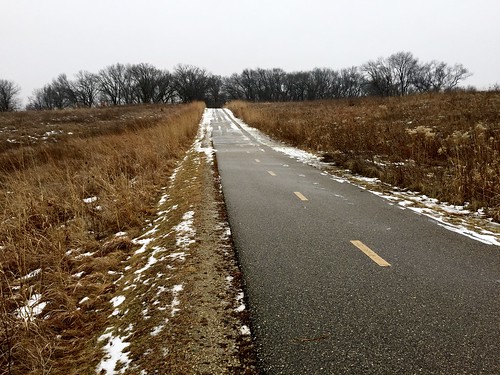
IMG_1845

"... appears to be a bike path, not a road."

I love the Berry quote, and thanks to Etienne for bringing it to us. It perfectly explains why I, using that photograph and needing a title for the "café," could not bring myself to use the word "path," even though I knew for sure — what you were left guessing* — that it is the thing most people call a "bike path."**

___________________

* Danno observed that if it's not a bike path, it's got "a very wide stripe!"

** Actually, around here, the official term for a thing like that is "bike trail." So you may want to discuss the path/trail distinction or bring out evocative poetic quotes with "trail." There must be many, "trail" being an even more powerful word in the legend of America. The Chisholm Trail, the Appalachian Trail, etc. And yet "trail" refers to dragging something along behind you. The oldest meaning is the trail of a long robe. On the landscape, then, the "trail" is what those who've gone before have left behind. And "trail" has only meant "path" since the early 1800s. "Path" has referred to "A way or track formed by the continued treading of pedestrians or animals" for as long as we can find a language called English — the period the OED calls "early OE" (600-950). That's profound. And — here's where I change my mind and decide that "path" is more powerful than "trail" — the word "pathfinder" has special resonance (from the OED):
1840 J. F. Cooper (title) The pathfinder.
1860 W. Whitman Leaves of Grass (new ed.) 425 The path-finder, penetrating inland, weary and long....
1847 R. W. Emerson Poems 169 Sharpest-sighted god.., Path-finder, road-builder, Mediator, royal giver.
1898 W. James Coll. Ess. & Rev. (1920) 408 Philosophers are after all like poets. They are path-finders. What every one can feel, what every one can know in the bone and marrow of him, they sometimes can find words for and express.
4 great American names, clustered in the great English Dictionary.

There is no word "trailfinder," though there is — we must give "trail" its due — "trail-blazer." But "trail-blazer" only arrives on the scene in the 20th century, and its earilest recorded usage cannot compare to the quadrumvirate of James Fennimore Cooper, Walt Whitman, Ralph Waldo Emerson and William James:
1908 Daily Chron. 19 May 3/2 Mrs. Hubbard's journey..with a small party of ‘trail blazers’ native to the ways of Labrador....
1957 V. Packard Hidden Persuaders xxi. 233 Tide, the merchandisers' journal, admonished America's merchandisers to pay attention to this trail-blazing development as it might be ‘tomorrow's marketing target.’
The "trail-blazing development" was a planned suburban community in Miramar, Florida:
What does it mean to buy a "packaged" home in a "packaged" community? For many (but apparently not all) of the Miramar families it means they simply had to bring their suitcases, nothing more. No fuss with moving vans, or shopping for food, or waiting for your new neighbors to make friendly overtures. The homes are completely furnished, even down to linens, china, silver, and a refrigerator full of food. And you pay for it all, even the refrigerator full of food, on the installment plan.

25 ఫిబ్రవరి, 2018

At the Winter Road Café...

IMG_1845

... come on in and warm up. Let's have a good conversation.

(And let's use the Althouse Portal to Amazon.)

"At the White House on Wednesday, President Trump suggested that if a football coach at the high school, Aaron Feis, had been armed, he would have saved even more lives than he did..."

"... perhaps even his own, because rather than simply shielding students from gunfire, he could have drawn his weapon, fired and killed the assailant — putting a tidy end to the rampage. This is absurd. More likely, had Mr. Feis been armed, he would not have been able to draw his weapon (a side arm, presumably) quickly enough to stop the shooter, who with an AR-15 would have had the coach outgunned. Even if the coach had been able to draw his weapon — from where? his athletic shorts? — any shots he managed to fire would have risked being errant, possibly injuring or killing additional students. As some studies have shown, even police officers have missed their targets more than 50 percent of the time. In firing a weapon, Mr. Feis would have only added to the carnage and confusion...."

From "I Was a Marine. I Don’t Want a Gun in My Classroom" by Anthony Swofford (NYT).

"Because to be discredited is to be credentialed in the world of fake news."

My answer to the question "Why is anyone listening to Michael Wolff, isn't he completely discredited?"

The question was asked by Meade, who was reading "Michael Wolff Says Donald Trump And Jared Kushner 'Will Throw Each Other Under The Bus'" (HuffPo).

If you imagine it's well known that, of course, you have to be a citizen to vote, listen to Saoirse Ronan, completely innocent of knowledge.


She speaks of wanting to vote for Oprah, and Jimmy Kimmel breaks in with "Are you allowed to vote here in the United States?" Her "I don't know actually..." feels utterly disingenuous. "I'm not a resident here..." as if being a resident would be enough.

But she's a great actress and could easily play disingenuous.

In a similar vein, she is beautifully made up to look as though she is wearing absolutely no makeup.

By they way, I love her as an actress and I strongly encourage the no-makeup look. It's especially refreshing to see the absence of eye makeup.

IN THE COMMENTS: Amadeus 48 said:
According to Wikipedia, she was born in the Bronx (so she is a US citizen by birth), but the family moved back to Ireland when she was three.
Well, then, that makes all the difference. She is a citizen, and her question about residency is exactly the one I would ask.

ADDED: Now, I'm annoyed at the show for playing a cute little game, with Jimmy treating the actress as if she were an airhead and me, at home, getting drawn in. Saoirse could easily have said — at some point — "I am an American citizen." She seems to have chosen to leave us with the misimpression that she's dumb. The old dumb blonde of long Hollywood lineage?!

Or is it that she's playing her Irishness very heavily and doesn't want to be thought of as American?

"On her way to work one morning, down the path along the lake, a tenderhearted woman saw a rich, coldhearted, frozen snake. His tangerine skin was all caked with makeup..."

"... and his bald spot was frosted with the dew. 'Poor thing,' she cried, 'I’ll take you in, and I’ll take care of you.'/'Take me in, oh tender woman. Take me in, for Heaven’s sake. Take me in, oh tender woman,' sighed the vicious snake. She wrapped him up all cozy, tucking in his absurdly long tie of silk, and laid him by her fireside with two Big Macs, two Filet-O-Fish, and a chocolate shake of milk. She hurried home that night from holding up a torch on Liberty Island, and soon as she arrived, she found that the freaky snake, transfixed by his own image on TV, had been revived...."

Maureen Dowd strikes venomously at Donald Trump, who did that damned "Snake" poem again the other day, at CPAC.

Here, I cued up Trump's "Snake" performance for you. As I said yesterday, live-blogging my reading of the speech, "Oh, no, he's going to do the snake! There's a big lead up, then the entire performance":

Weird Al-evator.

Yesterday, after reading the Washington Post article about Weird Al, I watched his video "Tacky," which — the article explains — was made in a single unedited shot that includes a ride down an elevator:


Here's the Pharrell Williams video it parodies, which is charmingly entertaining but not as inventive photographically. You can watch the 2 videos playing side by side here. There's also a video at the WaPo link with background on the making of "Tacky," where we learn that the room we see in that freeze frame is also in "The Big Lebowski."

Last night, I dreamed I needed to get around in a strange hotel with an unusual, confusing elevator. I said "The hotel had a weird elevator... a weird al-evator."

Peter Sloterdijk is known for "impressionistic coinages—' anthropotechnics,' 'negative gynecology,' 'co-immunism' —that occasionally suggest the lurking presence of some larger system."

"A signature theme of his work is the persistence of ancient urges in supposedly advanced societies. In 2006, he published a book arguing that the contemporary revolt against globalization can be seen as a misguided expression of 'noble' sentiments, which, rather than being curbed, should be redirected in ways that left-liberals cannot imagine. He has described the Presidential race between Hillary Clinton and Donald Trump as a choice 'between two helplessly gesticulating models of normality, one of which appeared to be delegitimatized, the other unproven,' and is unsurprised that so many people preferred the latter.... Sloterdijk’s comfort with social rupture has made him a contentious figure in Germany, where stability, prosperity, and a robust welfare state are seen as central to the country’s postwar achievement. Many Germans define themselves by their moral rectitude, as exhibited by their reckoning with the Nazi past and, more recently, by the government’s decision to accept more refugees from the Syrian civil war than any other Western country. Sloterdijk is determined to disabuse his countrymen of their polite illusions. He calls Germany a 'lethargocracy' and the welfare state a 'fiscal kleptocracy.' He has decried Merkel’s attitude toward refugees, drawn on right-wing thinkers such as Martin Heidegger and Arnold Gehlen, and even speculated about genetic enhancement of the human race. As a result, some progressives refuse to utter his name in public...."

From "A Celebrity Philosopher Explains the Populist Insurgency/Peter Sloterdijk has spent decades railing against the pieties of liberal democracy. Now his ideas seem prophetic" by Thomas Meaney (in The New Yorker).

ADDED: The term "negative gynecology" never reappears in the article, and I was curious enough to dig up "Taking Up The Challenge Of Space: New Conceptualisations Of Space In The Work Of Peter Sloterdijk And Graham Harman" by Marijn Nieuwenhuis in a journal called "continent," which I'd have advised is a terrible name — what with its medical, excretory meaning — but the subtitle is "maps a topology of unstable confluences and ranges across new thinking, traversing interstices and alternate directions in culture, theory, biopolitics and art," so get your head out of the toilet. Nieuwenhuis explains:
Sloterdijk empirically demonstrates that within the womb... it is impossible to draw an epistemological distinction between the object and the subject. This is because the foetus does neither recognise the placenta nor the “‘nobjects’ ([ie.] neither subjects nor objects) such as placental blood, intrauterine acoustics, and other medial givens… [The] child develops [therefore] an identity not by recognizing itself at a distance in the mirror but through presubjective resonances” (van Tuinen 2007: 281). This “negative gynaecology” (negative Gynäkologie), Sloterdijk argues, embodies the perfect immersion of “Being-a-pair” [Paar-Sein] in a bubble, which ultimately bursts when the natal process commences.

“In terms of its dramatic content, what one generally calls ‘cutting the [umbilical] cord’ is the introduction of the child into the sphere of ego-forming clarity. To cut means to state individuality with the knife. The one who performs the cut is the first separation-giver in the subject’s history; through the gift of separation, he provides the child with the stimulus for existence in the external media.” (Sloterdijk 2011: 388). The moment the child is “thrown-into-the-World” and has bid farewell to the placenta (“primal companion” or the Urbegleiter) is also the moment in which it will have to form new relationships and in turn create and dwell in new bubbles....
Does the New Yorker article ever talk about the womb? Only here:
“The car is like a uterus on wheels,” [Sloterdijk] says. “It has the advantage over its biological model for being linked to independent movement and a feeling of autonomy. The car also has phallic and anal components—the primitive-aggressive competitive behavior, and the revving up and overtaking which turns the other, slower person into an expelled turd.”
The return of the toilet.

24 ఫిబ్రవరి, 2018

At the 15 Minutes Café...


... the suspense is killing me.

By the way... remember to do your Amazon shopping through the Althouse Portal.

"The House Intelligence Committee released a redacted Democratic memorandum on Saturday countering Republican claims that top F.B.I. and Justice Department officials had abused their powers in spying on a former Trump campaign aide."

The NYT reports.

Here's the whole memo.

Trump's tweets in response:

1. "The Democrat memo response on government surveillance abuses is a total political and legal BUST. Just confirms all of the terrible things that were done. SO ILLEGAL!"

2. "Dem Memo: FBI did not disclose who the clients were - the Clinton Campaign and the DNC. Wow!

3. “'Russians had no compromising information on Donald Trump' @FoxNews Of course not, because there is none, and never was. This whole Witch Hunt is an illegal disgrace...and Obama did nothing about Russia!"

4. "'Congressman Schiff omitted and distorted key facts' @FoxNews So, what else is new. He is a total phony!"

He's on the Judge Jeanine show right now, phoning it in. He's going from one topic to another, seemingly in full campaign mode.

The Olympic squirrel.

No, he was talking about Clinton.


(Link.)

#powerofthestash.