১১ জুন, ২০০৫

No, no, no...

This is so not the right list of sad songs. But you know how we love lists, so here I am linking.

Please offer better suggestions in the comments.

My personal sad, sad song -- the song I used to play when I was already sad and wanted an accompanying soundtrack for my sorrows -- is: "Fool To Cry."

UPDATE: On a nonpersonal level, I should think "Gloomy Sunday" would take first place, given its reputation for inspiring suicide.

ANOTHER UPDATE: Lots of great suggestions in the comments. Go in and add some! I thought of a long -- really long -- story song that gets me: "El Paso." I remember hearing the Grateful Dead do it, and recently I heard the brilliantly sung Marty Robbins version on the radio. Here's the cowboy's terrible end:
Something is dreadfully wrong, for I feel
A deep burning pain in my side
Though I am trying to stay in the saddle
I'm getting weary, unable to ride

But my love for Felina is strong and I rise where I've fallen
Though I am weary, I can't stop to rest
I see the white puff of smoke from the rifle
I feel the bullet go deep in my chest

From out of nowhere Felina has found me
Kissing my cheek as she kneels by my side
Cradled by two loving arms that I'll die for
One little kiss, then Felina good-bye.

Photo advice.

Rick Lee has a lot of photo advice.

With a digital camera, one really should take a lot of shots of the same thing, trying different angles. When Chris and I were at Harvest last week, we shot over 300 pictures of each other during the meal, just trying to get good shots and thinking up new angles, composing different backgrounds. You can see the ones I saved in this Flickr photoset.

When we were out at Crave with the other day, I took a hundred shots of Nina -- trying to get a good portrait, but also looking for new compositions, like this one making the Cosmopolitans monumental.

Another portrait with a monumental drink -- and distortion from the glass that I love but that Chris might object to (don't, please, Chris!):

Dinner at Harvest

Hey, give me that.

Dinner at Harvest

Idly shopping State Street.

Just browsing. And snapping. Let other people do the real shopping. I'm just noticing the scenery, hanging around State Street, here in Madison, Wisconsin.

Record shop.

Jazzman

Sale

Kids, don't do drugs.

Especially meth. For one thing, it'll ruin your teeth. Persuasive photo at the link. Also: tales of teeth that became "'little black stubs' too painful to brush" and a 17-year-old getting dentures.

"Mr. Dylan has turned his act into one of the weirdest road shows in rock. "

From the NYT:
He rarely speaks to the crowd, and when he does, his remarks are often gnomic throwaways. ("I had a big brass bed, but I sold it!") He plays some of his best-known songs, but often in contrarian, almost unrecognizable versions, as if to dampen their anthemic qualities. He highlights recent compositions more than most of his 60's coevals, but these, too, are delivered as highly stylized, singsongy chants.
I think Bob Dylan has invented the best style of being an old rock star. Better than doing the big showy tours, reaching back, like the Rolling Stones, trying to recapture your glory, is this low-key, constant playing. It poses a fascinating puzzle for us.

Are you afraid of your real life? Are you completely bonded to art? Do you think you owe penance? What are you doing, Bob?

We know something is happening, but we don't know what it is. It's right that Bob Dylan should needle us to the very end.

Very cleanly, Mr. Stork!

Storchennest is live-streaming a stork's nest, from Germany. I waited for it to load and then the first thing the stork did was back up to the edge of the nest and poop. Very cleanly, Mr. Stork!

Love the audio. It's so sharp and dimensional, I had to turn off the sound more than once to check to see if I wasn't hearing birds just outside my window.

UPDATE: In other bird news. But maybe we should be worrying about birds.

ANOTHER UPDATE: Sissy Willis loves the storkcam.

Make Room for Daddy.

There's no Danny Thomas ("Danny Williams") on TiVo's list of TV's Greatest Dads! Throwing Things doesn't acknowledge the glaring omission of that classic TV dad, but found lots of other omissions -- like "Uncle Bill, who deserves a credit for "taking in those three kids like he did and keeping his 'relationship' with Mr. French behind closed doors as not to scar them."

Wasn't "Make Room for Daddy" the original dad show? It started in 1953 and ran until 1964 and was a top show the whole time. TiVo puts Andy Taylor second on its list (after Cliff Huxtable), but did you know that the pilot for "The Andy Griffith Show" was an episode of "Make Room for Daddy" ("'Danny Meets Andy Griffith'")?

Well, all I can say is that if they ever do a TV's Greatest Uncles list: don't forget Uncle Tonoose.

IN THE COMMENTS: A reader asks, "How about Ozzie and Harriet? That was from way before Make room for Daddy. I can remember when it was a radio program." Good point! Especially since the TiVo list includes Ozzy Osbourne.

"Ozzie and Harriet" goes back to 1941 in radio form and to 1952 as a TV show, one year before Danny Thomas. Funny, I just heard an Ozzie Nelson band song on the 1940s Decade channel on the radio the other day. Ozzie also made the first TV music video, with Ricky, who went from kid to teen idol, singing "Travelin' Man."

Ozzie was the original hapless, bumbling TV dad. Many people over the years have joked about how he didn't seem to have a job. Harriet played the smart housewife, another classic TV sitcom type. By contrast, "Leave It to Beaver" seems to have been designed to copy O&N (down to the two sons, with the younger one the troublemaker), but getting the proper sex roles enforced. (Ward Cleaver does make the TiVo list, at #5.)

I think a big part of my love for "Make Room for Daddy" was that, unlke Ozzie and Ward, Danny had a daughter. I was so jealous of Angelica Cartwright! Why wasn't I on TV? That question nagged me throughout childhood. Sometimes, I imagined my life was a TV show. I really enjoyed the way the television audience saw everything from my point of view!

Anyway, like Ozzie Nelson, Danny Thomas was on the radio -- even named the "best newcomer in radio" in 1945. He's also notable for being a Lebanese-American, and for refusing to yield to pressure to get his big nose rhinoplastied. The nose proved useful for many jokes. He did change his name, though -- from Muzyad Yahkoob.

Here's a Danny Thomas bio. It's very impressive. Click on the link to see a picture of him doing something no TV dad of today would do.

"A New York Times reporter is just a blogger who..."

The NYT takes issue with a column by Julie Hilden about copyright problems that might develop with more sophisticated newswriting software robots. Currently, Hilden writes, Google News is "lawsuit-proof" because readers need to click a link to get the whole story and so Google is increasing the readership of the news media it links. In the future, Google's software might combine tiny snippets from many sources into a readable article that wouldn't stimulate click-through. Then traditional media might sue and win. But if it did, Hilden writes, Google might switch to nontraditional sources and compose its articles from blogs.

Here's how the Times quotes her and reacts:
"Traditional media, of course, is hardly dead yet," [Hilden] concludes. "But with tools like these, new media may drive a few stakes in its heart."

A reporter for The New York Times, she writes, "is just a blogger who happened to attend college; impress some bosses with his or her talent; get some training through experience - and possibly (though certainly not always) journalism school; and receive a podium for his or her pains."

Which is a little like saying a lawyer is just someone who likes to argue who happened to go to law school, pass the bar, and get a job at a law firm. There is little doubt that blogs are transforming the news media, mostly in positive ways. But what the "blogs will destroy the media business" argument misses is that there are fundamental economic reasons that it can never happen.
The Times ends it at that. It's just a cute squib for them -- at least in print. Maybe in person, they are quaking about the economic implications.

Let's look at the Hilden quote in context. Read the Hilden piece. I've given you the link to it. (The NYT only linked to the Findlaw website, but I tracked down the link.) Hilden has ideas about how software might be designed to identify bloggers whose reliability compares to traditional media.
Much-linked-to sites tend to be reliable. Blogs that do well on the "fantasy market" for Blog shares tend to be reliable. Sites that report local events tend to be reliable. (Bloggers have the ability to provide the most local reportage possible - doing it literally street by street; so do local news sites and the like.)

Of course, these proxies for reliableness - links, market evaluation, geographic proximity - wouldn't be perfect. Far from it. But it's worth noting that neither are traditional media. Remember, a New York Times reporter is just a blogger who happened to attend college; impress some bosses with his or her talent; get some training through experience - and possibly (though certainly not always) journalism school; and receive a podium for his or her pains.

Indeed, certain institutional features suggest bloggers (or other local reports) may actually be more reliable than traditional media when it comes to local topics.

Recall, for instance, the New York Times's problem with "touchdown bylines" - where a Mobile, Alabama byline, for example, could merely mean the reporter's plane touched down there briefly - while the reportage came from a local, uncredited freelancer unaffiliated with the Times. Might not credited reportage by a Mobile-based blog be more reliable than the Times's "Mobile" story?

Similarly, consider Newsweek's headline-making - but now-retracted - reportage on alleged desecration of the Koran. Wouldn't an anonymous blog by someone within the military -and vetted by others in the military, who could anonymously comment -- have been more likely to get the story (or lack thereof) right?

Moreover, and crucially, Google would not have to rely on proxies for reliability such as links, fantasy markets, and the like. Instead (or in addition), it could limit its sources to blogs (and other sites) willing to incorporate a system to further guarantee reliability.

How would this system work? It could ask readers to rate content for reliability - and to rate other raters as to how accurate their ratings were.

Systems for rating raters already exist - though they are not yet legion. Transparensee (for which I have worked, and from which I have stock options) has developed a dynamic system by which writers' ratings are adjusted based on readers' evaluation of their postings; top-rated writer's posts would appear first for readers. Daily Kos also uses a rating system for those providing comments.

Google could also require disclosure -- through which a content writer or producer could, in effect, make an argument for his, her, or its reliability.

For instance, one rater (or source) on economic issues might disclose that he has a Ph.D. in economics from, say, Stanford. Readers - and raters - may infer that he probably knows what he's talking about in economics (but not necessarily when it comes to, say, wine tasting).

Long-established brands like "Stanford" wouldn't be the only ones that counted: The Wired brand, the Wonkette brand, and individuals' names ("Anne Rice" is a brand when it comes to vampire knowledge) would matter too.

Video game scores could be proof of reliability regarding knowledge of video games; "top Amazon book reviewer" status could indicate knowledge of books. People could also vouch for each other's reliability, just as they often do in real life.

Finally, a writer who couldn't resort to any of these brands - a rare occurrence -- could just make an argument: "Why you should believe me." In this way, content itself could vouch for reliability: After all, expertise doesn't always come from a degree; it can come from experience or access instead.
So we see the NYT omitted a lot as it made its wisecracking analogy to lawyers and nonlawyers and bluntly concluded that new media replacing traditional media "can never happen." Having read Hilden's piece in full, however, I'm inclined to wonder if it could happen.

ADDED: And, yes, you don't have to tell me: you can't trust people just because they happen to have law degrees either.

১০ জুন, ২০০৫

The wealth of the Justices.

Here's up-to-date info on the wealth of the Supreme Court Justices. Distinctly poorest: Anthony Kennedy and Clarence Thomas. Richest: Ruth Bader Ginsburg, David Souter, and Stephen Breyer.

Travel info, too. Most trips, by far: Sandra Day O'Connor. Least trips -- that is, none: Souter.

"3170 illustrations complete; 33495 remaining."

An illustration for every verse of The Bible, that's the goal of Flaming Fire, an elaborate on-line project. (Via Drawn.) Each chapter has a page -- like this, for Genesis 1 -- where you see the citation for each verse -- 1:1, 1:2, 1:3, etc. -- with either a thumbnail of the completed illustration or the notation "not yet illustrated."

The artists are in a position to claim the verses they want to say something about, and they might hate rather than love the verse they choose. There's no enforcement of orthodoxy in the project. Let's check out a famously controversial verse.

The first one I think of is Leviticus 12:22: "Thou shalt not lie with mankind, as with womankind: it is abomination."

Here's the illustration. We can click on the artist's name and see a page of thumbnails of the artist's other contributions. That's interesting not only to see the illustrations but also to see the verses he claimed. The same artist, Mark Baldridge, has done Leviticus 18:19: "The nakedness of thy sister, the daughter of thy father, or daughter of thy mother, whether she be born at home, or born abroad, even their nakedness thou shalt not uncover." You look at the thumbnails and decide what you want to click!

IN THE COMMENTS: A reader draws attention to Aerick Duckhugger, who chooses verses of "disgusting horrors." Here's a striking example!

Visiting the corpse flower with pro-sunsetters.

I didn't really want to go watch that sunset. I wanted to see and smell the Titan Arum in bloom. Yesterday was the big day for the plant, and the UW Greenhouse was open until midnight for the sniffing gawkers. Unlike me, the pro-sunset people I was with did not care about the flower. I stayed to get my share of lungfuls of the animal-smell of the gigantic flower and to struggle to get some pictures in the dark:

At the UW Greenhouse

The pro-sunsetters hurried right through and waited outside for me. They pronounced the flower a "nonevent" and complained about the illusion that it was the crowd around the plant and not the plant that was the source of the stink.

How did the flower smell? I thought it had a zoo smell. Maybe I've never smelled a corpse, but it didn't smell dead to me, just funky and animal-y. It wasn't at all fishy. More mouse-y. It wasn't nauseating or even terribly strong, in my opinion. I can't really understand the distinct aversion felt by the three persons who humored me by coming along.

Ah! I humored them about the lake and the sunset!

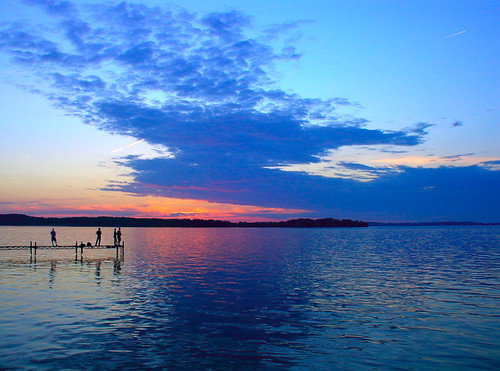
Lake Mendota at sunset.

After a nice dinner at Crave, we walked down to the Memorial Union Terrace and watched the sun set.

Lake Mendota at sunset

Lake Mendota at sunset

৯ জুন, ২০০৫

"Nuts!"

Oscar goes to Bastogne. Earlier: The Maginot Line.

Are you math teachers sure you're trying hard enough...

To indoctrinate your students?

Well, now really, let's think about this. I agree that this is ridiculously politically slanted in one direction. But if we're going to use "story problems," why shouldn't we demonstrate how useful math is in analyzing social and political matters?

And shouldn't teaching math have the end of preparing students to function competently as citizens, voters, and consumers of news media? I'm thinking of the issues raised in the very cool book "A Mathematician Reads the Newspaper."

UPDATE: More on teaching math here.

IN THE COMMENTS: Lots of actual right-wing math story problems!

"The peduncle has not grown beyond yesterday's measurement of 14 inches"!

Get ready, people!

At the UW Greenhouse

And click on the live-streaming at the link. People are visiting the corpse flower, and you can watch them and hear them talk. At some point the thing is going to stink like mad, and you'll be able tell from the reaction of the visitors. Then it's time to scamper over there and get a whiff of it yourself.

What does it smell like? Read the sign (click the image and then on "all sizes" to get the full enlargement):

At the UW Greenhouse

A woman has a second set of quadruplets... and wants a third set?

Why stop at three, when you're so in love with quadrupling? Go ahead, have four sets. If you're going to have twelve children, you might as well have sixteen.