Ipinapakita ang mga post na may etiketa na the History of. Ipakita ang lahat ng mga post

Abril 26, 2013

"Following Portugal's April 1974 Carnation Revolution..."

"... , it granted independence to Guinea-Bissau on 10 September 1974."
Luís Cabral, Amílcar Cabral's half-brother, became President of Guinea-Bissau.   Following independence local soldiers that fought along with the Portuguese Army against the PAIGC guerrillas were slaughtered by the thousands. A small number escaped to Portugal or to other African nations. The most famous massacre occurred in Bissorã. In 1980 PAIGC admitted in its newspaper "Nó Pintcha"...  that many were executed and buried in unmarked collective graves in the woods of Cumerá, Portogole and Mansabá.
Today's "History of" country is Guinea-Bissau.

Abril 24, 2013

"In Monte Alto near La Democracia, Escuintla, giant stone heads and potbellies (or barrigones) have been found..."

"... dating back to around 1800 BC. The stone heads have been ascribed to the Pre-Olmec Monte Alto Culture and some scholars suggest the Olmec Culture originated in the Monte Alto area. It has also been argued the only connection between the statues and the later Olmec heads is their size. The Monte Alto Culture may have been the first complex culture of Mesoamerica, and predecessor of all other cultures of the region. In Guatemala, there are some sites with unmistakable Olmec style, such as Chocolá in Suchitepéquez, La Corona, in Peten, and Tak'alik A´baj, in Retalhuleu, the last of which is the only ancient city in the Americas with Olmec and Mayan features."

In Guatemala, today's "History of" country.

Abril 22, 2013

"Julien Fédon, a mixed race owner of the Belvedere estate in the St. John Parish, launched a rebellion against British rule on the night of 2nd March 1795..."

"... with coordinated attacks on the towns of Grenville, La Baye and Gouyave. Fédon was clearly influenced by the ideas emerging from the French Revolution..."
... especially the Convention's abolition of slavery in 1794: he stated that he intended to make Grenada a "Black Republic just like Haiti." Fédon and his troops controlled all of Grenada except the parish of St George's, the seat of government, between March 1795 and June 1796. During those insurgent months 14,000 of Grenada's 28,000 slaves joined the revolutionary forces in order to write their own emancipation and transform themselves into "citizens"; some 7,000 of these self-liberated slaves would perish in the name of freedom. Fédon's forces were defeated by the British in late 1796, but Fédon himself was never caught and his fate is unknown.
Grenada is the next "History of" country, as we resume our alphabetical progression the the "History of" Wikipedia pages for the 206 countries of the world.


IN THE COMMENTS: bagoh20 said: "Is that outfit ever appropriate in Grenada near the equator?" And Anniella said: "That's an amazing painting, but there's a very good reason he's so bundled up," linking here.
In 1819, Charles Willson Peale headed down to Washington to paint portraits of President James Monroe, Henry Clay, and other dignitaries for exhibition in the famed Peale museum located in Independence Hall. But there was another sitter the painter wanted to snare on his trip.

"I heard of a Negro who is living in Georgetown said to be 140 years of age," Peale wrote in his diary. "He is comfortable in his Situation having Bank stock and lives in his own house."

The man was Yarrow Mamout, a free African, a Muslim who indeed held bank stock, purchased with great effort to secure a comfortable old age - after a life of abduction and bondage...
So... it's not Julien Fédon. I had my doubts, and I won't take advantage of the lame excuse — though I thought of it when I decided to use that picture — that I never actually say that's Julien Fédon. I'm glad to hear of Yarrow Mamout and I love the painting.
"Yarrow owns a house & lotts and is known by most of the Inhabitants of Georgetown & particularly by the Boys who are often teazing him which he takes in good humour," Peale confided in his diary. "The acquaintance of him often banter him about eating Bacon and drinking Whiskey - but Yarrow says it is no good to eat Hog - & drink whiskey is very bad."

Abril 5, 2013

"Ancient Greece is considered by most historians to be the foundational culture of Western Civilization."

"Greek culture was a powerful influence in the Roman Empire, which carried a version of it to many parts of Europe. Ancient Greek civilization has been immensely influential on the language, politics, educational systems, philosophy, art and architecture of the modern world, particularly during the Renaissance in Western Europe and again during various neo-Classical revivals in 18th and 19th century Europe and the Americas."

Today's "History of" country is Greece.

Marso 31, 2013

"Strictly speaking, ghana was the title of the king..."

"... but the Arabs, who left records of the kingdom, applied the term to the king, the capital, and the state."
The 9th-century Berber historian/geographer Al Yaqubi described ancient Ghana as one of the three most organized states in the region (the others being Gao and Kanem in the central Sudan). Its rulers were renowned for their wealth in gold, the opulence of their courts, and their warrior/hunting skills....

Ghana succumbed to attacks by its neighbors in the 11th century, but its name and reputation endured. In 1957, when the leaders of the former British colony of the Gold Coast sought an appropriate name for their newly independent state — the first black African nation to gain its independence from colonial rule — they named their new country after ancient Ghana. The choice was more than merely symbolic, because modern Ghana, like its namesake, was equally famed for its wealth and trade in gold.
Ghana is today's "History of" country.

Marso 27, 2013

"The concept of Germany as a distinct region in central Europe can be traced to Roman commander Julius Caesar..."

"... who referred to the unconquered area east of the Rhine as Germania, thus distinguishing it from Gaul (France), which he had conquered...."
In the first years of the 1st century, Roman legions conducted a long campaign in Germania, the area north of the Upper Danube and east of the Rhine, in an attempt to expand the Empire's frontiers and shorten its frontier line. They subdued several Germanic tribes, such as the Cherusci. The tribes became familiar with Roman tactics of warfare while maintaining their tribal identity. In 9 AD, a Cherusci chieftain named Arminius defeated a Roman army in the Battle of the Teutoburg Forest, a victory credited with stopping the Roman advance into Germanic territories and forming the birth of German history....
Much more happens in Germany, today's "History of" country.

Marso 25, 2013

How did this happen?


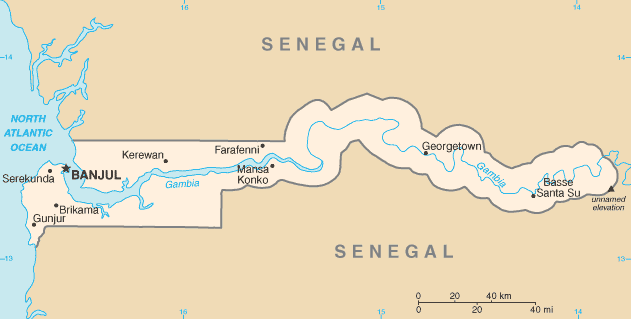
A river, a country: It's The Gambia, today's "History of" country.
In medieval times the area was dominated by the trans-Saharan trade. The reign of the Mali Empire, most renowned for the Mandinka ruler Mansa Kankan Musa, brought world wide recognition to the region due to its enormous wealth, scholarship, and civility....

As time went on the area began to suffer from continuous Moroccan and Portuguese invasion and looting. By the end of the 16th century, as the raids continued, the empire collapsed and was conquered and claimed by Portugal....

During the late 17th and throughout the 18th century, Great Britain and France constantly struggled for political and commercial supremacy in the regions of the Senegal and Gambia Rivers....

An 1889 agreement with France established the present boundaries, and the Gambia became a British Crown Colony, divided for administrative purposes into the colony (city of Banjul and the surrounding area) and the protectorate (remainder of the territory).

Marso 24, 2013

"Portuguese traders who arrived in the 15th century named the country after the Portuguese word gabão, a coat with sleeve and hood..."

"... resembling the shape of the Komo River estuary. The coast subsequently became a center of the slave trade with Dutch, English, and French traders arriving in the 16th century."
France assumed the status of protector by signing treaties with Gabonese coastal chiefs in 1839 and 1841. In 1849, the French captured a slave ship and released the passengers at the mouth of the Komo; The slaves named their settlement Libreville, French for "free town." In 1910 Gabon became one of the four territories of French Equatorial Africa, a federation that survived until 1959.
Gabon is today's "History of" country. 


Union... travail... justice...

Marso 23, 2013

"Clovis made Paris his capital and established the Merovingian Dynasty..."

"... but his kingdom would not survive his death in 511."
Under Frankish inheritance traditions, all sons inherit part of the land, so four kingdoms emerged: centered on Paris, Orléans, Soissons, and Rheims. Over time, the borders and numbers of Frankish kingdoms were fluid and changed frequently. Also during this time, the Mayors of the Palace, originally the chief advisor to the kings, would become the real power in the Frankish lands; the Merovingian kings themselves would be reduced to little more than figureheads.

By this time Muslim invaders had conquered Hispania and were threatening the Frankish kingdoms. Duke Odo the Great defeated a major invading force at Toulouse in 721 but failed to repel a raiding party in 732. The mayor of the palace, Charles Martel, defeated that raiding party at the Battle of Tours (although the battle took place between Tours and Poitiers) and earned respect and power within the Frankish Kingdom. The assumption of the crown in 751 by Pepin the Short (son of Charles Martel) established the Carolingian dynasty as the Kings of the Franks.
A couple hundred years in the history of France, today's "History of" country. We are proceeding in alphabetical order through the world's 206 countries, reading their Wikipedia "History of" pages. France has one of the most interesting pages, and I couldn't begin to summarize the summary there.

Here's the Battle of Tours, which happened in 732, as depicted by Charles de Steuben in 1837:

Marso 22, 2013

"The last ice age in the area of the modern-day Finland ended c. 9000 BC."

"Starting about that time, people migrated to the area of Finland from the Kunda and - possibly - Swiderian cultures, and they are believed to be ancestors of today's Finnish and Sami people in Finland."
The oldest confirmed evidence of the post-glacial human settlements in Finland are from the area of Ristola in Lahti and from Orimattila, from c. 8900 BC. Finland has been continuously inhabited at least since the end of the last ice age, up to date.
Finland is today's "History of" country.

Marso 20, 2013

"Austronesian peoples are believed to have settled in the Fijian islands some 3,500 years ago..."

"... with Melanesians following around a thousand years later."
Most authorities agree that they originated in Southeast Asia and came via Indonesia. Archeological evidence shows signs of settlement on Moturiki Island from 600 BC and possibly as far back as 900 BC.

In the 10th century, the Tu'i Tonga Empire was established in Tonga, and Fiji came within its sphere of influence. The Tongan influence was thought to have brought Polynesian influence to customs and some language into Fiji. The empire began to decline in the 13th century....
Fiji is today's "History of" country.

Marso 19, 2013

"Although Medieval Ethiopia was very isolated from the other Christian Nations..."

"... they did maintain a degree of contact through Jerusalem."
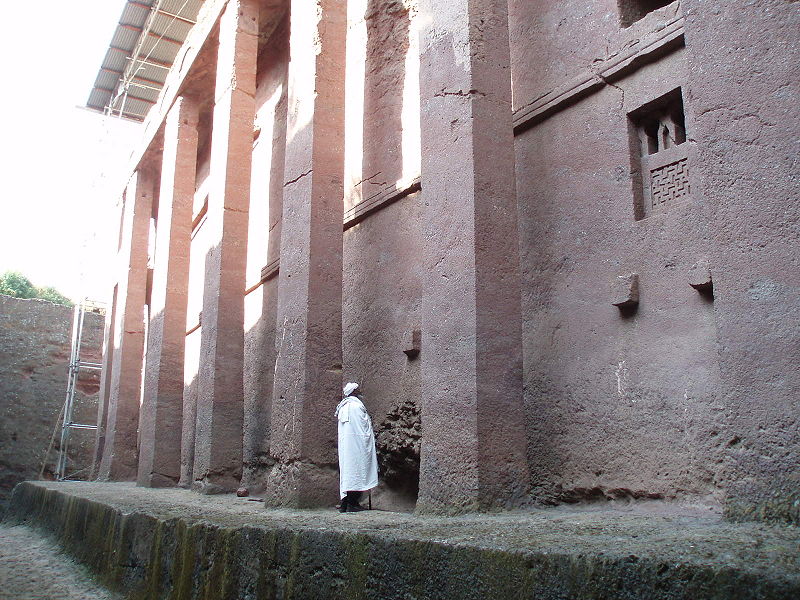
Like many other nations and denominations, the Ethiopian Church maintained a series of small chapels and even an annex at the Church of the Holy Sepulchre. Saladin, after retaking the Holy City in 1187, expressly invited the Ethiopian monks to return and even exempted Ethiopian pilgrims from the pilgrim tax. His two edicts provide evidence of Ethiopia's contact with these Crusader States during this period. It was during this period that the great Ethiopian king Gebre Mesqel Lalibela ordered the construction of the legendary rock-hewn churches of Lalibela.


Ethiopia is today's "History of" country.

I'm going to make a list of the 10 most beautiful names of countries in the world today. Ethiopia is the list.

Marso 18, 2013

"Estonia remained one of the last corners of medieval Europe to be Christianized."

"In 1193 Pope Celestine III called for a crusade against pagans in Northern Europe. The Northern Crusades from Northern Germany established the stronghold of Riga (in modern Latvia). With the help of the newly converted local tribes of Livs and Letts, the crusaders initiated raids into part of what is present-day Estonia in 1208. Estonian tribes fiercely resisted the attacks from Riga and occasionally themselves sacked territories controlled by the crusaders. In 1217 the German crusading order the Sword Brethren and their recently converted allies won a major battle in which the Estonian commander Lembitu was killed. The period of the several Northern Crusade battles in Estonia between 1208 and 1227 is also known as the period of the ancient Estonian fight for independence."

In Estonia, today's "History of" country, which looked like this before September 21, 1217:

Marso 17, 2013

"The British and Americans preferred to cede Eritrea to the Ethiopians as a reward for their support during World War II..."

Says the "History of Eritrea" page at Wikipedia. (In our "History of" project, we're proceeding through the world's 206 countries in alphabetical order.)
The resolution ignored the wishes of Eritreans for independence, but guaranteed the population some democratic rights and a measure of autonomy. Some scholars have contended that the issue was a religious issue, between the Muslim lowland population desiring independence while the highland Christian population sought a union with Ethiopia....

Marso 12, 2013

"The Portuguese explorer, Fernão do Pó, seeking a route to India, is credited with having discovered the island of Bioko in 1471."

"He called it Formosa ('beautiful [isle]', a name later applied to Taiwan), but it quickly took on the name of its European discoverer, albeit spelt 'Fernando Po.' The islands of Fernando Po and Annobón were colonized by the Portuguese in 1474.... From 1827 to 1843, Britain established a base on the island to combat the slave trade."

In Equatorial Guinea, today's "History of" country.

Marso 11, 2013

Pedro de Alvarado "named the district for El Salvador ('The Savior') and was appointed its first governor..."

"... a position he held until his death in 1541. The area was under the authority of a short-lived Audiencia of Panama from 1538 to 1543, when most of Central America was placed under a new Audiencia of Guatemala.... In 1786, the Republic of El Salvador, which previously had been broken up into many corregimientos, was transformed into an intendancy, as part of the Bourbon Reforms..."

In El Salvador, today's "History of" country.

Marso 10, 2013

"Climate changes and/or overgrazing around 8000 BC began to desiccate the pastoral lands of Egypt, forming the Sahara."

"Early tribal peoples migrated to the Nile River where they developed a settled agricultural economy and more centralized society."

What would have happened in Egypt — today's "History of" country — and in the rest of the history of the world, if those early people had controlled their greedy grazing and not anthropogenerated the Sahara Desert?


IN THE COMMENTS: chickelit said:
Grass guzzlers caused the Sahara. Got it.

Marso 8, 2013

"As the Inca Civil War raged, in 1531 the Spanish landed in Ecuador."

"Led by Francisco Pizarro, the conquistadors learned that the conflict and disease were destroying the empire."
... Pizarro sent an embassy, led by Hernando de Soto with 15 horsemen and an interpreter; shortly thereafter he sent 20 more horsemen led by his brother Hernando Pizarro as reinforcements in case of an Inca attack. Atahualpa was in awe of these men dressed in full clothing, with long beards and riding horses (an animal he had never seen). In town Pizzaro set a trap for the Inca and the Battle of Cajamarca began....

During the next year Pizzaro held Atahualpa for ransom. The Incas filled the Ransom Room with gold and silver awaiting a release that would never happen. On August 29, 1533 Atahualpa was garroted.
In Ecuador, today's "History of" country.

Marso 7, 2013

"The island of Timor was populated as part of the human migrations that have shaped Australasia more generally."

"It is believed that survivors from three waves of migration still live in the country. The first is described by anthropologists as people of the Veddo-Australoid type, who arrived from the north and west at least 42,000 years ago.... Around 3000 BC, a second migration brought Melanesians. The earlier Veddo-Australoid peoples withdrew at this time to the mountainous interior. Finally, proto-Malays arrived from south China and north Indochina...."

East Timor, today's "History of" country.

Marso 3, 2013

"Christopher Columbus reached the island of Hispaniola on his first voyage, in December 1492."

"On Columbus second voyage in 1493 the colony and Santo Domingo became the new capital, and remains the oldest continuously inhabited European city in the Americas."
Hundreds of thousands Tainos living on the island were enslaved to work in gold mines. As a consequence of oppression, forced labor, hunger, disease, and mass killings, by 1535, only 60,000 were still alive. In 1501, the Spanish monarchs, Ferdinand I and Isabella, first granted permission to the colonists of the Caribbean to import African slaves, which began arriving to the island in 1503. These African importees have had the most dominant racial influence, and their rich and ancient culture has had an influence second only to that of Europe on the political and cultural character of the modern Dominican Republic.
The Dominican Republic is today's "History of" country. (In the "History of" project, we're going through the 206 countries of the world in alphabetical order and reading their "History of" page in Wikipedia.)