sean (the commenter) लेबल असलेली पोस्ट दाखवित आहे. सर्व पोस्ट्‍स दर्शवा

१९ मे, २०२३

"Being around birds is associated with better mental health."

Says this article in WaPo.
If a participant [in a study] reported seeing or hearing birds at one point, their mental well-being was higher, on average, hours later even if they did not encounter birds at the next check-in.... 
“Listening to birdsong through headphones was able to hit the same pathways that might be beneficial toward mental well-being.... That’s a very, very nice finding.”

One study compared people whose headphones played birdsong with those subjected to traffic noise.  

IN THE COMMENTS: Sean said:

Lemme guess, they didn't do crows.

२ मे, २०२१

"Perelman crammed every joke he could think of into every sentence and polished his pieces relentlessly until they couldn’t get any crazier."

"There’s a story that a friend called him up while he was writing something, and Perelman said, 'I’ll call you back when I finish this sentence.' He called back the next day and said, 'O.K., what do you want?' When I first read Perelman, it was completely over my head. Half the words he was using didn’t exist in the real world, as far as I knew—and I was twelve, I’d been around. I figured one of us was nuts. Later on, when I had started writing for a living and picked up a few more multisyllable words, I checked him out again. I’ve been a fan ever since."

 From "John Swartzwelder, Sage of 'The Simpsons'/The first major interview with one of the most revered comedy writers of all time" (The New Yorker).

There's a lot about "The Simpsons" in there too. For example, the key to writing Homer Simpson is to think of him as "a big talking dog":

One moment he’s the saddest man in the world, because he’s just lost his job, or dropped his sandwich, or accidentally killed his family. Then, the next moment, he’s the happiest man in the world, because he’s just found a penny—maybe under one of his dead family members. He’s not actually a dog, of course—he’s smarter than that—but if you write him as a dog you’ll never go wrong.

FROM THE EMAIL: Sean writes:

Hey Althouse, thanks for that link to the interview with John Swartzwelder, of whom I had never heard before. After reading that interview, I immediately bought his self-published novel The Time Machine Did It (Kindle edition), and am thoroughly enjoying it. Up to chapter 17 already, just put it down long enough to say thanks to you.

२८ डिसेंबर, २०११

In Madison, Wisconsin, "the Occupy movement isn't resonating with people."

Todd Finkelmeyer observes ruefully, in Madison's pathetic newspaper, The Capital Times ("Your Progressive Voice"). He's found one UW student who is into the protest and who "has struggled to find fellow students willing to join him in making a visible and vocal protest on behalf of the youthful 99 percent."

By "the youthful 99 percent," I presume Finkelmeyer means the portion of the 99% that happens to be adult but not yet middle aged. I suppose, depending on how you define young, the percent might be something like 30%. But young people who find themselves at the lower end of the income scale have the least to gripe about. They're just starting out. The question is: Can they move up over the course of their careers? If they are students at a fine university, they ought to think they can or they're wasting their time. Whether making it in America today is easy or hard nowadays, these students are better off studying than protesting. I congratulate the students for their good sense in resisting the protest scene.

But Finkelmeyer chides them:
But in Madison, despite its reputation as a hotbed of student activism — notoriety that dates to the late 1960s and early 1970s, when the city served as an epicenter for those protesting the Vietnam War — college students are slow to jump on the Occupy bandwagon.

"From the very beginning of Occupy Madison, from the very first general assembly at Reynolds Park and in the following weeks, there was a noticeable lack of students," says [that one UW student], who in late October helped organize two Occupy UW marches as a member of the Direct Action Committee of Occupy Madison. He had hoped those would turn into weekly on-campus protests, but only 15 people showed up for the second march and no more were held due to a lack of interest.

"I don't think the outreach we did was as good as it could have been, so it didn't grow and Occupy UW has sort of been put on the back burner," says Phillips.
Maybe people don't want to be organized — by others, that is. Maybe the UW students are organized within their own lives and are pursuing an education and aiming toward a career path. Back in the not-so-good good old days of Vietnam protesting, you couldn't just concentrate on getting started on the path to economic well-being. The military draft was staring you in the face.

And, by the way, Finkelmeyer, mixed metaphor alert: "hotbed... epicenter...  bandwagon."

The article goes on and on, with lots of quotes from professors and other politicos who wonder why the students are resisting the pull of protests. The delightfully named Elizabeth Wrigley-Field — "a New York native who is pursuing her Ph.D. in sociology from UW-Madison" — "cautions" us not to "over-generalize" and say that the students are apathetic.
"I think part of the strength of the Occupy movement in most areas is that it's a novelty of sorts... But we already had that here with the occupation of the Capitol (in February and March) and then we had Walkerville...."
So maybe they're not apathetic; they're sick of all the protesting. Or they're passionate about their own individual lives and they need to study to get to a solid place for themselves in this risky economy. That tent-city out on East Washington Avenue is — by contrast — a horrifying alternative. It's irrational to think that hanging around in a parking lot with a bunch of left-wingers hoping for a revolution is going to work out better for you than concentrating on your school work and your job search.

IN THE COMMENTS: sean said:
Somewhat akin to what Prof. Althouse said, my back-of-the-envelope calculation shows that there are about 12 million Americans of college age, of whom perhaps 400,000 go to colleges of the caliber of Wisconsin or better. (The majority, of course, don't go to college at all, at least not to four-year institutions.) So Wisconsin students are in the top 3% of their age group, if not the top 1%, and obviously they aren't disposed to protest on behalf of other people.
And Patrick said:
I had the good fortune of being in Madison on Christmas eve day. As we drove down E. Wash, past the Occupy parking lot, it looked barren, save for some tents. I'd assumed that if they were still "occupying," they'd be up at the Capitol. What sort of impact could they possibly imagine having from that parking lot? "Occupy Parking Lot" just loses whatever zing those clowns ever had. Total failure. They need to "move on."
I responded: "It's the parking lot of what used to be a Don Miller car dealership, so we always call it 'Occupy Don Miller.'"

१० जानेवारी, २००९

The new Solicitor General -- Elena Kagan -- is female, so the question is: What will she wear?

The Solicitor General — up to now, invariably a male — has always worn a "morning coat" — that is to say, tails. So it's a puzzle. Lawprof Patricia J. Williams writes:
The persistence of this sartorial custom beyond its natural lifespan—and in the American justice system of all places—is not merely a quirk of history but testament to the deep and tenaciously clubbish culture that still afflicts the highest levels and most intransigently closed circles of power. Blockquote
Tradition, it's an affliction.

Williams tells the story — "perhaps apocryphal" — of a female deputy solicitor who wore a "'dove-brown' or 'doe-beige' business suit" when she argued a case in the Supreme Court:
According to a friend who, to this day, fears being identified, Chief Justice Rehnquist "went berserk." He chastised her for inappropriate attire, and followed it up with a scathing letter to the Solicitor General himself, requesting that this not occur again. Brown textiles! The scandal!...

In response, the Solicitor General’s office thenceforth recommended that women wear what is popularly known as a "feminized" version of morning attire, and/or a plain black suit.
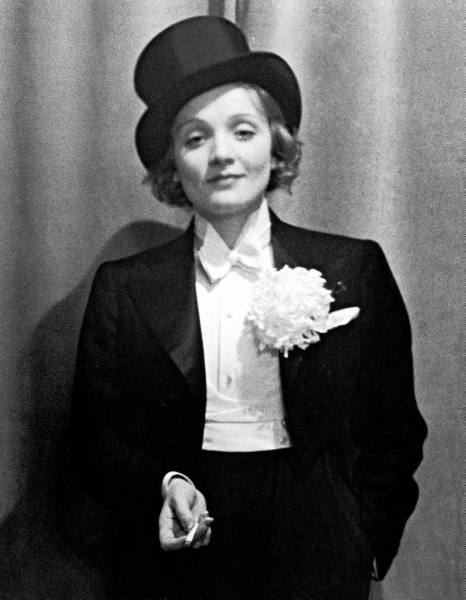
So, then, the answer is easy: Kagan will wear a nice black skirted suit. Yes, it might have tails, but in my view that would seem oddly costume-y in the absence of an established tradition. Dressing like a man is not a tradition. It's sort of kinky.


IN THE COMMENTS: Sean writes:
There hasn't been a female solicitor general before, but women from the solicitor general's office have argued before the Supreme Court, and they wore business suits.

In fact, my [Appellate Advocacy]professor told us that there was some discussion, when there first started being women in the solicitor general's office, of what was the female analogue of a morning coat. Several answers suggest themselves, based on the situations where morning coats are encountered: bridesmaids' dresses (men still wear morning coats if they are in a wedding party); women's church clothes of the 1950s, featuring knee length dresses and white gloves (men used to wear morning coats at upper class churches into the 1950s); or upper class female street clothes of the Edwardian era, perhaps featuring a bustle (this was the last time that men wore morning coats on a regular basis). None of these female attires seems quite suitable for a lawyer.

Theo Boehm says: "Forget Dietrich. If that era is any guide to style, the new Solicitor General should try the Louise Brooks look":