puzzles लेबल असलेली पोस्ट दाखवित आहे. सर्व पोस्ट्‍स दर्शवा

२१ जुलै, २०२६

Bison man speaks.


My tag for bison is "buffalo." Sorry. I know it's a bison. I searched for "bison" in my tags, but all that came up was "Roy Orbison." Hmm. Good idea for a purple category in the NYT game "Connections." 

ADDED: Back in 2012, we went to Yellowstone, and I wrote a post, with photographs, titled "Buffalo in the Mist." In the comments, I wrote these 2 things:

1. "Driving into Yellowstone, Meade and I had a conversation about whether we preferred to say 'bison'" (the technically correct term) or 'buffalo' (the colloquial american name for the beast). We decided on buffalo. It's more American and it's just a cooler word."

2. Responding to a commenter who warned me: "Careful, Althouse. Though they look gentle, they're still wild animals and should be treated as such." I wrote: "We were on a boardwalk that is about 2 miles long. You can't go any other way (unless you go back). You can't walk on the ground. We were just trying to get back out to the parking lot, and the buffalo was right there. I was scared, but I had to walk past it. There was no other way to go. I am not one of these people who go up to the animals. I'm about photographing the landscapes."


P1070078

१९ जून, २०२६

"Wordle’s Hard Mode Is Actually Easier, 730 Million Games Show."

The NYT reports, and here's a gift link. I've always played in hard mode. I don't know if that's because my intuition told me it was easier or because I could see it would be more fun, but it certainly wasn't in order to make it harder on myself.

Players in hard mode solve in fewer turns on average.... Those in hard mode have a lower rate of failing to solve in six turns.... Hard mode seems to help players avoid poor choices.... Standard-mode players have more freedom but often don’t know how to use it. Not needing to use revealed letters, they have many more choices on their second and third turns.

David Epstein, author of “Inside the Box: How Constraints Make Us Better,” said in an interview that in any area of life, “when options are really large” there’s a tendency to “back out of a decision or make a poor one.” Citing the cognitive scientist Daniel T. Willingham, he said the brain is mostly not for thinking, but for preventing you from thinking. “It’s wired for convenience, the easy thing, the first thing to pop to mind,” he said, while constraints can paradoxically lead to creativity and productivity....

I get it. We're supposed to think: The choice of hard mode or easy mode in Wordle is like a choice we make in how to live our life. And that's why you might want to stick to tradition (if you are conservative) or have government experts eliminate most of the choices (if you are progressive).

३ जून, २०२६

"Got any more of these cross-literary sparks, or is there another Stafford zinger that cracks you up?"

Grok asked me after I was asking it about the poem "Farm Implements and Rutabagas in a Landscape" by John Ashbery, specifically my favorite line, "Olive came hurtling through the window; its geraniums scratched/Her long thigh."

The poem had just come up in a crossword puzzle: 20 Across: "Cartoon character featured in the John Ashbery poem 'Farm Implements and Rutabagas in a Landscape.'" There are a lot of cartoon characters in that poem, but the answer is POPEYE. 

I'd said to Grok: "That description of Olive Oyl and the poem title — 'Farm Implements' — made me think of this quote David Sedaris found in the biography of Jean Stafford: 'She was sharp-tongued and once described a fellow writer as 'looking as if she were pregnant with farm machinery.'"

That's in DS's new book (commission earned).

Well, I didn't have any more cross-literary sparks or Stafford zingers, so I said "No. Do you?"

And Grok was all "Yes — plenty." Etc.

७ मार्च, २०२६

"As the categories have gotten, well, weirder, I’ve tried to create balance by not mixing tricky wordplay with hard trivia, so that there’s a path to a solution."

"If there’s a particularly hard-to-spot category, I might try to include a hint on the board. While cards are usually arranged to mislead the solver, sometimes the arrangement can be used to help, too. The category of 'Anagrams of Famous Painters' was tough, for example, so the top row of that board read 'EGADS SCRAMBLE ARTIST NAME' (EGADS is an anagram of 'Degas')...."

From "I Make Connections. Here’s What I’m Actually Thinking. The 1,000th Connections puzzle is out today. Wyna Liu, the writer behind the game, knows you have thoughts" (NYT)(gift link).

"I’ve... learned that some people hate when a word on the board is repeated in a category name. So I was honored when a friend showed me a post in the subreddit r/NYTConnections, with the heading 'In celebration of the single worst purple connections category ever …' A solver shared an image of what appeared to be a tattoo: a clam encircled by the words 'Things That Open Like a Clam.' (COMPACT, LAPTOP, WAFFLE IRON and … CLAM.)"

I think the problem is that a clam isn't like a clam. A clam's a clam. It was a great category, just named inaccurately.

Now, that I've got my "mollusks" tag on this post, I'm motivated to blog this other thing. I didn't even know about nudibranchs — lovely colorful mollusks — but I learned about them today when somebody at Metafilter linked to Wool Creature Lab a place that uses the craft of felting to make (to order) images of quite specific nudibranchs. They're beautiful, too beautiful to believe they are accurate images of real creatures. But the scientific name is listed with the felt item, and you can look it up and see photos of the living nudibranch. It's accurate.

१३ फेब्रुवारी, २०२६

"Poem so beloved by Abraham Lincoln that he carried it in his pocket and memorized it."

The clue for 11 Down in today's NYT crossword.

९ ऑक्टोबर, २०२५

Should have been 34D.

I'm reading Rex Parker's write-up of today's NYT crossword: 

35D: Annual breast cancer awareness observance (NO BRA DAY) — I did not know this was a thing, or still a thing. Seems like an impractical option for many women. According to wikipedia, "The day is controversial as some see it as sexualizing and exploiting women's bodies while at the same time belittling a serious disease." I misread the clue as [Annual breast cancer awareness month] and, having the "NO-," wrote in NOVEMBER (which fits ... it's wrong, but it fits). Breast Cancer Awareness Month is actually right now, October, and NO BRA DAY is next week (October 13).

I'd never heard of "No Bra Day" — I don't think — until I did today's NYT crossword. A search of the NYT archive shows it's only ever been used in the crossword. This annual "observance" — ahem — has never been spoken of in an actual article or column. It's not like Breast Cancer Awareness Month, which is talked up all the time.

I'd say it’s ridiculous to have a day where women are urged to invite people to focus on their undefended — unshielded, unsupported — breasts. Making breasts more gawkable does not create awareness of cancer. It creates awareness of breasts, especially healthy, good-looking breasts. But we don't want a special event for that, because it seems to legitimate staring. If the idea is to increase awareness of the comfort of not wearing a bra, it fails. The best bralessness happens when you believe no one notices, whether your belief is true or false.

Anyway, too bad the NYT made the clue 35D and not 34D or 36D. 35D almost sounds like a bra size.

२५ सप्टेंबर, २०२५

"meh - candidate for worst puzzle of the year"/"perhaps worst of the decade!"

Comments at the NYT column about today's crossword, which wasn't that hard, but was rather annoying for those of us who like to — semi-spoiler — see what we are doing.

७ जुलै, २०२५

Revolution in the air.

Seen, just now, in a prominent place, which I won't name, out of mild avoidance of spoiling.

You know, Bob Dylan recorded "Tangled up in Blue" on the second-to-last day of the year 1974 — half a century ago. And he was telling the story of something further back in the past: "It didn't pertain to me. It was just a concept of putting in images that defy time – yesterday, today and tomorrow. I wanted to make them all connect in some kind of a strange way." It's hard to say what year there was that "revolution in the air." Perhaps a decade earlier.

And now the "revolution in the air" is in the crossword puzzle.

Speaking of revolution "in the air" in the 1960s, I always think of the 1969 Thunderclap Newman record, "Something in the Air." Maybe if "Tangled up in Blue" didn't pertain to Bob Dylan, it pertained to Thunderclap Newman. He'd have heard their song in the air:


Call out the instigators/Because there's something in the air/We got to get together sooner or later/Because the revolution's here....

४ जून, २०२५

"I love this style of clue, where even if you don't know the exact trivia (I've never heard of the band or the song) you can puzzle it out based on the context."

Writes Malika, at Rex Parker Does the NY Times Crossword Puzzle.

Here's the clue: "Girl in Jefferson Airplane's 'White Rabbit.'"

One day everything new will be old, and one day everything will be forgotten. 

२४ मार्च, २०२५

"... the anile, demented echo chamber of social media."

A phrase I found — in a 2016 National Post article about Justin Trudeau’s "sunny Liberalism" — when I looked up the word "anile" in the OED.

A Wordle spoiler follows. "Anile" is not the answer, but "anile" was accepted as a guess, though after getting the right answer, I was told that "anile" would never be the answer in Wordle.

Why not?! "Anile" is a perfectly good word. It means, the OED tells us, "Of, belonging to, or characteristic of old women; resembling an old woman. Chiefly derogatory with connotations of foolishness, senility, or decrepitude."

३१ डिसेंबर, २०२४

I knew the day would eventually come... and it came yesterday.

I changed my first word, and it's off to a good start on the last day of the year.

३१ जानेवारी, २०२४

"Chayka, a millennial, is nostalgic for... the images he once shared on Tumblr; an earlier, jankier World Wide Web of illegal file-sharing, blogs and and massive multiplayer online role-playing game (MMORPG) forums."

"He first heard 'My Favorite Things' not in 'The Sound of Music' but the John Coltrane version, listening to an indie station as he wended his way back from a friend’s house in the suburbs in the early ’00s. Boomers and Gen X, with more years logged algorithm-free, might find 'Filterworld' unduly bleak; Zoomers, hopelessly naïve. Or, as they say on the internet, YMMV."


I'm reading that this morning after searching the NYT archive for "MMORPGs," a very annoying set of letters that I'd never noticed before, but ran across as an answer in a crossword, clued as "RuneScape and World of Warcraft, for two: Abbr."

My reaction was: If that's the way it's going to be, I'm not doing your crosswords anymore.

Overreaction? My test of whether this is something I should recognize, because it comes up in real life, is whether it's in the NYT archive. This was not the NYT crossword. And, yes, I'm a Boomer.

You can see that the recent appearance of MMORPG was in parentheses, after a spelling-out of what it abbreviates. Before that, it hadn't appeared since 2019. But back in 2013 and in 2005-2006, the annoying letter combo appeared a handful of times. I see the phrase "the wonderfully named MMORPGs (massively multiplayer online role-playing games)."

I guess I won't boycott that puzzle, but I can see how puzzle publishers risk alienating their audience. Puzzles are full of things that are easy for Boomers like me and that must be very annoying to Millennials and Zoomers. But when I see something like MMORPG, I just think it's a pathetic play to get young people to think this thing is for them. And please don't say YMMV either. 

And yet MMORPGs are among the things the "Filterworld" author is nostalgic for. It's not new. It's old. Mid-level old. Like blogs. I'm nostalgic for blogs too, of course, but I'm still here in mine, and I presume there's this other group of people — who the hell are they? — who are still out there in their MMORPGs.

५ जानेवारी, २०२४

"At least Hanlon's razor... has something witty and memorable and real-life-applicable about it..."

Writes Rex Parker about today's NYT crossword, where the 18-across clue is "'Never attribute to ___ that which is adequately explained by stupidity' (Hanlon's razor)."

The answer to on that clue is... spoiler alert...

१६ नोव्हेंबर, २०२३

"Travel back in time and solve a puzzle from every year of [Will] Shortz’s career at The Times."

"These puzzles will be available for free until Nov. 30. When solving, remember the context of the year you’re solving in. Some facts and figures have changed since the year each puzzle was originally published."

So it says, in "Will Shortz’s Life as a ‘Professional Puzzle Maker’/The New York Times Crossword editor celebrates his 30th year in a job many would love to have" (NYT).

I'll give you the links to those free puzzles... as the dealer tries to hook you. This is a good way to learn the levels of difficulty on the various days of the week. Me, I like Friday best (and then Saturday):

२८ जुलै, २०२३

A vogue word, rejected.

You don't need to care about the NYT crossword to be interested in what follows — it discusses a current buzzword — but it does reveal a couple answers. 

From Rex Parker's write-up of today's puzzle:

२८ जून, २०२३

A new sighting of "large boulder the size of a small boulder."

In today's New Yorker crossword:


My tiny screen grab doesn't show the place for the answer, but it's a 10-space answer that I'll just spoil after the jump.

२३ जून, २०२३

"... cluing voice..."

"I hear that there's some scheme afoot in the NYT Games newsletter to offer themeless puzzles up with clues that have been completely rewritten by in-house staff (gutting the original constructor's cluing voice completely, without their consent). Editors change clues all the time, of course, but that's ... editing. Not wholesale rewriting. Maybe I have misunderstood, and the plan is less heavy-handed and constructor-unfriendly."

Writes Rex Parker, in today's blog post about the NYT crossword. (Answers for today's puzzle revealed at the link.) 

I'd always assumed all the clues were edited into the style of the NYT, so it's interesting to me to see that the constructors — the original constructors — are thought of as having a "cluing voice" — something that is valued and can be threatened. There is a lot of room to be dull or clever or cute or weird in the clues, so, as a daily solver of the puzzle, I get what it means to say "cluing voice." And of course, I know how much "voice" means to a writer and how aggravating it is to suffer the intrusions of an editor who's bent on imposing a uniform institutional voice. That's why I write a blog and not law review articles.

१३ जून, २०२३

New term learned: "Sunday scaries."

I was surprised to see this childish locution as a serious answer — clued "Feeling of dread heading into a workweek." It would be a spoiler to say where, but it was in a highly respected puzzle and presented as an established phrase.

I googled and got over a million hits:

९ मे, २०२३

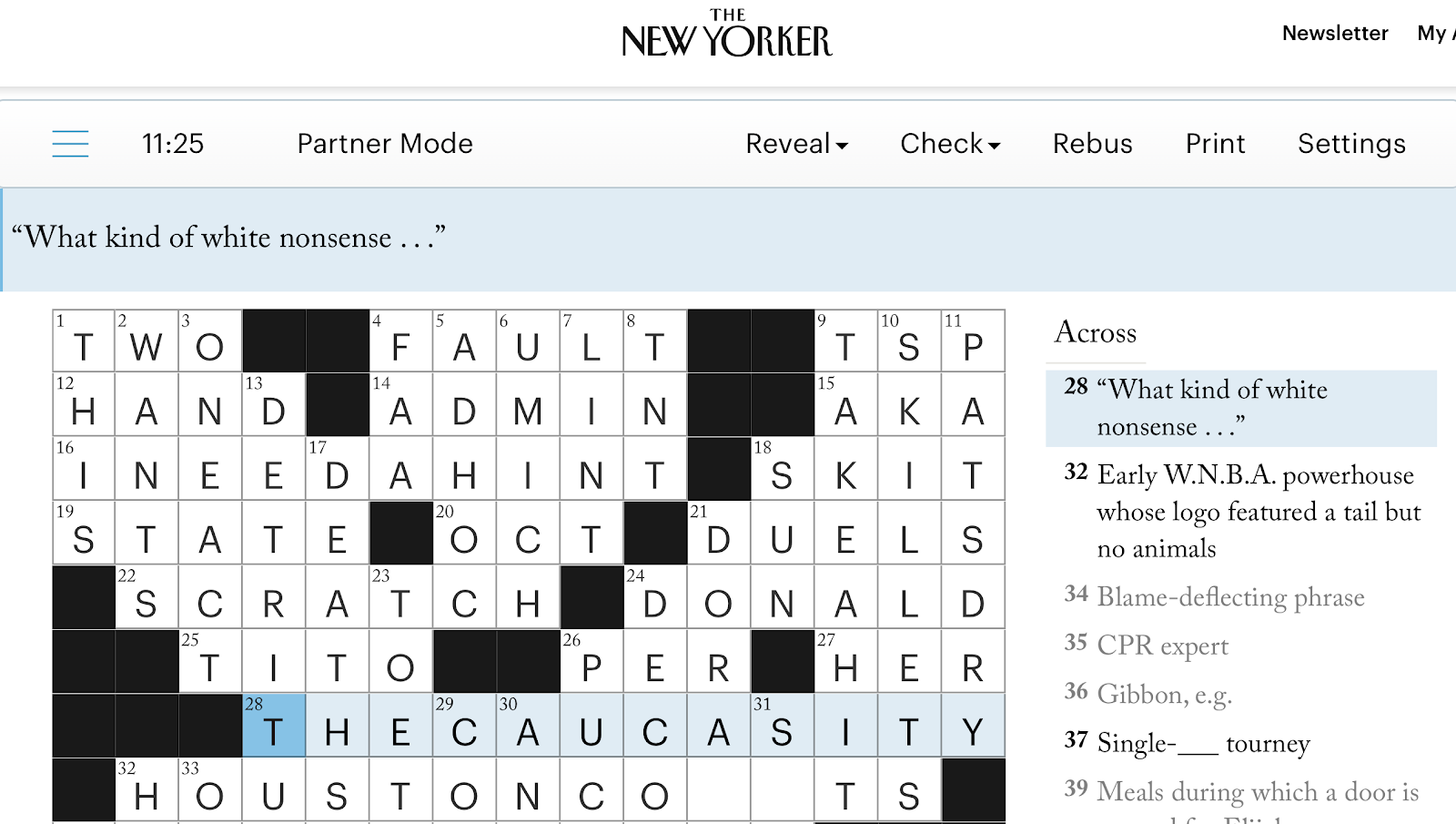
So... they're doing this in the New Yorker crossword.

That's today's puzzle. Clue: "What kind of white nonsense..." Answer: "The Caucasity!"

It's good wordplay — a twist on "the audacity!" — but not anything I'd seen before, and the clue suggests this is a phrase in ordinary speech these days rather than a new joke. 

It really is white supremacy, in my view, which is — as advised yesterday by WaPo's Philip Bump — not to be too "rigid" about the meaning of "white supremacy." Bump, you will remember, argued that "white supremacy" could be understood to include promotion of the "structures of power that largely benefit Whites." So, if you like just about anything the way it is, you may be a white supremacist.

I had thought that The New Yorker would refrain from using racial taunts in its crossword! Why did it seem okay? Answer: White supremacy. You don't understand my point? To quote Philip Bump, "This confusion... stems from overly rigid understanding[] of... 'white supremacist.'"

८ मे, २०२३

"Solitude is the profoundest fact of the human condition."

"Man is the only being who knows he is alone, and the only one who seeks out another. His nature – if that word can be used in reference to man, who has 'invented' himself by saying 'no' to nature – consists of his longing to realize himself in another. Man is nostalgic and in search for communion. Therefore, when he is aware of himself he is aware of his lack of another, that is, of his solitude."

Wrote Octavio Paz in "The Labyrinth of Solitude." 

I wasn't reading that book. I encountered the first line of the quote in a puzzle just now and went looking for more context. I became aware that the sentence was alone and experienced a longing that it realize itself in a paragraph.