heart लेबल असलेली पोस्ट दाखवित आहे. सर्व पोस्ट्‍स दर्शवा

१ एप्रिल, २०२६

"In the tiny town of Castlewood, S.D., where everyone knows the Noems, the prevailing sense was that people can’t help but feel bad for Bryon Noem after a tabloid photo leak."

I'm blogging the NYT article, "In South Dakota, Neighbors Feel Sorry for Kristi Noem’s Husband," written by Shawn McCreesh.

I've avoided blogging this story until now because I too felt sorry for Kristi Noem's husband. What a cruel invasion of a person's privacy! 
“Must be A.I.,” a burly cattle rancher named Kevin Ruesink said as he inspected pictures of his neighbor Bryon Noem that had been published by The Daily Mail on Tuesday morning.... The rancher squinted at them with a mixture of suspicion and pity. “I grew up playing ball with Bryon,” he said. “I’ve never known him to be part of stuff like that. I don’t believe that at all.”... 
In response to multiple requests for an interview, Mr. Noem wrote in a text message on Tuesday: “I will at some point. Today is not the day. I appreciate your heart.” 
While the pictures of Ms. Noem’s husband with what appear to be enormous inflated balloons under his spandex shirt ricocheted across the internet, becoming a political punchline for her many, many enemies, the reaction back on the proverbial ranch was a little more … tenderhearted....

As the yard signs in my neighborhood say: Kindness is everything.

Another newspaper expressed puzzlement over the statement "I appreciate your heart." But the statement was made to the NYT writer Shawn McCreesh, whose article earned that sentiment.

३१ मे, २०२५

"I was trying to make a heart for him. I was too late."

Said Robert Jarvik, quoted in "Robert Jarvik, a creator of the artificial heart, dies at 79/He was the lead designer of the Jarvik-7, a controversial plastic and metal device intended to permanently replace an ailing human heart" (WaPo).
A handsome, tousle-haired man whose interests ranged from skiing and weightlifting to poetry and theoretical physics, he cited a personal motivation for his work on the device: His father, a physician, had died after open-heart surgery in 1976.

The first artificial heart, the Jarvik-7, was implanted in 1982. Perhaps, like me, you remember the name and occupation of the recipient: Barney Clark, a dentist. When he awakened from the surgery, he said to his wife, "I want to tell you, even though I have no heart, I still love you."

The artificial heart never became a replacement for a real heart. Didn't you think it would, if you were around, reading the news 43 years ago? Artificial hearts are only used as to keep people alive while they wait for a heart from a human donor.

Jarvik, the "handsome, tousle-haired man," also posed in Hathaway shirt ads — like this one, complete with the company's trademark eyepatch. He also posed in a Lipitor ad that got criticized as misleading because Jarvik was "not a cardiologist" and — though the ad depicted him rowing — "apparently, not a rower."

Jarvik was married to Marilyn vos Savant, the woman who's been famous for decades for supposedly having the highest IQ. (She scored 228 on the Stanford-Binet test when she was 10.)

१९ जानेवारी, २०२४

Malia Ann — AKA Malia Obama — hopes her film makes you feel "a bit less lonely."


It's "an odd little story," we're told, and, judging from the photographs and the voiceover, it seems to be about man who needs to follow instructions left in his mother's will to do something with her heart — her actual physical heart, which we see him holding in a jar.

३ ऑक्टोबर, २०२३

"Tonight the touch points are going to include your hand holding another hand, your back against somebody’s back, your hand on someone’s heart space..."

"... and their hands on your heart space, and you’re going to take turns leaning in and out of two long-held hugs."

When it was time to touch each other’s “heart space,” some laid their hands directly on the left side of their partner’s chest while others made contact with just the tips of their fingers. Somatic practices like meditation and eye gazing have long been incorporated in relationships.... The innovation here is attaching this mindfulness style to first-time romantic meet-ups....

I can't imagine volunteering (let alone paying) for this kind of thing. Here are the first 2 associations that sprang into my head.

1. In the James Whale movie "The Old Dark House" — which I watched on October 1st, the first day it became available on the Criterion Channel, part of a collection called "Pre-Code Horror" — the owner of the house suddenly lays her hand on her hand on the bare upper chest of the young Gloria Stuart:

१७ मे, २०२३

"Exercise demands a lot of our hearts. As soon as we start running or otherwise exerting ourselves, our hearts double or triple the rate at which they pump blood..."

"... to our laboring muscles. Over time, this exertion strengthens our hearts, just as it does other muscles, remodeling the organ, including its atriums, which are the upper chambers of the heart. The atriums deliver blood to the lower chambers, the ventricles, which pump it onward. In general, these changes are desirable and welcome. But for reasons that remain mysterious, years of repeated, strenuous workouts and races may exact a toll on the heart, according to some emerging research...."

१८ एप्रिल, २०२३

"Organ transplantation is mired in stagnant science and antiquated, imprecise medicine that fails patients and organ donors."

"And I understand the irony of an incredibly successful and fortunate two-time heart transplant recipient making this case, but my longevity also provides me with a unique vantage point. Standing on the edge of death now, I feel compelled to use my experience in the transplant trenches to illuminate and challenge the status quo.... Because a transplant begins with the overwhelming gift of a donor organ that brings you back from the brink of death, the entirety of a patient’s experience from that day forward is cast as a 'miracle.'... But this narrative discourages transplant recipients from talking freely about the real problems we face and the compromising and life-threatening side effects of the medicines we must take. This 'gratitude paradox,' as I’ve come to think of it, can manifest itself throughout the transplant professional communities as well. Without vigorous pushback, hospitals and physicians have been allowed to set an embarrassingly low bar for achievement...."

Writes Amy Silverstein, in "My Transplanted Heart and I Will Die Soon" (NYT).

६ जानेवारी, २०२३

"On Thursday, his doctors announced [Damar] Hamlin had started to awaken. Though he remains critically ill and on a ventilator..."

"... his medical team said the player is showing signs of 'good neurologic recovery' and is making significant improvement.... In cardiac arrest, the heart is no longer pumping blood, which means no oxygen is traveling to the brain or other organs. Seconds matter: The longer a person goes without oxygen, the chances of organ damage increase, and the chances of survival decrease. CPR mimics a pumping heart, which keeps blood flowing.... In audio obtained by CNN... [a]t 8:55 p.m. ET, when Hamlin hit the ground, someone can be heard saying, 'Go over to the cot. I don’t like how he went down.' A few seconds later, another voice says, 'We’re going to need everybody. All call, all call.' Within the minute, several other cries go out for all personnel to rush to the field...."

CNN reports.

And there's this from Yahoo!sports (which sounds like the way you'd write the story in fiction):

३ जानेवारी, २०२३

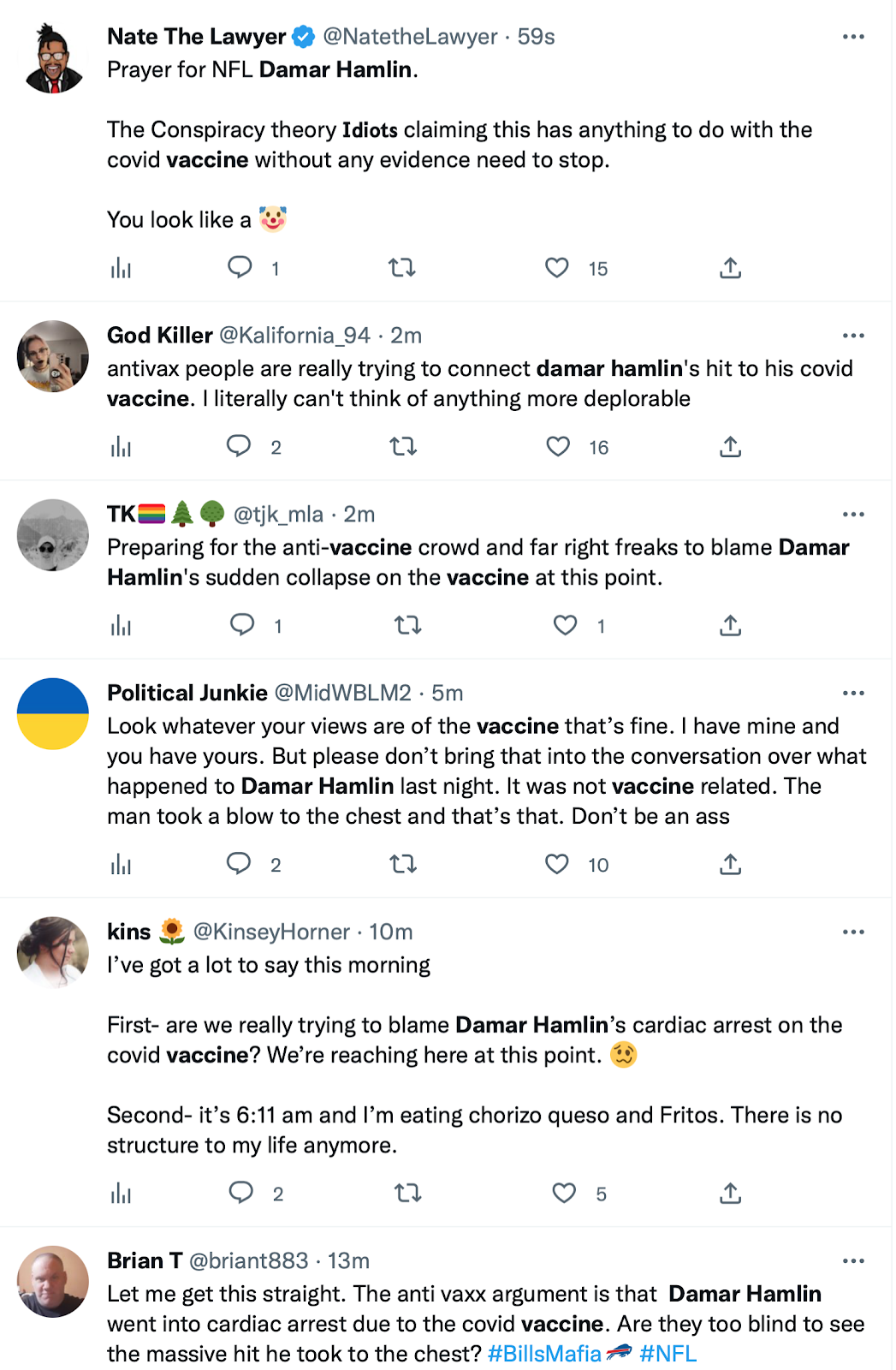
Damar Hamlin, hit in a football game, goes into cardiac arrest, some people are bringing up the Covid-19 vaccine, and we are told those people are deplorable.

This is my screenshot of the top of what comes up when I search Twitter for Damar Hamlin and vaccine:

३ सप्टेंबर, २०२२

"I waited until morning to listen to Biden's nighttime speech... I went out for my sunrise run and thought about what I'd heard. I'll tell you some more about that later."

I wrote that yesterday in a post I published at 9:58 a.m. — a post that combed through the text of the speech. It's now a day later and I haven't followed through, and I could just forget about. Would anyone remember? Is anyone thinking, yeah, what did she think about, while running and viewing the sunrise, about a speech she'd listened to but not yet read? It's highly unlikely, and "I'll tell you some more about that later" isn't even a promise.

We're having a big thunderstorm here at that moment:
 

I'm thinking of keeping my non-promise. I made notes to myself — audio notes — as I was watching the sunrise yesterday, and I've listened to the notes and can see there is something I wanted to say that I haven't said yet. Let me get something to eat and settle in and see if I can find a way to put it in writing without it seeming too... internal.
ADDED: This is a rewriting and an expansion of my audio notes to myself. 

२२ जून, २०२२

"Since my bypass surgery I’ve been haunted by the presence of a terrible knowledge that is just out of reach..."

"... my brain can’t access this pain but my nerves, bone, muscle, tissue keep the fact of it with them, I feel.... I had been... reading three newspapers a day, reading many magazines, and in general, trying to stay informed. But more or less overnight, staying informed ceased to matter to me. Though I subscribed to the New York Times in three cities I put it aside one day and didn’t read another issue for seven months. From being a living person with a distinct personality I began to feel more or less like an outline of that person—and then even the outline began to fade, erased by what had happened inside. I felt as if I was vanishing—or more accurately, had vanished.... The thing, more than any other, that convinced me I had in some sense died was that I couldn’t read. I went to my bookshops but could not connect with the books.... I had read every day of my life... It was the stablest of all pleasures, and now it was gone. The fact was that even then I could read professionally.... But read for pleasure, no. I had floated down the Nile and out to sea.... The problem, I eventually realized, was that reading is a form of looking outward, beyond the self, and that, for a long time, I couldn’t do—the protest from inside was too powerful. My inability to externalize seemed to be organ based, as if the organs to which violence had been done were protesting so much that I couldn’t attend to anything else."

१३ फेब्रुवारी, २०२२

Covid culture, year 3 — how Valentine's Day looks on the front page of the NYT.

I just wanted to share this woeful screenshot from at the NYT:

Let's see... how depressing is this? 

1. "For Valentine’s Day, Try Being Nice to Yourself/Sending love to others is easy. Being kind to yourself can be surprisingly difficult." This piece was originally published on Valentine's Day, 2019, so only the choice to resurrect it reflects the dreary spirit of 3-year-old Covid.

Use this short test developed by Dr. Neff to gain a snapshot of your own level of self-compassion. If you score low, commit to learning some self-compassion practices.... "You deserve your care and attention... Treat yourself to a delicious meal, a good book, a nice walk with a lovely view. As you would invest in the person you love, so you should invest in yourself."

2. "The Unbearable Heaviness of Clutter/A cluttered home can be a stressful home, researchers are learning." Another piece from 2019. Remember, pre-Covid, when clutter was the great plague? I can see from my Marie Kondo tag that I still blogged about her up through the end of 2020, so I guess staying at home in Year 1 overlapped with the exciting passion for de-cluttering. But it didn't carry over to Year 2, so is it ready for a comeback in Year 3? Instead of finding love out in the real world, we're supposed to keep staying home and putting ourselves — see #1, supra — and our homes in good order? Or maybe that relationship you think you want can be analogized to household clutter:

Dr. Saxbe agreed that a good way to declutter is to keep items out of the house in the first place. She urged shoppers to consider whether they truly need an item or if it will add to their home’s sense of dysfunction. “Once it’s in the house, it’s really hard to deal with. You get attached to the things you own,” she said.

Once it’s in the house, it’s really hard to deal with — see what I mean? 

3. Now, why is my eyelid twitching? This is an article from last December, and I can only think that the reason for re-elevating this issue on Valentine's Day weekend is to direct your attention away from that other body part that normally gets the attention — the heart. Why does my heart ache? No no no, why does your eyelid twitch?

३ डिसेंबर, २०१९

The Tuesday sunrise, photographed at 7:13.

32B733C8-7C51-41EF-B50F-DA0422338942_1_201_a

1. The actual sunrise time was 7:12. The truth is that the best time for a photograph was about 7:00, when there were some vaguely rounded pink rectangles. If I'd delayed the start of the run, I could have captured that unusual sight, but I had it for my personal, private viewing as I ran the first half of my out-and-back. The half run took about 12 minutes, and that's where I stopped and got out my iPhone, and that's the best picture of the morning.

2. At 7:00, I didn't know it wasn't going to get better, so it was hard to decide whether to stop or or to try to get out to the best vantage point sooner. It was cold, so maybe getting out there later would have been better, because once I got out there I ended up waiting, thinking the light would become more dramatic. Post-run, Meade said: "I told you you should take picture at the beginning." I said: "Why didn't you take a picture?" He said: "That's not my thing." I said: "Who was it who was just saying 'That's not my thing'?" Meade, joking, said: "Zabriskie." Ah, yes! Zabriskie Point, site of some of my best sunrise photography (from back when I had no idea I'd be going out for all the sunrises):

fullsizeoutput_c5

3. It was Zelensky, the President of Ukraine. He said: "Look, I never talked to the president from the position of a quid pro quo. That’s not my thing." And I wondered aloud — as we drove back home — how it is that he used the colloquial expression "That's not my thing"? Meade said: "He speaks good English." Which naturally caused both of us to switch to our Bob Dylan voice: "He speaks good English as he invites you up into his room."

4. The Bob Dylan song is "Just Like Tom Thumb's Blues": "Sweet Melinda/The peasants call her the goddess of gloom/She speaks good English/And she invites you up into her room/And you’re so kind/And careful not to go to her too soon/And she takes your voice/And leaves you howling at the moon." There was some confusion over the line "careful not to go to her too soon." Maybe it was "careful not to come to her too soon." There was a long involved discussion about whether the line referred to the male orgasm, which got tangled up with the subject of Trump's imitation of Peter Strzok's orgasm. Even if the word were "come," I think the idea is about accepting the invitation and coming up into the goddess of gloom's room, but you never know about poetry. A woman's room could be her womb, her womb-room. Who knows where Sweet Melinda was inviting Bob Dylan and why it was kind for him to delay? But anyway, she got whatever counts as his voice that somehow didn't render him silent. He could howl. Howl at the moon. Moon, room, gloom, soon.

5. That conversation gets us all the way home. It's only a short drive. It's not as though we dragged out those musings. I had a big handful of mittens and gloves as I walked from the car back to the house. And then I thought I'd lost one of the gloves. (I wear iPhone-sensitive liner gloves — these, at Amazon — with fleece mittens over them when the weather is as cold as today (27°)). But I looked again through the handful of handwear and found it. When you're afraid you've lost something, it's usually best to check to make sure you've lost it before you go looking for it.

6. I wanted to express that principle of lost things in the style of Dorothy from "The Wizard of Oz." What is it? If you haven't something something something then you haven't really lost it at all? I try about 12 variations before I look up the text in the script:  "If I ever go looking for my heart's desire again, I won't look any further than my own backyard, because if it isn't there, I never really lost it to begin with." That's not really apt when it comes to losing a glove. If it's not here in the house, I never really lost it? Makes no sense. I just wanted to say, it might be right here with me, and it's most efficient to look here first, before going outside.

7. But why did Dorothy's line ever make sense? Suddenly, I see the sense of it. She's not talking about searches for all sorts of things. She's only talking about the search for her "heart's desire," and the desire is always in the heart. The desire is not the thing that is desired. The desire is the desire. If the desire is not there in your heart, then you don't have the desire in the first place. There is the desire to desire. As soon as you think you need to look for your "heart's desire," you have the desire to desire. It's there and you have not lost it.

8. "The Desire to Desire" is the title of a book I had on my office shelf for many, many years. Something feminist. What was it? Ah, here: "The Desire to Desire: The Woman's Film of the 1940s (Theories of Representation and Difference)." There was a time when I had the desire to desire to read "The Desire to Desire." That book has 2 reviews — useless, spammy reviews — "I'm very happy with this book. I was glad to purchase it. There is always wonder in the pages of it. Thank you seller!" and "Thank you for the great book, it was better than I thought it would be for my very first used book order online. Thank you so much."

9. There is always wonder in the pages of it...

२२ सप्टेंबर, २०१९

Who are these festive soldiers, pictured at Drudge to represent Iran's preparation for war?


The linked article is "Iran's president warns America to 'stay away' as it unveils long range missiles that could strike US bases" (Yahoo News), and that photo is there, with the caption, "Iranian Turkmen Basij militia members marching during the annual." The annual what, I don't know. But who are the Turkmen in Iran? I look it up. Wikipedia says:
Turkmen rulers, successively of the Black Sheep Turkomans and White Sheep Turkomans, ruled much of Persia and surrounding countries before Shah Ismail I defeated them to begin the Safavid dynasty in 1501. Tabriz was their usual capital. There remains a relatively small population identifying as Turkmen in modern Iran.
So it makes zero sense for Yahoo to use that photograph for the article, which has nothing about the Turkmen other than that caption. Jesus said "You will hear of wars and rumors of wars, but see to it that you are not alarmed." In fact, I was not alarmed. My reaction was to look up Tabriz in Google maps and take a look around. I caught this wonderful sight:

१६ सप्टेंबर, २०१७

२४ एप्रिल, २०१७

Let's read the full transcript of Trump's interview with AP White House Correspondent Julie Pace.

Talking Points Memo put the whole thing up here. I'm cutting and pasting the whole thing before reading it, and as I read it, I'll be cutting it down to what I'm interested in blogging. That is, if you start reading as soon as I put this up, the whole thing will appear below. If you arrive at this post later, it will have been cut down to my taste, and you'll need to go to the link for the full text. I haven't read what anyone else has said about this interview, so my cut-down will show what jumped out at me.
AP: I do want to talk to you about the 100 days.

TRUMP: Good.

AP: I want to ask a few questions on some topics that are happening toward the end of the interview.

TRUMP: Did you see Aya (Hijazi, an Egyptian-American charity worker who had been detained in the country for nearly three years) …
Trump takes control of the interview, depriving Pace of control of the narrative arc. Don't let Pace pace it. 
AP: Can you tell me a little bit about how that came about?

TRUMP: No, just — you know, I asked the government to let her out. …

TRUMP: You know Obama worked on it for three years, got zippo, zero.
He's bragging, taunting Obama, using the benevolent, suffering woman — Hijazi — as the centerpiece for his dance of triumph. 

१४ ऑगस्ट, २०१६

"A pet owner was forced to rifle through 1,000 bags of rubbish when her 90-year-old tortoise hitched a lift in a bin lorry and ended up at the local tip."

So says the UK Telegraph — could you tell it was British? — but the lady did not singlehandedly search the rubbish from the bin lorry before it ended up in the local tip.
Using satellite tracking, the council tracked down the refuse lorry to a waste treatment facility.... After dressing in protective clothing, Mrs Joiner and staff used a thermal imaging camera to hunt for the lost tortoise amid 1,000 bags of rubbish. 
How much tax money was spent looking for a turtle that a lady let get into her garbage? But we're expected to feel heart-warmed. It's not even my tax money, but this irks me. The tortoise was 90 years old. I'd say it lived a long, good life. Let the government conserve its funds for spending that benefits young turtles.
He was eventually found amid a pile of lettuce leaves and plucked to safety.
They're always after the lettuce, these turtles. How about the lettuce that is money? Don't spend it on elderly turtles!

८ ऑगस्ट, २०१६

६ ऑगस्ट, २०१६

Suddenly, Hillary's using the hand-to-the-heart gesture.

What does it mean? Alessandra Stanley drills down:
Bill McGowan, a communications coach and chief executive of Clarity Media Group, calls the hand-on-heart motion “the gesture du jour.” He said he has noticed that other politicians have adopted the habit...
It's not just Hillary:
Chelsea Clinton used the gesture when she introduced her mother at the convention. Michelle Obama put her hand on her heart multiple times when she mentioned her daughters. Khizr Khan, the father of a Muslim United States soldier killed in combat, did the same when the crowd applauded his son’s sacrifice.
There's a theory that it started in Canada:
Prime Minister Justin Trudeau of Canada may have inspired the trend: He put his hand to his heart so humbly and so often before cheering audiences during his campaign last year, it became almost a trademark.
It worked for him, and he's dreamy, so why not the whole party of dreams — the Democrats?
There is no way to pinpoint how or when the motion gained currency. When Angelina Jolie received a humanitarian award at the Sarajevo Film Festival in 2011, she put her hand on her heart several times to show how moved she was by the honor...
I associate it with Al Gore, conceding the election in late 2000. He was at his best that day, and the hand on the heart was part of the overall poignancy of the acceptance of loss. I can't find video or still photos of this, but he'd delivered an excellent concession speech and, greeted by crowds as he walked to his car, he patted his hand over his heart.

At the time, as I remember, the gesture was a way to acknowledge affection, to say, "You've touched my heart," which seems to be what Justin Trudeau is described as doing.

In a less honest-seeming person, it may come across as more of a clumsy effort at saying: I do indeed have a heart. Like the way one might point at one's head as a way to comically say: See? I'm thinking! I have a brain!

Meanwhile, Hillary, confronted with her 4-Pinocchio's lie about what the FBI director said about her email problem, said: "So I may have short circuited." Like she's a robot.

२८ जून, २०१५

"Ah, the wisdom of ages! How arrogant it would be to think we knew more than the Aztecs..."

"... we who don’t even know how to cut a person’s heart out of his chest while’s he still alive, a maneuver they were experts at."

Said Judge Posner, in a piece titled "The chief justice’s dissent is heartless."


ADDED: Perhaps the heart should be ripped out. Maybe we like our judges heartless. But "heart" has been a big theme in judging judges.

At the John Roberts confirmation hearing, Senator Teddy Kennedy probed him about heart:
KENNEDY: [Y]ou were enormously complimentary about Earl Warren, about him understanding not only the law, but also understanding the importance of a chief justice, bringing other justices together in a very important way in terms of dealing with a societal issue and a question. And I think we're a fairer country and a fairer land because of this.This was really the bringing together of the mind and the heart. Oliver Wendell Holmes said, "It's dangerous to think about legal issues can be worked out like mathematics."

And another nominee who was here not too long ago [Stephen Breyer] had this to say about the head and the heart: "What you worry about is someone trying to decide an individual case without thinking out the effect of that decision on a lot of cases. That is why I always think law requires both a heart and a head. If you do not have a heart, it becomes a sterile set of rules removed from human problems and it will not help. if you do not have a head, there is the risk that in trying to decide a particular person's problem in a case, that may look fine for that person, but you cause trouble for a lot of other people, making their lives yet worse."
How did Roberts respond?
I recognize as a judge and I recognized as a lawyer that these cases have impact on real people and real lives.  I always insisted when I was a lawyer about getting out into the field and seeing. If I was arguing a case involving native villages in Alaska, I went to the villages. If I was arguing a case about an assembly line, I went to the assembly line. You had to see where the case was going to have its impact and what it's impression was going to be on people. Now, none of those cases were as important as Brown v. Board of Education but the basic principle is the same: I think judge's do have to appreciate that they're dealing with real people with real cases.I think judges do have to appreciate that they're dealing with real people with real cases. We, obviously, deal with documents and texts, the Constitution, the statutes, the legislative history, and that's where the legal decisions are made. But judges never lose sight or should never lose sight of the fact that their decisions affect real people with real lives, and I appreciate that.
Voting against Roberts, Senator Barack Obama said:
[W]hile adherence to legal precedent and rules of statutory or constitutional construction will dispose of 95 percent of the cases that come before a court, so that both a Scalia and a Ginsburg will arrive at the same place most of the time on those 95 percent of the cases — what matters on the Supreme Court is those 5 percent of cases that are truly difficult.... [I]n those difficult cases, the critical ingredient is supplied by what is in the judge's heart.
After Obama became President and got to choose his own Justice, his nominee, Sonia Sotomayor, disentangled herself from that heart business: 
The job of a judge is to apply the law. And so it's not the heart that compels conclusions in cases, it's the law.... What judges consider is what the law says.
Obama had chosen Sotomayor after doubling down on this idea of heart, saying:
We need somebody who's got the heart, the empathy, to recognize what it's like to be a young teenage mom. The empathy to understand what it's like to be poor, or African-American, or gay, or disabled, or old. And that's the criteria by which I'm going to be selecting my judges.
When he said that, I blogged:
[W]e know what this "heart" business means! It means that the President (or would-be President) understands that judging won't be neutral, that the human being doing the judging, no matter how dutiful and honest he tries to be, can only find his way to a decision in a complex case by responding to the pull of emotion. So "heart" matters. The question isn't whether "heart" counts. It's: which "heart" do you want?
And I remember way back in 2005, when President George W. Bush was struggling to convince us that Harriet Miers belonged on the Supreme Court. "I know her; I know her heart" he said, and I blogged:
I razzed the Democrats for all the "heart" talk at the Roberts confirmation hearings, and the word makes me suspicious. Bush knows hearts (and he can look into a man's eye and see his soul). One wonders if his father believed he knew David Souter's heart...
This reminds me. I once conceived of a superhero I called Framerman:
Framerman appears upon the legal scene whenever judges have difficulty interpreting the Constitution. His superpower is the possession in a single mind of the collective consciousness of all the framers and ratifiers. He stands ready to answer any question, however unforeseen at the time of ratification, precisely as the entire body of relevant decisionmakers at the time would have resolved it. No more guesswork! No more result-oriented historical mumbo-jumbo! Dramatic conflict heightens as Framerman gives answers that surprise and then outrage the judges. The judges could rise up in anger and murder our poor superhero in the end, but this seems out of judicial character. Instead, what happens is this: the judges begin to write opinions rejecting the controlling effect of original intent. Hearing this, Framerman — bearing a slight resemblance to Tinkerbell, who would die if people stopped believing in fairies — clutches at his heart and succumbs.
Well, so, even Framerman had a heart!

२६ जुलै, २०१४

Stop talking about my heart.

Does Buzzfeed have a rule about the frequency of appealing to our heart? I was curious, after writing the last post and highlighting a Buzzfeed post-with-plagiarism called "7 Miracle Babies To Warm Your Heart Today."

Searching the Buzzfeed site for "heartbreaking," I'm guessed there is a rule against more than one usage per day. How many times can reader be expected to jump at the promise of a metaphorical collapse of a most vital organ?

I happened to click on "28 Men With Eating Disorders Confess Their Heartbreaking Secrets" and was pleased to see the author's name was Althouse... Spencer Althouse. Anyway, there was really only one secret: These men were anorexic and male.

Is your heart broken because these males had the additional pain of a problem usually associated with females? Maybe men should feel some special pain when they stoop to using a metaphor associated with females. Eh, Mr. Althouse?

Searching Buzzfeed for "heartwarming," I can see more than one on a single day, e.g., "Get Ready To Wipe Your Tears After You Watch This Heartwarming Short Film." I refused to get ready. Or to watch the short film. Leave my heart alone. And leave my eyes alone.

Can we get a moratorium on heart metaphors? It's not just Buzzfeed. It's everywhere. In a single short article at the NYT this month, I'm seeing: "That scene where the black girls were all talking just like old times in the bunk was heartwarming... 'My Taystee girl, you break my heart'... It’s heartbreaking, but having finally realized that Vee can’t be her mommy, she also looks more sane...." That's not sane.