"... one with an especially unwieldy and Orwellian name: Defending Women from Gender Ideology Extremism and Restoring Biological Truth to the Federal Government. The order proclaims, with unwarranted confidence, that '"Female" means a person belonging, at conception, to the sex that produces the large reproductive cell. "Male" means a person belonging, at conception, to the sex that produces the small reproductive cell.'... At this year’s March for Life rally... Mike Johnson, the Speaker of the House... brought up Trump’s executive order early in his speech: 'I don’t know if you saw his executive order on gender, but it defines life as beginning at conception, rather than birth.' Johnson put invisible air quotes around 'gender,' but he came down hard on the word 'conception,' jabbing one finger in the air as he said it. The crowd cheered. Ideas have consequences."
Writes Margaret Talbot, in "Does a Fetus Have Constitutional Rights? After Dobbs, fetal personhood has become the anti-abortion movement’s new objective" (The New Yorker).
Trump and abortion లేబుల్తో ఉన్న పోస్ట్లను చూపుతోంది. అన్ని పోస్ట్లు చూపించు
Trump and abortion లేబుల్తో ఉన్న పోస్ట్లను చూపుతోంది. అన్ని పోస్ట్లు చూపించు
22 ఏప్రిల్, 2025


9 డిసెంబర్, 2024
Trump doesn't want to be "like Joe Biden," who makes promises and then breaks them.
Here are 2 examples from yesterday's "Meet the Press" — transcript here — of Trump answering a question and weaving in a criticism of Biden.
Was he just taking advantage of a perceived opportunity to take a shot at Biden, or does he have some genuine concern about not making any absolute promises that he might not want to keep (either because he respects the truth or because he wants to keep his options open and to deprive his opponents of the ability to attack him as liar (which they always do))?
EXAMPLE #1: Asked if he'd commit to refraining using executive action — without Congress — to restrict access to "medication abortions," Trump said:
EXAMPLE #1: Asked if he'd commit to refraining using executive action — without Congress — to restrict access to "medication abortions," Trump said:
Well, I commit. I mean, are -- things do -- things change. I think they change. I hate to go on shows like Joe Biden, “I’m not going to give my son a pardon. I will not under any circumstances give him a pardon.” I watched this and I always knew he was going to give him a pardon. And so, I don’t like putting myself in a position like that. So things do change. But I don’t think it’s going to change at all....
EXAMPLE #2: Asked if he's going to fire FBI director, Christopher Wray, he said:
Well, I can’t say I’m thrilled with him. He invaded my home. I’m suing the country over it. He invaded Mar-a-Lago. I’m very unhappy with the things he — he’s done, and crime is at an all time high. Migrants are pouring into the country that are from prisons and from mental institutions, as we’ve discussed. I can’t say I’m thrilled. I don’t want to say -- I don’t want to, again, I don’t want to be Joe Biden and give you an answer and then do the exact opposite... so I’m not going to do that. What I’m going to say is I certainly cannot be happy with him....
8 ఆగస్టు, 2024
"More than 20 States in our country have a Trump abortion ban, many with no exceptions even for rape and incest, and if he wins we all know he will sign a national abortion ban to outlaw abortion in every state."
Said Kamala Harris, at her Eau Claire rally yesterday, clipped below.
I was listening live, and this argument really struck me at the time. But, on reflection, I thought it was an inaccurate representation of what Trump has been saying. I think he's been saying that he wants to leave abortion regulation to the states and keep the federal government out of it.
But why should we trust him? Nevertheless, I do think it's wrong to say "we all know he will sign a national abortion ban." It's justified to scare us with the possibility, but "we all know he will sign a national abortion ban"? No, I don't know it.
22 మే, 2024
"This is a clarifying political vote that will put every Republican on record as to whether or not they believe in a constitutional right to contraception...."
"They can try to rationalize a vote, but that will not be how it is interpreted by women who want a right to contraception. If the bill doesn’t pass into law, it will be because Republicans oppose protecting American’s right to contraception."
Said Senator Edward J. Markey, Democrat of Massachusetts, quoted in "Schumer Plans Vote on Contraception Access, Teeing Up a Campaign Issue/Democrats are planning to spotlight Republicans’ opposition to legislation protecting birth control access nationwide, as part of an election-year push" (NYT).
Trump responded to a question about this bill: "We’re looking at that. Things really do have a lot to do with the states, and some states are going to have different policies than others." So: leave it to the states. The benefits of federalism. But that's a little hard to understand, and Democrats are pushing Republicans to speak in these mystifying terms that cause anxiety about what's really going on.
Trump responded to a question about this bill: "We’re looking at that. Things really do have a lot to do with the states, and some states are going to have different policies than others." So: leave it to the states. The benefits of federalism. But that's a little hard to understand, and Democrats are pushing Republicans to speak in these mystifying terms that cause anxiety about what's really going on.
After Trump got a chance to see the reaction in the media, he stepped away from the federalism talk and said that he would "never advocate imposing restrictions on birth control" or a "ban on birth control."
9 ఏప్రిల్, 2024
"Throughout Monday afternoon, Trump raged at Graham in post after post on the social media platform after Graham said he 'respectfully' disagreed with Trump’s conclusions about abortion policy."
"Graham, in posts shared on X, argued that the court’s ruling on Roe 'does not require that conclusion legally.' 'The states’ rights only rationale today runs contrary to an American consensus that would limit late-term abortions and will age about as well as the Dred Scott decision,' Graham said. 'The science is clear — a child at fifteen weeks is well-developed and is capable of feeling pain.' Graham has been a staunch proponent of federal limits on abortions. Most recently, he has pushed for a ban after 15 weeks of pregnancy.... 'The Democrats are thrilled with Lindsey, because they want this issue to simmer for as long a period of time as possible,' Trump said. In another post, Trump argued that by allowing states to make their own abortion laws, 'we have taken the Abortion Issue largely out of play.' 'We cannot let our Country suffer any further damage by losing Elections on an issue that should always have been decided by the States, and now will be,' Trump said...."
From "Trump rages against [Lindsey] Graham on abortion in rare break between allies/The posts from the former president came after the senator said he ‘respectfully’ disagreed with Trump’s stance on abortion Monday" (WaPo).
From "Trump rages against [Lindsey] Graham on abortion in rare break between allies/The posts from the former president came after the senator said he ‘respectfully’ disagreed with Trump’s stance on abortion Monday" (WaPo).
Graham's support for a federal statute limiting abortion undercuts an argument that abortion opponents will want to make if Congress ever creates a right to abortion in the form of a federal statute. But if protecting the life of the unborn is your highest priority, that's where you go as a matter of principle. The idea of leaving it to the states seems like a pragmatic compromise.
16 ఫిబ్రవరి, 2024
"One thing Mr. Trump likes about a 16-week federal ban on abortions is that it’s a round number. 'Know what I like about 16?'..."
"... Mr. Trump told one of these people, who was given anonymity to describe a private conversation. 'It’s even. It’s four months.' When discussing prospective vice-presidential candidates, Mr. Trump often asks whether they are 'OK on abortion.' He is instantly dismissive when he hears that a Republican doesn’t support 'the three exceptions.'"
From "Trump Privately Expresses Support for a 16-Week Abortion Ban/In supporting a 16-week ban with exceptions, Donald Trump appears to be trying to satisfy social conservatives who want to further restrict abortion access and voters who want more modest limits" (NYT)(free access link).
From "Trump Privately Expresses Support for a 16-Week Abortion Ban/In supporting a 16-week ban with exceptions, Donald Trump appears to be trying to satisfy social conservatives who want to further restrict abortion access and voters who want more modest limits" (NYT)(free access link).
The 3 exceptions are when the pregnancy resulted from rape or incest and when it is necessary to save the life of the mother.
"In a Fox News town-hall event in January, a week before the Iowa caucuses, a socially conservative voter asked Mr. Trump to 'reassure me' that he would protect 'every person’s right to life, without compromise.' Mr. Trump declined to reassure her. 'I love where you are coming from,' he told the voter. 'But we still have to win elections. And they have used this — you know, we have some great Republicans and they are great on the issue, and you would love them on the issue. And a lot of them have just been decimated in the election.'"
19 జనవరి, 2019
"But on Friday, Trump and Pence spoke again. And again, some said they were unhappy to associate the antiabortion movement with a president they dislike."
I'm reading the Washington Post article about yesterday's March for Life, "Trump and Pence give surprise addresses at antiabortion March for Life."
How many people am I seeing in that video? I googled "how many people at March For Life 2019," looking for another news report. First, I clicked on USA Today:
CNN: "Crowds of people packed the National Mall on Friday for the March for Life, an annual march against abortion." Crowds!
Is the video I looked at fake news?
Anyway, here's the video and text of Trump's address (which, unlike Pence's, was presented on video at the event). Excerpt:
[L]last year, when Trump addressed the crowd, some complained that the polarizing president distanced those who aren’t fans of Trump from the antiabortion movement. In this shifting environment, the march leaders picked science as their theme this year — under the headline, “Unique from Day One: Pro-Life is Pro-Science.”How many marchers were there? The first sentence of the article gives the only clue: "President Trump and Vice President Pence surprised thousands of protesters demonstrating against abortion on the Mall in Washington...." Thousands? That surprised me because I searched for a news story on the 2019 March for Life after I happened across this aerial video of a mindbogglingly huge crowd.
March for Life president Jeanne Mancini and other leaders of the movement said before the march that they wanted to include a politically diverse audience of anyone who opposes abortion — which, according to polling, includes at least a quarter of Democratic voters, although antiabortion Democrats in Congress are a rapidly dwindling group. ...
“I think the most dangerous thing we ever did is make this a partisan issue. It’s a human rights issue,” said Destiny Herndon-De La Rosa, 35, president of a group called New Wave Feminists that brought about 50 marchers to the event....
How many people am I seeing in that video? I googled "how many people at March For Life 2019," looking for another news report. First, I clicked on USA Today:
Thousands of anti-abortion activists, including many young people bundled up against the cold weather gripping the nation's capital, gathered at a stage on the National Mall Friday for their annual march in the long-contentious debate over abortion.Thousands!
CNN: "Crowds of people packed the National Mall on Friday for the March for Life, an annual march against abortion." Crowds!
Is the video I looked at fake news?
Anyway, here's the video and text of Trump's address (which, unlike Pence's, was presented on video at the event). Excerpt:
This is a movement founded on love and grounded in the nobility and dignity of every human life. When we look into the eyes of a newborn child, we see the beauty and the human soul and the majesty of God’s creation. We know that every life has meaning and that every life is worth protecting, As president, I will always defend the first right in our Declaration of Independence -- the right to life.Did he mention the science theme — "Unique from Day One: Pro-Life is Pro-Science"? That's debatable. He said: "Every child is a sacred gift from God. As this year's March For Life theme says, each person is unique from Day One." He said "unique from Day One," which is the proposition some of the speakers discussed in scientific terms. But he doesn't say "science," and his stated support for the proposition is religious: "Every child is a sacred gift from God."
18 మే, 2018
"Clinics that provide abortions or refer patients to places that do would lose federal funding under a new Trump administration rule..."
The NYT reports.
The policy would be a return to one instituted in 1988 by President Ronald Reagan that required abortion services to have a “physical separation” and “separate personnel” from other family planning activities. That policy is often described as a domestic gag rule because it barred caregivers at facilities that received family planning funds from providing any information to patients about an abortion or where to receive one....
The policy could prompt legal challenges, as it did soon after the Reagan administration adopted it. Planned Parenthood and other groups filed lawsuits that blocked the rules, and while the Supreme Court decided in 1991 that they could move forward, they were never fully carried out. President Bill Clinton rescinded the policy in 1994.
5 ఏప్రిల్, 2018
Let's talk about The Atlantic firing Kevin D. Williamson — immediately after hiring him.
Here's Adele M. Stan at The American Prospect last week, "The Atlantic’s Gigantic Stumble/When a 'thought-leader' magazine hires the misogynist Kevin Williamson, that’s some kind of leading from behind":
Here's "By Firing Kevin Williamson,The Atlantic Shows It Can't Handle Real Ideological Diversity/Williamson's rhetoric is inflammatory, but his views on abortion are not beyond the pale" by Katherine Mangu-Ward (Reason). Excerpt:
The thing for which Williamson is most famous is his (since deleted) tweet advocating the execution by hanging of every woman who has an abortion. [Jessica] Valenti notes that this would encompass approximately 25 percent of U.S. women.So Williamson got the boot.
Williamson’s second-most famous comment is in his contemptuous depiction of a nine-year-old African American boy, which is basically a litany of racist stereotypes strung together, complete with a description of the boy making a gesture Williamson describes as “the universal gesture of primate territorial challenge.”...
Here's "By Firing Kevin Williamson,The Atlantic Shows It Can't Handle Real Ideological Diversity/Williamson's rhetoric is inflammatory, but his views on abortion are not beyond the pale" by Katherine Mangu-Ward (Reason). Excerpt:
But the thing that cost him the gig was a remark he made on a podcast well before his firing and in a tweet (since deleted):The Atlantic is obviously caving to pressure. They had to know when they hired Williamson that he maintains that abortion is murder, and the fact that he would treat it the way he'd treat any murder is just standard, mundane adherence to principle and resistance to pragmatism. There's nothing to be shocked about. Why hire him if that wasn't what you wanted?
And someone challenged me on my views on abortion, saying, "If you really thought it was a crime, you would support things like life in prison, no parole, for treating it as a homicide." And I do support that. In fact, as I wrote, what I had in mind was hanging.
16 నవంబర్, 2017
The disgust factor.
"According to some assessments, a pivotal factor in last week’s elections was a sense of disgust with the President—and one of the results was a sharp increase in the number of female candidates and winners," wrote David Remnick in that New Yorker piece I've already blogged about this morning.
I was struck by the idea that rising disgust had potential to lift the Democratic Party to new success, because a couple days ago we were talking about a test that uses susceptibility to feelings of disgust to determine how conservative or liberal you are. There, I noted reports of research that sees liberals as resistant to disgust. Psychology Today had a piece called "Are You Easily Disgusted? You May Be a Conservative," which said:
I'm trying to look at the big picture, the long-term effect, and I think there's some risk for the Democrats in going too far into sexual negativity. I think those of us who are disposed toward liberalism — and I say "us" because I came up 59% liberal on that disgust test — will tune out or come to view them as too fussy and nosy about sex.
ADDED: I'm talking about persuasion at the emotional level, so I naturally thought of Scott Adams's book "Win Bigly: Persuasion in a World Where Facts Don't Matter," which I've read in full. Adams talks about how persuasion is all about emotion, but he doesn't get into the role of disgust. The word only comes up once, quoting the famous Megyn Kelly debate question that began, “You’ve called women you don’t like ‘fat pigs,’ ‘dogs,’ ‘slobs,’ and ‘disgusting animals . . .’” Trump (as you must remember) broke in to say, “Only Rosie O’Donnell.”
It wasn't Kelly's effort at using disgust that got Adams going. It was Trump's interruption:
But why should Trump benefit from attaching himself to disgustingness? Elsewhere in the book, Adams says Carly Fiorina made a terrible mistake when she attempted to showcase her opposition to abortion by vividly describing a botched abortion:
But why, then, wasn't Trump doomed? Maybe Trump would have fared worse if Megyn Kelly had been able to ask her question uninterrupted, speaking generically about women and Trump's bad mouth. She sought to ruin him by making him disgusting to the disgust-susceptible conservatives, and he interposed the image of a lady comedian. It's funny. It's all in good fun.
I was struck by the idea that rising disgust had potential to lift the Democratic Party to new success, because a couple days ago we were talking about a test that uses susceptibility to feelings of disgust to determine how conservative or liberal you are. There, I noted reports of research that sees liberals as resistant to disgust. Psychology Today had a piece called "Are You Easily Disgusted? You May Be a Conservative," which said:
Evidence suggests that harm avoidance and the need for fairness underlie people's moral judgments in a number of cultures. While liberals rely primarily on these two values, conservatives also rely on desires for group loyalty, authoritative structure, and, most importantly here, purity. Following this logic, Kevin [Smith] and other researchers became interested in the potential for a relation between disgust and political orientations. They speculated that conservatives are more disgust sensitive than liberals as a result of their concern with purity-related norms and that this difference would manifest itself on issues that some may associate with sexual purity (e.g., homosexual sex and, therefore, gay rights).If we assume this research has got it right, Democrats might want to reconsider the use of the disgust factor. Maybe the effort to disgust liberals will fall flat, and they won't get excited and out to the polls to vote for Democrats. Meanwhile, the disgust talk might stimulate conservatives, and they'll be running out to vote, presumably for Republicans. Or do you think the disgust-oriented ones, the erstwhile Republicans, will go for Democrats because the Republicans — Donald Trump, Roy Moore, etc. — have been successfully portrayed as just so disgusting?
Sure enough, Kevin and his co-authors found that conservatives are more easily disgusted than liberals....
I'm trying to look at the big picture, the long-term effect, and I think there's some risk for the Democrats in going too far into sexual negativity. I think those of us who are disposed toward liberalism — and I say "us" because I came up 59% liberal on that disgust test — will tune out or come to view them as too fussy and nosy about sex.
ADDED: I'm talking about persuasion at the emotional level, so I naturally thought of Scott Adams's book "Win Bigly: Persuasion in a World Where Facts Don't Matter," which I've read in full. Adams talks about how persuasion is all about emotion, but he doesn't get into the role of disgust. The word only comes up once, quoting the famous Megyn Kelly debate question that began, “You’ve called women you don’t like ‘fat pigs,’ ‘dogs,’ ‘slobs,’ and ‘disgusting animals . . .’” Trump (as you must remember) broke in to say, “Only Rosie O’Donnell.”
It wasn't Kelly's effort at using disgust that got Adams going. It was Trump's interruption:
He created an emotion-triggering visual image (Rosie O’Donnell) that sucked all the attention from the question to the answer, and it wasn’t even a real answer... He also picked a personality who was sure to trigger the emotions of his base. Republicans generally don’t like Rosie O’Donnell because of her outspoken liberal views. Trump knew his Republican base has a strong negative reaction to O’Donnell, so he bonded with them on that point. This is the persuasion method known as pacing and leading. First you match your audience’s emotional condition to gain trust, and later you are in a position to lead them.Another way to look at that is Trump was able to stimulate conservatives — the disgust-susceptible human beings — by confronting them suddenly with a particular "disgusting" woman.
But why should Trump benefit from attaching himself to disgustingness? Elsewhere in the book, Adams says Carly Fiorina made a terrible mistake when she attempted to showcase her opposition to abortion by vividly describing a botched abortion:
Fiorina paired her brand with a dead baby. I knew voters wouldn’t want to think about Fiorina’s horrible story of a dead baby for one second longer than they needed to. I doubt anyone consciously interpreted the situation as I describe it. But humans don’t make political decisions for rational reasons.If that's correct, maybe it shouldn't have worked for Trump to "pair his brand" with a (purportedly) disgusting woman. You could say Trump was (essentially) offering to defend us from disgusting women, but Fiorina was offering to defend us from dead babies. Adams says "Fiorina lost support because she polluted her brand beyond redemption by associating it with the most horrible image one could ever imagine, on live television." He's really talking about disgust there: the emotional reaction to something that seems "horrible" and "polluted." There's an idea that particular, reasoned arguments don't matter. If what is disgusting gets all over the person, we'll feel aversion, at an instinctive emotional level. And that doomed Fiorina.
But why, then, wasn't Trump doomed? Maybe Trump would have fared worse if Megyn Kelly had been able to ask her question uninterrupted, speaking generically about women and Trump's bad mouth. She sought to ruin him by making him disgusting to the disgust-susceptible conservatives, and he interposed the image of a lady comedian. It's funny. It's all in good fun.
21 జనవరి, 2017
The Women's March in Madison.
At the state capitol today:
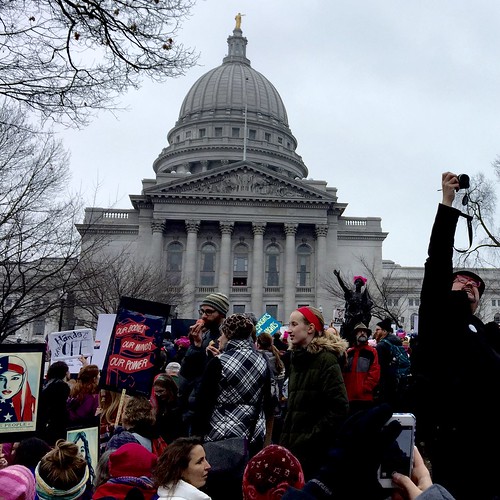
The photos are all by my son Chris, not me.
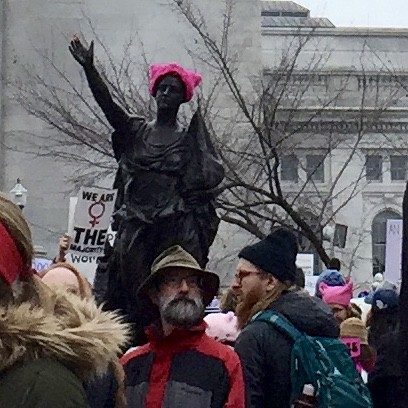
Let's close in on the "Forward" statue — often seen in my old pictures of the Wisconsin protests of 2011. Today, it had on a "pussy hat":
I was critiquing a Women's March poster earlier today — one that was way too complicated — and I said: "Keep it simple. Pick one idea and present it clearly." So I was pleased to see this image:
The Fallopian tube is giving the finger. And it's saying "Boy, Bye," which obviously means about the same thing as giving someone the finger — brusque rejection. If you know the Beyoncé song, "Sorry," it calls to mind the lyric:
I do see 2 problems:
1. One might read the "boy" as an unwanted child, waved "bye" through abortion. That's unfortunately mean and not helpful to the abortion rights cause. Abortion is better presented as the woman's choice about what do with her body, not any hatred toward the unborn.
2. The message Get government out of my uterus is a compelling libertarian message, but the Women's March may be seen as demanding more than the continued protection of reproductive freedom (which Trump does endanger, since he's said he wants a Supreme Court that will overturn Roe v. Wade). Here's a list of the Women's March "unity principles," and it is not a "boy, bye" to the government. It's demanding that the government get very involved in women's bodies:
The photos are all by my son Chris, not me.
Let's close in on the "Forward" statue — often seen in my old pictures of the Wisconsin protests of 2011. Today, it had on a "pussy hat":
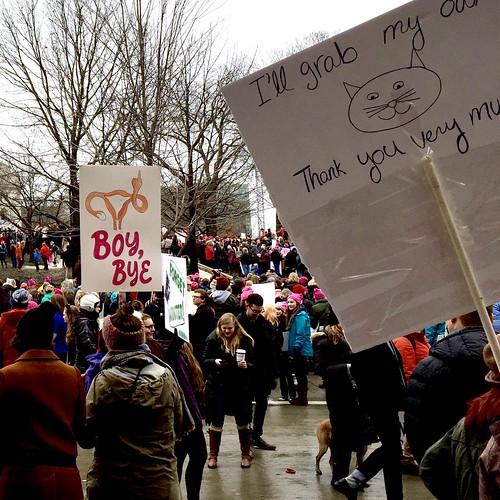
I was critiquing a Women's March poster earlier today — one that was way too complicated — and I said: "Keep it simple. Pick one idea and present it clearly." So I was pleased to see this image:
The Fallopian tube is giving the finger. And it's saying "Boy, Bye," which obviously means about the same thing as giving someone the finger — brusque rejection. If you know the Beyoncé song, "Sorry," it calls to mind the lyric:
Middle fingers up, put them hands highI'm reading the placard to mean: Get government out of my uterus. The "boy" is Trump and the sign is warning him away from any impingement on the female body. This is a good, straightforward message, and I agree with it.
Wave it in his face, tell him, boy, bye
Tell him, boy, bye, boy, bye, middle fingers up
I ain't thinking 'bout you
I do see 2 problems:
1. One might read the "boy" as an unwanted child, waved "bye" through abortion. That's unfortunately mean and not helpful to the abortion rights cause. Abortion is better presented as the woman's choice about what do with her body, not any hatred toward the unborn.
2. The message Get government out of my uterus is a compelling libertarian message, but the Women's March may be seen as demanding more than the continued protection of reproductive freedom (which Trump does endanger, since he's said he wants a Supreme Court that will overturn Roe v. Wade). Here's a list of the Women's March "unity principles," and it is not a "boy, bye" to the government. It's demanding that the government get very involved in women's bodies:
We do not accept any federal, state or local rollbacks, cuts or restrictions on our ability to access quality reproductive healthcare services, birth control, HIV/AIDS care and prevention, or medically accurate sexuality education. This means open access to safe, legal, affordable abortion and birth control for all people, regardless of income, location or education.It's more of a "hi" than a "bye" — more of a hi, get in here and never go away. If that's your message, that Fallopian tube ought to be waving furiously.
19 జనవరి, 2017
"We don't want your tiny hands/Anywhere near our underpants/We don't want your tiny hands/Anywhere near our underpants..."
A very minimal anti-Trump song by Fiona Apple gets an article of its own in The New York Times.
ADDED: I was glad to have a chance once again to use my underpants tag. I hadn't used it since March 1st of last year. Oddly enough, the post was about Trump. I was linking to something in the NYT, something tragically titled "Inside the Clinton Team’s Plan to Defeat Donald Trump":
Before that, there was a Jeb Bush interview in February 2015:
And all the posts about Anthony Weiner's underpants? And references to the underpants gnomes? There was the underpants bomber.
And there was the time The Gatsby Project — should I bring back The Gatsby Project? — got to a sentence with underpants:
ALSO: I do want to give Fiona Apple credit for inventing a new chant. "We don't want your tiny hands/Anywhere near our underpants" really is chantable. I'd like to see marches with new chants. I'm really tired of the continual repurposing of: 1. "What do we want?/X!/When do we want it?/Now!" and "Hey, hey, ho, ho/X has got to go." (The Wisconsin protests of 2011 were notable for their distinctive chants: "What's Disgusting?/Union busting" and "This is what democracy looks like.")
ADDED: I was glad to have a chance once again to use my underpants tag. I hadn't used it since March 1st of last year. Oddly enough, the post was about Trump. I was linking to something in the NYT, something tragically titled "Inside the Clinton Team’s Plan to Defeat Donald Trump":
“They’ll flip their top, and they’ll flip their panties...” read the subject line of a recent news release from Emily’s List, a group that works to elect Democratic women who support abortion rights. The quote came from comments Mr. Trump made about women on “The Howard Stern Show” in the 1990s, unearthed by BuzzFeed last month.The excited suburban and young women will need to content themselves with the women's march. Apple's tiny-hands-underpants song is intended to be chanted by the marching women.
Those types of comments, spoken by Mr. Trump over the years as he served as a tabloid regular and reality TV star, could help Mrs. Clinton excite suburban women and young women who have been ambivalent or antagonistic toward her candidacy....
Before that, there was a Jeb Bush interview in February 2015:
When Hannity said he had one more question, Jeb said "boxers." (Bill Clinton's answer to the famously inappropriate question, by the way, was "Usually briefs. I can't believe she did that." Obama's answer was: "I don't answer those humiliating questions. But whichever one it is, I look good in 'em.")And remember that sculpture of a man stumbling about in his underpants that disturbed the women of Wellesley College?
And all the posts about Anthony Weiner's underpants? And references to the underpants gnomes? There was the underpants bomber.
And there was the time The Gatsby Project — should I bring back The Gatsby Project? — got to a sentence with underpants:
The prolonged and tumultuous argument that ended by herding us into that room eludes me, though I have a sharp physical memory that, in the course of it, my underwear kept climbing like a damp snake around my legs and intermittent beads of sweat raced cool across my back.And "Hey, look! It's my giant underpants!"
ALSO: I do want to give Fiona Apple credit for inventing a new chant. "We don't want your tiny hands/Anywhere near our underpants" really is chantable. I'd like to see marches with new chants. I'm really tired of the continual repurposing of: 1. "What do we want?/X!/When do we want it?/Now!" and "Hey, hey, ho, ho/X has got to go." (The Wisconsin protests of 2011 were notable for their distinctive chants: "What's Disgusting?/Union busting" and "This is what democracy looks like.")
14 నవంబర్, 2016
How Donald Trump used and deflected questions about same-sex marriage and the abortion precedents.
Let's study the "60 Minutes" transcript. Lesley Stahl brought up the diverse set of individuals that she labeled "the LGBTQ group" — it's "One of the groups that’s expressing fear." Trump reminded her that he "mentioned them at the Republican National Convention," and: "Everybody said, 'That was so great.' I have been, you know, I’ve been a supporter."
So Stahl switched to an issue that is important to many of people, individuals both in and, like me, outside of the group: "Do you support marriage equality?" Trump said:
With abortion, the question was about whom he'd pick for the Court and whether that person was not just someone who personally opposes abortion but someone who "wants to overturn Roe v. Wade." That's a different question, and it was also a question he didn't answer:
So Stahl switched to an issue that is important to many of people, individuals both in and, like me, outside of the group: "Do you support marriage equality?" Trump said:
It’s irrelevant because it was already settled. It’s law. It was settled in the Supreme Court. I mean it’s done.Stahl tried to jump in with "So even if you appoint a judge that," and Trump just kept going, mentioning the Supreme Court, but only as an institution that has already done something. It's already decided:
It’s done. It-- you have-- these cases have gone to the Supreme Court. They’ve been settled. And, I’m fine with that.This is different — but not that different — from how he'd spoken a moment earlier about abortion and the Supreme Court. I say "not that different," because the question was framed differently for abortion:
Lesley Stahl: During the campaign, you said that you would appoint justices who were against abortion rights. Will you appoint-- are you looking to appoint a justice who wants to overturn Roe v. Wade?That's different from the demand for his opinion on same-sex marriage, "Do you support marriage equality?" Note that Trump did not answer the question asked. He only said it didn't matter, then pointed to the Court's past decision, which he said he was "fine with." I'd infer that he supports same-sex marriage or at least opposes upsetting the expectations that fell in place when the Court decided.
With abortion, the question was about whom he'd pick for the Court and whether that person was not just someone who personally opposes abortion but someone who "wants to overturn Roe v. Wade." That's a different question, and it was also a question he didn't answer:
Donald Trump: So look, here’s what’s going to happen-- I’m going to-- I’m pro-life. The judges will be pro-life. They’ll be very—Note that he first switched to his personal opinion — "I’m pro-life" — and then he addressed the nominees' — he pluralized it — opinion: They'll be very pro-life. Stahl then prodded him about whether they'd actually be for overturning the precedent (because one can be personally pro-life but still believe in keeping the precedent in place). Trump deflected the question again:
Well, there are a couple of things. They’ll be pro-life, they’ll be-- in terms of the whole gun situation, we know the Second Amendment and everybody’s talking about the Second Amendment and they’re trying to dice it up and change it, they’re going to be very pro-Second Amendment. But having to do with abortion if it ever were overturned, it would go back to the states. So it would go back to the states and--You might think he finally danced back to the question, but he did not. He only started explaining what would happen if Roe v. Wade were overturned, not whether he'd appoint a justice who "wants to overturn Roe v. Wade." This time, he succeeded in knocking Stahl off the question. We got this back-and-forth:
Lesley Stahl: Yeah, but then some women won’t be able to get an abortion?
Donald Trump: No, it’ll go back to the states.
Lesley Stahl: By state—no some --
Donald Trump: Yeah.
Donald Trump: Yeah, well, they’ll perhaps have to go, they’ll have to go to another state.
Lesley Stahl: And that’s OK?
Donald Trump: Well, we’ll see what happens. It’s got a long way to go, just so you understand. That has a long, long way to go.That's only about how people would deal with the loss of the constitutional right to have an abortion. Trump doesn't even concede that it would be "OK" to put women in the position of needing to travel farther to obtain an abortion. He gently puts the question away with the familiar colloquial phrase "we’ll see what happens." He pats the question to sleep with "long... long, long." I read that to mean what I already thought: He doesn't want Roe v. Wade to be overturned, and even as he wants pro-lifers to know he cares, he'd like pro-choicers not to worry too much.
22 అక్టోబర్, 2016
"Something very positive has come out of Trump's run for the Presidency. Women have come out of the shadows..."
".... refusing to feel shame about some of the terrible things that have happened to them, and they have shared their stories. Shared them [publicly] and in print. Some have spoken about sexual assault and how that has affected them going forward. Some have shared stories about their abortions. There is such power when we come together as a group. The plots of the stories may differ but many of the feelings are the same. What you did for precious Lev is motherhood in its highest form. You protected him. You protected him from trauma, pain and suffering. And then you turned this dreadful experience into something positive. The experience didn't harden you, it softened you. Bless you for openly sharing your story. I know you have touched many people. Thank you."
The top-rated comment on a NYT op-ed titled "Late-Term Abortion Was the Right Choice for Me."
By the way, I need to elaborate on something I was writing about yesterday in the post "Who — Trump or Hillary — was confused or dishonest about abortion at the last debate?" I was looking very closely at a something written by the obstetrician/gynecologist Jen Gunter, who had mostly attacked what Donald Trump said about abortion in the last debate, but who also said that Hillary Clinton was "confused." Gunter wrote:
That, I assume, is the reason why Hillary Clinton spoke of late-term abortion as a matter of the woman's health. In other words, it wasn't "an error." The person "with the laws" was not "confused." She was framing her position carefully to fit the law. Gunter is a person familiar with the medical practice. From her point of view, Hillary seemed "confused" because Hillary's position is out of line with the real-life facts as Gunter has experienced them. So it seems that Gunter stumbled into what can be understood as devastating to Hillary Clinton's position. I don't know how many people will notice this, however. I didn't notice it when I wrote the post yesterday.
Here's something else I noticed only after writing the post.
The top-rated comment on a NYT op-ed titled "Late-Term Abortion Was the Right Choice for Me."
By the way, I need to elaborate on something I was writing about yesterday in the post "Who — Trump or Hillary — was confused or dishonest about abortion at the last debate?" I was looking very closely at a something written by the obstetrician/gynecologist Jen Gunter, who had mostly attacked what Donald Trump said about abortion in the last debate, but who also said that Hillary Clinton was "confused." Gunter wrote:
Talking about abortion from a medical perspective is challenging when you are not a health care provider. Even someone familiar with the laws can get confused. For example, Mrs. Clinton made an error speaking about late-term abortion when she said it was a health of the mother issue. Typically it is not (it’s almost always fetal anomalies).... I don’t know where Mrs. Clinton got this “bad news at the end” of the pregnancy being about maternal health.... [N]o one is performing health of the mother abortions at 38 or 39 weeks we just do deliveries. It’s called obstetrics.Gunter proceeds to talk about "deliveries" that are designed to kill the unborn — a procedure she speaks of approvingly because "After 24 weeks birth defects that lead to abortion are very severe and typically considered incompatible with life." Now, 24 weeks is generally considered the point of viability, and under the case law, a woman has a right to choose to have an abortion for any reason prior to viability. But after viability, laws may protect the life of the unborn, but the woman has a right to get an abortion to protect her own life or health.
That, I assume, is the reason why Hillary Clinton spoke of late-term abortion as a matter of the woman's health. In other words, it wasn't "an error." The person "with the laws" was not "confused." She was framing her position carefully to fit the law. Gunter is a person familiar with the medical practice. From her point of view, Hillary seemed "confused" because Hillary's position is out of line with the real-life facts as Gunter has experienced them. So it seems that Gunter stumbled into what can be understood as devastating to Hillary Clinton's position. I don't know how many people will notice this, however. I didn't notice it when I wrote the post yesterday.
Here's something else I noticed only after writing the post.
21 అక్టోబర్, 2016
Who — Trump or Hillary — was confused or dishonest about abortion at the last debate?
I'm reading "Fact-Checking the Debate Fact-Checkers on Abortion" by Ramesh Ponnuru at The National Review.
Gunter says:
Back to Dr. Gunter:
Gunter proceeds to school us in birth defects, which, she says, are the reason for 80% of abortions that take place after 21 weeks. The defects, she says, "could range from Down syndrome to anomalies incompatible with life." Gunter shifts quickly to abortions that take place after 24 weeks, considered the point of viability, after which the woman no longer has a constitutional right to have an abortion for any reason. She writes:
Gunter tells us that some women "might think they can make it to term and then at 34 weeks cave and ask to be delivered because they just can’t bear one more person asking them about their baby":
But Trump's use of "ripping" wasn't technical. It was dramatic rhetoric expressing how horrible it is to deliberately kill a human being who is this far along in development. Dr. Gunter is interested in presenting medical practitioners as expert and ethical, but she's not very attuned to the way clinical terminology can sound heartless or deceptive. I'm not convinced by her effort to skewer Trump on his use of the word "rip." Her better argument has to do with how unlikely it is that any baby is killed on the last day of a full term pregnancy, but Ponnuru deals with that argument well: Trump is testing Clinton's principle. Nevertheless, Trump is making people think about the reality, not merely a hypothetical. He's distracting us if he's alarming us about things that aren't happening. I'd like to see the candidates concentrate on the matters that genuinely will occupy their attention if they get into office.
Clinton was also confused or dishonest, as Gunter explains. I suspect that she doesn't want to delve into the ethical questions surrounding the disabled, especially if we're talking about anomalies that begin with Down syndrome.
I suspect that Hillary Clinton feels most comfortable and most politically effective talking about the feelings of women and seeming to empathize with their struggles, referenced abstractly, before scrambling to the high ground of individual autonomy.
Many news outlets accused Trump of misrepresenting Clinton’s position by bringing up the possibility of killing “the baby on the ninth month on the final day.” This does not happen, said the fact-checkers. But go back and read the transcript: What Trump said (in two iterations) was that “if you go with what Hillary is saying in the ninth month you can take the baby and rip the baby out of the womb of the mother just prior to the birth of the baby.” That is the logic of her position on late-term abortion, which is that an abortionist should be free to perform an abortion at any stage of pregnancy if there is a health reason for it, including a reason of emotional health. Some journalists were touting this criticism of Trump’s comments and defense of Clinton’s position, which ends up saying that abortions at the very end of pregnancy never happen but should still be legal because of the principle of the thing. Trump grasps that logic and says he objects to it. “Now you can say that that’s okay and Hillary can say that that’s okay, but it’s not okay with me.” You can agree with Trump or you can agree with Clinton, but you can’t truthfully say that there’s no difference between their stated positions.The link at "this criticism" goes to a blog post by Dr. Jen Gunter, "Donald Trump confuses birth with abortion and no, there are no ninth month abortions." I'm reading that now. She quotes Trump's "I think it’s terrible if you go with what Hillary is saying in the ninth month you can take the baby and rip the baby out of the womb of the mother just prior to the birth of the baby." Her first objection is is: "we don’t rip anything in OB/GYN." They use sharp instruments and make neat cuts.
Perhaps we can forgive Donald Trump for not knowing this as it is hard to believe that a man who bragged that he doesn’t change diapers and said he wouldn’t have had a baby if his wife had wanted him to actually physically participate in its care would have attended the birth of his own children. It’s certainly not for the faint of heart as there is, after all, lots of blood coming out the “wherever.”That's amusingly written — if you're in the mood to be amused on this subject — but it's willfully ignoring Trump's motivation to use inflammatory rhetoric. He's not purporting to accurately describe a medical procedure but to dramatize the perspective of the baby who is getting killed. To be fair, it probably feels better to get killed with sharp instruments than to be ripped apart. And yet "partial-birth" abortion is illegal under federal law and the Supreme Court upheld that ban precisely because there is another method of late-term abortion, and that method — if I may believe Justice Kennedy's opinion in Gonzales v. Carhart — does involve ripping:
The doctor grips a fetal part with the forceps and pulls it back through the cervix and vagina, continuing to pull even after meeting resistance from the cervix. The friction causes the fetus to tear apart. For example, a leg might be ripped off the fetus as it is pulled through the cervix and out of the woman. The process of evacuating the fetus piece by piece continues until it has been completely removed....That grabbing and ripping is the the method that remained legal after the "partial-birth" abortion ban. (Gunter eventually describes this procedure: "The fetus is essentially taken apart with a D and E to fit through the dilated cervix." But, she says, this is not "ripping," but "simply surgical technique.")
Gunter says:
Trump’s statement, as incorrect as it may be, supports the fallacy of the due-date abortion.Supports the fallacy. In other words, he didn't say doctors were agreeing to perform abortions as late as the due date, but he caused people to picture this nonexistent event. His words, as Ponnuru observes, are about Hillary's philosophical principles: Hillary sees no role for the law to do anything in the hypothetical situation. Hillary, for her part, doesn't defend herself by saying we don't need laws about things that are not happening in the real world. She rests on the belief in the woman's autonomy. (As I would put it: The woman has sovereignty over the interior of her own body and the only legitimate law is her law.)
Back to Dr. Gunter:
Talking about abortion from a medical perspective is challenging when you are not a health care provider. Even someone familiar with the laws can get confused. For example, Mrs. Clinton made an error speaking about late-term abortion when she said it was a health of the mother issue. Typically it is not (it’s almost always fetal anomalies).... I don’t know where Mrs. Clinton got this “bad news at the end” of the pregnancy being about maternal health.... [N]o one is performing health of the mother abortions at 38 or 39 weeks we just do deliveries. It’s called obstetrics.Was Clinton confused? It might be a political choice not to talk about destroying a defective child.
Gunter proceeds to school us in birth defects, which, she says, are the reason for 80% of abortions that take place after 21 weeks. The defects, she says, "could range from Down syndrome to anomalies incompatible with life." Gunter shifts quickly to abortions that take place after 24 weeks, considered the point of viability, after which the woman no longer has a constitutional right to have an abortion for any reason. She writes:
After 24 weeks birth defects that lead to abortion are very severe and typically considered incompatible with life.Typically. What's hidden behind that word? Are we still destroying children with disabilities that do not mean that they'll die before birth or soon after? After 24 weeks, Gunter tells us, the doctor can either induce labor (after killing the fetus with an injection so that the "partial-birth" approach to removing the fetus won't violate the federal law) or use the ripping (it's not ripping!) method described above (which is called "dilation and extraction").
I’ve never heard of a dilation and extraction for any other reason than severe birth defects and often it is for a woman who has had two or three c-sections for whom inducing labor might pose other health hazards, like uterine rupture. Are we to force women to have c-sections for a pregnancy that is not compatible with life?A good question. I've had 2 c-sections myself, and the second one was recommended because, after the first one, there was a danger of uterine rupture. But what I don't understand here is why wouldn't waiting for a natural birth be the alternative to a c-section? It is natural birth, not abortion, that is parallel to a c-section, since it is intended to keep the baby alive. Gunter doesn't even seem to notice the ethical question why would we accept the deliberate destruction of the fetus at this point? Is it euthanasia (because the fetus is suffering)? Is it for the mental peace of the woman once she knows that this pregnancy is not going to result in a healthy baby? Does it matter whether the disability is fatal? Remember Gunter wrote of birth defects that are "typically considered incompatible with life." So some but not all of these babies would, if not actively killed, go on to die a natural death.
Gunter tells us that some women "might think they can make it to term and then at 34 weeks cave and ask to be delivered because they just can’t bear one more person asking them about their baby":
Do they just smile and walk away or say, “Well, actually, my baby has no brain and will die at birth?” Some women go to term and others can’t. To judge these women for requesting an early delivery is cruel on so many levels. I wrote more about it here if you are interested. Regardless, terminations for birth defects isn’t ripping “the baby out of the womb in the ninth month.” At 38 or 39 weeks it’s always an induction and is simply called a delivery.Notice the language glitch: It's "isn't ripping" because it's "called a delivery." Of course, the official terminology avoids the ugly word "ripping." But calling it "delivery" aligns with calling it "partial-birth," which is what horrified people more than the dilation and extraction method and produced the federal law that the Supreme Court upheld in Carhart. Gunter has talked about both methods, above, but she switched to speaking only of the delivery method (with isn't illegal when the body is already dead because of the injection). But Gunter has shifted to talking about abortions after 38 or 39 weeks and now she's telling us there is no longer a choice between the 2 methods. So in that sense, there is no "ripping."
But Trump's use of "ripping" wasn't technical. It was dramatic rhetoric expressing how horrible it is to deliberately kill a human being who is this far along in development. Dr. Gunter is interested in presenting medical practitioners as expert and ethical, but she's not very attuned to the way clinical terminology can sound heartless or deceptive. I'm not convinced by her effort to skewer Trump on his use of the word "rip." Her better argument has to do with how unlikely it is that any baby is killed on the last day of a full term pregnancy, but Ponnuru deals with that argument well: Trump is testing Clinton's principle. Nevertheless, Trump is making people think about the reality, not merely a hypothetical. He's distracting us if he's alarming us about things that aren't happening. I'd like to see the candidates concentrate on the matters that genuinely will occupy their attention if they get into office.
Clinton was also confused or dishonest, as Gunter explains. I suspect that she doesn't want to delve into the ethical questions surrounding the disabled, especially if we're talking about anomalies that begin with Down syndrome.
I suspect that Hillary Clinton feels most comfortable and most politically effective talking about the feelings of women and seeming to empathize with their struggles, referenced abstractly, before scrambling to the high ground of individual autonomy.
20 అక్టోబర్, 2016
Where do Hillary Clinton and Donald Trump want to see the Supreme Court "take the country"?
At last night's debate, the moderator, Chris Wallace, chose to make the first question about the Supreme Court. This perked me up. It's what I've concentrated my attention on for the past 35 years, and we've got an open seat and maybe 2 or even 4 seats that may open up in the next presidential term. What I remember from watching the debate last night is that both candidates were absolutely awful. Now that I've slept on it and have access to the transcript, I want to double-check my own opinion. So come along with me and judge for yourself.
Wallace observed that the topic of the Supreme Court had yet to be discussed at a debate in any depth, and he wanted to "drill down." Going to Clinton first, Wallace said:
Clinton goes first:
Wallace observed that the topic of the Supreme Court had yet to be discussed at a debate in any depth, and he wanted to "drill down." Going to Clinton first, Wallace said:
[W]here do you want to see the court take the country?The idea that the Court is in the lead taking us somewhere is all wrong, but no one is going to point that out.
And secondly, what’s your view on how the constitution should be interpreted? Do the founders' words mean what they say or is it a living document to be applied flexibly, according to changing circumstances?That's a simple way to prompt the candidates to talk about interpretive methodology, and it's an invitation to bungle, because candidates don't really want to get stuck at either end of those seemingly opposite positions. (I say "seemingly," because you can say that the founder's words meant that this is a living document to be applied flexibly, according to changing circumstances.)
Clinton goes first:
You know, I think when we talk about the Supreme Court, it really raises the central issue in this election. Namely, what kind of country are we going to be? What kind of opportunities will we provide for our citizens? What kind of rights will Americans have? And I feel strongly that the Supreme Court needs to stand on the side of the American people. Not on the side of the powerful corporations and the wealthy.I was already loudly arguing with her. The side? The Supreme Court isn't supposed to take sides. She's blatantly saying she wants a Court that doesn't act like a court but gets on one side. Her Court is a Court that ought to have to recuse itself constantly.
5 అక్టోబర్, 2016
When Tim Kaine and Mike Pence got religious.
"Great line from the — great line from the gospel of Matthew. From the fullness of the heart, the mouth speaks."
Tim Kaine interrupted Mike Pence to spout a Biblical quotation as Mike Pence was in the middle of responding to the invitation to "discuss in detail a time when you struggled to balance your personal faith and a public policy position."
Kaine's interrupting had been exasperating from the outset of last night's debate, but Pence annoyed me by resisting the question, praising his own religiosity, and then going on about his favorite religious issue, abortion.
Pence's answer had nothing about any balancing of personal faith with public policy. Kaine had something quite specific: As governor of Virginia, he did not rescue every condemned person from execution, even though his Catholic faith demands opposition to the death penalty. In fact, Pence used his turn to call attention to a second religious struggle of Kaine's:
I think the passage in Matthew is this, spoken by Jesus:
That's a hard proposition to apply to politicians, since so much of what they say is not what they mean. But sometimes the truth slips out. And yet the person who is saying That time you told the truth is probably a political player, accusing you of telling the truth because it serves his interest. If you credit your opponent with telling the truth only when it helps you in your quest for worldly power, will you "on the day of judgment... be justified... [or] condemned"?
If you really believe your religion, how can you dare to participate in politics? The risk is too great.
Tim Kaine interrupted Mike Pence to spout a Biblical quotation as Mike Pence was in the middle of responding to the invitation to "discuss in detail a time when you struggled to balance your personal faith and a public policy position."
Kaine's interrupting had been exasperating from the outset of last night's debate, but Pence annoyed me by resisting the question, praising his own religiosity, and then going on about his favorite religious issue, abortion.
Pence's answer had nothing about any balancing of personal faith with public policy. Kaine had something quite specific: As governor of Virginia, he did not rescue every condemned person from execution, even though his Catholic faith demands opposition to the death penalty. In fact, Pence used his turn to call attention to a second religious struggle of Kaine's:
I know Senator Kaine, you hold pro-life views personally — but the very idea that a child that is almost born into the world could still have their life taken from them is just anathema to me. And I cannot — I can’t conscience about — about a party that supports that. Or that — I know you’ve historically opposed taxpayer funding of abortion. But Hillary Clinton wants to — wants to repeal the longstanding provision in the law where we said we wouldn’t use taxpayer dollars to fund abortion.Kaine reacts, stressing that women should be "trust[ed]" to make their own decision about abortion and asserting that Donald Trump said "women should be punished, as Donald Trump said they should, for making the decision to have an abortion." (Here's my old post on exactly what Trump said and how he quickly corrected it.) Pence defended Trump and a dialogue ensued that ended with a Biblical quote:
PENCE: Donald Trump and I would never support legislation that punished women who made the heartbreaking choice to end a pregnancy.So Pence's idea was that Trump's wording some things badly is the downside of something we ought to like: He's not a career politician. Kaine's comeback is: When you're not wording things carefully, we get the advantage of seeing what you really think.
KAINE: Then why did Donald Trump say that?
PENCE: We just never would.
KAINE: Why did he say that?
PENCE: Well, look, it’s — look, he’s not a polished politician like you and Hillary Clinton. And so...
KAINE: Well, I would admit that’s not a polished...
(CROSSTALK)
PENCE: You know, things don’t always come out exactly the way he means them.
KAINE: Well, can I say...
PENCE: But I’m telling you what the policy of our administration would be.
KAINE: Great line from the — great line from the gospel of Matthew. From the fullness of the heart, the mouth speaks.
I think the passage in Matthew is this, spoken by Jesus:
“Either make the tree good, and its fruit good; or make the tree bad, and its fruit bad; for the tree is known by its fruit. You brood of vipers! how can you speak good, when you are evil? For out of the abundance of the heart the mouth speaks. The good man out of his good treasure brings forth good, and the evil man out of his evil treasure brings forth evil. I tell you, on the day of judgment men will render account for every careless word they utter; for by your words you will be justified, and by your words you will be condemned.”It's hard to find a translation that uses "fullness" for "abundance," but "fullness" doesn't make it much easier to understand. The New English Translation is nicely comprehensible: "For the mouth speaks from what fills the heart." If you say something, it's because that's what you mean.
That's a hard proposition to apply to politicians, since so much of what they say is not what they mean. But sometimes the truth slips out. And yet the person who is saying That time you told the truth is probably a political player, accusing you of telling the truth because it serves his interest. If you credit your opponent with telling the truth only when it helps you in your quest for worldly power, will you "on the day of judgment... be justified... [or] condemned"?
If you really believe your religion, how can you dare to participate in politics? The risk is too great.
27 జూన్, 2016
Why hasn't Trump said anything about the Supreme Court's new abortion case?
Hillary tweeted right away: "SCOTUS's decision is a victory for women in Texas and across America. Safe abortion should be a right—not just on paper, but in reality. -H" and "This fight isn't over: The next president has to protect women's health. Women won't be 'punished' for exercising their basic rights. -H" And Trump hasn't tweeted anything. Josh Voorhees (at Slate) says "The obvious answer is that Trump is either unwilling or unable to quickly sum up his thoughts on a topic that he has expressed so many conflicting views on in the past and that has caused him so many problems in the present...."
Another obvious answer is: Gender politics isn't his thing. He only talks about abortion when pushed or when attacked.
Another obvious answer is: Gender politics isn't his thing. He only talks about abortion when pushed or when attacked.
12 మే, 2016
When Trump met Ryan...
"The two men met at the Republican National Committee first thing on Thursday morning, with Reince Priebus, the committee’s chairman, as a chaperone."
And, just now, the 2 men issued this joint statement:
Mr. Ryan gave no public signal that he was poised to back Mr. Trump, and two people briefed on their private meeting said they did not discuss a possible endorsement. But... [a]t a news conference, Mr. Ryan said he had found the meeting encouraging and pleasant... [and that] he and Mr. Trump had discussed the constitutional separation of powers, Supreme Court justices and abortion, among other subjects.Sounds as though they stress constitutional law for some reason — perhaps because Trump has given off some signs that he doesn't much care about or understand the role of law in the United States.
Mr. Ryan said he had found Mr. Trump a “very warm and genuine person.” “Donald Trump and I have had our differences — we talked about those differences today,” Mr. Ryan said, adding, “I do believe that we are now planting the seeds to get ourselves unified.”
And, just now, the 2 men issued this joint statement:
The United States cannot afford another four years of the Obama White House, which is what Hillary Clinton represents. That is why it’s critical that Republicans unite around our shared principles, advance a conservative agenda, and do all we can to win this fall. With that focus, we had a great conversation this morning. While we were honest about our few differences, we recognize that there are also many important areas of common ground. We will be having additional discussions, but remain confident there’s a great opportunity to unify our party and win this fall, and we are totally committed to working together to achieve that goal. We are extremely proud of the fact that many millions of new voters have entered the primary system, far more than ever before in the Republican Party's history. This was our first meeting, but it was a very positive step toward unification.They are there already, no? This is just padding, for the sake of pride, maybe, or for the comfort of the neverTrumper crowd.
5 ఏప్రిల్, 2016
"In the wake of Donald Trump’s abortion gaffes, it should finally be clear that Trump is not a real conservative..."
"... he is the liberal caricature of a conservative."
Since Trump does not actually understand what pro-life conservatives truly believe, he mindlessly echoes the liberal caricature of pro-life conservatives. He mistakenly thinks this is what these conservatives want to hear. They don’t. This is, however, what liberals want to hear. They want a Republican candidate who feeds their false “war on women” narrative. They want to run against the caricature of the pro-life position, because the caricature is ugly. And Trump is giving them precisely what they want....
దీనికి సబ్స్క్రయిబ్ చేయి:
పోస్ట్లు (Atom)


 పోస్ట్లు


