Tom Stoppard लेबल असलेली पोस्ट दाखवित आहे. सर्व पोस्ट्‍स दर्शवा

२९ नोव्हेंबर, २०२५

"I write fiction because it’s a way of making statements I can disown, and I write plays because dialogue is the most respectable way of contradicting myself."

Said Tom Stoppard, quoted in "Sir Tom Stoppard obituary: playful and prolific playwright/A popular and exotic figure, Stoppard was known for his dandyish appearance as well as his wit and eloquence" (London Times).

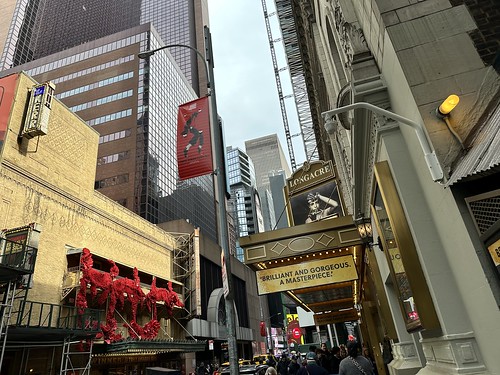
Goodbye to a great playwright. Stoppard was 88. We were blown away when we saw "Travesties" at the American Players Theater a few years ago.
[In] Travesties (1975)... Lenin, the Dadaist Tristan Tzara and James Joyce meet in Zurich during the First World War and become involved in a production of The Importance of Being Earnest.
APT also produced "The Importance of Being Earnest," so we took that in, then returned to see "Travesties" again. I think that may have been the best theatrical production I've seen in my entire life. 
 
I've also seen "Rosencrantz and Guildenstern Are Dead" (based on "Hamlet") and "Arcadia," both at APT. And I saw his last play "Leopoldstadt," in New York City. If you click on my "Tom Stoppard" tag you'll see what I think are some interesting details. 

१ मे, २०२३

"ChatGPT doesn’t just get things wrong at times, it can fabricate information. Names and dates. Medical explanations."

"The plots of books. Internet addresses. Even historical events that never happened. When ChatGPT was recently asked how James Joyce and Vladimir Lenin first met — there is no evidence they ever did — this is how it responded: 'James Joyce and Vladimir Lenin met in Zurich, Switzerland in 1916. Both men were living in exile in Zurich during World War I. Joyce was a writer and Lenin was a revolutionary. They met at the Cafe Odéon, a popular gathering place for artists and intellectuals in Zurich.' Fabrications like these are common...."

From the comments over there: "It's interesting that the chatbot brought Lenin and Joyce together in Zurich, just as Tom Stoppard's play 'Travesties' imagined them both in the Zurich library during World War I. I'm guessing chatbots scrape their information from available fiction as well as non-fiction? And what we get is Webster's literal definition of travesty: 'a debased, distorted, or grossly inferior imitation.'"

Ha ha ha. Great comment. And I love the play "Travesties." Here's what I wrote in 2014 when we saw the play (twice!):

२० फेब्रुवारी, २०२३

"You live as if without history, as if you throw no shadow behind you."

IMG_0267

Saw a play.

From the New Yorker review:
The first scene is a welter of references to Viennese thought and art—Freud, Mahler, Klimt—and the coming destruction of that golden culture is one of the tragedies of the play. Over whiskey, Hermann and his mathematician brother-in-law, Ludwig Jakobovicz... argue about Hermann’s blithe disregard of Austrian anti-Semitism. Hermann is joining the Jockey Club and—a mathematician, you say? Your inner Stoppard gong should ring at that; this is the playwright who taught us chaos theory and probability. When Ludwig later tries to demonstrate coördinate geometry using a cat’s cradle, we can see that one of Stoppard’s famous Knowledge Metaphors is twisting itself into view. And, indeed, like the knots on Ludwig’s cat’s-cradle string, family members change positions yet maintain their connection.
Not just connection but — in the cat's cradle configuration — distance.

७ सप्टेंबर, २०२२

"I don’t take things very hard. Death, for example. People die, and I sidestep the moment in some way. Or if you just say something embarrassingly dumb to someone..."

"... or you think you’re talking to one person but he’s actually somebody else. I’m vaguely aware that I have a capacity not to dwell on this. I can see that there’s another way to live where you’re lying awake about it. I just think, 'Move on and to hell with it.'"

He describes how he felt when his cousin, Sarka Gauglitz, got in touch with him when he was 56, and  she "told him how his four grandparents had perished at the hands of the Nazis and how his mother’s three sisters had died in Auschwitz and another camp": 
"I was totally poleaxed. I was in my 50s. I’d had this entire life. I couldn’t change it retroactively even in my mind. So it wasn’t like some kind of new start. I just carried on being the person I was.”

 He also has this to say about politics:

२७ मार्च, २०२२

"If my life had not been diverted when I was eight, I would very likely be living in Czechoslovakia where I had friends who were persecuted for what they spoke and wrote."

"As far as I could see, tolerance of dissenting opinion was the sine qua non of a free society; indeed it was the freedom on which the structures of freedom rested. Yet, it turns out, I couldn’t see as far as I thought I could. Back then, all the way to — it seems — the day before yesterday, I saw the battlefront as one between the individual and the state. It is still that, of course, all over the globe, but identity politics has thrown up a phenomenon, a battleground that is not political so much as psychosocial, an intolerance between individuals, and it’s about language. Words speak louder than actions. Sticks and stones will still break your bones, but the idea that words can’t hurt you has been repealed. People are being hurt by words, and consequently are picking up sticks and stones, not in the form of death threats (mostly) but (frequently) in the form of hounding the transgressor out of his or her livelihood.... [P]ersonally I always had faith in the ultimate commensurability of language and reality. When the German Democratic Republic put out that the Berlin Wall was to keep people out it made me laugh. Reality would take care of itself.... I don’t want to criminalise every fool who says the moon landing was faked and there were no gas ovens. Reality will take care of them too. But no one, not even Lewis Carroll, saw identity politics coming.... 'When I use a word, it means just what I choose it to mean — neither more nor less,' [Humpty Dumpty] tells Alice. And that includes pronouns. Will reality take care of it now?"

Says the great playwright Tom Stoppard (in The London Times). 

Stoppard was born in Czechoslovakia in 1937, and his family fled in 1939 (on the day before Hitler invaded). They fled to Singapore, then, because the Japanese were about to invade, to India. The father stayed behind and died in the war, and the mother remarried and Englishman who liked to quote Cecil Rhodes — "to be born an Englishman was to have drawn first prize in the lottery of life"— and to tell young Tom, "Don't you realize that I made you British?"

१६ फेब्रुवारी, २०२१

"He will obsessively listen to one song while working."

"He wrote one of his first plays to Leadbelly’s 'Ol’ Riley.' He listened to Bob Dylan’s 'Like a Rolling Stone' and 'Subterranean Homesick Blues' while writing 'Rosencrantz and Guildenstern,' and John Lennon’s 'Mother' while writing the play 'Jumpers.'... [Tom Stoppard thinks] that art arises from difficulty and talent. 'Skill without imagination,' one of his characters says, 'is craftsmanship and gives us many useful objects such as wickerwork picnic baskets. Imagination without skill gives us modern art.'... His idea of a good death, he’s said, would be to have a bookshelf fall on him, killing him instantly, while reading."


We've all had the experience of listening to one song obsessively over and over, but under what circumstance? Probably not while trying to get some serious mental work done! We're talking about songs — with words — over and over. Imagine writing a play while Bob sings "Subterranean Homesick Blues" over and over. So annoying! Maybe it helps to set up a big obstacle, to cram out 90% of what would otherwise crowd into your head. 

When have you played one song over and over and why? When I was a teenager, I'd play one song over and over because it was a new song — a missive from the outside world — that I felt I needed to completely internalize. For example, "All You Need Is Love." As an adult, it was an old song that expressed an emotion I was experiencing and benefited from having the company and support. You could say that was an externalizing of what I was feeling. For example, "Fool to Cry."

But I really never want to hear someone else's words when I am trying to write. 

As for the "idea of a good death," would you like a song to be playing? Unless you're in one of those death-bed positions where you can manage the audio, it's likely to be an inappropriate song, perhaps something ironic about how full of life you are, like "I Will Survive."

२० जानेवारी, २०२१

"The critic Kenneth Tynan divided playwrights into two categories, 'smooth' and 'hairy,' and one could probably make a similar distinction among biographers."

"Smooth biographers offer clean narrative lines, well-underscored themes, and carrots, in the form of cliffhangers, to lure the reader onward. Their books are on best-seller lists. They’re good gifts for Dad. William Feaver, the author of 'The Lives of Lucian Freud'... exists on the opposite extreme. There’s little smoothness in him at all. His biography is hairier than a bonobo.... Lucian and his furious id would have made an interesting case study for his grandfather. The artist was amoral: violent, selfish, vindictive, lecherous.... He had at least 14 offspring he acknowledged as his own. He called himself 'one of the great absentee fathers of the age.' Soon there are grandchildren as well. Freud did not do much hugging, but his progeny could tap him for money. Many got to know him by sitting for portraits. He painted his daughters naked. 'They make it all right for me to paint them,' he said. 'My naked daughters have nothing to be ashamed of.' Freud had a mean word for everyone.... If he didn’t like you, he cut you from his life like cancer. You can always tell a monster: He wears scarves indoors."


The biography is a 2-volume thing, and Volume 2 just came out. In posing this question about whether you could just start with Volume 2, Garner reveals a shocking ignorance of the power of Google: 
When "Clement" suddenly appears in Volume Two, with no surname attached, will every reader know this is Clement Freud, Lucian’s estranged brother? 
Who capable of reading a big hairy biography wouldn't just google the words Lucian Freud Clement? It gets you right to a Wikipedia article on Clement Freud.
The grandson of Sigmund Freud and brother of Lucian Freud, he moved to the United Kingdom from Germany as a child.... He worked at the Nuremberg Trials and in 1947...  He married June Flewett (the inspiration for Lucy Pevensie in C. S. Lewis's children's series The Chronicles of Narnia).... Freud was one of Britain's first "celebrity chefs"... He appeared in a series of dog food advertisements (at first Chunky Meat, later Chunky Minced Morsels) in which he co-starred with a bloodhound called Henry (played by a number of dogs) which shared his trademark "hangdog" expression. 

Too much information, if anything. Bark, and Google scoops it into your bowl. Chunky Meat, later Chunky Minced Morsels indeed! Not only will every reader know this is Clement Freud, Lucian’s estranged brother. Every reader will know that the dogfood Chunky Meat was rechristened Chunky Minced Morsels.

१ सप्टेंबर, २०१४

That was the biggest hunk of bait I've ever seen on this blog...

... the first comment, totally off topic and saying obscene things about the Christian religion. Admirably, you talked about what I'd invited you to talk about, Ted Cruz saying "Sadly, the state of the world is the Russian bear is encountering the Obama kitty cat."

Said troll arrived just as Meade and I were leaving to go to the theater, another drive out to Spring Green to the American Players Theater, this time to re-see "Travesties," that Tom Stoppard play that has Vladimir Lenin and James Joyce as characters and uses elements of Oscar Wilde's "The Importance of Being Earnest." We saw the Wilde play on Friday, dodging lightning. And that made the second viewing of "Travesties" more different from the first than most re-seeings. Re-seeings are always different though, in good ways. Anything I like enough to see a second time I prefer to see with the experience of having seen it before. The surprises are gone, and undistracted by predicting and looking for surprises, you notice everything that's been planted along the way to make the coming surprises surprising. It's at least different. Do you agree that it's better?

२२ ऑगस्ट, २०१४

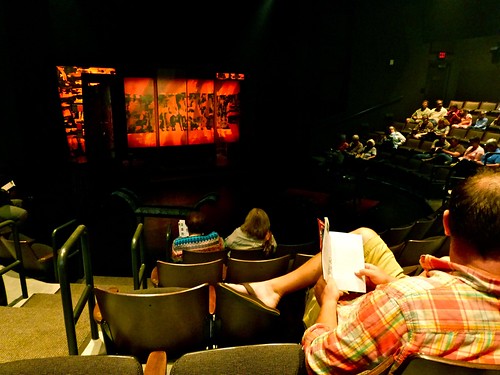
Before the performance...

Untitled

... of "Travesties" at the American Players Theater the other night. This play was so good — as a text and as a performance — that the next day I bought tickets to see it again. And I also bought tickets to see "The Importance of Being Earnest" a couple days before the second viewing of "Travesties." The 2 plays are related, and some of the actors play corresponding roles in the 2 plays. I'd seen "The Importance of Being Earnest" (in movie form) long ago, so I got the hang of the references, but not all the particularity. "Earnest" is playing in the outdoor theater at APT, "Travesties" indoors.

I was so taken with "Travesties" that I even bought the text. It's one of these plays about art, and I love art about art. What is art? I'm entranced by all sorts of blabbing on this subject, especially wrangling with the problem of art and politics — propaganda and all that — and "Travesties" has Vladimir Lenin as one of the characters. Lenin says things like:
Today, literature must become party literature. Down with non-partisan literature! Down with literary supermen! Literature must become a part of the common cause of the proletariat, a cog in the Social democratic mechanism. Publishing and distributing centres, bookshops and reading rooms, libraries and similar establishments must all be under party control. We want to establish and we shall establish a free press, free not simply from the police, but also from capital, from careerism, and what is more, free from bourgeois anarchist individualism!
Lenin actually wrote that. The playwright (Tom Stoppard) worked it into the script, which isn't all horrific blowharding like that, there's a lot of absurd banter and mistaken identity and various hijinks of a theatrical kind. Lenin is a minor character. James Joyce is more important, and the Dadaist Tristan Tzara.

Speaking of evil dictators — who never wear shorts and flip-flops, by the way — I got around to watching that 2004 movie "Downfall," you know, the raw material for all those Hitler parodies. It's heavy going, 156 minutes, mostly in the bunker. The familiar scene isn't the ending. It's quite close to the beginning.