Writes Jackie Delamatre, in "I Had Buyer’s Remorse. It Almost Ended My Marriage. When you can’t agree on the right city to live in, home can be more hell than haven" (NYT).
१३ फेब्रुवारी, २०२६
"During my second pregnancy, rats began clawing their way up our sewage pipes. For months, we found them in our toilet bowl."
Writes Jackie Delamatre, in "I Had Buyer’s Remorse. It Almost Ended My Marriage. When you can’t agree on the right city to live in, home can be more hell than haven" (NYT).
१० फेब्रुवारी, २०२६
"The urge to bring back old words is evergreen..."
I'm reading "Why Kids Are Starting to Sound Like Their Grandparents/The strange resurgence of words like 'yap' and 'skedaddle'" (NYT).
५ फेब्रुवारी, २०२६
"Jim and Rachel Van Eerden had a 'barn raising' for their cabin in Stokesdale, N.C., with friends building historically accurate furniture, a contractor working on the frame..."
From "They Went to the Woods Because They Wished to Live Deliberately/Paying homage to the long-dead Transcendentalist, some people are building full-scale replicas of Henry David Thoreau’s Walden cabin" (NYT)(gift link, so you can read more and see the pictures, and read the comments, predictably from folks who just have to recite the received idea, his mother did his laundry).
९ मार्च, २०२५
"Most men live lives of quiet desperation," said Joe Rogan.
ROGAN: I had a buddy of mine who was an actor and he got this part, I think it was in a movie. It was good, you know, good little, small part. He was real excited and his girlfriend started crying and she said, when is something gonna happen for me?... That was her response....
TRUSSELL: Jesus, dude. That's so dark.
ROGAN: I think about that guy sometimes. 'cause I was, I was on a, a show with him, one day, just bit part on a show. And I was like, this guy's gonna be a movie star.... But I remember him telling me, he's like, she started crying, man.... She was crying saying, when is it gonna happen to me? So [he says] I don't know what to do. And I was like Captain Fucking Jettison — I'm Captain Fucking Pull the Parachutes — that's me.... So I was like, dude, you gotta bail out.... You gotta bail now. This one, you can't fix that girl....
TRUSSELL: That's so fucked up.
ROGAN: But she's pretty hot....
TRUSSELL: Dude, I wouldn't have bailed.
ROGAN: She had the heavies... she had natural heavies.
TRUSSELL: Natural heavies. It's worth it!
२ डिसेंबर, २०२४
"While England endeavors to cure the potato-rot, will not any endeavor to cure the brain-rot, which prevails so much more widely and fatally?"
११ जून, २०२४
Why I read something this blurry.
I'd just watched "What a Way to Go" — the Criterion Channel is featuring Shirley MacLaine movies — and checking Rotten Tomatoes, I saw that Joan Didion wrote a review in the May 1964 issue of Vogue. I could subscribe to Vogue just to read that paragraph, but I found that by calming down and believing in myself, I could read it. It's not much different from reading without one's reading glasses. It's an apt and pithy review. "What a Way to Go" was a big movie in its day, so it deserves the bad reviews it got, but 60 years later, it's fun to look at the stars and the costumes and the sets. The Hollywood that produced it no longer exists. Nothing to get mad at now. Here's a sentence from the contemporaneous NYT review by Bosley Crowther:Inspired by a Gwen Davis story, which has not swum into my ken, so I cannot tell you how fairly or fouly it has been used, the team of musical-comedy writers is making kookie jokes about a girl whose sad fate it is to marry a succession of burgeoning millionaires.
The "girl" hates money, loves Henry David Thoreau, and only wants to live the simple life, but the movie seems to have been made on the theory that the way to make good art is by spending as much money as possible.
४ नोव्हेंबर, २०२३
"Western civilization is what gave the world pretty much every goddamn liberal precept that liberals are supposed to adore."
१० जुलै, २०२३
"On a continuum of good vs. evil, Zuckerberg is probably less evil than Elon. I don't like Zuckerberg, but Elon is a disgusting bottom dweller. I hope this is the nail in Twitter's coffin."
This is the top rated comment at the WaPo article "What we love and hate about Threads, Meta’s new Twitter clone/Threads may be the first Twitter alternative that really matters because it’s built on top of Instagram’s existing base of billions of users."
And it's a better answer to the question of what to "love and hate about Threads" than anything in the article, which suggests we ought to love Threads because it's easy to get on it via your Instagram account (which millions did without realizing that they can't delete their Threads account without deleting their Instagram account).
Anyway, for me, the key thing to like (or "love") would be good, readable writing (and part of readability is the absence of visual clutter). But Threads won't let me look at it as a web page, and I won't accept the app without seeing that it's something I want. It's what people used to call a pig in a poke. Or, in some countries, a cat in a bag. At least with Twitter, I can see the pig/cat.
And didn't Thoreau say, "Beware of enterprises requiring new apps"?
But let's think about that comment (in the post title). It states the "lesser of 2 evils" principle. I understand that in an election, but is this a lesser-of-2-evils situation? We don't need to choose one or the other. We can reject both.
Now, I'm reading the Wikipedia article "Lesser of two evils principle":
In Nicomachean Ethics, Aristotle writes: "For the lesser evil can be seen in comparison with the greater evil as a good, since this lesser evil is preferable to the greater one, and whatever preferable is good". The modern formulation was popularized by Thomas à Kempis' devotional book The Imitation of Christ written in early 15th century.In part IV of his Ethics, Spinoza states the following maxim:
Proposition 65: "According to the guidance of reason, of two things which are good, we shall follow the greater good, and of two evils, follow the less."
I'm sure these wise men all realized that there are circumstances where you can choose neither. For example, I abstained in the last election, and I endorse abstention as an option and argue with those who say you're doing something wrong if you refuse to vote.
I get diverted into the Wikipedia article "False dilemma." The best thing about that article is this cool poster from 1910:

२७ जून, २०२३
Tiny travel: going for a walk.
२७ डिसेंबर, २०२२
Was Louisa May Alcott a trans man?
Alcott, we're told, "used the names Lou, Lu or Louy." And:
३ डिसेंबर, २०२२
I've got exactly 2 TikToks to show you tonight.
1. "The Lord... maketh me to lie down in green pastures," it says in Psalm 23, but is it really a good idea to lie down in a pasture? I see a problem (or 2). But this lady lies down. She's got her idea. She wants to see what animal comes to her first.
2. Thoreau wrote: "If a man does not keep pace with his companions, perhaps it is because he hears a different drummer. Let him step to the music which he hears, however measured or far away." And here is that man, God bless him.
८ ऑगस्ट, २०२२
"Rather than working late on a Friday evening, organising the annual team-building trip to Slough or volunteering to supervise the boss’s teenager on work experience..."
From "Quiet quitting: why doing the bare minimum at work has gone global/The meaninglessness of modern work – and the pandemic – has led many to question their approach to their jobs" (The Guardian).
२४ जानेवारी, २०२२
"When the snow melts in the spring, fields can get so muddy in the plains of Eastern Europe that Russians have a word for it: Rasputitsa, or 'the season of bad roads.'..."
"If Russian President Vladimir Putin orders his forces to invade, analysts believe it would come before the spring thaw. 'The best time to do it is winter because it's going to be a mechanized advance and the mechanized divisions need hard frozen ground'... At a news conference Wednesday marking his first year in office, President Joe Biden warned Putin against an invasion, threatening a strong response by the US and NATO, but waffled over what would happen if Russia made a 'minor incursion,' in an awkward statement he sought to clarify afterward. 'The Russian dictator has not been subtle or secretive about what he wants. He might as well make the national anthem the Beatles' "Back in the U.S.S.R.,"' wrote Max Boot, in the Washington Post. 'He definitely wants to resurrect the Soviet empire, thereby undoing what he has called "the greatest geopolitical catastrophe" of the 20th century. And that requires bringing back into the fold the second-largest former Soviet republic (by population) — the independent state of Ukraine.'"
From "Putin confronts the mud of Ukraine" (CNN).
***
From a 2011 post of mine, collecting mud quotes:
"We sit in the mud... and reach for the stars." — Ivan Turgenev
"I have tried to lift France out of the mud. But she will return to her errors and vomitings. I cannot prevent the French from being French." — Charles de Gaulle
"Let us settle ourselves, and work and wedge our feet downward through the mud and slush of opinion, and prejudice, and tradition, and delusion, and appearance..." — Thoreau
"My own brain is to me the most unaccountable of machinery - always buzzing, humming, soaring roaring, diving, and then buried in mud. And why? What's this passion for?" — Virginia Woolf
Russian, French, American, British.
८ डिसेंबर, २०२१
"I think the Commission's summary of the case against court-packing (pp. 79-84) includes much stronger arguments than its overview of the case for it (pp. 74-79)."
I'm reading "Biden Supreme Court Commission Issues Final Report/The report doesn't endorse court-packing or term limits. But it's generally more to the latter than the former. It also provides valuable overview of a wide range of SCOTUS-related issues" — by Ilya Somin (at Reason).
२८ नोव्हेंबर, २०२१
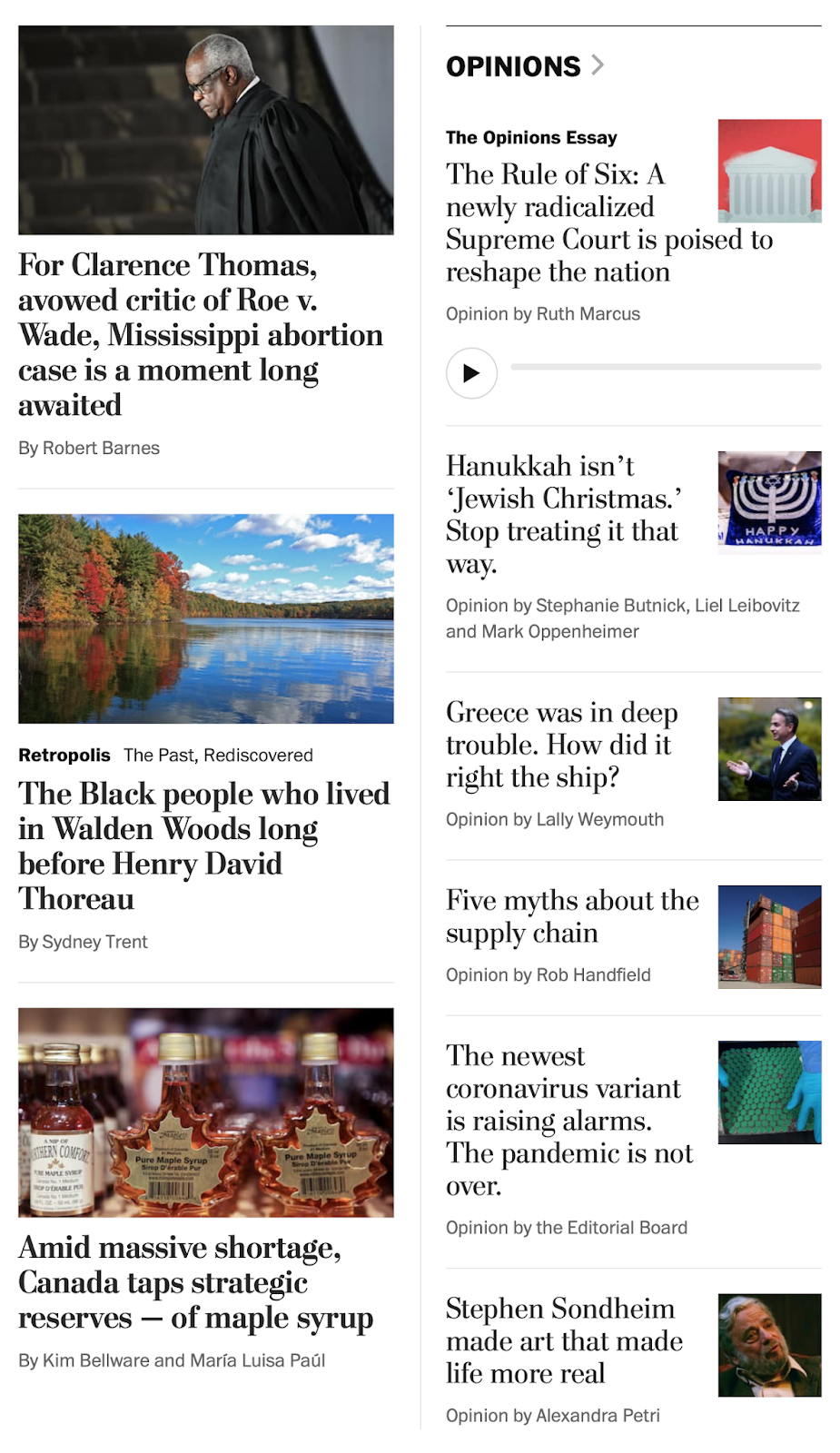
I'm pulled into the upper right hand corner of The Washington Post — so dangerous, so syrup-drenched.
It's an omakase breakfast — omakase, not omicron — the selections entrusted to the illustrious mainstream newspaper. I will update this post, course by course.
1. "For Clarence Thomas, avowed critic of Roe v. Wade, Mississippi abortion case a moment long awaited" by Robert Barnes. There's oral argument in the big abortion case this Wednesday, and, we're told, Thomas receives "unprecedented deference" these days — because of all his new colleagues, who "think like him," and because there's a new method of asking questions at oral argument, and not only does he speak now, he goes first, and no one cuts him off. They let him finish "his low-key inquiries." Thomas has repeatedly written separate opinions to say that Roe ought to be overruled. "Thomas’s idiosyncratic views and his resistance to compromise still make him the justice most likely to write a solo opinion," writes Barnes. But what's to prevent these new Justices, who may genuinely respect him, from curing that loneliness? Asking that question, I thought of the adage, "Any man more right than his neighbors constitutes a majority of one already." And then I realized I'm talking about the person named in the next headline down, Henry David Thoreau.
2. "The Black people who lived in Walden Woods long before Henry David Thoreau": "'Down the road, on the right hand, on Brister’s Hill lived Brister Freeman, ‘a handy Negro,’ slave of Squire Cummings once... With him dwelt Fenda, his hospitable wife, who told fortunes, yet pleasantly – large, round, and black, blacker than any of the children of night, such a dusky orb as never rose on Concord before or since,' Thoreau wrote in 'Walden.'"
3. "Amid massive shortage, Canada taps strategic reserves — of maple syrup": "Petroleum stockpiles aren’t the only strategic reserves being tapped this season amid concerns of supply shortages and sky-high prices." There's a Canadian federation that, we're told, gets called "the OPEC of maple syrup." The shortage seems to have mostly to do with people cooking more pancakes and such on account of the lockdown, but there's also stress to the maple trees from climate change, so make sure to keep worrying about climate change. It affects pancakes!
4. "The Rule of Six: A newly radicalized Supreme Court is poised to reshape the nation" by Ruth Marcus. The conservatives are no longer just looking for a 5th vote. With 6, it's like "an heir and spare." They can afford to lose one. No more need to cajole that last one, the fussed-over "swing" voter. And Marcus tells WaPo readers to be be afraid, be very afraid.
5. "Hanukkah isn’t ‘Jewish Christmas.’ Stop treating it that way. No need to include our holiday in the winter extravaganza of commercialization, thanks." Sample sentence, representing the tone and message of the entire piece: "No Jew has ever gazed longingly at a 12-foot inflatable reindeer and wished in her heart she had an equally large Moses to display in front of her house."
6. "Greece was in deep trouble. How did it right the ship? Prime Minister Kyriakos Mitsotakis on the arrival of migrants — and tech companies." An interview with the prime minister. Highlights: "We should agree in principle that no country has a right to weaponize migrants. . . . We won’t let people come in as they please." About criminalizing “fake news”: "What we are doing is very measured and very valid."
7. "Five myths about the supply chain/No, self-driving trucks wouldn’t fix all our problems." "Much of today’s mess was caused by relying on extremely fragile — and extremely long — supply lines. Ohno would have shuddered at the thought that his ideas were being applied in this manner." Oh no! Taiichi Ohno originated the concept of just-in-time delivery.
8. "The newest coronavirus variant is raising alarms. The pandemic is not over." "It will take time to determine if the variant is more transmissible than delta, or more virulent, but it is a worrisome development." Won't there always be a new variant so that we will always be told we don't know enough yet and we will need, once again, to err on the side of safety? This feels like a treadmill that we can never step off.
9. "Stephen Sondheim made art that made life more real" by Alexandra Petri. A song "can’t be too clever, and it can’t be too dull. It has to land on your ear as a surprise. If it contains jokes, they have to rhyme. (If it contains rhymes, words that are spelled differently are funnier, Sondheim thought, than words that are spelled the same.)... The song has to take the character singing it somewhere. It has to be essential to the show. 'If you can take the song out,' Sondheim said, 'and it doesn’t leave a hole, then the song’s not necessary.'... Life also exists in time. You cannot stop it and start it and go back and hope to make yourself better understood. You must express yourself in the moments allotted and make yourself heard and choose what to say."
If I hadn't committed to reading every one of those 9 stories, the ones I would have read would be: 1, 2, and 9. And I would have blogged all 3.
Having read all the stories, I rank their bloggability, for me, beginning with: 1, 9, 2. Then, there's a big drop off. There's something I'd wanted to say that 8 gave me the chance to say, so I'll put 8 next. I'd put 3 dead last, because I don't really want to blog about the syrup supply, though it would shoot to the top if I had a "syrup" tag (and I might create a "syrup" tag, but it will take a while to add it retrospectively, and it's only interesting if it collects a lot of old things, which it will, more than 10). I put 4 next to last, because it's obvious to me what it will be from the headline and the author, and I don't need more of that. Third from last is 5, which is unnecessary holiday fluff, and I didn't like the insinuation that I was "treating" Hanukkah in any particular way. That leaves 6 in dead center. The Greek Prime Minister. I had to force myself to read that, but he was concise and hard core — quotable.
Oops, I forgot the supply chain. I know it's important, but it's not my thing. I put Greek Prime Minister at what I called "dead center" and in 5th place, so let's put 7 in 6th place.
Final ranking: 1, 9, 2, 8, 6, 7, 5, 4, 3.
ADDED: I have now made the tag "syrup." Click. It's pretty exciting.
१४ नोव्हेंबर, २०२१
"In the 1860s, New England was in the grip of a 'pear mania,' an enthusiasm for amateur horticulture which irked Henry David Thoreau, who felt pears were..."
(The illustration, from the NYRB article, is of a Belle Angevine pear from Fleury-sous-Meudon, Île-de-France, France, 1900.)
१२ ऑक्टोबर, २०२१
"These days, we understand Thoreau to have been a nonpracticing gay man, whose retreat to his weatherized cabana at Walden was... an anti-heteronormative broadside."
I'm trying to read "Thoreau in Love/The writer had a deep bond with his mentor, Ralph Waldo Emerson. But he also had a profound connection with Emerson’s wife" by James Marcus (The New Yorker).
I've taken an ongoing interest in Thoreau ever since I encountered him when I was a high school student in the 1960s, and I've noticed and blogged things about him throughout the 17 years of this blog, and I'm even also interested in the subject of historical figures who might have been gay. How did I miss the development of this understanding that Thoreau was "a nonpracticing gay man"?
If he's nonpracticing, and he didn't talk about it, whence the idea that he was gay? Doesn't that erase asexuality?
Anyway. Let's read:
२९ ऑगस्ट, २०२१
"I thought Robin hated me. He had a habit of making a ton of jokes on set. At 18, I found that incredibly irritating."
२० जून, २०२१
"We are in great haste to construct a magnetic telegraph from Maine to Texas; but Maine and Texas, it may be, have nothing important to communicate... "
Wrote Henry David Thoreau. I'm quoting that now, because of that post earlier today about a telegram and because it seems to relate to our current predicament living on the internet.
In case you're wondering about Princess Adelaide, she does look interesting:
ADDED: A reader questions whether I have the right Princess Adelaide. There's also this Princess Adelaide, a granddaughter of King George III. She was born in 1833, and was portrayed like this in 1846:
Age and photography rendered her less cute:
६ जून, २०२१
"The moon in China has a special meaning. And when it's full, that represents the fullness and reunification of the family. So that poem struck the deep core of my heart whenever I miss my family."
Moonlight in front of my bed
I took it for frost on the ground
I lift my head, gaze at the mountain moon
Lower it, and think of home.
I'm reading that this morning because a reader, K, saw my post about "tangping" and emailed:
Tang was the greatest age of Chinese poetry and the greatest Tang poetry included attacks on the court, and on corruption and in praise of "drunkenness" or withdrawal from the struggle to get ahead at the court. Perhaps for the Chinese "tang-ling" [sic] has some sort of resonance suggesting these great Tang poets. Asking, was the Tang era the greatest Chinese era or is Xi's China the greatest. Subtle, maybe, but the Chinese have been civilized for a long time. I wonder. Perhaps we should love bomb Beijing with millions of copies of On Walden Pond and A Week on the Concord and Merrimack Rivers to counter the Confucian Institutes here.
I don't know what classic literature you're reading right now. Me, I've been reading G.K. Chesterton's "Orthodoxy." That line about the moon — "The moon in China has a special meaning" — caught my eye, because I'd just read this, from Chesterton: