There's a lot of fascinating material in
this NYT Magazine article by Nathaniel Rich, but I'm just going to pick out a few things that might motivate you to read the whole thing rather than to think: New York Times Environmentalism.
1.
It's not about global warming or carbon emissions. Louisiana is losing land at a bizarrely fast rate, but it's because of a reversal of the process that built the land up in the first place: "As the Mississippi shifted its course over the millenniums, spraying like a loose garden hose, it deposited sand and silt in a wide arc. This sediment first settled into marsh and later thickened into solid land. But what took 7,000 years to create has been nearly destroyed in the last 85. Dams built on the tributaries of the Mississippi, as far north as Montana, have reduced the sediment load by half. Levees penned the river in place, preventing the floods that are necessary to disperse sediment across the delta. The dredging of two major shipping routes, the Mississippi River Gulf Outlet and the Gulf Intracoastal Waterway, invited saltwater into the wetlands’ atrophied heart." None of that is attributable to the gas and oil industry, but they did dig a lot of wells, canals, and pipelines that seem to have accelerated the inflow of the saltwater.
2. The title of the article reveals its hook:
A supposedly heroic underdog, in this case a political journalist named John Barry, who spent a long time writing a book called "The Ambition and the Power" and was in the middle of writing another book — "Roger Williams and the Creation of the American Soul" — when he got distracted by Hurricane Katrina and concluded that "people died because of cynical decisions made by shortsighted politicians drawing on bad science." Back in those days, Bobby Jindal was a member of Congress, and Barry met with him and "left in total disgust." Is Barry contemplative and public-spirited, or is Barry a politico who hates Bobby Jindal? The fact that the second option even occurs to me while reading this article — framed on Barry's heroics — suggests that's the correct one.
3. Stray football hate: "When discussing his public battles, he often summons football metaphors. 'Writing is pretty isolated,' he said. 'I enjoy the action. I like to fight.'"
Where's the football metaphor? Action?
Fighting?
4. Stray intellectualism: "For Barry, the battle for New Orleans’s survival would be fought along the Santayana-Hegel axis." Santayana is George Santayana, best known for the aphorism
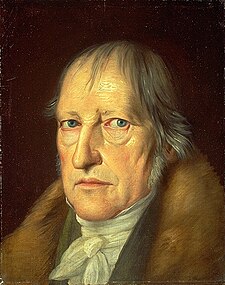
"Those who cannot remember the past are condemned to repeat it." Hegel, unlike Santayana, apparently needs no first name (or, really, would require 3 more names if we weren't on a single-name basis with him)...

... Hegel —
doesn't he look like he's wearing glasses when he's not? — said a lot of things. Whatever Hegel's most famous quote is, he also said — and this is the source for the concept of
a Santayana-Hegel axis —
"The only thing we learn from history is that we learn nothing from history."
5. Flare up of bad science in an article impugning the bad science of others: "The sea is rising along the southeast coast of Louisiana faster than it is anywhere else in the world." (Thanks to The Drill SGT, in the comments, for pointing to that.) Connected waters — such as the Gulf of Mexico and all of the oceans of the world —
rise in one big, flat unit. "The sea" may be
encroaching on the land in Louisiana faster than anywhere else in the world, but that's mainly because
the land isn't getting continually regenerated with mud from upstream. I read that sentence as an effort to slip in
some global warming alarmism, which, as noted in #1, supra, is not what this story is about.
6. Louisiana has a Coastal Master Plan, which is supposed to cost $50 billion, with $20 billion of that coming from the BP oil spill settlement. Barry's lawsuit is based on a calculation about who should pay the remaining $30 billion: "Because the industry conceded responsibility for 36 percent of land loss, it should pay its part: $18 billion would be a start." That's a calculation of the damages. A successful lawsuit requires a basis for liability. The liability argument is premised on 100 years of violating permits. But whether that's enough to win or not, the article reveals that the lawyers "hoped, perhaps
quixotically, that after filing their lawsuit, other parishes and levee boards across the state would join the effort, with the goal of achieving a larger settlement with the entire industry." Is filing a frighteningly huge and complex lawsuit with the aim of forcing your opponent to settle anything like anything that happened in "Don Quixote"?
7.
Not getting the Rotary Club. Barry, on the advice of a lobbyist, gave presentations at Rotary Club meetings. The NYT writer ascribes this thought to Barry: "If he could sway hostile crowds at Rotary Clubs, shouldn’t he be able to persuade enough legislators to kill a bill?" (The bill would deprive the regional levee board, the plaintiff in the lawsuit, of power to bring the suit.) My experience with the Rotary Club is limited
a single event here in Madison, but there's one thing that was
outstandingly clear:
These people are dedicated to principles of friendliness and goodwill. Barry encountered "hostile crowds at Rotary Clubs"? But he
swayed them? I find that hard to believe. I think it's more likely that he felt — or could tell himself and others — that he swayed people because he had reason to believe they didn't like his lawsuit, but they evinced the civility and good feeling to which the club dedicates itself.
8. The meat of the article has to do with the Louisiana legislature considering a series of bills aimed at depriving the plaintiff of standing to bring the lawsuit. The NYT writer outlines a story of oil and gas company lobbyists and legislators changing their minds over small favors like "funding for a new roof for a V.F.W. hall in his district." I see a lot of compression in this sentence: "Some of the bills were seen as overly broad, raising the fear that they might endanger the incipient BP settlement; others were voted down over constitutional concerns."
Were minds changed or was legislative text refined? In the end a bill passed, Governor Bobby Jindal signed it, and the last hope for the lawsuit is an argument to the federal judge that the bill is unconstitutional (or that it doesn't, on its text, deprive the levee board of standing in federal court). The judge is
Nannette Jolivette Brown, who was appointed by Barack Obama. Meanwhile, Bobby Jindal is working on repopulating the board, which is currently 5-4 in favor of continuing its lawsuit.
9. There's political pressure on Jindal to fund the Coastal Master Plan, and the end of the lawsuit could focus attention on that. Having promoted the lawsuit-ending legislation, he could see a glorious self-interest in balancing his environmental image by extracting that $18 billion from the oil and gas companies. His term ends in January 2016, a presidential election year.
Jindal's stalled at 3% in the polls. Impress us, Bobby!
10. Barry was a member of the levee board when the lawsuit was filed, and he'd been accused of joining the board for "ulterior motives." So he pledged not to write about the lawsuit. But now, as the last paragraph of the article tells us, he's considering breaking that pledge. So the hero of the NYT Magazine article will be the (pledge-breaking) hero of his own book? Last sentence of the article: "But John Barry, John Barry insists, would be just a minor character."
Damn, a paraphrase! I'm going to infer that our hero didn't get the words out quite so elegantly.




 পোস্টগুলি


