Rebecca Blank లేబుల్‌తో ఉన్న పోస్ట్‌లను చూపుతోంది. అన్ని పోస్ట్‌లు చూపించు

18 సెప్టెంబర్, 2021

"The University of Wisconsin Smears a Once-Treasured Alum."

A column by John McWhorter (NYT). 

The alum is Fredric March, an actor most people going to school today probably don't remember. Try streaming "The Best Years of Our Lives" (1946). He was important enough to the University of Wisconsin that they put his name on some theater buildings.

He's been attacked for an obvious reason: He belonged to the Ku Klux Klan! But it wasn't that Ku Klux Klan. It was back in 1919/1920 and there was an interfraternity group that called itself the Ku Klux Klan. To think that means something awful is to be historically ignorant, McWhorter explains:
The later 20th century Klan emerged gradually in the wake of the racist film “The Birth of a Nation” in 1915, and only became a national phenomenon starting in 1921. In Wisconsin in 1919, when March was inducted into his group, it was possible to have never heard of the Ku Klux Klan that was later so notorious.... 
Even Madison’s chancellor, Rebecca Blank, has written that March had “fought the persecution of Hollywood artists, many of them Jewish, in the 1950s by the House Un-American Activities Committee” and that March “took actions later in life to suggest (he) opposed discrimination.”...

So... it was 4 years after "The Birth of a Nation." And "it was possible to have never heard of the Ku Klux Klan"? But why was it called "the Ku Klux Klan"? McWhorter says there's "no evidence" that it's the same Ku Klux Klan. But the name is some evidence, and the lack of any other explanation of the name, and the fact that "The Birth of a Nation" had been out for 4 years are at least some evidence.

I agree with McWhorter that March shouldn't be tarred as a racist for something he did for a year as a young man and that might have been genuinely racist. But the question is whether his name should be used to name the campus theaters. We have a much more important theater-related alum — Lorraine Hansberry. I'd put her name on the theaters. Update the honoring.

Back to McWhorter:

This witch-burning mentality is something most of us less concur with than fear.... The students who got March’s name taken off those buildings made a mistake, as did the administrators who again caved to weakly justified demands, seemingly too scared of being called racists to take a deep breath and engage in reason. The University of Wisconsin must apologize to March and his survivors. His name should be restored to both of the theaters now denuded of his name, including the Madison building, which he in fact helped bring into being and funded the lighting equipment even before the building was named after him. This must happen in the name of what all involved in this mistake are committed to: social justice — which motivated March throughout his life.

ADDED: As someone who has taught the law school course called Evidence, I rankle at the phrase "no evidence." Evidence is anything that makes a fact of consequence either more likely to be true or less likely to be true. There is clearly some evidence that March affiliated himself with a racist group. It's fine to say there's not enough evidence to justify removing March's name from these buildings, especially when we also have evidence that March was an anti-racist. That's all you need to say. 

AND: This isn't a trial of March where his accusers must meet a burden of proof and the question is whether he ought to be convicted of racism. That ought to fail because he has a constitutional right to be a racist. We wouldn't even go to trial. But if it did, there wouldn't be enough evidence to convict him. But the important point here is that the question in issue is whether his name ought to be on campus buildings today. What should the burden of proof be and is it met? That's the way to analyze this controversy.

2 సెప్టెంబర్, 2020

"In collaboration with the Black Student Union at the school, University of Wisconsin-Madison leaders are discussing plans to remove a 70-ton boulder from campus grounds due to it once being called a racist name nearly a century ago."

"The boulder had traveled to the region over 10,000 years ago, deposited by ancient pre-Cambrian bedrock drift from Canada, according to its plaque. In 1925, workers pulled the rock out of the side of a hill on campus and named it 'Chamberlin Rock' after Thomas Chrowder Chamberlin, a 19th century glaciologist and University of Wisconsin president. The rock was adorned with a plaque commemorating Chamberlin and placed at the university’s Washburn Observatory, where it remains today. While Chamberlin Rock has been a campus fixture for 95 years, it recently came under fire due to once being described as a 'n****rhead' in 1925 as was common geological practice at the time to describe large dark rocks.... The Black Student Union at UW is now calling on the university to find an alternate way to represent Chamberlin on campus without the legacy implied by the rock. 'You clearly see what the rock was called and you can’t deny the history. Additionally you can’t deny the way it makes some people feel,' Black Student Union president Nalah McWhorter told Madison.com. 'If you’re not going to move the things that are disrespectful to us because other students love it, put something up that us Black and brown students can celebrate.'"

The College Fix reports.

What is the cost of moving a 70-ton boulder? What is the value of the beauty of the rock itself, which has nothing to do with racism? The only reason for attacking the rock is that there is no way to do anything to the use of a word 95 years ago. That's an incident in the past. Gone. But the rock is there. You're getting mad at a rock? No, you're asking for something to be done that can be done. A 70-ton rock can be moved, and so the demand is to move the rock. It's theater, and the university should have the sense to say no.

IN THE COMMENTS: Meade said:
We live a stone’s throw from the Chancellor’s mansion. Last Friday morning around 7AM, I heard chanting outside. Turns out it was coming from a group of 20-30 protesters at her front door chanting, “Wake up, Becky and move the rock! Wake up, Becky and move the rock!”

It is despicable of the protesters to harass Chancellor Rebecca Blank anywhere but especially at her personal residence.

28 జనవరి, 2017

Should the University of Wisconsin reconsider its policy of doing admissions without looking at the applicant's criminal record?

Yesterday, we learned that a UW-Madison student who'd been trying to start a "pro-white student club" had served prison time for racially motivated arson attacks on black churches. And:
"Chancellor Rebecca Blank said the university was not aware of student Daniel L. Dropik’s conviction when he was admitted to UW-Madison because the university is barred from asking about or considering an applicant’s criminal history."
So is it a bad policy? Blank asked the UW Regents to reconsider the policy, and the student government came out with a statement against her:
The statement from members of the Associated Students of Madison also repeated concerns UW administrators have not done enough to address racism on campus....
It's a crash in the racism intersection. The student that prompted the call for reconsideration was white, with a criminal record of anti-black racism, but the policy is designed to help minority applicants:

11 నవంబర్, 2016

In NYC — Protests include a Trump effigy hanging from a noose.


From "Liberals Gone Wild: Protests, flag burnings, Trump hung in effigy."

From Madison, Wisconsin, David Blaska cracks the joke everyone here in Madison should get: "Assuming the folks with the noose won't be admitted to Camp Randall. Right?"

You might remember — click my UW noose incident tag — that here in Madison, much was made of an incident at the football stadium (Camp Randall) on the night of Halloween festivities, when people saw of a photo of a man in a black-and-while prison suit with a noose around his neck and an Obama mask on the back of his head. On the front of his head was a Hillary mask and holding the other end of the rope was a guy in a Donald Trump mask.

This wasn't tolerated as free speech and political street theater, but condemned as racism, and everyone was supposed to know that a noose refers to the lynching of black people and that the guy in the noose was enacting hate and had to be punished.

Initially, the University referred to freedom of speech and purported to have dealt properly with the incident by simply talking to the man and persuading him to voluntarily remove the noose. But criticism ensued and the University repositioned itself. On Monday, 9 days after the incident, the UW–Madison Chancellor Rebecca Blank apologized:
“I am personally very sorry for the hurt that this incident and our response to it has caused,” Blank read from a prepared statement at a Monday afternoon Faculty Senate meeting. “I have heard from students, faculty and community members who are dissatisfied with our response and I understand why. A noose is the symbol of some of the worst forms of racial hatred and intimidation in our country’s history. We understand this, and we should have communicated that more forcefully from the very beginning...I understand the deeply hurtful impact this particularly has on our students and communities of color.”...

Blank told the Faculty Senate that she was limited in what she could say, but that the season tickets of “a pair of individuals related to this event” were revoked because the person using them brought a prohibited item into the stadium, and failed to follow directions of event staff....

"This is a work in progress, and we are a long way from where we want to be," Blank said. "But with your advice and input of governance, we have invested time, energy and effort into things like the Our Wisconsin program aimed at incoming freshmen, a bias reporting system, a review of our ethnic studies curriculum, and a black cultural center."
You can read my old posts at the tag. I'll just repeat that hanging in effigy is long-standing political theater — notably in the American Revolution — and when current political figures are hung in effigy the reference is more naturally to that tradition and not to the history of racism and lynching. There is at least ambiguity, and the punishment of these individuals through revocation of their season tickets is shameful pandering and a violation of freedom of speech.


Maybe the hanging of Trump in effigy will restore some interest in the depth of the meaning of the noose in American history and the importance of freedom of speech in the form of street theater and protest.

16 ఏప్రిల్, 2016

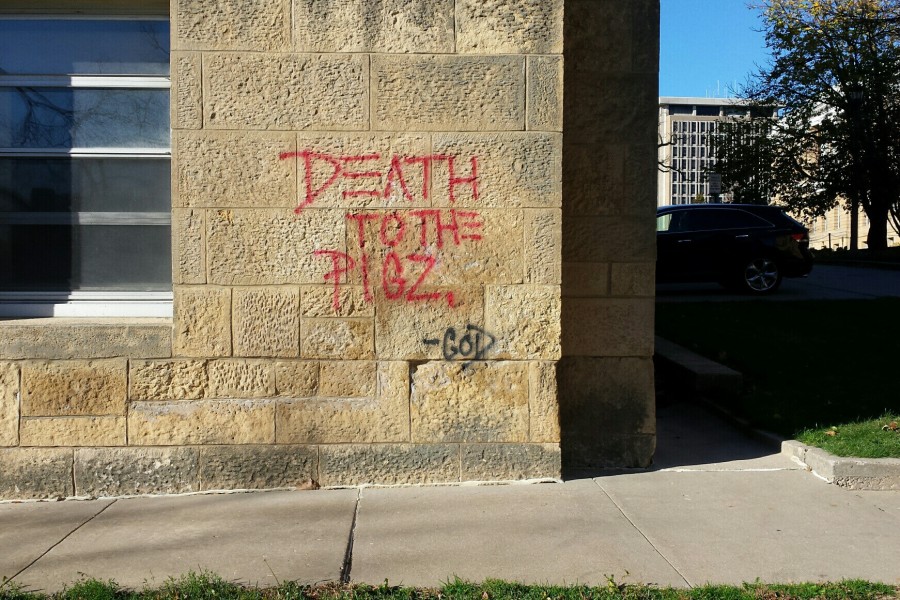
University of Wisconsin police apologize for going into a classroom to confront a student about graffiti on campus.


That's a photograph by the police of one of 11 incidents of vandalism on campus that were attributed to the 21-year-old student. There's a lot of talk on campus about the decision to go into the classroom:
Top officials at the University of Wisconsin criticized and apologized Friday for an incident with campus police that comes as a result of the UW's struggle with racial issues.

Thursday UW police officers made the uncommon move of interrupting a class to remove a student for questioning. In this case, for a recent rash of graffiti, messages against racism and white supremacy. They appeared after several racist or intolerant incidents this school year....

Police say before going into the classroom, which they usually only do for emergencies, officers had spent two weeks trying to reach the student by phone and at his home. The officer didn't realize class had already started when he walked in and confronted the suspect, Denzel McDonald.
Why, then, you might wonder, was there an apology? There are many reasons to apologize, of course. An apology may be or may seem like the simplest way to defuse a controversy. Meanwhile, the police have released the body-cam footage of the classroom interruption and the discussion with the student. I'd characterize it as respectful and low key. You can watch it yourself:


ADDED: Here's the full set of photographs of the graffiti. Another example:

10 డిసెంబర్, 2015

"After UW-Madison chancellor's email stirred controversy, Regents prepare resolution on free speech."

The Wisconsin State Journal reports.

The email, sent to students by Rebecca Blank on November 13th included:
"While individuals are always free to express their own beliefs, no one is entitled to express them in ways that diminish others, or that devalues the presence of anyone that is part of our Badger community." 
Full text here. Later, Blank said she'd intended it "as an appeal for civility and respect in how we deal with each other as a community." But it's not just an appeal for civility and respect, because it said "no one is entitled," which means there is no right. Blank seemed to acknowledge a right when she said "individuals are free to express their own beliefs," but she qualified it by denying that there's a right to express those beliefs in the wrong "ways." That seems to draw a line between the ideas you can express and the form you may use to express them, but: 1. Many ideas, even stated in a polite form, diminish and devalue others (or could be deemed to do so), and 2. We actually do have a right to choose not only the substance but the form of expression. (And by the way, the demand for polite, respectful, civil expression can undercut the speech of protesters and has a disparate impact on those who do not come from a cultural and family background where polite speech is the usual form of communication.)
 
The proposed resolution says:
"It is not the proper role of the university to attempt to shield individuals from ideas and opinions they, or others, find unwelcome, disagreeable, or even deeply offensive... Exploration, deliberation, and debate may not be suppressed because the ideas put forth are thought ... to be offensive, unwise, immoral, or wrong-headed... It is for the members of the university community, not for the institution itself, to make those judgments for themselves, and to act on those judgments not by seeking to suppress exploration of ideas or expression of speech, but by openly and vigorously contesting the ideas that they oppose.... Although the university greatly values civility... concerns about civility and mutual respect can never be used as justification for closing off discussion of ideas."
That language tracks the statement the Princeton faculty adopted last April:
"[I]t is not the proper role of the University to attempt to shield individuals from ideas and opinions they find unwelcome, disagreeable, or even deeply offensive. Although the University greatly values civility, and although all members of the University community share in the responsibility for maintaining a climate of mutual respect, concerns about civility and mutual respect can never be used as a justification for closing off discussion of ideas, however offensive or disagreeable those ideas may be to some members of our community."
MEANWHILE: Observe that calls for civility can come from different directions and even from both sides of a single dispute, like this: "Yale professor resigns: Can 'civil dialogue' share space with student rage?/A Yale professor resigned after a student uproar over her e-mail about offensive Halloween costumes. While critics have called students coddled and naive, observers say there's more going on than political correctness run amok."

7 జూన్, 2015

"I know there is serious concern among the faculty about the changes in tenure and governance proposed by the Legislature."

Writes University of Wisconsin Chancellor Rebecca Blank in a letter emailed to the faculty just now. (and posted here):
This is not surprising, given the lack of any consultation with higher education leaders or with the public prior to announcing these changes.

The proposal would remove tenure from state statute. I am pleased that the Board of Regents voted Friday to adopt into Regent policy the language establishing tenure that previously existed in state statute. We can discuss the pros and cons of having tenure established in statutory versus Regental policy, and I recognize that many faculty are worried about this change. This is a conversation we need to have. Almost all of our peers have long operated with tenure policies established by their governing boards.

12 ఆగస్టు, 2014

"Is an English professor a scientist?"

Asks University of Wisconsin chancellor Rebecca Blank.
I’ve always believed that “scientist” describes a way of looking at the world. What differentiates a tenure-track faculty member or a senior researcher from an informed journalist or interested layperson is that academic researchers are trained to think theoretically. That is, they are trained to bring intellectual frameworks to their exploration of knowledge. They are trained to use evidence to build an argument, often calling upon one or more theoretical frameworks and testing how the evidence supports or does not support the conclusions that a particular theoretical framework would suggest....

Hence, I’ve always believed that an English professor discussing the feminist implications of a medieval manuscript is as much a scientist as the microbiologist analyzing the impact of a particular chemical agent on cell reproduction. What differentiates academic researchers from others who write on similar topics is the intellectual rigor they bring....
But does the English professor really bring "as much... intellectual rigor" as the microbiologist? And what happens when the feminist's framework makes out "intellectual rigor" as a patriarchal concept?

Sorry, I'm a law professor, and my framework is not "to use evidence to build an argument." It's to question the arguments that other people make and to ask what interest they have in making those arguments that way. Your argument is my evidence, and I am not engaged in a building project. (On those last 8 words, I more or less said what I had to say 20 years ago, in "Late Night Confessions in the Hart and Wechsler Hotel" — PDF.)

18 మార్చి, 2013

"Acting Commerce Secretary Rebecca Blank plans to depart the Obama administration to become chancellor of the University of Wisconsin-Madison..."

"... she told the department's staff Monday after being tapped for the new job."
... Wisconsin Gov. Scott Walker, a Republican, said on Twitter that Blank is "a great pick" for the job. "Academic credentials, leadership experience & economic smarts."
Welcome to our new leader!

ADDED: The UW press release.