Pledge of Allegiance లేబుల్‌తో ఉన్న పోస్ట్‌లను చూపుతోంది. అన్ని పోస్ట్‌లు చూపించు

17 సెప్టెంబర్, 2019

"Duka and Koski's beliefs about same-sex marriage may seem old-fashioned, or even offensive to some. But..."

"... the guarantees of free speech and freedom of religion are not only for those who are deemed sufficiently enlightened, advanced, or progressive. They are for everyone. After all, while our own ideas may be popular today, they may not be tomorrow. Indeed, '[w]e can have intellectual individualism' and 'rich cultural diversities … only at the price' of allowing others to express beliefs that we may find offensive or irrational. West Virginia State Board of Education v. Barnette (1943). This 'freedom to differ is not limited to things that do not matter much … [t]he test of its substance is the right to differ as to things that touch the heart of the existing order.' Id."

From Brush & Nib Studios, LC v. City of Phoenix, quoted at "Freedom of Speech Protects Calligraphers' Right Not to Create Custom Same-Sex Wedding Invitations/So holds the Arizona Supreme Court" (Volokh Conspiracy).

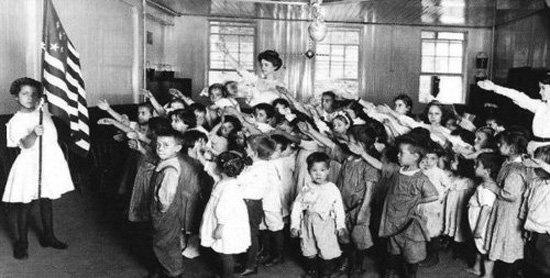
Barnette was about compelling school children to recite the Pledge of Allegiance. The children had a religious objection but the case was not decided on the basis of a special religious exclusion. Justice Jackson famously wrote:
If there is any fixed star in our constitutional constellation, it is that no official, high or petty, can prescribe what shall be orthodox in politics, nationalism, religion, or other matters of opinion, or force citizens to confess by word or act their faith therein.

15 సెప్టెంబర్, 2016

"To believe that patriotism will not flourish if patriotic ceremonies are voluntary and spontaneous, instead of a compulsory routine..."

"... is to make an unflattering estimate of the appeal of our institutions to free minds. We can have intellectual individualism and the rich cultural diversities that we owe to exceptional minds only at the price of occasional eccentricity and abnormal attitudes. When they are so harmless to others or to the State as those we deal with here, the price is not too great. But freedom to differ is not limited to things that do not matter much. That would be a mere shadow of freedom. The test of its substance is the right to differ as to things that touch the heart of the existing order."

Wrote Justice Jackson in West Virginia State Board of Education v. Barnette, the Supreme Court case that that recognized a free-speech right of public schoolchildren to resist compulsion to recite the Pledge of Allegiance. That's quoted by Jeffrey Toobin in a New Yorker article about Colin Kaepernick's refusal to show the customary respect of standing during the National Anthem as it is played before professional football games.

Toobin acknowledges that Barnette is about a legal rights that can only be asserted against the government. He doesn't mention that compulsion to recite a pledge is very different from compulsion to show respect while somebody else is saying/singing words that are not even a pledge. And he doesn't mention that Kaepernick chose to join a team, while the children in Barnette were compelled to go to school. And children compelled to go to school are required to follow dictated behavior standards while they are taught material that may be designed to instill patriotism or other political dogma that they might not believe.

And, most importantly, Kaepernick is not being compelled to stand during the national anthem. He sits or takes the knee and we all get to see that. He's got his freedom of expression. He's just being criticized for what he is expressing. There was absolutely nothing in Barnette that saved the schoolchildren from being regarded as bad and unpatriotic for failing to say the pledge.

The criticism too is free speech.

4 జులై, 2016

"In a perverse gesture, the gunmen separated the Muslims from the non-Muslims. The Muslims were given food and water."

From the CNN article about the Dhaka massacre, which I linked to last night. The commenter Mary Beth extracted the line I've quoted above and said "Perverse?"

"Perverse" is a key word in the American processing of the religious dimension of terrorist attacks.


I have a post from mid-June — just after the Orlando massacre — titled "President Obama's Sermon of 2 Perversions."

It happened to be Flag Day — today is Independence Day — and I quoted a line from the Supreme Court's famous case about pledging allegiance to the flag: "If there is any fixed star in our constitutional constellation, it is that no official, high or petty, can prescribe what shall be orthodox in politics, nationalism, religion, or other matters of opinion...."


Obama used his position of authority to instruct us about what is orthodox in religion:
Since before I was president, I've been clear about how extremist groups have perverted Islam to justify terrorism. As president, I have called on our Muslim friends and allies at home and around the world to work with us to reject this twisted interpretation of one of the world's great religions.
I said:
There are many versions of all of the religions. How is he supposed to know what versions are perversions? It sounds awful: perversion! But how can it mean more than that it's religion that seems bad to him? In which case, it's still religion. It's religion he doesn't like.

30 ఏప్రిల్, 2015

"Nary a 'no' vote in Louisiana House on resolution urging Ginsburg, Kagan recusal in gay marriage case."

Reports The Times-Picayune.
Justices Ruth Bader Ginsburg and Elena Kagan "have each engaged in public conduct suggestive of bias," reads Louisiana House Concurrent Resolution 85, sponsored by state Rep. Valerie Hodges, R-Denham Springs. In engaging on the issue of same-sex marriage, the justices have "thus demonstrate(d) an inability to be objective," and should therefore withdraw from the Obergefell v. Hodges case, the resolution says.
Embarrassing. 

And why Ginsburg and Kagan in particular? What was the "public conduct suggestive of bias"? Just because you can predict in advance where their thinking on a legal issue will lead them doesn't mean they are any more biased and bereft of objectivity than anyone else on the Court. In fact, unpredictability is more suggestive of bias. Consistency in legal reasoning, case by case and in expressions about law, suggests that you are following the norms of constitutional interpretation.

ADDED: A commenter says that the "public conduct" is officiating at same-sex wedding ceremonies. I'm seeing this at The Hill:
“Justices Ginsburg and Kagan, knowing full well that unique legal issues regarding the definition of marriage would soon come before them, deliberately officiated at so-called homosexual wedding ceremonies creating not merely the appearance of bias, but an actual and blatant conflict of interest,” [said Scott Lively, president of Abiding Truth Ministries].

“In my personal view they have committed an unparalleled breach of judicial ethics by elevating the importance of their own favored political cause of gay rights above the integrity of the court and of our nation.”
I don't see how participating in a wedding ceremony is a statement that you think there is a constitutional requirement that states must recognize same-sex marriage. Presumably, same-sex marriage was either already recognized in the place where Ginsburg/Kagan was performing the ceremony or it was a ceremony that wasn't recognized as creating a legal marriage. That probably shows they approve of same-sex marriage, though what Ginsburg did was perform a wedding for a former law clerk. Maybe she just treats all her former law clerks the same.

Anyway, doing something doesn't mean you believe you have a right to do it, and it would be utterly unworkable to say judges who do something must recuse themselves in cases about whether there is a right to do something. Should a judge who's had an abortion have to recuse herself in abortion cases? Should a judge who has given a speech have to recuse himself in a free speech case?

ALSO: A separate question is: Let's assume that doing something does equal a statement that one has a right to do it. Is belief that a right exists bias? I can't see that. I think the argument is more that a decision about the law was arrived at too early. But that doesn't make sense. Judges are always thinking, writing, and speaking about the law, forming beliefs about the answers. There's nothing wrong with that. I know there's this idea that Supreme Court Justices shouldn't express their conclusions about cases that might later come before the Court. That's the stock answer to every other question at confirmation hearings, though the Senators doing the questioning don't seem to think there's anything wrong with repeatedly inviting nominees to tip their hand.

There was a famous instance of a recusal by a Justice who tipped his hand about a pending case. Back in '03, Justice Scalia dropped out of the case about whether "under God" in the Pledge of Allegiance violated the Establishment Clause:
According to press accounts, in his talk to the Knights of Columbus, Justice Scalia adverted to the lower court rulings in the Newdow dispute twice -- both in his prepared remarks and in response to a protestor in the audience.

First, Scalia mentioned prior rulings by his own Court indicating that government could not favor any religious sect or religion over non-religion. He observed that such rulings were "contrary to our whole tradition, [and] to 'in God We Trust' on the coins," and said that these rulings had created inconsistencies that lent "some plausible support" to the lower court rulings in Newdow.

Second, when Scalia saw a protest sign in the crowd, he remarked: "The sign back there which says, 'Get religion out of government,' can be imposed on the whole country. . . . I have no problem with that philosophy being adopted democratically. If the gentleman holding the sign would persuade all of you of that, then we could eliminate 'under God' from the Pledge of Allegiance. That could be democratically done." Scalia thus arguably implied that the elimination of the "under God" phrase could not be accomplished by any Court -- even his own.
Was that recusal required or even advisable? I don't think so. And I'm suspicious. I think the recusal served the interests of conservatives. As it happened, the Supreme Court weaseled out, but if the Court's liberals had not figured out a way to avoid the merits — they used standing doctrine — they might have had to say that "under God" violated the Establishment Clause, and that would have been very useful to conservatives in the 2004 presidential election. It was well-remembered that in the 1988 election, George H.W. Bush had battered Michael Dukakis over the Pledge of Allegiance:
With President Reagan at his side in a raucous campaign rally here, Vice President Bush intensified his argument with Michael S. Dukakis today over the Pledge of Allegiance. He said he would have signed a bill that Mr. Dukakis vetoed in 1977 requiring teachers to lead their classes in the pledge.

'What is it about the Pledge of Allegiance that upsets him so much?'' Mr. Bush said of Mr. Dukakis, as an enthusiastic crowd roared its agreement. ''It is very hard for me to imagine that the Founding Fathers - Samuel Adams and John Hancock and John Adams -would have objected to teachers leading students in the Pledge of Allegiance to the flag of the United States.''
Newdow was a rich political opportunity, and I'm sure Scalia knew that. So one could say that his recusal was biased, since he would have voted on the side that would not have leveraged the conservative presidential candidate.

11 అక్టోబర్, 2014

"To Justice and All!"/"And vampires!"

Those are the kids' toasts heard at the end of "What Happens When Second Graders Are Treated to a Seven-Course, $220 Tasting Meal":

[EMBEDDED VIDEO REMOVED]

The incredibly charming video is made by Jeffrey Blitz, who did "Spellbound."

ADDED: I want to analyze that the delightful toast "To Justice and All!" The ultra-casual "and all" after the grand beginning "to justice" makes funny contrast, but we're intrigued by what seems to be a mutation of the end of the familiar Pledge of Allegiance phrase "With Liberty and Justice for All." Assuming that's the source, we wonder how "for all" became "and all." We might think that the kids say "and all" frequently and that caused them to substitute "and" for "for."

But I think something subtler happened. These kids knew about toasting. Look how the stemmed glasses and the dinner setting seem to have motivated them to engage in toasting behavior. So I think they knew that a toast begins with "to." Having put "to" rather than "and" before "justice" in the familiar Pledge phrase, the sense of the missing "and" affected their flexible minds, and having begun with the preposition "to," the next preposition, "for," seemed excessive, and that's where the "and" moved.

4 అక్టోబర్, 2014

Justice Scalia wants you to know that he's not going to tell you what he's pretty much telling you.

What a scamp this man is!
After giving a speech against the concept of an evolving Constitution, Justice Scalia at the University of Colorado was asked by a high school student about Colorado becoming the first state to allow recreational-pot sales...
Scalia smiled and said, “I’m not going to respond to that because it would force me to have to recuse myself” if the question ever went to the high court.

But he added, “the Constitution contains something called the Supremacy Clause,” which is the provision stating that federal laws trump state laws.
The justice was also asked when we’ll find out if the high court will take up the question of whether state same-sex marriage bans are constitutional.
“I know when, but I’m not going to tell you,” he reportedly replied, getting a big laugh from the audience. “Soon! Soon!” he added.
By the way, years ago, Justice Scalia did recuse himself in a case where he'd commented on the issue in public. It was the case about whether "under God" in the Pledge of Allegiance violates the Establishment Clause:
[I]n his talk to the Knights of Columbus, Justice Scalia... mentioned prior rulings by his own Court indicating that government could not favor any religious sect or religion over non-religion. He observed that such rulings were "contrary to our whole tradition, [and] to 'in God We Trust' on the coins," and said that these rulings had created inconsistencies that lent "some plausible support" to the lower court rulings in Newdow.

[And] when Scalia saw a protest sign in the crowd, he remarked: "The sign back there which says, 'Get religion out of government,' can be imposed on the whole country. . . . I have no problem with that philosophy being adopted democratically. If the gentleman holding the sign would persuade all of you of that, then we could eliminate 'under God' from the Pledge of Allegiance. That could be democratically done." Scalia thus arguably implied that the elimination of the "under God" phrase could not be accomplished by any Court — even his own....
The standard for recusal is vague — "[a]ny justice, judge or magistrate of the United States shall disqualify himself in any proceeding in which his impartiality might reasonably be questioned" — and there's a great deal of analysis of it at that last link by Vikram David Amar. Excerpt:
The truth is that Scalia's judicial opinions are often far more sweeping, far more dismissive, and far more harsh in their treatment of legal theories, contentions and cases — including fact-patterns not yet before the Court — than any of his extra-judicial public statements have been. And yet no one in the world thinks that simply because a Justice in a published opinion has made clear in passing, say, that he does not agree with an earlier ruling and would overrule it when given a chance, that he is "biased" against that ruling — in the sense that he cannot participate in a case that comes up in which the continued vitality of that ruling is squarely presented. Having opinions about the law is very different from being biased in a particular case.
But cases must be decided. It's the judge's duty. He doesn't have to fly about the country and the world doing speeches and question-and-answer sessions. There, he's choosing to speak, and what he says on those occasions may seem more freely spoken from his mind: I'm saying this because I've got a will to say it. Within the constraints of the opinion-writing duty, there is paradoxically greater freedom: I'm saying this because I must.

But, now, Newdow was a very special case. For one thing, the plaintiff Michael Newdow asked for the recusal and pushed that demand in the press. Another thing is, the Newdow case was to be decided in the presidential election year of 2004, and to leave the liberals to determine that "under God" couldn't be in the Pledge was to invite them to burden the Democratic candidate and help President George Bush get his reelection. (Remember how his father kicked Dukakis around over the Pledge in 1988?)

In Newdow, the liberals ended up figuring out some weird tweak on the standing doctrine and avoided saying something inopportune about the Establishment Clause and the Pledge. And that maneuver has always been enough for me — arguably, a reasonable person — to question their impartiality. But the recusal statute can't mean that. Otherwise, it would be recusals all the way down and nothing could ever be decided.

19 డిసెంబర్, 2011

The atheist creche in the Wisconsin Capitol rotunda.

We checked out the Christmas displays today...

14 మార్చి, 2011

Indoctrinating children.

I'm working on editing some video I took at the Capitol today, showing the political indoctrination of children. It pains me to see children taught to intone or chant things that should be understood first. When you think of things like that, what comes to mind? Maybe you think of the schoolkids taught to sing "Mmm mmm mmm/Barack Hussein Obama." Maybe you think about making kids say the Pledge of Allegiance, about which Justice Frankfurter wrote:
The wisdom of training children in patriotic impulses by those compulsions which necessarily pervade so much of the educational process is not for our independent judgment. Even were we convinced of the folly of such a measure, such belief would be no proof of its unconstitutionality. For ourselves, we might be tempted to say that the deepest patriotism is best engendered by giving unfettered scope to the most crochety beliefs.... But the courtroom is not the arena for debating issues of educational policy. It is not our province to choose among competing considerations in the subtle process of securing effective loyalty to the traditional ideals of democracy, while respecting at the same time individual idiosyncracies among a people so diversified in racial origins and religious allegiances. So to hold would, in effect, make us the school board for the country. That authority has not been given to this Court, nor should we assume it....
(Details on that case, Gobitis, here.)

I'll have my video up in a separate post soon.

UPDATE: Here.

IN THE COMMENTS: What Irene thinks of is "The old country."

6 అక్టోబర్, 2010

Margie Phelps, a daughter of Fred Phelps, will be arguing before the Supreme Court today.

The issue is freedom of speech, and the speech in question is repulsive. (Phelps's church protests near military funerals, with signs like "Thank God for Dead Soldiers," to express the view that God is punishing the U.S. for its immorality.) The father of one soldier sued for intentional infliction of emotional distress — which is a tort — and won $5 million against the church.

Much more detail at SCOTUSblog.  This is telling:
[T]his case has about it the promise of rewriting a considerable body of First Amendment law.

For a Court that so recently had refused to create a new exception to the First Amendment’s protection (so as to permit the outlawing of animal cruelty videos and films), the task of crafting a “funeral rights” exception to free speech doctrine may be a forbidding one. But for a Court hearing this case in the midst of war weariness and an expanding fear of decaying morality, the prospect of drawing a First Amendment shield around the Westboro Baptists’ message may also be a daunting one.

Perhaps this is a case in which the quality of legal advocacy, during oral argument, could make a difference. If one side or the other’s lawyer were to falter, for lack of seasoning at that demanding podium, it might ease the Justices’ decisional choice — but, then again, maybe not.
The quality of legal advocacy... is that meant as a laugh line? How did it happen that the work of upholding First Amendment rights is in the hands of Margie Phelps? I don't know the story, but it's not that the usual free speech defenders have failed to support these profoundly unpopular and ugly speakers. There are amicus briefs from the ACLU and from law professors in support of the Phelps group.

It will be interesting to see how Margie Phelps carries out her lawyerly task. Back in 2004, Michael Newdow argued his own case in the "Under God"/Pledge of Allegiance case and his nontraditional, passionate style seemed to work rather well.
Dr. Newdow, a nonpracticing lawyer who makes his living as an emergency room doctor, may not win his case.... But no one who managed to get a seat in the courtroom is likely ever to forget his spell-binding performance.

That includes the justices, whom Dr. Newdow engaged in repartee that, while never disrespectful, bore a closer resemblance to dinner-table one-upmanship than to formal courtroom discourse. For example, when Dr. Newdow described ''under God'' as a divisive addition to the pledge, Chief Justice William H. Rehnquist asked him what the vote in Congress had been 50 years ago when the phrase was inserted.
The vote was unanimous, Dr. Newdow said.

''Well, that doesn't sound divisive,'' the chief justice observed.

Dr. Newdow shot back, ''That's only because no atheist can get elected to public office.''

The courtroom audience broke into applause, an exceedingly rare event that left the chief justice temporarily nonplussed. He appeared to collect himself for a moment, and then sternly warned the audience that the courtroom would be cleared ''if there's any more clapping.''
I doubt if there will be any clapping for Margie Phelps. Or any dinner-table-style repartee. She's coming in from the other end of the God spectrum, and we shall see how that sounds.

12 మార్చి, 2010

"See, for example, the words of former Governor Sarah Palin of Alaska: 'If [the Pledge] was good enough for the founding fathers, its [sic] good enough for me....'"

Those words appear in Palin's Gubernatorial Candidate Questionnaire, Eagle Forum Alaska, July 31, 2006. In his dissenting opinion in the new 9th Circuit case upholding the constitutionality of the Pledge of Allegiance, Judge Reinhardt cited Palin's words in a footnote in support of the proposition that "some individuals" don't know their history:
For many Americans, the current version of the Pledge is the only version they have ever known. Some individuals not familiar with our political history may even be under the impression that its language dates back to the founding fathers.
Orin Kerr sees the hand of a smartass clerk:
I think it’s notable when a federal court of appeals judge with a well-established political view picks up a meme from political blogs and pokes fun at a politician on the other side in a pretty gratuitous way. It also screams “law clerk idea.” If you don’t think that’s notable, then I suppose we’ll just have to disagree.
A Kerr commenters defends Palin. DrGrishka says:
Reinhardt’s citation is misleading. The question to which Sarah Palin responded read:
11. Are you offended by the phrase “Under God” in the Pledge of Allegiance? Why or why not?
The answer was
Not on your life. If it was good enough for the founding fathers, its good enough for me and I’ll fight in defense of our Pledge of Allegiance
It could be that she gave a stupid answer in which the “it” referred to the Pledge itself. That would be historically inaccurate. But the “it” could have just as easily referred to the phrase “under G-d.” If so, the answer would be completely plausible as founding fathers used such phrases all the time.
And Palin's task at hand was to be an effective political candidate, and that is not about parsing the question and saying the most technically correct thing. People who assume they are smarter than Palin need to perceive the contextual dimension of intelligence. Are you smart at doing the thing you are currently trying to do or smart in the abstract? Because life is not in the abstract, and the people who are smartest in the abstract are not the ones who win political power. Reinhardt/his law clerk was overconfident, perhaps, in his own intelligence and failed to pay attention to the context in which he was operating, a judicial opinion. Fortunately, the political process is pretty good at filtering out individuals afflicted with this form of stupidity. But if they have life tenure, as judges do, we are stuck with it. And yet, Reinhardt needed votes too, and here we see he is writing in dissent, having lost.

Another commenter, footnoter, says:
What a sad reflection on Reinhardt. When a judge gets to doing this, it’s past time to hang up the spurs.
On the topic of a 133-page dissent with its own table of contents, on a rather simple issue, I’m reminded of EZ Rider’s dictum: “simple arguments are winning arguments; convoluted arguments are sleeping pills on paper. . . . when judges see a lot of words they immediately think: LOSER, LOSER. You might as well write it in big bold letters on the cover of your brief”
[I]magine if Judge Bybee or Justice Scalia said “we have 50 states– a fact unknown to some Americans in power” with a footnote saying “see, e.g., President Obama’s remarks he had visited ’57 states.’”
What if the other side had done the equivalent? That question pops up so often these days.

3 డిసెంబర్, 2008

It's me and Emily Bazelon -- on the new Bloggingheads!

They've called this one "Playground Edition" -- because all the topics involve children -- also law, Lori Drew, suicide, dressing like stereotypical Indians, book-learning, and the Pledge of Allegiance:

30 నవంబర్, 2008

"I could hear little Muscovites recite a similar pledge to their hammer-and-sickle flag with equal solemnity."

The Rev. George M. Docherty -- who died on Thanksgiving, at the age of 97 -- sermonized about the Pledge of Allegiance:
[He] was summoned from his native Scotland in 1950 to become pastor of the historic church in downtown Washington, which Abraham Lincoln attended when he was president in the 1860s. Each year on the Sunday closest to Lincoln's birthday, Feb. 12, the church had a special service that was traditionally attended by the president.

On Feb. 7, 1954, with President Dwight D. Eisenhower sitting in Lincoln's pew, Rev. Docherty urged that the pledge to the flag be amended, saying, "To omit the words 'under God' in the Pledge of Allegiance is to omit the definitive factor in the American way of life."

He borrowed the phrase from the Gettysburg Address, in which Lincoln said, "this Nation, under God, shall have a new birth of freedom."

Rev. Docherty's inspiration for the sermon came from his son's schoolroom experience of reciting the Pledge of Allegiance, which was written in 1892 by Baptist minister Francis Bellamy. When Rev. Docherty realized that it had no reference to God, he later said, "I had found my sermon."

Without mentioning a deity, Rev. Docherty said, the pledge could just as easily apply to the communist Soviet Union: "I could hear little Muscovites recite a similar pledge to their hammer-and-sickle flag with equal solemnity."...

But in 1954, with Eisenhower in the congregation and the threat of communism in the air, Rev. Docherty's message immediately resounded on Capitol Hill. Bills were introduced in Congress that week, and Eisenhower signed the "under God" act into law within four months....

"An atheistic American is a contradiction in terms," he said in his sermon. "If you deny the Christian ethic, you fall short of the American ideal of life."
Those words may grate on some liberals' ears. Remember the oral argument in the Supreme Court case challenging the constitutionality of the words "under God" in the Pledge?
Michael A. Newdow stood before the justices of the Supreme Court on Wednesday, pointed to one of the courtroom's two American flags and declared: ''I am an atheist. I don't believe in God.''...

Earlier, Dr. Newdow responded to Justice Stephen G. Breyer's suggestion that ''under God'' had acquired such a broad meaning and ''civic context'' that ''it's meant to include virtually everybody, and the few whom it doesn't include don't have to take the pledge.''

''I don't think that I can include 'under God' to mean 'no God,' '' Dr. Newdow replied. ''I deny the existence of God.'' He added, ''Government needs to stay out of this business altogether.''...

[The 9th Circuit court] ruled last year that the addition of ''under God'' turned the pledge into a ''profession of religious belief'' and made it constitutionally unsuitable for daily recitation in the public schools. Congress added the phrase at the height of the cold war in an effort to distinguish the American system from ''Godless Communism.''
But Docherty was no arch conservative. From the first link:
During his 26 years as pastor, he became better known for his liberal social activism than for his quest to alter the Pledge of Allegiance. He promoted racial equality and led outreach efforts to feed and educate the city's hungry and poor. His church was often a staging point for civil rights and antiwar demonstrations, and the Rev. Martin Luther King Jr. preached from its pulpit. Rev. Docherty was with King on the Edmund Pettus Bridge during the "Bloody Sunday" civil rights march in Selma, Ala., in 1965.