Olga Khazan लेबल असलेली पोस्ट दाखवित आहे. सर्व पोस्ट्‍स दर्शवा

१६ ऑगस्ट, २०२३

"When it gets hot enough, as it has across the South in recent weeks, barefoot toddlers suffer second-degree burns from stepping onto concrete."

"People who fall on the blistering pavement wind up with skin grafts. Kids stay inside all day, 'trying to survive.' Windshield wipers glue themselves in place, and the ocean transfers heat back into your body. One electric blackout could bake thousands to death inside their homes. You would think people would flee such a hellscape expeditiously. But as record-breaking heat fries the Sun Belt, the region’s popularity only grows. The numbers, laid out recently in The Economist, are striking: 12 of the 15 fastest-growing cities in the U.S. are in the Sun Belt."

I'm reading an Atlantic article that purports to answer the question I've been asking: "Why People Won’t Stop Moving to the Sun Belt."

But does this article really know why people do what they do? The author gives us 3 reasons: 1. cheap housing, 2. "a 'business-friendly' environment," and 3. warm winters. That is, on point 3, the weather is still a reason to go there, not a reason to escape. Ah, well, the fear of the cold is deep-seated. 

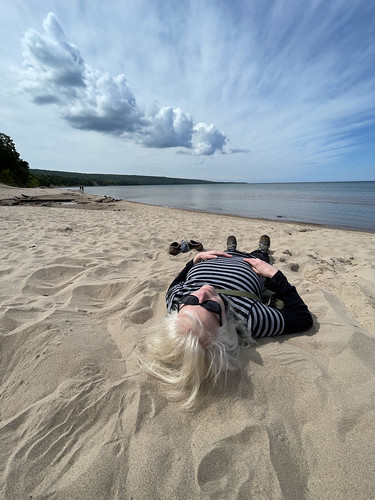
Here I am, lying on a nearly empty beach on the shore of Lake Superior, on August 14th, wearing 2 layers of long-sleeved shirt, experiencing what to me is the perfect temperature — 62°:
F13B3C53-215B-4F7B-BA7C-241BB6BE80C2_1_105_c

Why isn't everyone here? Ah, well, I like the emptiness. The sand was very fine and soft, the water perfectly clear... and swimmable if you're hale and exuberant. 

२ ऑगस्ट, २०२०

"Why Can’t We Just Have Class Outside? It might be the answer to America’s school-reopening problem."

Writes Olga Khazan in The Atlantic.
A small group of activists across the country are pushing for schools to consider teaching children in person, but outdoors in a park or even a parking lot....

It might sound crazy, but kids learn outside all the time, and did so even before the pandemic. About 250 “forest schools” exist in the U.S., in which younger kids spend much of their time in nature... In the early 1900s, during a tuberculosis outbreak in Rhode Island, kids attended a school with the windows always open, even in the winter. They sat in sleeping-bag-like blankets and had heated soapstones placed at their feet, The New York Times reported. Eventually, there were 65 such “open air” schools around the country....

Outdoor school would look like an extremely low-tech, mildly uncomfortable version of a regular school day, though perhaps with more sunscreen. Kids would be at a soccer field, in a park, or on another patch of green, advocates told me, or even in the middle of a closed road, if the school lacks green space. They’d sit under a tree or portable shade structure or simply wear sun hats.... [K]ids would wear jackets or head for the gym or cafeteria on rainy or cold days....
Kids should be outside most of the daytime, so it would be a great experiment in teaching them how to be outside. But are teachers prepared to be outside? Can teachers really meet the responsibility of caring for youngsters who are not walled in? I'm picturing kids getting up and running off. Isn't that what the outdoors inspires — what we hope for kids to want and love to do outdoors?

I'm thinking the entire enterprise of schoolteaching has to do with capturing young people indoors and insisting that they do indoor things, so the schoolteachers are people who've wanted to spend their lives doing that. How can they adapt to an outdoor setting? As Khazan writes, outdoor school is envisioned as the same as indoor school, just more uncomfortable! That is, these people who are the current schoolteachers will not be launching toward anything like "forest school." They'll just be tasked to get the kids to behave like the indoor kids that, until now, they've been creating and shaping in a convenient indoor setting.

Put them out in the middle of a closed road and watch the magic happen.

३ ऑगस्ट, २०१७

"Why Do Women Bully Each Other at Work?"

By Olga Khazan in The Atlantic. Excerpt:
"One psychologist, Joyce Benenson, thinks women are evolutionarily predestined not to collaborate with women they are not related to. Her research suggests that women and girls are less willing than men and boys to cooperate with lower-status individuals of the same gender; more likely to dissolve same-gender friendships; and more willing to socially exclude one another. She points to a similar pattern in apes. Male chimpanzees groom one another more than females do, and frequently work together to hunt or patrol borders. Female chimps are much less likely to form coalitions, and have even been spotted forcing themselves between a female rival and her mate in the throes of copulation.

Benenson believes that women undermine one another because they have always had to compete for mates and for resources for their offspring. Helping another woman might give that woman an edge in the hot-Neanderthal dating market, or might give her children an advantage over your own, so you frostily snub her. Women “can gather around smiling and laughing, exchanging polite, intimate, and even warm conversation, while simultaneously destroying one another’s careers,” Benenson told me. “The contrast is jarring.”

Perhaps not surprisingly, Benenson’s theory is controversial—so much so that she says she feels sidelined and “very isolated” in academia....

२८ मे, २०१७

"Some say 90 minutes is simply how long it takes to pace through all the sacred asanas, and that we shouldn’t tamper with tradition."

"But there is nothing traditional about most of today’s yoga studios, which are more about monetizing relaxation than they are about honoring whomever yoga is supposed to honor. I recently went to one class, supposedly a hybrid dance-yoga endeavor, in which the instructor shimmied around a stage to Jason Derulo. We’re not exactly meditating in the Indus Valley anymore...."

From "Yoga Classes Should Be Shorter/The light in me honors the light in you, but it is also extremely busy," by Olga Khazan (in The Atlantic), who got what she was asking for, comments denouncing her for "#whiteproblems" and bumbling through the puzzle of "cultural appropriation." (Is it better or worse to take less of the culture?)

ADDED: "Been around the world, don't speak the language/But your booty don't need explaining...."

१८ नोव्हेंबर, २०१३

Fetal pain as a "pro-life strategy" — a successful pro-life strategy.

An article in The Atlantic by Olga Khazan. Excerpt:
On the basis of... uncertain science rests one of the most comprehensive rollbacks of abortion rights in decades. It’s also a sign of the major gains the pro-life movement has made by emphasizing the agony that fetuses might feel, rather than what the movement sees as their God-given right to be born....

“The life at conception issue gets to a spiritual question that's unknowable and unanswerable to a lot of people,” said Alesha Doan, chair of the women, gender, and sexuality studies department at the University of Kansas. But the fetal pain argument touches on the fact that, “we anesthetize for all surgeries, and it's considered cruel and unusual punishment not to do so.”
You don't have to believe in God to believe in pain, but where do you go with your morality when you put pain — not God — at the center of your thinking?