Obama is like Nixon লেবেলটি সহ পোস্টগুলি দেখানো হচ্ছে৷ সকল পোস্ট দেখান

২২ জুলাই, ২০২৫

"Trump just wants the media to cover the story."

I'm reading "Getting media to cover Obamagate/Crazy Like A Fox Trump did it again with a fake but accurate video" by Don Surber, at Substack.
The media refused this weekend to cover the story of the century, in which Obama personally helped create and promote Russiagate which tied the first presidency of Donald Trump up in knots for years and also served as a cover story for Obama using the FBI to spy on Trump....
President Trump knows beating the media better than anyone. He did what no one would ever believe possible when he forced Disney’s ABC to admit it lied about him, He collected legal fees and a $15 million donation to the Trump Presidential Library. He also collected $16 million for the library from CBS for making Kamala Harris sound intelligent in a heavily edited 60 Minutes story. You’re gonna need a bigger library. Trump forced NBC to give him equal time for Kamala’s appearance on Saturday Night Live. His time was on Sunday Night Football, which has 10 times the audience.

The media wants the Obamagate story to go away, but Trump figured out a way to make them admit there is a story. He posted an AI video of Obama being arrested. This is his post on Truth Social....

১৯ সেপ্টেম্বর, ২০১৭

"This is much worse than Watergate, folks. That was a third-rate burglary that went awry."

"Trump was called a liar. He was mocked for tweeting about Trump Tower being wiretapped. David Gergen, you’ll hear on the sound bites today, practically chokes when confronted with the news that Trump was right and doesn’t quite know what to say about it. But, I tell you what, folks, in many ways it’s worse than Watergate, and it’s still going on even with Trump in the White House. Richard Nixon was accused of spying on the DNC, but Nixon never ordered any such spying. In fact, he didn’t know anything about it. He was accused of using the IRS against his political opponents, but he never did. We know for a fact that Obama did both of these things, used the IRS against political opponents and probably more. There’s no outrage in the media on this. They think it’s great that Manafort’s lock was picked. The New York Times reports this as though it’s something that happens every day. Yep, the FBI showed up, they picked the lock of Manafort’s front door in Virginia and walked in and woke him up along with his family and then started demanding things and taking things...."

Rush Limbaugh, today.

৪ মার্চ, ২০১৭

"Trump, citing no evidence, accuses Obama of ‘Nixon/Watergate’ plot to wiretap Trump Tower."

WaPo reports.

"Citing no evidence" doesn't mean he has no evidence. What happens next?
Trump offered no citations nor did he point to any credible news report to back up his accusation, but he may have been referring to commentary on Breitbart and conservative talk radio suggesting that Obama and his administration used “police state” tactics last fall to monitor the Trump team. The Breitbart story, published Friday, has been circulating among Trump's senior staff, according to a White House official who described it as a useful catalogue of the Obama administration's activities.
What's "credible news" these days? Maybe Trump is fighting fire with fire. The Russian business is a conspiracy theory so why not distract with a conspiracy theory on top of the conspiracy theory? There was a conspiracy to plant a conspiracy, etc. etc.

But Trump is accusing Obama of wiretapping his New York office. That's a very specific charge. Presumably Trump has high-level security within his homestead. Maybe something was detected. Here are Trump's tweets this morning:

1. "Terrible! Just found out that Obama had my 'wires tapped' in Trump Tower just before the victory. Nothing found. This is McCarthyism!"

2. "Is it legal for a sitting President to be 'wire tapping' a race for president prior to an election? Turned down by court earlier. A NEW LOW!"

3. "I'd bet a good lawyer could make a great case out of the fact that President Obama was tapping my phones in October, just prior to Election!"

4. "How low has President Obama gone to tapp* my phones during the very sacred election process. This is Nixon/Watergate. Bad (or sick) guy!"

#3 feels vaguely like a threat to get a criminal investigation going against Obama. This is a big move by the art-of-the-deal master. Perhaps the goal is to get his attackers to stand down.
____________________

*"Tapp" would be a good name for an app.

ADDED: Meade is saying "You over-educated professional class elites, you don't understand TrumpTweet." Most important, he says, is that Trump put "wires tapped" and "wire tapping" in quotes and that misspelling "tapp" could have been intentional. Is it some figure of speech? Is there a special way of speaking within Twitter that the grownups don't understand?

১২ মে, ২০১৫

"Readers are expected to believe that the story of the Bin Laden assassination is a giant 'fairy tale' on the word of a single, unnamed source."

"This source fits the profile of nearly all of [Seymour] Hersh’s informants in the national security world: a grizzled veteran of the intelligence sector who, freed from the shackles of government work, has become a withering critic of the national security state and American hubris overseas...," writes James Kirchick, in Slate.
The problem is that Hersh hasn’t moved past 1969: It’s always My Lai, and the government is always composed of people as devious as the denizens of the Nixon White House....

Hersh’s placement of this article in the London Review of Books, a literary journal whose take on international affairs tends toward the Chomskyan... is notable in that it has become the go-to place for Hersh’s exposés of American perfidy in the Obama era.... The first piece Hersh published in the London Review of Books, a fantastical 2013 concoction accusing Syrian rebels of gassing their own civilians and the Obama administration of “cherry-picked intelligence” in its brief against the Assad regime, was passed over by [The New Yorker], as it similarly passed over his fable about the Bin Laden raid... The New Yorker, where Hersh has contributed since 1971, published Hersh’s thinly sourced calumnies when his target was the Bush administration. Yet the magazine suddenly lost interest the minute he started accusing Obama of “lies, misstatements and betrayals.”

১৪ নভেম্বর, ২০১৪

"I have never seen a president in exactly the position Mr. Obama is, which is essentially alone."

Writes Peggy Noonan in "The Loneliest President Since Nixon/Facing adversity, Obama has no idea how to respond."
He’s got no one with him now. The Republicans don’t like him, for reasons both usual and particular: They have had no good experiences with him. The Democrats don’t like him, for their own reasons plus the election loss.... No one at [his post-election lunch with congressional leaders] looked at him with colder, beadier eyes than outgoing Senate Majority Leader Harry Reid, who clearly doesn’t like him at all. The press doesn’t especially like the president; in conversation they evince no residual warmth. This week at the Beijing summit there was no sign the leaders of the world had any particular regard for him....

The last time we saw a president so alone it was Richard Nixon, at the end of his presidency, when the Democrats had turned on him, the press hated him, and the Republicans were fleeing.... But Nixon had one advantage Obama does not: the high regard of the world’s leaders, who found his downfall tragic (such ruin over such a trifling matter) and befuddling (he didn’t keep political prisoners chained up in dungeons, as they did. Why such a fuss?).

৩১ অক্টোবর, ২০১৪

"Before President Obama, whose brown eyes are opaque when you look into them, presidents have been more known for blue eyes…."

"The ones with brown eyes, Richard Nixon and L.B.J., came a cropper."

And:
George Washington, blue-gray eyes; John Adams, blue; Thomas Jefferson, hazel; James Madison, brown; James Monroe, blue-gray; John Quincy Adams, black; Andrew Jackson, blue (Old Stonewall-blue eyes?); Martin Van Buren, blue; William Henry Harrison, brown. John Tyler, blue; James Polk, gray; Zachary Taylor, hazel (it figures); Millard Fillmore, blue; Franklin Pierce, gray; James Buchanan, blue; Abraham Lincoln, gray (huh?); Andrew Johnson, black; Ulysses S. Grant, blue. Rutherford B. Hayes, blue; James Garfield, blue; Chester A. Arthur, black (of course); Grover Cleveland, blue (but only once); Benjamin Harrison, blue; William McKinley, blue-gray; Theodore Roosevelt, blue (come on); William Howard Taft, blue; Woodrow Wilson, blue-gray; Warren G. Harding, gray. Calvin Coolidge, blue; Herbert Hoover, hazel (stop laughing); Franklin D. Roosevelt, blue; Harry Truman, blue; Dwight D. Eisenhower, blue (I know, I didn`t believe it, either); John F. Kennedy, blue; Lyndon B. Johnson, brown; Richard Nixon, brown; Gerald Ford, blue; Jimmy Carter, hazel (don't say it); Ronald Reagan, blue.
ADDED: I didn't really mean for this to be a separate post, but I accidentally published what was the draft of a comment to go in the "Eye Implants" thread, where I said something hyperbolic about blue eyes and got called on it. I don't delete posts. Ever. Not in 10+ years.

২২ অক্টোবর, ২০১৪

"In my opinion, Obama has governed as a moderate conservative — essentially as what used to be called a liberal Republican..."

"... before all such people disappeared from the GOP. He has been conservative to exactly the same degree that Richard Nixon basically governed as a moderate liberal, something no conservative would deny today."

Writes Bruce Barlett in The American Conservative.

Whatever you think of all that — and Barlett lays out his evidence at length — it will be interesting to see what Obama does when he has to work with a GOP-dominated Congress after the election.

১১ জুলাই, ২০১৪

"Bears, beer and horse heads: What exactly is going on with the leader of the free world?"

What exactly is going on with the leader of the free press? That's the first line of a Washington Post story that is the top item on the site's home page. Has WaPo turned against Obama? I'm going to guess no and that this article is actually supportive, but let's check it out:
On a single day this week in Denver, President Obama scarfed down pizza and drinks with strangers, shot pool with Colorado’s governor and shook hands with a guy on the street wearing a horse mask. His top staffers are promoting these stops on Twitter with the hashtag #TheBearIsLoose — a term one of Obama’s aides coined in 2008 when the candidate would defy his schedule....
So... this is easy: Obama is campaigning. It's what he does well, and he wants to be seen in a good light. He wants these photo ops to be used as WaPo mostly uses them: To revive old love and to make journalists decry gridlock in Washington.

But can the Obama-for-President routine play when we've got that children-crossing-the-border crisis? Obama is traveling about, doing political theater, and when he was questioned about his avoidance of the scene near the border, he said: "This is not theater." That is, it's a problem to be solved in a serious way, and that to visit the detention camps would be theater. He's right about that. It's not the kind of theater he wants. He's not denying that pizza-scarfing and horse-mask-guy greeting are theater. So the showman chooses what show to mount. 
The president... seems genuinely impatient with the limitations of his office.
We have limited government. Love it or don't serve in it, conlawprof.
He has started walking around D.C. for short stints, referring to himself in the third person as “the bear” as he walks across Lafayette Park or heads to a nearby Starbucks....
Maybe one morning he'll awaken before 4 a.m and wander down to the Lincoln Memorial to talk with the young people. His chief of staff might write in his diary "I am concerned about his condition" and call it "the weirdest day so far." The President might dictate notes to be shared with "anyone else who may have raised questions": "Even when I'm tired, I do not talk about nonsensical things," and talking with the young people was an effort "to lift them a bit out of the miserable intellectual wasteland in which they now wander."
I hope that (your) hatred of the [what's going on these days], which I could well understand, would not turn into a bitter hatred of our whole system, our country and everything that it stood for. I said that I know probably most of you think I'm an SOB. But I want you to know that I understand just how you feel.
Nah. That was Nixon. The young people don't think Obama's an SOB, and Obama has never had to entertain the slightest notion that the young people think he's an SOB.

১৭ জুন, ২০১৪

In the context of the (arguably) destroyed IRS email, let's revisit an old question: Why didn't Richard Nixon destroy the Watergate tapes?

I've taught the Watergate Tapes case — United States v. Nixon — for 20 years, and I think I always include what I believe is a central question about that case and about law more generally: Why didn't Richard Nixon destroy the Watergate tapes?

Nixon had possession of the tapes, and no physical force prevented his people from starting an "accidental" fire or causing a chance encounter with magnets... Yeah, bitch, magnets....


Here's the description in the book "The Brethren" of how Nixon reacted to the news of the Supreme Court's decision:
His Chief of Staff, Alexander M. Haig, told him that the Supreme Court decision had just come down. Nixon had seriously contemplated not complying if he lost, or merely turning over excerpts of the tapes or edited transcripts. He had counted on there being some exception for national security matters, and at least one dissent. He had hoped there would be some “air” in the opinion. 

“Unanimous?” Nixon guessed.

“Unanimous,” Haig said. “There is no air in it at all.”

“None at all?” Nixon asked.

“It’s tight as a drum.”

After a few hours spent complaining to his aides about the Court and the Justices, Nixon decided that he had no choice but to comply. Seventeen days later, he resigned.
So, why didn't Richard Nixon destroy the Watergate tapes? 3 ideas for an answer:

1. Nixon was part of the American culture of the rule of law that had grown and deepened over the years. We were long past the days when Andrew Jackson (supposedly) said: "John Marshall has made his decision; now let him enforce it!" This is the answer I've always liked, and I can see that if I like it too much I'm falling prey to the age-old human foible of believing what you want to believe.

2. Nixon knew that if he said the tapes were destroyed, no one would accept any attempt to explain it away as a mishap, and he'd be impeached forthwith. It was nothing other than the best self-serving political move he could make at that point.

3. Nixon was, in fact, a fool not to destroy the tapes.
"I had bad advice, bad advice from well-intentioned lawyers who had sort of a cockeyed notion that I would be destroying evidence," Nixon said years later in a videotaped interview. "I should have destroyed them."
Let's compare the IRS email story. There are some differences:

1. Nixon was more hated and people weren't apt to cut him any slack, and Obama, whatever he does, is relentlessly liked.

2. The press was bearing down hard on Nixon — "They're after me! The president. They hate my guts. That's what they're after." — and the press is ever ready to give Obama a boost.

3. Nixon seemed tricky and shifty, unlike Obama, whose lies seem less... lie-like.

4. Tapes are bigger, bulkier objects, and email is evanescent.

5. Nixon, actually, at some level, felt shame about transgressing what another branch of government says is the law, and Obama has great confidence in asserting his view of the law and sticking to it. 

6. The Watergate scandal was about unlawful actions intended to help reelect the President, and... oh, wait... that's not a difference.

১৪ জুন, ২০১৪

"Did The IRS Really Lose Lois Lerner's Emails? Let a Special Prosecutor Find Them."

That headline — at the National Journal — says exactly what needs to be said.

For decades the received wisdom has been it's not the crime, it's the coverup. And here we see evidence of a coverup. What kind of crime must there be that after all these years of warnings that it's the coverup that will get you, we've got a glaring, egregious coverup?!

Oh? Do they say maybe it's not a coverup? Maybe Lois Lerner's emails really did disappear in a computer crash? We need a neutral prosecutor to find out what happened. There's zero reason to take that on faith.

How could it possibly be that government operates this way, with high-level government officials working with one computer that could crash and take everything with it? Aren't there central computers, backed up multiple times, with a record of everything?

We're talking about the IRS. Doesn't it have multiple, backed up records on all of us taxpayers?

Give us a special prosecutor, because it's not acceptable to tell us we're supposed to believe this story of disappearing evidence....

৪ জুন, ২০১৪

Drudge cites "LAW PROF" as saying Obama is "The President That Richard Nixon Always Wanted To Be..."

Linking to Jonathan Turley (speaking with Sean Hannity):
SEAN HANNITY: We do have co-equal branches of government, separation of powers. You teach this regularly. You agree with the president politically. For you to say we are at a tipping point constitutionally -- now, I agree with you. What does that mean considering our constitution is our rule of law and they are ignoring it?

JONATHAN TURLEY: Well, unfortunately our system is changing, and it's changing without a debate. Or even a discussion about what we're going to do in the future when we have a three branch system, a tripartite system but one branch is so dominant. What's emerging is an imperial presidency, an uber presidency as I've called it, where the president can act unilaterally. This is only the latest example of that. What's troubling is that we have a system that has been stable precisely because these are limited and shared powers. This president has indicated that he's just not willing to comply with some of those aspects. He told Congress he would go it alone and in our system you're not allowed to go it alone.... Well, I think that the biggest problem we have is that the system itself, if we have a dominant branch, simply begins to shut down in terms of the safeguards. People don't seem to understand that the separation of powers is not about the power of these branches, it's there to protect individual liberty, it's there to protect us from the concentration of power. That's what is occurring here. You know, I've said it before, Barack Obama is really the president Richard Nixon always wanted to be. You know, he's been allowed to act unilaterally in a way that we've fought for decades...
I'm a lawprof too, and I too regularly teach this separation of powers business. And Turley is downplaying the argument for exclusive presidential power over some military and foreign affairs matters. Unlike Turley, I wouldn't say I "agree with the president politically," but I did vote for him in 2008, and when I did, part of my reason was that criticisms of President Bush were distorted by partisanship and that if a Democrat were President and responsible for the military, a more balanced assessment of presidential power would emerge.

And here's the memo (PDF) from NSC Spokesperson Caitlin Hayden explaining the administration's legal position, which reads the statute — Section 1035(b) of the FY 2014 NDAA — not to require 30-day notice to Congress when the Secretary of Defense has determined that notice "could endanger" a captive soldier’s life. You might find that statutory interpretation strained, but without it, the administration would resort to a constitutional argument and say that the notice requirement encroaches on the President's constitutional function of "protecting the lives of Americans abroad and protecting U.S. soldiers." The memo points to the President's signing statement:
“Section 1035 does not... eliminate all of the unwarranted limitations on foreign transfers and, in certain circumstances, would violate constitutional separation of powers principles. The executive branch must have the flexibility, among other things, to act swiftly in conducting negotiations with foreign countries regarding the circumstances of detainee transfers.” 
I would say the signing statement disavows any belief in the statutory interpretation propounded by the memo, but the signing statement expresses the constitutional problem that drives statutory interpretation. (And by the way, just last Monday, the U.S. Supreme Court issued a decision that very strongly supports narrowing a statute to avoid getting to a question whether Congress has exceeded its constitutional powers.)

২ জুন, ২০১৪

Obama: "When the President does it, that means it is not illegal."

I mean... Nixon:


But Obama could say it — right? — about this:
The Obama administration’s failure to notify Congress of the release of five Guantanamo Bay detainees ahead of his exchanging them for American soldier Bowe Bergdahl is a direct violation of the law, according to CNN legal analyst Jeffrey Toobin.

“I think he clearly broke the law,” Toobin said on Monday, adding that the president’s signing statement in which he called the law unconstitutional does not automatically make it so. “Certainly this is an example of a signing statement where the president is taking power for himself that the law didn’t give him — he’s explicitly contradicting it.”
I guess by "law," Toobin means statute. The Constitution is also law, and the President's view of the Constitution is that the statute in question encroaches on his constitutional power and is therefore a nullity. The President may be claiming power that the statutory law didn't give him, but he's not taking power if it was given by the Constitution, and there's nothing illegal about contradicting a nullity.

২৩ মার্চ, ২০১৪

"Just as nobody would trust John Mitchell to investigate Richard Nixon, nobody should trust a partisan Obama donor..."

"... to investigate the IRS’s political targeting of President Obama’s enemies. Sadly, 'in the discretion of the Attorney General,' Eric Holder has chosen to reject the bipartisan tradition of the Department of Justice of putting rule of law above political allegiance. Both Nixon Administration Attorney General Elliot Richardson and Clinton Administration Attorney General Janet Reno appointed special prosecutors whose integrity was beyond reproach; Eric Holder should do likewise. To date, nine months after a damning Inspector General report, nobody has been indicted, many of the victims have not even been interviewed, and Lois Lerner has twice pleaded the Fifth. And yet the Attorney General refuses to allow a genuine — and impartial — investigation."

That's Ted Cruz, waving the WORSE THAN NIXON sign.

১৫ আগস্ট, ২০১৩

"President Obama’s increasingly grandiose claims for presidential power are inversely proportional to his shriveling presidency."

"Desperation fuels arrogance as, barely 200 days into the 1,462 days of his second term, his pantry of excuses for failure is bare, his domestic agenda is nonexistent and his foreign policy of empty rhetorical deadlines and red lines is floundering. And at last week’s news conference he offered inconvenience as a justification for illegality."

So begins George Will's column today, which is headlined "Obama’s unconstitutional steps worse than Nixon’s."

৩১ মে, ২০১৩

"So you dislike Democrats as much as you dislike the GOP?"

Details asks Woody Harrelson (who played Steve Schmidt in that movie about Sarah Palin, "Game Change")"
It's all synchronized swimming to me. They all kneel and kiss the ring. Who's going to take on the oil industry or the medical industry? People compare Obama to Lyndon Johnson, but I think a better comparison is between Obama and Nixon. Because Nixon came into office saying he was going to pull out of Vietnam, and then he escalated the war. A lot of us were led to believe that Obama was the peace president, but there are still, I think, 70,000 troops in Afghanistan. Corporations like Grumman are so powerful that—I don't know, is this the kind of shit we want to talk about? It's making me depressed.

১৩ মে, ২০১৩

"We know a lot about President Obama, and I think the idea that he would want the IRS used for retribution — we have no evidence of any such thing."

Says Carl Bernstein, declaring that the Obama administration's IRS scandal is not Watergate. 
"In the Nixon White House, we heard the president of the United States on tape saying 'Use the IRS to get back on our enemies."
The link goes to Politico, which doesn't close the quotation marks around "Use the IRS to get back on our enemies," and doesn't link to specific Nixon quotes found on the Watergate tapes. It's strange to put quotes around that if it's not a quote. Here's the Wikipedia article "Nixon's Enemies List," which doesn't quote any Nixon remarks. It does have the truly shocking John Dean memo that asks "how we can use the available federal machinery to screw our political enemies." Politico needs to close the quotation marks and link to the quote or take away the quotes and add some material about how Nixon never said that and perhaps Bernstein — the wheeled-out old authority on Watergate — meant to say John Dean when he said Nixon.

Now, as to we have any evidence that Obama would want the IRS used for retribution, Obama once joked about using the machinery of the IRS against his enemies:
At his Arizona State University commencement speech [in May 2009], Mr. Obama noted that ASU had refused to grant him an honorary degree, citing his lack of experience, and the controversy this had caused. He then demonstrated ASU's point by remarking, "I really thought this was much ado about nothing, but I do think we all learned an important lesson. I learned never again to pick another team over the Sun Devils in my NCAA brackets. . . . President [Michael] Crowe and the Board of Regents will soon learn all about being audited by the IRS."

১২ মে, ২০১৩

What did the President know and when did he know it?

An old question. It springs to mind upon reading today's news:
Senior Internal Revenue Service officials knew agents were targeting tea party groups as early as 2011, according to a draft of an inspector general's report obtained by The Associated Press that seemingly contradicts public statements by the IRS commissioner.
Over at the Isthmus forum — a Madison, Wisconsin site, where lefties try to cocoon — a regular commenter who uses the pseudonym Henry Vilas had said: "Sounds like an over-zealot functionary in a local office. While such partisan use of the IRS should be condemned, it's not like a presidential enemies list." And when confronted with the news that senior IRS officials knew, he said: "So did Obama sic the IRS on them, like Nixon did with his enemies list?"

Our own Meade followed the link to the Wikipedia article "Nixon's Enemies List," actually read it, and wrote:
Obamaphiles should hope so:
"On December 20, 1973, the Congressional Joint Committee on Internal Revenue Taxation concluded that people on the 'Enemies' list had not been subjected to an unusual number of tax audits."

১০ মে, ২০১৩

"I kid you not: The IRS just released a statement on its improper harassment of conservative groups in the run-up to the 2012 election including the words: 'mistakes were made.'"

Says Instapundit, under the heading "It just gets worse."

I see that "Mistakes were made" has its own Wikipedia page:
The New York Times has called the phrase a "classic Washington linguistic construct." Political consultant William Schneider suggested that this usage be referred to as the "past exonerative" tense, and commentator William Safire has defined the phrase as "[a] passive-evasive way of acknowledging error while distancing the speaker from responsibility for it." While perhaps most famous in politics, the phrase has also been used in business, sports, and entertainment.
The phrase is most associated with Richard Nixon and his press secretary Ron Ziegler:
U.S. President Richard Nixon used the phrase several times in reference to wrongdoings by his own electoral organization and presidential administration.

On May 1, 1973, White House Press Secretary Ron Ziegler stated "I would apologize to the Post, and I would apologize to Mr. Woodward and Mr. Bernstein" (referring to Bob Woodward and Carl Bernstein of The Washington Post). He continued, "We would all have to say that mistakes were made in terms of comments. I was overenthusiastic in my comments about the Post, particularly if you look at them in the context of developments that have taken place." The previous day, White House counsel John Dean and Nixon aides John Ehrlichman and H.R. Haldeman had resigned, as the Watergate scandal progressed.
But it's not as though the association with Nixon has worked over the years to warn off other politicians. As you can see at the Wikipedia page, President Reagan used it in 1987 (about Iran-Contra, President Clinton used it in 1997 (about Democratic Party fundraising scandals. Senator McCain used it in 2005 (about the Iraq war). There are more items on the list, including — I love Wikipedia —today's statement by the IRS.

Under the "see also" heading:
List of political catch phrases
Non-apology apology
Non-denial denial
Spin (public relations)
IN THE COMMENTS: Erich said: "Calls to mind the classic Matt Groening cartoon."

২৮ ফেব্রুয়ারি, ২০১৩

"Strains credulity to think that ice releases thousands of illegals..."

"... and no one there ran it up the food chain. Not even a 'heads up?' Hmmm."

The old buzzword "deniability" popped into my head.

ME (out loud): "Deniability. Who do you associate with that word."

MEADE: "Nixon."

ME (having Googled, reading from Wikipedia): "Kennedy. 'Plausible deniability is a term coined by the CIA during the Kennedy administration to describe the withholding of information from senior officials in order to protect them from repercussions in the event that illegal or unpopular activities by the CIA became public knowledge.'"

I love Wikipedia. I love that there's a whole long article on the topic "plausible deniability." The name Nixon comes up — in a list of 6 "major flaws" in the "doctrine." The Nixon-related flaw is:
It rarely worked when invoked; the denials made were rarely plausible and were generally seen through by both the media and the populace. One aspect of the Watergate crisis is the repeated failure of the doctrine of plausible deniability, which the administration repeatedly attempted to use to stop the scandal affecting President Richard Nixon and his aides.
Also at the article, under the heading "other examples":
The Murder of Thomas Becket

King Henry II of England is often said to have stated of Archbishop of Canterbury Thomas Becket, "Who will rid me of this meddlesome priest?" Becket was indeed murdered, although the king denied that his plea was to be taken in such a way.
We don't live in a monarchy, and efforts to insulate a U.S. President from criticism should fail and will fail if we haven't lost track of our role as citizens.

(And, as noted a few posts ago, these Washington writers are nauseatingly dependent on clichés. The food chain, heads up. "Food chain" isn't even the right cliché. Perino meant the chain of command. That other chain. Django Unchained. Chain of Fools. Chains, my baby's got me locked up in chains. Workers of the world unite. You have nothing to lose but your chains. Ball and chain. A chain is only as strong as its weakest link. Chain smoking. Hey, I'm only yanking your chain.)

২ ফেব্রুয়ারি, ২০১৩

Obama, skeet-shooting last August.

The photographic evidence — responding to skepticism — uploaded at the presidential Flickr page today:

P080412PS-0464

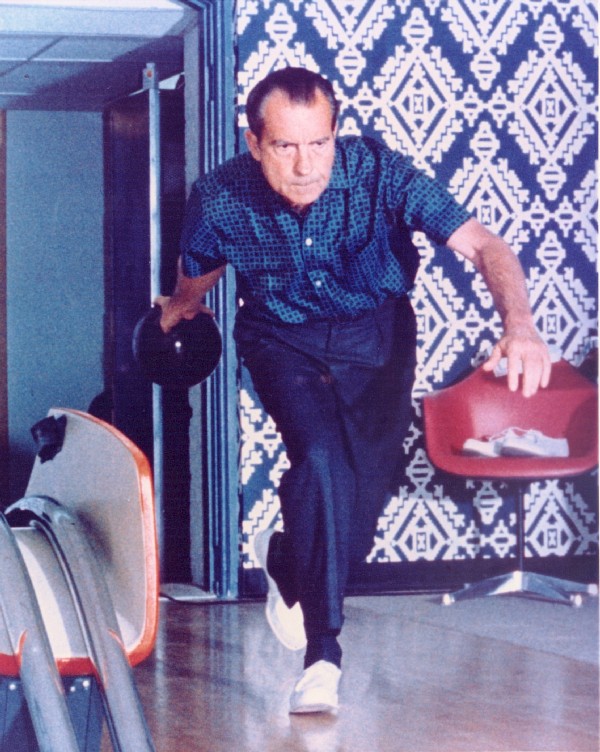
IN THE COMMENTS: mccullough said: "Cool picture. I want a poster of it to put next to my poster of Nixon bowling."


ADDED: White House coins the term "skeeters" to make fun of people don't believe Obama goes skeet shooting all the time at Camp David.