That's the top rated comment on this TikTok about Rama Duwaji, the wife of Zohran Mamdani:
Mother Teresa లేబుల్తో ఉన్న పోస్ట్లను చూపుతోంది. అన్ని పోస్ట్లు చూపించు
Mother Teresa లేబుల్తో ఉన్న పోస్ట్లను చూపుతోంది. అన్ని పోస్ట్లు చూపించు
29 డిసెంబర్, 2025


21 మే, 2021
"There is the surge of interest in cults, likely driven by the fact that for four years America was run by a sociopathic con man with a dark magnetism..."
"... who enveloped a huge part of the country in a dangerous alternative reality. And there’s a broader drive in American culture to expose iniquitous power relations and re-evaluate revered historical figures. Viewed through a contemporary, secular lens, a community built around a charismatic founder and dedicated to the lionization of suffering and the annihilation of female selfhood doesn’t seem blessed and ethereal. It seems sinister."
From "Was Mother Teresa a Cult Leader?" by Michelle Goldberg (NYT)(drawing attention to a new podcast, "The Turning," that portrays Mother Teresa in a negative light).
Viewed through a contemporary, secular lens, is anything blessed and ethereal?
This "surge of interest in cults" — if you want me to take it seriously — needs also to include looking inward, at yourself. What cults do you belong to? I ask this of Goldberg and of everyone who's choosing to characterize other people as belonging to cults. Some people — notably Rose McGowan — say the Democratic Party is a cult. But Goldberg, unsurprisingly, brings up Trumpsters as the cult here in America as she critiques a woman in a culture that is foreign to her.
What's the difference between "cult" and "culture"? Whether you look at other people through your "lens" and react to them as alien and defective? To be a serious thinker, you must critique your own lens.
FOOTNOTE: According to the Online Etymology Dictionary entry for "cult":
4 సెప్టెంబర్, 2016
"I think, perhaps, we may have some difficulty in calling her St. Teresa..."
"... Her holiness is so near to us, so tender and so fruitful, that we continue to spontaneously call her Mother Teresa."
Said Pope Francis at the canonization ceremony.
ADDED: From the archive:
Said Pope Francis at the canonization ceremony.
ADDED: From the archive:
She tried her best to believe. Her atheism was not like mine. I can't believe it and I am glad to think that it is not true, that there is a dictator in the heavens. So the fact that there is no evidence for it pleases me. She really wished it was true. She tried to live her life as if it was true. She failed. And she was encouraged by cynical old men to carry on doing so because she was a great marketing tool for her church, and I think that they should answer for what they did to her and what they have been doing to us. I think it has been fraud and exploitation yet again....ALSO: To clarify the previous quote, which is (obviously?) from Christopher Hitchens, here was the news from 2007:
The letters, many of them preserved against her wishes (she had requested that they be destroyed but was overruled by her church), reveal that for the last nearly half-century of her life she felt no presence of God whatsoever — or, as the book's compiler and editor, the Rev. Brian Kolodiejchuk, writes, "neither in her heart or in the eucharist."That made me think of:
I'd like to conclude with a passage from 1 John, Chapter 4. You know it? See, most groups I speak to don't know that. But we know it. If you want, we can say it together: "No one has ever seen God, but if we love one another, God lives in us and His love is made complete in us." And that is so true.
14 ఫిబ్రవరి, 2016
"And that’s always the ugly Faustian bargain with the Clintons..."
"... not only on the sex cover-ups but the money grabs: You can have our bright public service side as long as you accept our dark sketchy side. Young women today, though, are playing by a different set of rules. And they don’t like the Clintons setting themselves above the rules."
The conclusion of Maureen Dowd's new column, "When Hillary Clinton Killed Feminism."
Here's one of the highest-rated comments there (at the NYT):
The conclusion of Maureen Dowd's new column, "When Hillary Clinton Killed Feminism."
Here's one of the highest-rated comments there (at the NYT):
Okay, so I'm supporting Bernie (as a Jewish male, I'm obligated to do so — right, Ms. Albright?). Even so, it's clear that none of Hillary's enemies in the top echelons of the GOP have anything on Maureen Dowd when it comes to pure, obsessive, unadulterated contempt. How many of these relentless screeds will The Times have to publish before its contractual obligations to their author are finally fulfilled? Whether it's an election year, an off-year or the (Chinese) Year of the Shrew there are simply no limits to the amount of spleen that Ms. Dowd has proven herself ready to vent when it comes to the affairs of Clinton and Clinton, Assassins at Large. I can't imagine just how many of the writer's loved ones have been bumped off over the years by this 21st Century version of the Borgias but the number must truly be immense. In any case, there's absolutely nothing in this op/ed piece that has anything new to say about Maureen's personal bête noirs. It may simply be time for her to knock off for a while, spend a few weeks (at least) on a beach in Cancun and try to find some other target for her all-consuming wrath. There IS another political party out there, after all, whose presidential candidates make Hillary look like Mother Teresa, particularly insofar as the rights of women are concerned.
11 నవంబర్, 2013
What if you bitched on Facebook about the raw deal you got under Obamacare and nobody "liked" you?
Shocked at the new and worse deal she was offered under Obamacare, Lori Gottlieb wrote an item titled "Obamacare or Kafkacare?” on Facebook. Facebook is a website that — unlike healthcare.gov — works, so she expected lots of "likes." She liked her old insurance, and Obama said if you like it, you can keep it.
Like, like, like!
Everything is, like, about liking these days, and Lori must have thought she was likeable enough, but nobody liked her.
It will be interesting to see how that website that works, Facebook, will process the stories of individuals burned by Obamacare. Ironically, Gottlieb is nudging Facebookers not to complain if they find themselves losers. Hers is a cautionary tale: You will not be liked. But perhaps enough stories will break through the fear of not being likeable, and a tipping point will be reached. There could be a cascade of liking not liking Obamacare.
Like, like, like!
Everything is, like, about liking these days, and Lori must have thought she was likeable enough, but nobody liked her.
Instead, aside from my friend David, who attempted to cheer me up with, “My dad, who never turns down a bargain, would take the sex change just because it’s free,” my respondents implied — in posts that, to my annoyance, kept getting more “likes” — that it was beyond uncool to be whining about myself when the less fortunate would finally have insurance.Gottlieb got seriously burned, but had she really never noticed this form of liberal disciplining before? It's funny to act surprised that these people are suddenly "such humanitarians," but she's experiencing heightened awareness because $5,400 is so specific and real, and she, in her personal anger, made the mistake of thinking her "friends" (Facebook friends) were people of empathy toward individual others. But sober observation should have taught her that left-liberals expect individual self-sacrifice for the good of the group.
“The nation has been better off,” wrote one friend. “Over 33 million people who did not have insurance are now going to get it.” That’s all fine and good for “the nation,” but what about my $5,400 rate hike (after-tax dollars, I wanted to add, but dared not in this group of previously closeted Mother Teresas)? Another friend wrote, “Yes, I’m paying an extra 200 a month, but I’m okay with doing that so that others who need it can have health care.”
I was shocked. Who knew my friends were such humanitarians? Has Obamacare made it un-P.C. to be concerned by a serious burden on my family’s well-being?
It will be interesting to see how that website that works, Facebook, will process the stories of individuals burned by Obamacare. Ironically, Gottlieb is nudging Facebookers not to complain if they find themselves losers. Hers is a cautionary tale: You will not be liked. But perhaps enough stories will break through the fear of not being likeable, and a tipping point will be reached. There could be a cascade of liking not liking Obamacare.
4 జనవరి, 2012
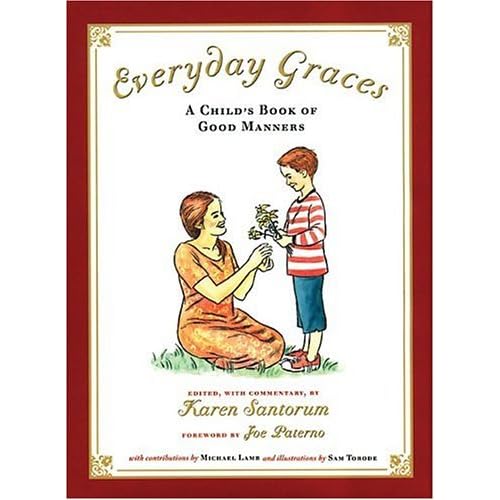
"Everyday Graces: Child's Book Of Good Manners," by Karen Santorum, Foreword by Joe Paterno.
What?!

I was going to read Santorum's "Letters to Gabriel," which deals with the same subject — the death of a baby — that Alan Colmes crudely mocked the other day. But not only is there no Kindle version, it's only available as a $130 hardcover book or a $192 audiobook. By the way, it has a Foreword by Mother Teresa.
Looking on to other works by Karen Santorum, I saw that "Good Manners" book, which sells for a reasonable $16.50, but unfortunately is not available for Kindle. I love the idea of teaching children manners. (Maybe if Rick Santorum wins the presidency, Karen — as First Lady — would make teaching manners her special issue. Michelle Obama gets away with insinuating that our kids are fat, so it would be fine, I'm thinking, for Karen Santorum to insinuate that are kids are rude. Or would that be rude?)
But what's with Joe Paterno writing the foreword? I know, Pennsylvania. It just seems so bizarre now.
I was going to read Santorum's "Letters to Gabriel," which deals with the same subject — the death of a baby — that Alan Colmes crudely mocked the other day. But not only is there no Kindle version, it's only available as a $130 hardcover book or a $192 audiobook. By the way, it has a Foreword by Mother Teresa.
Looking on to other works by Karen Santorum, I saw that "Good Manners" book, which sells for a reasonable $16.50, but unfortunately is not available for Kindle. I love the idea of teaching children manners. (Maybe if Rick Santorum wins the presidency, Karen — as First Lady — would make teaching manners her special issue. Michelle Obama gets away with insinuating that our kids are fat, so it would be fine, I'm thinking, for Karen Santorum to insinuate that are kids are rude. Or would that be rude?)
But what's with Joe Paterno writing the foreword? I know, Pennsylvania. It just seems so bizarre now.
3 సెప్టెంబర్, 2007
"Her atheism was not like mine."
Christopher Hitchens versus Bill Donohue re Mother Teresa.
Newsbusters highlights the part where Donohue asks if Hitchens wants to "take it outside" because it's missing from the MSNBC transcript. Also missing from the transcript is the last word out of Hitchens mouth, which amused me. At the end of the whole heated debate, Donohue gets off his last line "The only people that do not have doubts today are dogmatic atheists, people like you, Chris." Hitchens mutters "Christopher."
I enjoyed watching this exchange, not only because I'd listen to Hitchens talk about anything, but because Donohue keeps up the pressure, baiting Hitchens. Hitchens always seems angry, but he keeps it at a controlled seethe, and Donohue is doing his damnedest to get him to boil over. Twice, Donohue taunts him about the physical dimensions of Hitchens' book about Mother Teresa: "the thing against her, five and a half inches by eight and a half inches long, 98 pages, not a single endnote, not a single footnote, not a single citation," "your 98 page book, five and a half by eight and a half inches long—you have no citations." And, although it only appears once in the transcript, Donohue repeatedly says "an Englishman has to be quiet when an Irishman talks." Twice, Donohue pulls out the old line about how it's the atheists who are dogmatic.
Hitchens maintains his seething control and won't get distracted into reciting citations or explaining why atheists are not dogmatic. He keeps the focus on Mother Teresa, and his new approach is to claim her as a fellow atheist and to express sympathy for her as a victim of the church:
Newsbusters highlights the part where Donohue asks if Hitchens wants to "take it outside" because it's missing from the MSNBC transcript. Also missing from the transcript is the last word out of Hitchens mouth, which amused me. At the end of the whole heated debate, Donohue gets off his last line "The only people that do not have doubts today are dogmatic atheists, people like you, Chris." Hitchens mutters "Christopher."
I enjoyed watching this exchange, not only because I'd listen to Hitchens talk about anything, but because Donohue keeps up the pressure, baiting Hitchens. Hitchens always seems angry, but he keeps it at a controlled seethe, and Donohue is doing his damnedest to get him to boil over. Twice, Donohue taunts him about the physical dimensions of Hitchens' book about Mother Teresa: "the thing against her, five and a half inches by eight and a half inches long, 98 pages, not a single endnote, not a single footnote, not a single citation," "your 98 page book, five and a half by eight and a half inches long—you have no citations." And, although it only appears once in the transcript, Donohue repeatedly says "an Englishman has to be quiet when an Irishman talks." Twice, Donohue pulls out the old line about how it's the atheists who are dogmatic.
Hitchens maintains his seething control and won't get distracted into reciting citations or explaining why atheists are not dogmatic. He keeps the focus on Mother Teresa, and his new approach is to claim her as a fellow atheist and to express sympathy for her as a victim of the church:
She tried her best to believe. Her atheism was not like mine. I can't believe it and I am glad to think that it is not true, that there is a dictator in the heavens. So the fact that there is no evidence for it pleases me. She really wished it was true. She tried to live her life as if it was true.
She failed. And she was encouraged by cynical old men to carry on doing so because she was a great marketing tool for her church, and I think that they should answer for what they did to her and what they have been doing to us. I think it has been fraud and exploitation yet again....
Because of the opportunist chance that Mother Teresa offered them for publicity, [the Church] failed to restrain someone who really should have been seeking proper help that she never got. Instead, they exploited her to the very end and even gave her an exorcism, as you know. The archbishop of Calcutta has admitted it. He even had to give her an exorcism in 1997, because they had so much despair of her state of mind. It‘s a cruel exploitation of a simple and honest woman....
[The C]hurch... has an answer for everything. If you can‘t believe it, if it all seems to be radically untrue, nonetheless, faith will square that settle for you. She was trying for that. But as we now know, she failed. It can‘t be done. You can‘t make people believe in the impossible. All you can do is make people feel very guilty that they can‘t make themselves believe it.
24 ఆగస్టు, 2007
"Jesus has a very special love for you. As for me, the silence and the emptiness is so great that I look and do not see, listen and do not hear."
Wrote Mother Teresa in letters to her confessor.
The letters, many of them preserved against her wishes (she had requested that they be destroyed but was overruled by her church), reveal that for the last nearly half-century of her life she felt no presence of God whatsoever — or, as the book's compiler and editor, the Rev. Brian Kolodiejchuk, writes, "neither in her heart or in the eucharist."Via Metafilter, where the comments include:
That absence seems to have started at almost precisely the time she began tending the poor and dying in Calcutta, and — except for a five-week break in 1959 — never abated. Although perpetually cheery in public, the Teresa of the letters lived in a state of deep and abiding spiritual pain. In more than 40 communications, many of which have never before been published, she bemoans the "dryness," "darkness," "loneliness" and "torture" she is undergoing. She compares the experience to hell and at one point says it has driven her to doubt the existence of heaven and even of God. She is acutely aware of the discrepancy between her inner state and her public demeanor. "The smile," she writes, is "a mask" or "a cloak that covers everything." Similarly, she wonders whether she is engaged in verbal deception. "I spoke as if my very heart was in love with God — tender, personal love," she remarks to an adviser. "If you were [there], you would have said, 'What hypocrisy.'" Says the Rev. James Martin, an editor at the Jesuit magazine America and the author of My Life with the Saints, a book that dealt with far briefer reports in 2003 of Teresa's doubts: "I've never read a saint's life where the saint has such an intense spiritual darkness. No one knew she was that tormented." Recalls Kolodiejchuk, Come Be My Light's editor: "I read one letter to the Sisters [of Teresa's Missionaries of Charity], and their mouths just dropped open. It will give a whole new dimension to the way people understand her."
My view: Mother Teresa saw the reality of life more intimately than nearly anyone who has ever lived; she saw no kind and benevolent God because it doesn't exist. Kindness and benevolence comes from us, not an invisible superhero in the sky, and there wasn't much of it to be found toward her chosen charges....IN THE COMMENTS: Paddy O:
[Another commenter:] In the hospital she ran, patients dying of cancer were offered aspirin instead of morphine and were told to offer up the pain to God. Dying patients were baptized regardless of what their religion was. Mother Teresa got a donation from one of the men involved in the Lloyd's of London mess and would not return it despite knowing that it was stolen money. Instead she told the victims to forgive the people responsible for the theft. She was fanatically opposed to birth control. She turned every donation her hospital got over to the Vatican - meanwhile, her hospital was criminally undersupplied. If Mother Teresa didn't believe in God anymore, what was her excuse for maintaining the Catholic line?...
[Another:] [A]s Hitchens documents, she didn't work selflessly for mankind. She was a sick, twisted suffering fetishist who raised millions of dollars that were split between building more places to die (and that's literal- the "shelters" she built are horrible hellholes) and the Vatican coffers and cavorted with dictators. She was a horrible individual, and her veneration is a symbol of all that's wrong with the Church and all that's wrong with modern humanity.
She didn't see God. But she saw God in others. And those others knew it.Original Mike:
That she did what she did with all those inner doubts makes her all the more saintly.
23 ఏప్రిల్, 2007
"The event was disgraceful, so lame and mediocre that it is beyond parody."
That's Christopher Hitchens on why he walked out of the White House Correspondents’ Association dinner:
“It is impossible to decide which is more offensive: the president fawning over the press or the press fawning over the president. It expresses everything that the public means when they talk about inside-the-Beltway and access journalism.”Living like that, how do you stay outraged and sharp enough to know when other people are being lame and mediocre? So he's a "social arbiter," eh? Looking at him on TV, you'd think he was a social pariah. Funny how things are.
Mr. Hitchens didn’t storm out of the city. He stormed back to his house, where he co-hosted (along with fellow Vanity Fair contributor Todd Purdum and former Clinton aide Dee Dee Myers) the magazine’s post-dinner party, a much sought-after ticket.
Mr. Hitchens, a one-time pariah for his support of the Iraq invasion and his savaging of Mother Teresa, still serves as something of a social arbiter in Washington. And following the strange-bedfellows theme, Paul Wolfowitz, the embattled World Bank president, was chatting amiably in a roomful of journalists at Mr. Hitchens’ home.
27 డిసెంబర్, 2005
"The thief 'went right for the bun.'"
You remember the cinnamon bun that looks like Mother Teresa:

Stolen!
Stolen!
The Bongo Java coffee shop sold T-shirts, prayer cards and mugs with the bun's image until Mother Teresa wrote a letter asking the sales be stopped, before her death in 1997.
[Coffee shop owner Bob] Bernstein said the thief "went right for the bun", ignoring cash lying nearby.
13 అక్టోబర్, 2004
The last debate live-blog of the presidential campaign.
Okay, I'm getting set up now for the big live-blog of the last debate. I've been pre-linked by Instapundit (thanks and best wishes for his dad) and I've already seen the day's traffic level shoot up, even though I can't be live-blogging yet. It hasn't started. Keeping to my standard form, I'll number the paragraphs to indicate the updates, starting a new number after each upload. I'm going au naturel tonight--i.e., no TiVo pausing--just straight live blogging--and not just so N.Z. Bear won't call me a sissy. I'm doing it because I'm weary--weary I tell you!--of all this ersatz debating. If I eschew TiVo, the ordeal will necessarily end in ninety minutes. You start TiVo-pausing and you can find yourself still struggling to get to the finish line three hours later. I'm not so interested in recording the details of the domestic policy disputes anyway, for reasons blogged about earlier today. So I'll just observe what I observe as the real-time minutes click by. I am not looking to find fault and run anybody down or plump anybody up. I'll honestly or humorously pass along the observations I happen to make.
1. Back to the clunky, oak-grained lecterns. Bush winks. Kerry's looking happy. Will our children live in a secure world? Kerry: Yes. Bush looks bright red on a broadcast channel and I switch to CNN and he isn't bright red anymore. Kerry is blaming Bush for any existing unsafeness (the ports and the cargo hold again). Bush also says we can be safe, unsurprisingly, and he's got a strategy for making us safe. Bush seems a bit jazzed up.
2. A question about the flu vaccine shortage gets Bush talking about tort reform and Kerry talking about health care reform. Bush is smiling a lot, and the left side of his mouth nevertheless turns down oddly. A glob of foam forms on the right side of his mouth! Yikes! That's really going to lose the women's vote. [UPDATE: the NYT and the WaPo take note of this, and only this, observation and I react to that attention here. Belmont Club also links to this observation, and I discuss that here.]
3. Taxes. Didn't listen, sorry. Jobs. Kerry doesn't like that Bush talked about education when asked about jobs. He makes an analogy between Bush and Tony Soprano, but he's speaking quickly and I don't quite pick it up. Another jobs question: maybe the President doesn't have that much control over jobs. Kerry says it's not all the President's fault, but Bush, of course, nevertheless has many faults that have resulted in the loss of jobs. Kerry's left eyelid is sagging. There's a lot of policy spewing right now. Bush: "wooo!" That's kind of how I felt. Bush slowly spells out the tax advantages he's given people. When you have more money in your pocket, you're able to buy things you want--I agree! I really doubt if many people would stick around to watch this.
4. Homosexuality: do you think it's a choice? Bush: I don't know. Tolerance is important, he says carefully, then launches into an explanation of why he's doesn't want courts to impose gay marriage on the country. Kerry firmly states that homosexuality is not a choice and spends a creepy amount of time re-informing us that Cheney's daughter is a lesbian (so what?) and that it's not a choice for her. He expresses trust in the restraint of the courts.
5. Abortion. Kerry repeats his position that he opposes abortion as an "article of faith" but can't impose it on others. He also says "faith without works is dead." He asserts that his public service is God's work, but he also supports the right to choose. A hard set of beliefs to fit together, but I think decent people do fit them together, though it's hard for abortion opponents to accept. Bush repeats his "culture of life" way of speaking about abortion. Unlike Kerry, Bush does not bring in religion, except to the extent that it is implied by the concept of "a culture of life."
6. Health care costs. Bush does a lively presentation of his proposals here. Kerry blames Bush for higher health care costs because a bill in Congress was blocked (but earlier he complained that Bush has never used his veto). Bush: Kerry has no record of leadership on health care--after so many years in the Senate. Kerry is able to cite an example of a health care bill of his, so Bush is misleading us again, he says.
7. Still with the health care costs. Kerry is reeling out a lot of proposals that sound pretty good, but that I am in no position to evaluate right now. Bush starts to insult the news media, then stops himself. That was sloppy. Bush points out the fundamental difference between him and Kerry: Kerry will move us to a government-run health care system and urges us to reject that. It will leave us with poor quality health care. Kerry responds that he isn't proposing a government run program. It's hard to tell if he is or not. Again, we're hearing a torrent of policy, and I think this is off-putting to most people. They're talking about insurance really. Don't you want to run when someone starts talking insurance at you? Not that it isn't important....
8. Saving social security. Bush says he will and explains various plans. Kerry objects to the part about letting young people set up separate accounts. He warns us of a two trillion dollar hole in social security. Somehow this makes Bush laugh. Kerry claims to be the fiscal responsibility candidate. And he won't cut benefits. Lots of promises. The key question is which candidate is inspiring more trust, because we really can't evaluate the proposals themselves. In this effort, Kerry presents himself as a competent problem solver, and Bush tries to warn us that Kerry will do those things liberals do.
9. Illegal immigration. Bush is vigorous and passionate here. He was a border governor. He expresses real empathy for those who are seeking employment. Kerry goes back to the subject of tax cuts from the previous question. I dislike going back to an earlier question, especially, as here, where it is done to repeat standard lines about taxes. It makes it seem as though he's not interested enough in the issue that is on the table. "It's against the law to hire people illegally." Gee, thanks, but isn't everything that is illegal against the law? "We have thumb-print technology," Kerry says wiggling all of his fingers.
10. I hope there aren't too many typos and glitches in these posts. I'm sure I'll cringe over them later. Back to the live-blogging: does Kerry want to raise the minimum wage? Of course! Raise away! If we pay people more, they will have more money and will buy more things! Okay. Bush: the key thing is education! No Child Left Behind.
11. Will Bush look for judges who will overturn Roe v. Wade? Bush: I won't have a litmus test. Both candidates rely on the idea that they will pick good judges. Kerry uses his time to go back to the subject of No Child Left Behind. He doesn't seem too interested at all in talking about what kind of judges he wants. Bush rebuts, saying Kerry clearly has a pro-Roe litmus test for judges. Bush adds some material about No Child Left Behind and Kerry uses his rebuttal to talk about that. Kerry never denies that he has a litmus test for judges.
12. The problem of overuse of the National Guard. Kerry uses this as an opportunity to repeat his points about Iraq (we went to war the wrong way, we need to work with the rest of the world, etc.). This is Bush's big final chance to defend his Iraq policy. Let's see what he does. "The best way to take the pressure off our troops is to succeed in Iraq." He has talked to the troops, and "their spirits are high." Speaking slowly, he brings up Kerry's "global test," and becomes emphatic saying that he won't give up our security decisions to other nations. Bush wins this exchange, I think.
13. Guns! Bush: go after the criminals, not the guns. (Not surprising.) Kerry: he's a hunter, you know. But we need to control assault weapons. Terrorists will come here and go to gun shows and buy assault weapons.
14. Do we still need affirmative action? Kerry: sadly, yes, and Bush is actually doing things that are making affirmative action more needed. Kerry's for affirmative action for women and for other groups as well as for racial minorities. But he is opposed to quotas. Bush: he doesn't like quotas either, but the key here is (again) education. He speaks about the affordability of education. (Pell grants are mentioned a lot tonight.) He wants to encourage entrepreneurship: "That's hopeful, and that's positive."
15. What part does faith play in making presidential decisions? Bush: he speaks well here. Faith is important in his life, he prays a lot, and he feels the prayers that are offered for him. He speaks of the importance of inclusion. "I believe God wants everybody to be free" and that belief has driven his foreign policy. He says he thinks God made it possible to bring freedom to Iraq, which I'm sure he'll catch hell for. Kerry: "Everything is a gift from the Almighty." Kerry does not chide Bush for what he's said about melding religious belief and governmental decisionmaking, which is a wise choice on his part. But I think his supporters will jump all over Bush for this.
16. Bringing the nation together. Kerry: Bush has squandered the goodwill that existed right after 9/11. Bush has been divisive and ideological. Kerry is going to work with "my friend John McCain" to bring more campaign finance reform. Bush expresses disappointment at how partisan Washington is. But it was nice how they got No Child Left Behind passed (that law is getting a lot of mentions tonight). He makes a big point of saying McCain is for him ... because of Iraq. The lectern is pounded.
17. Talk about the strong women in your life. Bush gets some laughs from the audience who aren't supposed to make a peep. He can't say how much he loves Laura, and he sounds really sweet and warm. Kerry laughs saying both men "married up," and it seems to be too much a reference to how incredibly rich Teresa is. Without saying that he loves his wife, he switches over to talking about his mother!
18. Kerry's closing statement: something about "ideers" and reaching higher and grabbing dreams. "Embark on that journey with me." Pretty platitudinous. Bush: there's painting in the Oval Office that has something to do with seeing the sunrise and hence with the way things are getting better in the U.S.
19. Tim Russert is saying Kerry went all out trying to appeal to women, but Kerry's biggest mistake was snickering over his economically beneficial marriage and forgetting to say a thing about loving his wife right after Bush seemed almost overcome with emotion saying how much he loved Laura!
20. Rudy Giuliani is saying that Bush did a great job expressing his love for his wife--I agree--and his deep feeling about religion, while Kerry was just spewing statistics. I think both candidates spend a lot of time blabbing about policy details that you couldn't really follow competently, but that at those two key points, as Giuliani said, Bush revealed the deep personal side of himself, while Kerry was always cool and businesslike. Dukakis-like.
1. Back to the clunky, oak-grained lecterns. Bush winks. Kerry's looking happy. Will our children live in a secure world? Kerry: Yes. Bush looks bright red on a broadcast channel and I switch to CNN and he isn't bright red anymore. Kerry is blaming Bush for any existing unsafeness (the ports and the cargo hold again). Bush also says we can be safe, unsurprisingly, and he's got a strategy for making us safe. Bush seems a bit jazzed up.
2. A question about the flu vaccine shortage gets Bush talking about tort reform and Kerry talking about health care reform. Bush is smiling a lot, and the left side of his mouth nevertheless turns down oddly. A glob of foam forms on the right side of his mouth! Yikes! That's really going to lose the women's vote. [UPDATE: the NYT and the WaPo take note of this, and only this, observation and I react to that attention here. Belmont Club also links to this observation, and I discuss that here.]
3. Taxes. Didn't listen, sorry. Jobs. Kerry doesn't like that Bush talked about education when asked about jobs. He makes an analogy between Bush and Tony Soprano, but he's speaking quickly and I don't quite pick it up. Another jobs question: maybe the President doesn't have that much control over jobs. Kerry says it's not all the President's fault, but Bush, of course, nevertheless has many faults that have resulted in the loss of jobs. Kerry's left eyelid is sagging. There's a lot of policy spewing right now. Bush: "wooo!" That's kind of how I felt. Bush slowly spells out the tax advantages he's given people. When you have more money in your pocket, you're able to buy things you want--I agree! I really doubt if many people would stick around to watch this.
4. Homosexuality: do you think it's a choice? Bush: I don't know. Tolerance is important, he says carefully, then launches into an explanation of why he's doesn't want courts to impose gay marriage on the country. Kerry firmly states that homosexuality is not a choice and spends a creepy amount of time re-informing us that Cheney's daughter is a lesbian (so what?) and that it's not a choice for her. He expresses trust in the restraint of the courts.
5. Abortion. Kerry repeats his position that he opposes abortion as an "article of faith" but can't impose it on others. He also says "faith without works is dead." He asserts that his public service is God's work, but he also supports the right to choose. A hard set of beliefs to fit together, but I think decent people do fit them together, though it's hard for abortion opponents to accept. Bush repeats his "culture of life" way of speaking about abortion. Unlike Kerry, Bush does not bring in religion, except to the extent that it is implied by the concept of "a culture of life."
6. Health care costs. Bush does a lively presentation of his proposals here. Kerry blames Bush for higher health care costs because a bill in Congress was blocked (but earlier he complained that Bush has never used his veto). Bush: Kerry has no record of leadership on health care--after so many years in the Senate. Kerry is able to cite an example of a health care bill of his, so Bush is misleading us again, he says.
7. Still with the health care costs. Kerry is reeling out a lot of proposals that sound pretty good, but that I am in no position to evaluate right now. Bush starts to insult the news media, then stops himself. That was sloppy. Bush points out the fundamental difference between him and Kerry: Kerry will move us to a government-run health care system and urges us to reject that. It will leave us with poor quality health care. Kerry responds that he isn't proposing a government run program. It's hard to tell if he is or not. Again, we're hearing a torrent of policy, and I think this is off-putting to most people. They're talking about insurance really. Don't you want to run when someone starts talking insurance at you? Not that it isn't important....
8. Saving social security. Bush says he will and explains various plans. Kerry objects to the part about letting young people set up separate accounts. He warns us of a two trillion dollar hole in social security. Somehow this makes Bush laugh. Kerry claims to be the fiscal responsibility candidate. And he won't cut benefits. Lots of promises. The key question is which candidate is inspiring more trust, because we really can't evaluate the proposals themselves. In this effort, Kerry presents himself as a competent problem solver, and Bush tries to warn us that Kerry will do those things liberals do.
9. Illegal immigration. Bush is vigorous and passionate here. He was a border governor. He expresses real empathy for those who are seeking employment. Kerry goes back to the subject of tax cuts from the previous question. I dislike going back to an earlier question, especially, as here, where it is done to repeat standard lines about taxes. It makes it seem as though he's not interested enough in the issue that is on the table. "It's against the law to hire people illegally." Gee, thanks, but isn't everything that is illegal against the law? "We have thumb-print technology," Kerry says wiggling all of his fingers.
10. I hope there aren't too many typos and glitches in these posts. I'm sure I'll cringe over them later. Back to the live-blogging: does Kerry want to raise the minimum wage? Of course! Raise away! If we pay people more, they will have more money and will buy more things! Okay. Bush: the key thing is education! No Child Left Behind.
11. Will Bush look for judges who will overturn Roe v. Wade? Bush: I won't have a litmus test. Both candidates rely on the idea that they will pick good judges. Kerry uses his time to go back to the subject of No Child Left Behind. He doesn't seem too interested at all in talking about what kind of judges he wants. Bush rebuts, saying Kerry clearly has a pro-Roe litmus test for judges. Bush adds some material about No Child Left Behind and Kerry uses his rebuttal to talk about that. Kerry never denies that he has a litmus test for judges.
12. The problem of overuse of the National Guard. Kerry uses this as an opportunity to repeat his points about Iraq (we went to war the wrong way, we need to work with the rest of the world, etc.). This is Bush's big final chance to defend his Iraq policy. Let's see what he does. "The best way to take the pressure off our troops is to succeed in Iraq." He has talked to the troops, and "their spirits are high." Speaking slowly, he brings up Kerry's "global test," and becomes emphatic saying that he won't give up our security decisions to other nations. Bush wins this exchange, I think.
13. Guns! Bush: go after the criminals, not the guns. (Not surprising.) Kerry: he's a hunter, you know. But we need to control assault weapons. Terrorists will come here and go to gun shows and buy assault weapons.
14. Do we still need affirmative action? Kerry: sadly, yes, and Bush is actually doing things that are making affirmative action more needed. Kerry's for affirmative action for women and for other groups as well as for racial minorities. But he is opposed to quotas. Bush: he doesn't like quotas either, but the key here is (again) education. He speaks about the affordability of education. (Pell grants are mentioned a lot tonight.) He wants to encourage entrepreneurship: "That's hopeful, and that's positive."
15. What part does faith play in making presidential decisions? Bush: he speaks well here. Faith is important in his life, he prays a lot, and he feels the prayers that are offered for him. He speaks of the importance of inclusion. "I believe God wants everybody to be free" and that belief has driven his foreign policy. He says he thinks God made it possible to bring freedom to Iraq, which I'm sure he'll catch hell for. Kerry: "Everything is a gift from the Almighty." Kerry does not chide Bush for what he's said about melding religious belief and governmental decisionmaking, which is a wise choice on his part. But I think his supporters will jump all over Bush for this.
16. Bringing the nation together. Kerry: Bush has squandered the goodwill that existed right after 9/11. Bush has been divisive and ideological. Kerry is going to work with "my friend John McCain" to bring more campaign finance reform. Bush expresses disappointment at how partisan Washington is. But it was nice how they got No Child Left Behind passed (that law is getting a lot of mentions tonight). He makes a big point of saying McCain is for him ... because of Iraq. The lectern is pounded.
17. Talk about the strong women in your life. Bush gets some laughs from the audience who aren't supposed to make a peep. He can't say how much he loves Laura, and he sounds really sweet and warm. Kerry laughs saying both men "married up," and it seems to be too much a reference to how incredibly rich Teresa is. Without saying that he loves his wife, he switches over to talking about his mother!
18. Kerry's closing statement: something about "ideers" and reaching higher and grabbing dreams. "Embark on that journey with me." Pretty platitudinous. Bush: there's painting in the Oval Office that has something to do with seeing the sunrise and hence with the way things are getting better in the U.S.
19. Tim Russert is saying Kerry went all out trying to appeal to women, but Kerry's biggest mistake was snickering over his economically beneficial marriage and forgetting to say a thing about loving his wife right after Bush seemed almost overcome with emotion saying how much he loved Laura!
20. Rudy Giuliani is saying that Bush did a great job expressing his love for his wife--I agree--and his deep feeling about religion, while Kerry was just spewing statistics. I think both candidates spend a lot of time blabbing about policy details that you couldn't really follow competently, but that at those two key points, as Giuliani said, Bush revealed the deep personal side of himself, while Kerry was always cool and businesslike. Dukakis-like.
దీనికి సబ్స్క్రయిబ్ చేయి:
పోస్ట్లు (Atom)


 పోస్ట్లు


