Marie Kondo లేబుల్‌తో ఉన్న పోస్ట్‌లను చూపుతోంది. అన్ని పోస్ట్‌లు చూపించు

28 నవంబర్, 2025

"[T]he '30-book limit' is a mistake. This misunderstanding likely originated from my comment, where I mentioned that I personally was left with about 30 books..."

"... after tidying my own collection. This comment was exaggerated over time, and somehow turned into the idea that I had created a 'rule' limiting books to 30.... The main focus is always on choosing what sparks joy for you. Therefore, whether the result is 30 books or 100 books, it is fine.... I actually have more than 30 books on my shelves now, partly because I now have a larger bookshelf than I did back then...."


I like the idea that part of what makes a book qualify for keeping in your collection is how it feels as an object.

8 ఆగస్టు, 2024

"[Chef Thomas Keller] inspired the chef Rob Rubba to display a plaque — 'always be knolling' — near the pass at his award-winning restaurant, Oyster Oyster..."

"... in Washington, D.C. The phrase, popular in the world of art and design, refers to arranging objects so they are parallel or at 90-degree angles. At Oyster Oyster, it’s meant to encourage chefs to organize their work spaces, and, by extension, their minds, 'like an opening yoga sequence or tuning a guitar,' Mr. Rubba said. 'As people in hospitality, we look to things to keep us inspired, to motivate us,' said William Bradley, the chef and director of the Michelin-starred San Diego restaurant Addison. Especially for a restaurant staff that is 'performing at the highest level.' After Addison earned its second star in 2021, Mr. Bradley huddled with his staff and agreed to install an engraved plaque in the kitchen with the Navy SEAL call and response, 'All in, all the time.'"

From "Live, Laugh, Lowboy: Fine Dining’s Love Affair With Inspirational Quotes/Sayings from Navy SEALs, furniture designers and Steve Martin are just a few examples of how restaurants use signs to motivate their staffs" (NYT).

It's funny to see these word wall signs presented as cool when hung by men in restaurant kitchens. For years, people have been mocking women who put up these signs in their homes. I can see from the article — not from my own TV habits — that the coolness has something to do with the show "The Bear" (the restaurant in that show has a sign that says "Every Second Counts").

Reminds me of: "I should get one of those signs that says 'One of these days I'm gonna get organizized...."/"... like those little signs they have in offices that say 'Thimk'":


"I know that Tom Sachs is where it proliferated," says Amy Auscherman, director of archives and brand heritage at MillerKnoll..... "It’s a point of pride to be able to say the company name is also a verb." While the blue-chip artist laid out the rules for knolling and championed the concept into the creative world, sculptor Andrew Kromelow originally invented it. Both men worked in Frank Gehry’s Santa Monica studio during the late 1980s; Kromelow was in charge of keeping the workshop tidy as a janitor and would feverishly organize so that workers could quickly and clearly see all the tools at once. At the time, the Gehry studio was constructing a bent-plywood chair for Knoll. The name stuck.

From the internal link:

HOW TO KNOLL

  1. Scan your environment for materials, tools, books, music, etc. which are not in use.
  2. Put away everything not in use. If you aren't sure, leave it out.
  3. Group all 'like' objects.
  4. Align or square all objects to either the surface they rest on, or the studio itself....
Sachs’ studio mantra was instituted - ABK - ‘Always Be Knolling', a riff on the salesmen’s ‘ABC - Always Be Closing’ recited by Alex Baldwin in the screen adaptation of David Mamet’s Glengarry Glen Ross. It is an exquisite subversion of the capitalist creed into a sense of creativity in the display of the tools of craft. It is a riposte to the real estate snake-oil sales culture in the form of a celebration of making and order.  

6 నవంబర్, 2023

"I normally bring nice clothes to travel, but this time I brought my worst, items I could chuck in the trash — where they belonged three years ago."

"Having Marie Kondo’d these rags, I had more room in my bag and could either dress normally en route home, or carry all the souvenirs I’d buy with the $128 I saved being my own suitcase."

I'm blogging this not because — as you might think — it shows how second-rate the travel experience really is but because it uses "Marie Kondo" as a verb and that's something I'd encountered only yesterday — when I blogged that essay about  "once-fabulous tits" that had "transmogrified into a bosom" — and because I thought it would be fun to write this sentence.

5 నవంబర్, 2023

"The night before my surgery, feeling perhaps a bit of sadness at losing my identity as a 'large-breasted woman'..."

"... I took a last look at my breasts in the mirror and—on the advice of a friend—Marie Kondo’ed them. I thanked them for their (purely cosmetic) service, and bid them, in their current iteration, farewell. At the hospital, the surgeon twisted each of my breasts up as if he was about to cut bangs and marked them with a Magic Marker. This was, he explained, a French technique...."

Writes Xochitl Gonzalez, in "Me and My Bosom/I wasn’t ready for the 'Doña Body'" (The Atlantic).

After the surgery:

29 డిసెంబర్, 2022

"The anti-clutter nags conflate two distinct forms of materialism. In behavioral psychology terms, 'terminal materialism' refers to..."

"... acquiring and valuing an object purely for its intrinsic properties — like a fancy new iPhone (that will inevitably become obsolete). The worthless-looking junk we hang on to often exemplifies 'instrumental materialism,' valued for its connection to another person, a place, a time in our lives, a meaningful affiliation. These can take obvious forms — a wedding ring, a crucifix. But they can also be as eccentric and inscrutable as an abundance of paperweights or a ceramic leprechaun."

Writes Rob Walker in "Clutter Is Good for You" (NYT).

Walker quotes a book by Mihaly Csikszentmihalyi and Eugene Rochberg-Halton that asserted: "We began to notice that people who denied meanings to objects also lacked any close network of human relationships."

A disturbing challenge to minimalists!

15 నవంబర్, 2022

"She admits to talking to her bathtub as she wipes it dry, saying, 'It’s amazing how you’re always so clean and free of mold.'..."

"A big obstruction to tidying, she notes, is the gap between the way many of us live and our ideal lifestyles. Rather than let this disparity discourage us, she recommends clinging to our dreams and doing whatever small things we can to realize them — like putting a photograph of a beautiful landscape on a windowless wall, where we might wish we had a view.... Her own ideal lifestyle involves daily yoga, herbal tea breaks, time with her three young children and the opportunity, when she can grab it, to scrub the floor on her hands and knees. This activity not only releases tension and improves posture but also brings good vibes, she writes: 'The floor is the foundation of the house. Cleaning it with my own hands helps me feel my connection to it.'"

From "Marie Kondo Takes On a New Role: Life Coach/There’s a big difference between the way most of us wish we lived and how we actually do. The tidying guru is back with a new book to help fix that" by Julie Lasky (NYT).

The new book is "Marie Kondo’s Kurashi at Home." That link goes to Amazon, where there's an excerpt from the book that includes defining "kurashi":

13 ఫిబ్రవరి, 2022

Covid culture, year 3 — how Valentine's Day looks on the front page of the NYT.

I just wanted to share this woeful screenshot from at the NYT:

Let's see... how depressing is this? 

1. "For Valentine’s Day, Try Being Nice to Yourself/Sending love to others is easy. Being kind to yourself can be surprisingly difficult." This piece was originally published on Valentine's Day, 2019, so only the choice to resurrect it reflects the dreary spirit of 3-year-old Covid.

Use this short test developed by Dr. Neff to gain a snapshot of your own level of self-compassion. If you score low, commit to learning some self-compassion practices.... "You deserve your care and attention... Treat yourself to a delicious meal, a good book, a nice walk with a lovely view. As you would invest in the person you love, so you should invest in yourself."

2. "The Unbearable Heaviness of Clutter/A cluttered home can be a stressful home, researchers are learning." Another piece from 2019. Remember, pre-Covid, when clutter was the great plague? I can see from my Marie Kondo tag that I still blogged about her up through the end of 2020, so I guess staying at home in Year 1 overlapped with the exciting passion for de-cluttering. But it didn't carry over to Year 2, so is it ready for a comeback in Year 3? Instead of finding love out in the real world, we're supposed to keep staying home and putting ourselves — see #1, supra — and our homes in good order? Or maybe that relationship you think you want can be analogized to household clutter:

Dr. Saxbe agreed that a good way to declutter is to keep items out of the house in the first place. She urged shoppers to consider whether they truly need an item or if it will add to their home’s sense of dysfunction. “Once it’s in the house, it’s really hard to deal with. You get attached to the things you own,” she said.

Once it’s in the house, it’s really hard to deal with — see what I mean? 

3. Now, why is my eyelid twitching? This is an article from last December, and I can only think that the reason for re-elevating this issue on Valentine's Day weekend is to direct your attention away from that other body part that normally gets the attention — the heart. Why does my heart ache? No no no, why does your eyelid twitch?

26 డిసెంబర్, 2020

"As retro as a shelf of books might seem in an era of flat-panel screens, Books by the Foot has thrived through Democratic and Republican administrations..."

"... including that of the book-averse Donald Trump. And this year, the company has seen a twist: When the coronavirus pandemic arrived, Books by the Foot had to adapt to a downturn in office- and hotel-decor business—and an uptick in home-office Zoom backdrops for the talking-head class.... If an order were to come in for, say, 12 feet of books about politics, specifically with a progressive or liberal tilt... one of [the] more politics-savvy staffers to the enormous box labeled 'Politically Incorrect' (the name of Books by the Foot’s politics package) to select about 120 books by authors like Hillary Clinton, Bill Maher, Al Franken and Bob Woodward. The books would then be 'staged,' or arranged with the same care a florist might extend to a bouquet of flowers, on a library cart; double-checked by a second staffer; and then shipped off to the residence or commercial space where they would eventually be shelved and displayed (or shelved and taken down to read).... A lover of books who professes to never want to see them destroyed, [Wonder Book President Chuck Roberts said] 'Pretty much every book you see on Books by the Foot [is a book] whose only other option would be oblivion'...."


All those political books — you see that they are published, and you see that they are calling cards for their authors to go on talk shows, but are they ever read? At least they have one more purpose, sitting on a shelf, a shelf that will be seen, a constituent of an extra-thick wall. How much bigger would rooms be without these for-show books? One more foot wide for every bookcase you can scuttle. But here are people shipping books in, books they have no intention of reading.

Meanwhile, a lot of people are trying to declutter, and books are a whole category for "tidying up" within the Marie Kondo system (which only has 5 categories). That system requires you to pile all your books on the floor and one one by one subject them to a test that has a strong presumption against keeping any given book:
The criterion is, of course, whether or not it gives you a thrill of pleasure when you touch it. Remember, I said when you touch it. Make sure you don’t start reading it. Reading clouds your judgment. Instead of asking yourself what you feel, you’ll start asking whether you need that book or not. Imagine what it would be like to have a bookshelf filled only with books that you really love. Isn’t that image spellbinding?...  [F]orget about whether you think you’ll read it again or whether you’ve mastered what’s inside. Instead, take each book in your hand and decide whether it moves you or not. Keep only those books that will make you happy just to see them on your shelves, the ones that you really love.... There’s no need to finish reading books that you only got halfway through. Their purpose was to be read halfway. So get rid of all those unread books....

Imagine touching a book "by authors like Hillary Clinton, Bill Maher, Al Franken and Bob Woodward" and feeling "a thrill of pleasure." I don't have to touch these books to know I would not be thrilled! I can't even imagine another person who could be thrilled. It's a difficult feat of imagination, and I cannot do it. 

14 ఏప్రిల్, 2020

"Kondo begins her workday by spritzing the air with an aromatherapy spray to clear her mind."

"(This particular day, she used a blend of cardamom and black pepper oils, lemon and sandalwood called Motivation Mist: Now or Never, which she sells on her website.) 'I read somewhere that of our five senses, our sense of smell is very important and affects the brain and relaxes our mind,' Kondo says. This ritual makes her feel like she’s 'shifting gears into a work mode.'"

Possibly the dopiest paragraph in WaPo today — from "Marie Kondo has advice for living and working at home in a pandemic."

I have almost no sense of smell, so the emphasis on smelling the right thing annoys me. And I read it right after this other smell-and-coronavirus offering from WaPo: "What it’s like to suffer from the coronavirus’s weirdest symptom."
"I could literally bite into an onion like it was an apple. And there was just nothing there. It was just absolutely bizarre."... They settled in for a joyless 10 days of putting food in their mouths and then swallowing it — "eating" would be the wrong word for it, because eating is a pleasure. This was mechanical. [She] bothered with it less and less. "There was no point,” she says. “Even if I had a craving for something and I had that item right in front of me, there was no satisfying it because we couldn’t taste it."
Jeez. All right. Have a little pity on the people who have this experience all the time, and you have my sympathy for your coronavirus. Stay alive. I mean, really, who cares about "weird" right now? But I guess it's a struggle for the newspapers to keep writing news stories when nobody's out there doing anything, and everything must be about coronavirus, including the fulfillment of the craving for fluff (which tastes like marshmallow, to those who have a sense of smell-taste).

What can we say of the brains of those afflicted with a lack of smell? Unaffected? Unrelaxed?

12 ఏప్రిల్, 2020

"Well, the treadmill you’ve been on for decades just stopped. Bam! And that feeling you have right now is the same as..."

"... if you’d been thrown off your Peloton bike and onto the ground: What in the holy fuck just happened? I hope you might consider this: What happened is inexplicably incredible. It’s the greatest gift ever unwrapped. Not the deaths, not the virus, but The Great Pause. It is, in a word, profound.... What the crisis has given us is a once-in-a-lifetime chance to see ourselves and our country in the plainest of views.... If we want to create a better country and a better world for our kids, and if we want to make sure we are even sustainable as a nation and as a democracy, we have to pay attention to how we feel right now. I cannot speak for you, but I imagine you feel like I do: devastated, depressed, and heartbroken. And what a perfect time for Best Buy and H&M and Wal-Mart to help me feel normal again. If I could just have the new iPhone in my hand, if I could rest my feet on a pillow of new Nikes, if I could drink a venti blonde vanilla latte or sip a Diet Coke, then this very dark feeling would go away.... What is about to be unleashed on American society will be the greatest campaign ever created to get you to feel normal again. It will come from brands, it will come from government, it will even come from each other, and it will come from the left and from the right.... This is our chance to define a new version of normal, a rare and truly sacred (yes, sacred) opportunity to get rid of the bullshit and to only bring back what works for us, what makes our lives richer, what makes our kids happier, what makes us truly proud. We get to Marie Kondo the shit out of it all.... But only if we resist the massive gaslighting that is about to come. It’s on its way. Look out."

Writes Julio Vincent Gambuto in "Prepare for the Ultimate Gaslighting/You are not crazy, my friends" (Medium).

22 నవంబర్, 2019

The cheap, obtuse fun of mocking Marie Kondo for selling some expensive, carefully chosen objects.

I saw the mockery the other day, but didn't want to take the trouble to say what is too obvious to ignore, but here's Penelope Green saying it in the NYT: "Marie Kondo Wants to Sell You Nice Things. What’s Wrong With That?/Her new online store honors her brand’s ethos: that objects can make people happy."

Kondo's decluttering was never about getting down to the bare minimum. It's about getting rid of everything that doesn't make you feel happy. That assumes you do have a few things that really work for you. But what would those things be? And what if you're just starting out? And also, what if you need to buy gifts for people who you know have followed the Marie Kondo method?

Here's the KonMari store. And here's the page for the most-mocked thing: Tuning Fork & Rose Quartz Crystal/$75.
Marie uses a tuning fork in her everyday life to help her to reset – and she’s never without a crystal. Striking the fork against a crystal creates pure tones that are believed to help restore a sense of balance. Made of aluminum alloy, this KonMari tuning fork has a frequency of 4,096 hertz. Comes with a rose quartz crystal.
She's never without a crystal, but she doesn't make any assertions about what the crystal is supposed to do. Leave the crystal beliefs to others to propound, but as for the tuning fork, the belief is stated: It restores a sense of balance. I note that there's no assertion that Marie believes that or that the belief is true. The assertion is only that there are such beliefs out there, presumably somewhere in the mind of some human beings, because where else could beliefs that complex exist? A cat might have a sense of balance, but it's unlikely that a cat has beliefs about a sense of balance, and virtually impossible for a cat to think it could recover a lost sense of balance by using an object to make a particular sound.

8 జూన్, 2019

Own... rent... it's all a state of mind, isn't it?

I'm reading "They See It. They Like It. They Want It. They Rent It. Owning nothing is now a luxury, thanks to a number of subscription start-ups" (NYT):
Many young American urbanites have resigned themselves to a life of non-ownership, abandoning the dream of their parents and grandparents and great-grandparents before them, often out of financial necessity. But renting isn’t just a matter of necessity these days. It’s become almost posh....

“We were raised to save and invest and buy a home and do all of these things,” said Miki Reynolds, 38, who pays a monthly fee for much of what she uses in her day-to-day life in Los Angeles. “But my mentality to currently rent — it’s not YOLO. It’s more living in the present as much as planning for the future because I feel like nothing is guaranteed.”...

“I want nice things, but I’m also not going to drop thousands of dollars all at once on a bunch of things when I don’t know in a year if I’m going to be in the same place,” [said Lili Morton, 36, who recently moved to Seattle from New York].... “I’m going to get a facial or a massage or get my hair blown out,” she said, “things that make me feel good and happy, rather than some impulse purchase that makes you feel good for a bit but maybe you get tired of it.”
The NYT presents this as a youthful change, but the big change is all these services that make it easy to rent different kinds of things. And it's not just for the young, is it?

This is also something us Baby Boomers might want. Get rid of all the accumulated stuff — Marie Kondo the hell out of your life — unload the real estate and move somewhere with no idea if in a year you're going to be in the same place.

Permanence is an illusion, and if you like that illusion, you can bolster it with an ownership relationship to your things, but you can embrace and highlight impermanence through rental.

And these rental services are there to help (and to employ both Miki Reynolds and Lili Morton, you'll see if you look closely).

This subject calls to mind the old joke: "You don't buy beer, you rent it." It's funny (or was funny, when it was funny) because of the graphic depiction of impermanence. You have paid and you think you own what you bought, but it is only flowing through you. You can't hold onto that beer or, in the long run, anything else. If that troubles you, raise your spirits with a certificate of ownership.

4 ఫిబ్రవరి, 2019

"I don't understand why the generic labeling of a time slot on a schedule means very much. People seem to be acting as though [Trump] just sat around watching Fox News."

"These seem to be the same people who don't like anything Trump does anyway, so you'd think they'd be happy that he's just idling. Does a schedule full of meetings prove you're a hard-worker, getting things done? I've gone to a lot of meetings where I felt my time was wasted and I was being kept from working. The people who schedule a lot of meetings maybe have a bureaucratic mindset and care about the superficiality of looking busy. I think an uncluttered schedule is helpful to a person with serious work that depends on the condition and quality of his mind."

I wrote... on a public Facebook post (put up by my son John) that linked to "Nearly 60 percent of Trump’s schedule is ‘Executive Time,’ report says" (CNBC). CBC relies on this AXIOS report, which has a response from White House press secretary Sarah Sanders:
"President Trump has a different leadership style than his predecessors and the results speak for themselves. While he spends much of his average day in scheduled meetings, events, and calls, there is time to allow for a more creative environment that has helped make him the most productive President in modern history."
A more creative environment.... That — not idling — is what should really set off the anti-Trumpsters.

Ah! I remember I have a tag for idleness. Now, I want to say, even if that executive time is idling, it should be respected. From a September 2017 post of mine:
2 of my favorite books are about idlers.

First — which I wrote about back in 2006, here and here — is "Essays in Idleness" by the 13th century Buddhist monk Kenko. He wrote:
What a strange, demented feeling it gives me when I realize I have spent whole days before this inkstone, with nothing better to do, jotting down at random whatever nonsensical thoughts have entered my head.
And I said...
How much do you value your free time? Do you use it to rest and recover or do you use it to do work that, because it's done in your own time -- in time you own -- is transformed into pleasure?
The second book is "An Apology for Idlers" by Robert Louis Stevenson. As I blogged a year ago, it begins:
BOSWELL: We grow weary when idle.

JOHNSON: That is, sir, because others being busy, we want company; but if we were idle, there would be no growing weary; we should all entertain one another. Just now, when everyone is bound, under pain of a decree in absence convicting them of lèse-respectability, to enter on some lucrative profession, and labour therein with something not far short of enthusiasm, a cry from the opposite party who are content when they have enough, and like to look on and enjoy in the meanwhile, savours a little of bravado and gasconade. And yet this should not be. Idleness so called, which does not consist in doing nothing, but in doing a great deal not recognized in the dogmatic formularies of the ruling class, has as good a right to state its position as industry itself....
Are you doing a great deal that is not recognized in the dogmatic formularies of the ruling class? 
Trump sure is!!

AND: Now I'm thinking at the schoolmarms who point and children and say, "You! Sit in your seat!" And I'm thinking about the jobs that require you to punch a time clock. Have you ever had to punch a times clock? Did you ever want to literally punch a time clock? Like Buster Keaton...


... punch it like you might punch a schoolboy for smiling.

ALSO: Everybody's talking about Marie Kondo and "The Life-Changing Magic of Tidying Up." They want help with decluttering and clearing their space of everything that's not doing them any good. If you don't want cluttered space — think about it — you don't want cluttered time.

PLUS: Commenter Hari links to the Wikipedia article, "Management by Walking Around" The term refers to "a style of business management which involves managers wandering around, in an unstructured manner." The "unplanned movement within a workplace" contrasts to "a plan where employees expect a visit from managers at more systematic, pre-approved or scheduled times."

And — brace yourself Trump-haters — "Historian Stephen B. Oates asserts that Abraham Lincoln invented the management style by informally inspecting the Union Army troops in the early part of the American Civil War."

29 జనవరి, 2019

"Madison thrift stores feel the effects of the Marie Kondo decluttering craze."

The Cap Times reports:
NPR reported that thrift stores around the country are subject to a tidal wave of Kondo castoffs.... [I]t’s impossible to directly attribute the increase to Kondo.... But anecdotally, stores report hearing “Kondo” on the lips of donors and customers alike....

There’s no such thing as having too many donations, [said Alie Tronnes, manager of the Odana Road St. Vinny]....
Okay! I would have thought the glut was a reason to be more selective about what to take to Goodwill (or wherever) and what to just throw away. But I guess not.

10 అక్టోబర్, 2017

"The Gentle Art of Swedish Death Cleaning."

I'm reading about that book here...
In Sweden, people start the process as early as their ‘50s, slowly but steadily decluttering as the years roll by...

“My motto is, if you don’t love it, lose it. If you don’t use it, lose it,” [Margareta] Magnusson tells me. (She loves a motto, the book is full of them. My favourite, when discussing how to deal with your secret vices, is this gem: “Save your favourite dildo, but throw away the other 15!”)

Death cleaning isn’t the story of death and its slow, ungainly inevitability. But rather the story of life, your life, the good memories and the bad. “The good ones you keep,” Magnusson says. “The bad you expunge.”
And here...
This reminds me of some appearance Alan Alda made in which he was talking about how his wife would say to him, "We're getting old. We should clean out the closets," and he said, "I don't get this. I say, we're going to be dead, and there are going to be people cleaning out the house after we go. What do we care? Screw them! Let them clean out the closets."
And I'm preordering it on Amazon...
In Swedish there is a word for it: Döstädning, “dö” means “death” and “städning” means “cleaning.” The idea behind death cleaning is to remove unnecessary things and get your home in order as you become older. But this word also can be applied whenever you do a thorough cleaning, to make your life easier and more pleasant. It does not necessarily have to do with age or death....
It's important for people to do this so that someone else doesn't have to. Quite aside from the burden on whoever it would be who would do this for Dead You, it's an invasion of your privacy, and even if you think Dead You cannot experience an invasion of privacy, you are experiencing it right now by thinking about it.
I like that it's presented as Swedish. I've been through the Marie Kondo books, which present de-cluttering as Japanese. I see immense procrastination potential. To read the book is not to do the thing, and there are so many countries in the world. From what sparks joy (Japanese) to you're going to die (Swedish) and onward.

12 జులై, 2017

"There are also small changes to be made: not adding salt to food, so one then needs less water..."

"... finding enjoyment in housework (which [he] finds 'never ceases to be novel'). The writer rubbishes curtains and doormats as extravagances. He praises the self-restraint of vegetarianism, but admits to longing for small pleasures such as tea and coffee ('Ah, how low I fall when I am tempted by them!'). To a modern reader, [it] reads like a combination of how-to-do minimalism and an inspirational poster. It is the ancestor of all the modern guides on how to live and eat and think purely – not by an author with a minder and a splashy book deal, but by a man hellbent on reminding everyone that 'money is not required to buy one necessity of the soul.'... There has been a revival of interest in [his] ideas. A recent opinion article in the New York Times called the man the 'original declutterer,' connecting [him] to organising maven Marie Kondo’s prescriptions for culling belongings.... And, of course, corporate America has already adopted his philosophy, with construction companies offering stressed hipsters and city dwellers 'luxury' tiny homes.... Funnily, these primped-up cabins are not that far from [his] life back in 1845 – looks poor on the face of it, but not so much inside. With their folding tables for 10 and secret recesses for widescreen televisions, these cabins are made with the same imaginative flair [he] possessed, as he reimagined a bucolic suburban lot into wilderness, a two-mile walk from town as isolation...."

From "In Thoreau's footsteps: my journey to Walden for the bicentennial of the original de-clutterer" (in The Guardian).

Ah! I'm only just realizing that today is the 200th anniversary of the birth of Henry David Thoreau. Click on my Thoreau tag for proof that I really have cared about him for a long time.

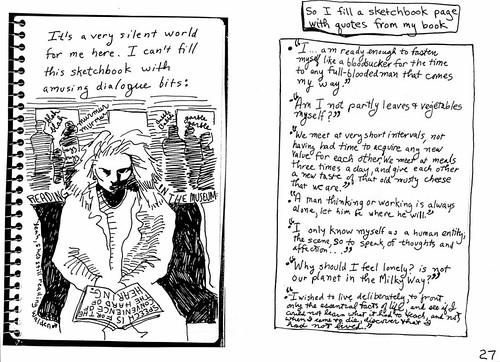
ADDED: I'm looking back into old posts in the "Thoreau" tag and noticed this one from 2005, on day 26 of a 35-day project I called "The Amsterdam Notebooks," which collected a set of drawings that I made in Amsterdam in 1993 (when I was traveling alone and had a fountain pen instead of a camera). The book I was reading was "Walden," and here are a couple pages I made in a museum:

Amsterdam Notebook

Enlarged: here and here.

11 జనవరి, 2017

Scott Adams's approach to his mind sounds like Marie Kondo's approach to her house.

Here's Scott Adams tidying up his brain:
For me, creativity is a process by which I rapidly FORGET the thought that is currently in my head so a new one will fill the space. Your brain isn’t good at thinking of nothing, so when you eject your current thought, another rushes in to take its place. If you flush-and-replace enough thoughts in a row, you have experienced creativity. And if any of those new thoughts made your body respond with a laugh, a sigh, or chills, or anything else physical – you might have created art. I think of creativity as a system of cycling through ideas until one of them “moves” me, literally. If an idea doesn’t create some sort of physical change in my body, I rapidly reject it and move to the next thought.
Here's Marie Kondo, explaining "The Life-Changing Magic of Tidying Up: The Japanese Art of Decluttering and Organizing"
I had been so focused on what to discard, on attacking the unwanted obstacles around me, that I had forgotten to cherish the things that I loved, the things I wanted to keep. Through this experience, I came to the conclusion that the best way to choose what to keep and what to throw away is to take each item in one’s hand and ask: “Does this spark joy?” If it does, keep it. If not, dispose of it. This is not only the simplest but also the most accurate yardstick by which to judge.... Keep only those things that speak to your heart.

2 జనవరి, 2017

"An unforgettable tip of Kondo’s from the first book is to empty your handbag at the end of each day, wrap it in some nonsense fabric as a mark of respect..."

"... and give yourself the gift of tidying all the stuff you just evicted. When I read this, I speculatively put my hand to the bottom of my handbag and found a cocktail sausage, whereupon I did what any normal person would do and popped it in my mouth. All I mean to convey by this is that some people are starting a lot farther away from Kondo than she could imagine."

From a review in the Guardian of Marie Kondo's new book "Spark Joy: An Illustrated Master Class on the Art of Organizing and Tidying Up."

I, like millions of others, read the first book, "The Life-Changing Magic of Tidying Up: The Japanese Art of Decluttering and Organizing." I tried some of it. That is, I did something with some clothes. Maybe I'll get the new book. I did enjoy the fantasy of the first book. I know the new book merely repeats what's already in the old book. It doesn't — as the Guardian reviewer puts it — "diversif[y] into mind-tidying or decluttering your lower intestine."

There shouldn't be a need for a second book. The first book says you do the method once and then you are done forever. Acting as if there is a market for the second book implicitly suggests that the method does not work!

For alternatives to changing your life through the "magic" of decluttering and organizing, I'm seeing...

1. "The Life-Changing Magic of Not Giving a F*ck: How to Stop Spending Time You Don't Have with People You Don't Like Doing Things You Don't Want to Do." This is not for me, and not because I'm offended by the crass language. It's not for me because I've already done this, probably a lot more than the author. Anyway, this is the mental decluttering that Kondo does not bother with.

2. There's "hygge" — Danish coziness — explained in lots of books like "The Little Book of Hygge: Danish Secrets to Happy Living." This looks like leaning into clutter, but I guess it's pretty selective about which things to clutter yourself with. Candles and hot drinks are big. So it's similar to Kondo's idea of surrounding yourself with happiness-inspiring things, but you're getting into the Danishness of it all as opposed to the Japaneseness.

11 జనవరి, 2015

"Rod Taylor?"

Bill Harshaw makes a suggestion in the comments to "If there's a rule of 3 about celebrity deaths, we have a set of 2." I connected Anita Ekberg and Taylor Negron based on their appearance in iconic movie scenes — "scenes so utterly memorable that when the death is announced, everyone seems compelled to put that scene first."

I saw the obituaries yesterday, but I'd skipped blogging Rod Taylor's death, even though I love the movie "The Birds."

I don't think of him as being iconic in any scene in "The Birds" though. He was just continually around for Tippi and Suzanne to bounce off of. And Veronica and Jessica. That's a woman movie.

The man is only there because you've got to have a man somewhere, like to put a table in front of the fireplace when birds take it into their heads to come down the chimney.

The table-in-front-of-the-fireplace is perhaps the 20th image you'd think of from "The Birds."

Camille Paglia has a book about "The Birds." Too bad it's not on Kindle, but at least Amazon has a "look inside" function for it, so it's possible to see the extent to which she saw Rod Taylor as important. I searched for "Taylor," and got 6 hits, excluding the index, and 2 of them aren't Rod Taylor — they're Elizabeth Taylor. Elizabeth Taylor is, of course, not in "The Birds." The remaining 4 mentions are minimal, with the only substantive statement being: "Taylor is all male, with a bluff Australian heartiness that doesn't qu...."

I actually have this book and have read it, but I can't find it, so I have to go on memory and what Amazon gives me before clipping it short. (A bluff Australian heartiness that doesn't quite... what?!) But I think it's fair to say that Taylor is in "The Birds" to be the hunk of masculinity for the actresses to play against.

There's also "The Time Machine":


I've seen the movie. It's much worse than that poster, but that's a great poster.

I need to get back to my "tidying up" project. If I'd only gotten through the book stage — which comes second, right after clothing — I would have easily found Camille Paglia's "The Birds," assuming it passed the "spark of joy" test:
"The criterion [for books] is, of course, whether or not it gives you a thrill of pleasure when you touch it. Remember, I said when you touch it. Make sure you don’t start reading it. Reading clouds your judgment. Instead of asking yourself what you feel, you’ll start asking whether you need that book or not. Imagine what it would be like to have a bookshelf filled only with books that you really love. Isn’t that image spellbinding? For someone who loves books, what greater happiness could there be?"

9 జనవరి, 2015

A warning about that "tidying up" book.

I recommended the book "The Life-Changing Magic of Tidying Up: The Japanese Art of Decluttering and Organizing," by Marie Kondo, and I see that 40 or more of my readers bought the book. How are you liking it? My recommendation was based on the nicely motivating advice in the first third of the book. And I liked the clear sharp writing. Now that I've finished the book, I do feel that it's necessary to alert you to the weirdness that becomes quite pronounced toward the end.

On page 159, 79% of the way through the book, the author reveals: "I once worked as a Shinto shrine maiden for five years." Interesting use of the word "once"! 5 years is a long time period, not a one-time instance. A page later she talks about the effectiveness of Shinto charms. (They expire after one year, we are told.) On page 188, 92% of the way through, she tells us that when she goes to a client's home she "greet[s]" it by "kneel[ing] formally on the floor in the center of the house and address[ing] the house in my mind." She says: "I began this custom quite naturally based on the etiquette of worshipping at Shinto shrines."

Now, this is fine, but I felt ambushed by this information so late in the book. I want to know when someone is luring me into New Age thinking. Shinto is not "new age" for her, if she is in fact from the Shinto tradition, but repackaging it for those outside the tradition is a New Age move. I don't particularly mind rituals like this, but I certainly don't believe them, and I didn't interpret the word "magic" in the title to promise something supernatural.

Those are the only mentions of Shinto in the book, but there is also quite a bit of animism, and this may be Shintoism as well. In any case, it is a kind of religion. I'll just note a few of the examples of animism that jumped out at me:
I pointed to the balled-up socks. “Look at them carefully. This should be a time for them to rest. Do you really think they can get any rest like that?”...

Clothes that have been shut up for half a year look wilted, as if they have been stifled. Instead, let in some light and air occasionally. Open the drawer and run your hands over the contents. Let them know you care and look forward to wearing them when they are next in season. This kind of “communication” helps your clothes stay vibrant and keeps your relationship with them alive longer....

Just like the gentle shake we use to wake someone up, we can stimulate our belongings by physically moving them, exposing them to fresh air and making them “conscious.”...

I put my wristwatch in a pink antique case in the same drawer and place my necklace and earrings on the accessory tray beside it. Before closing the drawer, I say, “Thanks for all you did for me today.”...

I promise you: whatever you let go will come back in exactly the same amount, but only when it feels the desire to return to you. For this reason, when you part with something, don’t sigh and say, “Oh, I never used this,” or “Sorry I never got around to using you.” Instead, send it off joyfully with words like, “Thank you for finding me,” or “Have a good journey. See you again soon!” Get rid of those things that no longer spark joy. Make your parting a ceremony to launch them on a new journey. Celebrate this occasion with them. I truly believe that our possessions are even happier and more vibrant when we let them go than when we first get them.
I find all of that quite charming. I don't know if the author believes it or if she thinks it's fun and helpful and energizing to attribute consciousness to inanimate objects. I still recommend the book, but I thought I owed you a warning. If you have no patience with this kind of cutesiness or want to avoid immersions in religionish things that you don't believe, you might want to say to this book "Sorry I cannot use you, but may you find joy with someone else."