Lewis Carroll लेबल असलेली पोस्ट दाखवित आहे. सर्व पोस्ट्‍स दर्शवा

१५ एप्रिल, २०२६

"Please don’t write about this immediately. I know how you work, and that you will. But please, just not right away."

Said the "Girls" showrunner, Jenni Konner, to Lena Dunham, quoted in "In 'Famesick,' Lena Dunham Diagnoses Celebrity, Illness and Herself/This unusually unfiltered memoir takes us to the hospital, to therapy and to the sometimes hostile set of 'Girls'" (NYT).

The book reviewer, Alexandra Jacobs, adds: "Maybe, contra Dunham’s mentor Nora Ephron, not everything is copy? Or at least … everything needs a copy editor? The Keebler elf makes a second, sexualized appearance; 'Harold and the Purple Crayon' is invoked twice; and Jack and Lena share soup from a 'terrine.'"

Points if you know the difference between a terrine and a tureen. 

I know "tureen" because I know "Alice in Wonderland" — "The Mock Turtle's Song":

९ डिसेंबर, २०२५

"Students at the University of Glasgow have been cautioned that Harry Potter and the Philosopher’s Stone contains 'outdated attitudes, abuse and language.'"

"The work by JK Rowling appears alongside a number of titles, including Alice’s Adventures in Wonderland by Lewis Carroll, the dystopian 2001 novel Noughts & Crosses by Malory Blackman and Edith Nesbit’s 1899 book The Treasure Seekers, assessed as having the potential to cause offence."

From "Trigger warning slapped on Harry Potter for ‘outdated attitudes’/Students at the University of Glasgow are also being warned about Alice’s Adventures in Wonderland by Lewis Carroll and The Treasure Seekers by Edith Nesbit" (London Times).

Maybe college students need to be warned to move on beyond children's books. 

२१ एप्रिल, २०२५

"That branch in the water looks like some creature rising from the lake and reaching for the shore...."

Said Rusty in the comments to last night's café. He was looking at the sunrise photo I'd taken that morning.

And Meade had made a similar comment about the previous morning's sunrise photo. He commented pictorially, by text, picking out the detail...


... with the caption "The Easter Bunny."

It made me wonder — what are the horror stories involving rabbits?

१५ नोव्हेंबर, २०२३

"There has always been a certain ambivalence on the part of many liberals regarding the actual implementation of affirmative action."

"I thought that it would ultimately be done in by the sheer collapse of the categories such as 'white' or 'Black,' and the impossibility of clearly defining who counts as 'Hispanic' or 'Asian.'"

Emailed lawprof Sanford V. Levinson to Thomas V. Edsall and quoted in Edsall's NYT column "The Liberal Agenda of the 1960s Has Reached a Fork in the Road."

The column is about "the strikingly different public responses to two recent Supreme Court rulings, one on abortion, the other on affirmative action." The idea of a "fork in the road" suggests a need to pick one or the other option, but liberals could forefront both issues. They're not mutually exclusive. They've simply chosen to use the abortion issue and forget about affirmative action, and the reason is obvious. Polls show that a big majority of Americans — including a big majority of Democrats — support what the Court did with affirmative action. 

I just wanted to pull out that Levinson quote, because I remember thinking — for a brief while, back in the 1990s — that affirmative action "would ultimately be done in by the sheer collapse of the categories." But I couldn't seem to find other lawprofs who saw that problem. Applicants identified themselves by race, and we took their word for it. Then there's no "impossibility of clearly defining who counts" as what. It's completely clear: You are what you say you are. What could go wrong?

About that "fork" (if there is a fork):


And "Fork in the road" has a Wikipedia article. Excerpt:

२८ मे, २०२३

"Dr. Ash’s old-world affect tilts and curdles, his mien shifting from twinkly 'Mad Men' gentility to something cooler and more menacing."

I'm slogging through a review of a book I would never read: "A Cabin in the Woods, Intermittent Wi-Fi and a Dead Landline/In Megan Abbott’s new novel, 'Beware the Woman,' a romantic dramedy morphs into horror" (NYT).

I'm only reading this review because Meade texted me the link. My response:


I'm only blogging this because, having ended up in "Jabberwocky," I took the occasion to check my memory — do I still have it memorized? — and wanted to ask those of you have memorized it, if you have found that there is one word that is the stubborn last holdout. For me, the word is "whiffling." If you're not like me, and it's not "whiffling," then I bet it's "uffish." 

But if you're ever trapped in a cabin in the woods and a monstrous man is trying to kill you, look around — try to find something vorpal.

१० जुलै, २०२२

"[O]n Oct. 4, 1969, everything changed... 20-year old Diane Linkletter jumped to her death from the window of her Los Angeles apartment after allegedly trying acid."

"Her grieving father, TV and radio host Art Linkletter, told the press, 'She was murdered by the people who manufacture and sell LSD.' The newspapers ran wild with Linkletter’s take: 'LSD KILLED DIANE.' Later, when news of her clean toxicology report made the rounds, Linkletter blamed the jump on an '“acid flashback.' President Richard Nixon — in the midst of launching his War on Drugs — invited Linkletter to the White House. Nixon knew that a story like this could galvanize the anti-drug movement more than any fact or figure could.... It was the perfect moment for a book like 'Go Ask Alice.'... The fact that the author was anonymous only heightened the buzz. 'Alice' could be anyone, even your daughter. The media ran with it — everyone from The New York Times to the Library Journal presented the book as a verified teenager’s diary. A million copies sold nearly overnight. Avon Books published the paperback and two years later, in 1973, ABC aired a TV adaptation of the book. That, too, was a supersonic hit, with nearly a third of all US households viewing it...."

People believe what they want to believe. Too good to check! I wanted to see how embarrassing the NYT coverage of this ridiculous book was. Here, from 1973: "Diary of a Schoolgirl En Route to Death." It's a review of the ABC TV movie. 

२७ मार्च, २०२२

"If my life had not been diverted when I was eight, I would very likely be living in Czechoslovakia where I had friends who were persecuted for what they spoke and wrote."

"As far as I could see, tolerance of dissenting opinion was the sine qua non of a free society; indeed it was the freedom on which the structures of freedom rested. Yet, it turns out, I couldn’t see as far as I thought I could. Back then, all the way to — it seems — the day before yesterday, I saw the battlefront as one between the individual and the state. It is still that, of course, all over the globe, but identity politics has thrown up a phenomenon, a battleground that is not political so much as psychosocial, an intolerance between individuals, and it’s about language. Words speak louder than actions. Sticks and stones will still break your bones, but the idea that words can’t hurt you has been repealed. People are being hurt by words, and consequently are picking up sticks and stones, not in the form of death threats (mostly) but (frequently) in the form of hounding the transgressor out of his or her livelihood.... [P]ersonally I always had faith in the ultimate commensurability of language and reality. When the German Democratic Republic put out that the Berlin Wall was to keep people out it made me laugh. Reality would take care of itself.... I don’t want to criminalise every fool who says the moon landing was faked and there were no gas ovens. Reality will take care of them too. But no one, not even Lewis Carroll, saw identity politics coming.... 'When I use a word, it means just what I choose it to mean — neither more nor less,' [Humpty Dumpty] tells Alice. And that includes pronouns. Will reality take care of it now?"

Says the great playwright Tom Stoppard (in The London Times). 

Stoppard was born in Czechoslovakia in 1937, and his family fled in 1939 (on the day before Hitler invaded). They fled to Singapore, then, because the Japanese were about to invade, to India. The father stayed behind and died in the war, and the mother remarried and Englishman who liked to quote Cecil Rhodes — "to be born an Englishman was to have drawn first prize in the lottery of life"— and to tell young Tom, "Don't you realize that I made you British?"

१२ मे, २०२१

Gazumping.

I learned a new word just now. Seeing it in a headline — "Clooneys gazumped me for French vineyard, rival buyer says" (London Times) — I thought it might be a made-up word. But the OED identifies it as a slang word that goes back to 1928:
1928 Daily Express 19 Dec. 2/7 ‘Gazoomphing the sarker’ is a method of parting a rich man from his money. An article is auctioned over and over again, and the money bid each time is added to it. ...
1934 P. Allingham Cheapjack xv. 189 Grafters speak a language comprised of every possible type of slang... Quite a number of words are Yiddish. These include ‘gezumph’, which means to cheat or to overcharge. 
1971 Guardian 8 Nov. 13/2 ‘Gazumping’—a system of profiteering by double selling and pushing prices up—is creeping into the property market... The word is car trade slang for selling to one buyer and then, as values rise, to a second buyer.

It means "To swindle; spec. to act improperly in the sale of houses, etc."

As the Times article notes, gazumping violates French law.

Guy Azzari, the buyer’s lawyer, alleges his client had agreed a price of €6 million (£5.14 million) in August for the six-bedroom 18th-century bastide set in 172 hectares that include woodland, an olive grove, a vineyard and an ornamental lake.

The seller is accused of raising the price after the offer was accepted, and it says here that there's "no suggestion that the Clooneys did anything unlawful, or indeed knew of the alleged gazumping." 

"Gazumping" should not be confused with "galumphing," which is one of the many words coined by Lewis Carroll in "Jabberwocky." "Galumphing" is clumsy, heavy walking. And we know the dashing George and the lovely Amal would never do that.

He left it dead, and with its head/He went galumphing back....

That's got nothing to do with celebs attaching their names to the trendiness of rosé wine.

२ नोव्हेंबर, २०२०

Weird WaPo headline catches my eye: "Kamala Harris knows things no vice president has ever known."

I have not read this piece yet. I'm just trying to observe my understanding as it dawns on me. My first thought was: What kind of fawning bullshit is this? I was just complaining that the mainstream media hasn't subjected Kamala Harris to any serious testing, and now here's this ludicrous headline ascribing special powers of knowing to her. 

I see it's in the "Style" pages, which is what we have in the newspaper today instead of what used to be called the "Women's" pages. So now I'm thinking of the old concept "Women's Ways of Knowing." Have you heard of these 5 "ways of knowing" — something about "women's cognitive development, dependent on conceptions of self (self), relationship with others (voice) and understanding of the origins and identity of authority, truth and knowledge (mind)"? 

Is that what this WaPo thing is onto? Harris "knows things no vice president has ever known" because no vice president has ever been a woman? And extend that to no vice president has ever been black.

The piece is by Monica Hesse. 

I keep thinking about how, at some point in Kamala Harris’s life, she has painstakingly reviewed her office wardrobe with the understanding that the difference between “slut” and “feminazi” is a few inches of worsted-wool hemline. At some point, she has approached a stranger in a public bathroom because the Tampax machine is broken again, and she has said, I’m so sorry, but do you have — and then she didn’t have to finish the question because women in bathrooms know that there is only one end to that question.

You know, I went through an entire life's worth of menstruating and never once asked as stranger in a public bathroom for a tampon. It's not something that just has to happen to every woman. Nor did I ever even consider whether clothes I wore to the office needed to get between “slut” and “feminazi.” I don't even know now which one is shorter, but why would it matter, since neither message is office-appropriate? Wouldn't you just be picking your length and deciding how much you cared about being appropriate? 

I'm not buying Hesse's portrayal of the necessary experience of a woman, but in any case, who cares whether vice presidents know these things, and didn't Hesse already go through this collection of thoughts when she contemplated a first woman president 4 years ago?

४ ऑगस्ट, २०२०

"I ought to mention that he marked the parenthesis, in the air, with his finger. It seemed to me a very good plan."

"You know there's no sound to represent it — any more than there is for a question. Suppose you have said to your friend 'You are better to-day,' and that you want him to understand that you are asking him a question, what can be simpler than just to make a '?' in the air with your finger? He would understand you in a moment!"

Wrote Lewis Carroll in "Sylvie and Bruno," describing the gesture made while singing the words "this was their wish" in this stanza of a song:
“The Badgers did not care to talk to Fish:
They did not dote on Herrings' songs:
They never had experienced the dish
To which that name belongs:
And oh, to pinch their tails,' (this was their wish,)
'With tongs, yea, tongs, and tongs!'”
I print the entire stanza because of the badgers, of course, this being Wisconsin. But why — you might ask, marking the air with a "?" — am I fooling around inside "Sylvie and Bruno" this evening? I have an answer!

I was reading the Wikipedia article "Air quotes," which naturally traces the origin of air quotes. It gives Lewis Carroll credit for arriving at the basic idea — albeit only with parentheses and question marks — all the way back in 1889.

The oldest definite use of air quotes seems to be Glenda Farrell the 1937 screwball comedy, "Breakfast for Two":


Isn't that wonderful! But air quotes got too popular in the 1990s and became subject to derision, notably by Steve Martin, Chris Farley, and Dr. Evil. And here's George Carlin in 1996:


People got the message and restrained themselves, but air quotes were still around enough to make their appearance in the fall of 2002, in the thing I just watched that got me started on this little research project, Episode 3 of Season 9 of "Friends" — where Joey (ostensibly the dumbest person in the group) does not understand how air quotes work:


१९ जुलै, २०२०

"The new anti-racism has a confessional, religious energy that the secular meritocracy has always lacked."

"But there is also something important about its more radical and even ridiculous elements — like the weird business that increasingly shows up in official documents, from the New York Public Schools or the Smithsonian, describing things like 'perfectionism' or 'worship of the written word' or 'emphasis on the scientific method' or 'delayed gratification' as features of a toxic whiteness. Imagine yourself as a relatively privileged white person exhausted by meritocracy — an overworked student or a fretful parent or a school administrator constantly besieged by both.... 'Wouldn’t it come as a relief, in some way, if it turned out that the whole 'exhausting "Alice in Wonderland" Red Queen Race of full-time meritocratic achievement,' in the words of a pseudonymous critic, was nothing more than a manifestation of the very white supremacy that you, as a good liberal, are obliged to dismantle and oppose? If all the testing, all the 'delayed gratification' and 'perfectionism,' was, after all, just itself a form of racism, and in easing up, chilling out, just relaxing a little bit, you can improve your life and your kid’s life and, happily, strike an anti-racist blow as well?"

Writes Ross Douthat in "The Real White Fragility/Does the white upper class feel exhausted and oppressed by meritocracy?" (NYT).

So it's sort of like the hippie movement all over again... but without the joy and the fun and the music and the flowers and the crazy clothes and the love of freedom and the willingness to say outrageous things. Instead there's grimness, guilt, pessimism, and the grueling realization that you do have to work, but it's not work at some job, it's work on yourself — you with the bred-in-the-bone racism problem.

Karl Marx wrote: "History repeats itself, first as tragedy, second as farce." I'm seeing this repetition the other way around. We got the comedy first. The tragedy is now.

१५ जुलै, २०२०

"The president of the United States, ladies and gentlemen, was in full Mad King mode, rambling, confused, disjointed, parading his grievances..."

"... with barely a wave from afar at coherence. It was as if a hive of buzzwords exploded in his head: statues, boats, vandalism, socialism, suburbs. It is hard to write this display without using the word 'impaired.' Because it wasn’t just the disjointed word salad. It was the delivery. Trump was somnolent, as if he’d pulled an all-nighter watching Fox & Friends or maybe his VCR tapes of Shark Week. Imagine the covfefe tweet come to life. The Rose Garden event was ostensibly about China, but quickly disintegrated into something between one of his improvisational stump performances, a stream of broken consciousness, and a rambling oppo dump. Perhaps the president really misses campaign rallies. Or maybe he just got confused. Someone on his staff gave him a summary of horrible things that he might someday be able to craft into a campaign attack on Joe Biden . . . and so he just stood there and read the whole thing...."

Writes Charles Sykes at The Bulwark. The full video of Trump's press conference is embedded over there. I could embed it here, but instead, I'll link to the transcript — a much faster, easier way to check Sykes's characterizations. It seems to me Trump has a way of speaking, and it's idiosyncratic but enjoyably listenable if you get into its groove but weird and chaotic if you resist. That's nothing new.

Let me pick something out of the transcript for discussion. Well, the first thing he says may explain the somnolence — it was hot (over 90°): "Too hot, but it’s pretty warm." Right off, that's crazy, no? What's with "but"? It's hot, but it's warm! I get a "Walrus and the Carpenter" vibe, you know:
The sun was shining on the sea,
Shining with all his might:
He did his very best to make
The billows smooth and bright--
And this was odd, because it was
The middle of the night.
That's not word salad. That's genius!

I've got to pick out something else. That was too easy. Here's the part where he transitions from talking about China — the lead-off topic — to Joe Biden. That is, it becomes a campaign speech with a forced-to-be-polite captive audience, broiling in the hot-but-warm sun:

१७ मे, २०२०

Snake on the bike path.

Yesterday...

IMG_5347

I got to talking with some little kids — who were doing this mountain bike path on strider bikes — and they had the idea of a snake on a bike. Their dad suggested a lizard. Yeah, a lizard on a bike makes sense... compared to a snake on a bike.

In the category of impossible things, some are more believable than others.

That makes me think of "Through the Looking Glass":
Alice laughed. "There's no use trying," she said. "One can't believe impossible things."

"I daresay you haven't had much practice," said the Queen. "When I was your age, I always did it for half-an-hour a day. Why, sometimes I've believed as many as six impossible things before breakfast!"
Are you trying to believe impossible things?  Have you had a lot of practice? Are you keeping score? Are you up to 6? What are you eating for breakfast? For me, it's snake bacon. Snakon.

२० फेब्रुवारी, २०२०

"Non-toxic masculinity."

There's a phrase.

I saw it on the front page of The New Yorker.


Inside, the article is titled "What Charles Portis Taught Us."* Charles Portis —who died this week at the age of 86 — was the author of the book "True Grit."
Portis’s diffident, modestly gallant characters were a world away from the marital bonfires and priapisms of other male writers of his crop—Roth, Updike, Yates. His male heroes practiced a masculinity that by the standards of the day was uniquely (and unfashionably) nontoxic. It’s hard to imagine the bafflement with which Portnoy or Angstrom would have confronted a guy like Jimmy Burns, from “Gringos,” who tries to persuade two young women to move into his hotel with a come-on like this: “The doorknobs are porcelain with many fine hairline cracks. The towels are rough-dried in the sun. Very stiff and invigorating after a bath.”

“Only a mean person won’t enjoy it” is something a critic once wrote about “True Grit.” In part, I love Portis because I feel less mean when I read him. It’s not just that his novels are gentle and funny; it’s that Portis’s books have a way of conscripting the reader into their governing virtues—punctuality, automotive maintenance, straight talk, emotional continence. Puny virtues, as Portis himself once put it, yet it is a great and comforting gift (in these days especially) to offer readers escape into a place where such virtues reign....
I didn't like the phrase "non-toxic masculinity" when I saw it in the headline, but in the context of this essay, it's fine. It's explained and specific. Out of context, I don't like the way it implies that masculinity is bad and in need of toning down or that we only want men who make sure they are innocuous.
_______________________

* Is that supposed to make us think of the passage from "Alice in Wonderland"?
"Why did you call him Tortoise, if he wasn't one?" Alice asked.

"We called him Tortoise because he taught us," said the Mock Turtle angrily: "really you are very dull!”
I think rhymes should be edited out of writing unless the writer has some sort of porpoise.

२८ नोव्हेंबर, २०१९

I'm reading "Are There Benefits to Intermittent Fasting?" in The New York Times.

Subtitle: "The best diet is the one where you are healthy, hydrated and living your best life. If you want to fast, it offers similar weight-loss benefits to just cutting calories." And I'm not at all impressed by the science — quotes from a couple nutrition professors who say that fasting is nothing more than another way to restrict total calories. But I do love this comment, from someone who adopts the old Marcel Duchamp pseudonym "R. Mutt"* and says he's in Timbuktu (aren't we all?):
Interesting article but as others have stated it focuses more on the weight loss benefits and not on the many other aspects of fasting. Our bodies and metabolisms have evolved to deal with a continuous cycle of feast or famine ... if it is all one or the other we will have problems. Living in an age where near unlimited access to an abundant supplies of food (both good and bad) encourages overeating and unfortunately if you live in a neighbourhood with limited access to a good grocery store you will be forced to eat mostly processed foods. The quality of what you are eating while doing an intermittent fast is a crucial component. I am lucky to have access to healthy food and have for most of my life incorporated different approaches to fasting into my day and have come to realize that as we age our metabolism slows and we must adjust our diet accordingly. I am only eating one nice healthy meal a day and feel great; have lost weight, more energy and clarity of mind, skin is feeling and looking better, senses mental clarity have been heightened, less aches and pains ... that's good medicine. I am also physically active which is another important component in the overall feeling of well-being. A fasting couch potato in my opinion would probably not reap the same benefits. It's not rocket science ... whether intermittent fasting or not, listen to your body and adjust your eating habits accordingly. And please remember to "stop eating all the time" guys ;-)
Hey! I'm writing about fasting on Thanksgiving! Why not fast for Thanksgiving? I see — also in The New York Times — "The Horrible History of Thanksgiving/Before you fill your plate, please remember why we mark this day," by Charles Blow, who says:
I spent most of my life believing a gauzy, kindergarten version of Thanksgiving, thinking only of feasts and family, turkey and dressing.

I was blind, willfully ignorant, I suppose, to the bloodier side of the Thanksgiving story, to the more honest side of it.

But I’ve come to believe that is how America would have it if it had its druthers: We would be blissfully blind, living in a soft world bleached of hard truth. I can no longer abide that.
Well, hell, how can you feel that bad and have it just be step 1, before step 2, "fill your plate"? No plate for you! How can you be all "I can no longer abide" and proceed to the piles of turkey and high-carb side dishes? It reminds me of Lewis Carroll's walrus:
"I weep for you," the Walrus said:
"I deeply sympathize."
With sobs and tears he sorted out
Those of the largest size,
Holding his pocket-handkerchief
Before his streaming eyes.
Whether we can expiate all of America's sins by fasting on the feasting day, I don't know. I doubt it.
"If seven maids with seven mops
Swept it for half a year.
Do you suppose," the Walrus said,
"That they could get it clear?"
"I doubt it," said the Carpenter,
And shed a bitter tear...
The Walrus was weeping over the great quantities of sand on the beach. He cared! He mused, and he went about his way, doing everything he wanted. But he still cried all the while. Wasn't that good of him?

How about fasting for Thanksgiving? Will you join me? If R. Mutt is right, we may get some "clarity of mind" and an "overall feeling of well-being." Ah, that sounds to good for us! Better to cry and simultaneously stuff your face. That's the new American tradition.
_____________________

* It's the famous signature that made a urinal art:


Duchamp explained:
Mutt comes from Mott Works, the name of a large sanitary equipment manufacturer. But Mott was too close so I altered it to Mutt, after the daily cartoon strip "Mutt and Jeff" which appeared at the time, and with which everyone was familiar. Thus, from the start, there was an interplay of Mutt: a fat little funny man, and Jeff: a tall thin man... I wanted any old name. And I added Richard [French slang for money-bags]. That's not a bad name for a pissotière. Get it? The opposite of poverty. But not even that much, just R. MUTT.
You remember "Mutt and Jeff":

२५ नोव्हेंबर, २०१९

"I don’t know if it’s the fact that my husband has voiced that sometimes too sexy is just overkill and he’s not comfortable with that."

"I listen to him and understand him. Still, at the end of the day, he always gives me the freedom to be and do what I want. But I have kind of had this awakening myself. I realized I could not even scroll through Instagram in front of my kids without full nudity coming up on my feed pretty much all the time. And I definitely contributed to that. I mean, one of my most iconic covers was the Paper magazine one, when I was all oiled up and ripping my dress off. I also did think, like, Okay, I’m here in the White House and then the next day I was posting, like, a crazy bikini selfie. And I was thinking, I hope they don’t see this. I have to go back there next week. I think I’m evolving to where I don’t feel the need to want to keep up. Not that I did it to feel like I had to keep up, but I guess I just don’t care as much anymore to want to take tons of photos in a thong bikini. I actually just want to lay out. I don’t care to take the time out of my day on vacation like I used to, where I’d pull up to the house and I’d see, This is a setup, this is an Instagram pic. Now this is a different setup. Oh, this place has so many different setups. This is going to be amazing. And now I’m just like, 'Let’s actually live in real time and enjoy it. If we happen to get a photo, great.'"

Said Kim Kardashian, asked about "dressing a little less sexy" and quoted in "In the 2010s, Fame Went Multi-Platform/Kim Kardashian West on life as a brand and her political awakening" (New York Magazine).

ADDED: It's funny that she speaking of "keeping up": "I don’t feel the need to want to keep up. Not that I did it to feel like I had to keep up..." This whole thing got started with the message to everybody else that we needed to be "Keeping Up with the Kardashians." It's a fascinating tell: She felt that she needed to keep up. Keep up with what? We were supposed to be keeping up with her. That says something about the emptiness and futility of the imagined race.

१५ ऑक्टोबर, २०१९

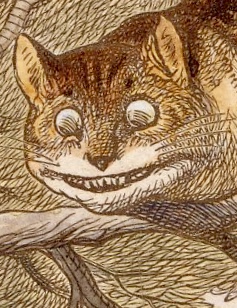
"Feels to me like living in some kind of Alice in Wonderland where you're up on the real world, then you fall down the rabbit hole and the president is the Cheshire cat asking you questions about crazy things that don't have any resemblance to the reality of anything that has to do with me."

Said Hunter Biden, deflecting questions about his foreign business dealings.


The relevant passage from "Alice in Wonderland" is this:
The Cat only grinned when it saw Alice. It looked good-natured, she thought: still it had very long claws and a great many teeth, so she felt that it ought to be treated with respect.

‘Cheshire Puss,’ she began, rather timidly, as she did not at all know whether it would like the name: however, it only grinned a little wider. ‘Come, it’s pleased so far,’ thought Alice, and she went on. ‘Would you tell me, please, which way I ought to go from here?’
The questions begin with Alice, and it's a sensible question. She gets a sensible answer:

२६ जुलै, २०१९

"Fattened up with acorns and chestnuts to the size of a cricket ball and then stuffed, baked and perhaps seasoned with honey and poppy seeds, the dormouse..."

"... was one of ancient Rome’s most popular delicacies. The Romans also adored dishes such as rabbit stuffed with figs, cockerel in pomegranate sauce, and terrines and mousses moulded in to the shape of chickens. A wealthy family reclining, not sitting, to eat their meal might start with snail, egg or fish appetisers before a goat or pig main course and then finish with a dessert, mainly fruit such as apples, plums, grapes, cherries, dates and figs. All liberally seasoned with fish sauce. And accompanied by gargantuan quantities of wine."

From "Baked dormouse and other Roman delicacies come to Oxford/Ashmolean Museum’s Pompeii exhibition includes food carbonised by eruption in AD79" (The Guardian).

Remember what the Dormouse said: Feed your head...

I looked up the old Jefferson Airplane lyric. Here's the annotation of that line at Genius:
[Lewis Carroll’s "Alice in Wonderland,"] the Dormouse never actually says “Feed your head.” Jefferson Airplane is either putting words in his mouth or introducing this sentiment as a separate thought.

The direct reference here is to Alice, Chapter 11, when the Mad Hatter is questioned before the court:
‘But what did the Dormouse say?’ one of the jury asked.
‘That I can’t remember’, said the Hatter.
‘You MUST remember,’ remarked the King, ‘or I’ll have you executed.’
This context gives an ominous spin to “Remember what the Dormouse said.” If you don’t “feed your head” (take drugs to tune in? expand your mind in general?), it could seriously cost you.

Alternatively, this might be a commentary on the apathy and nonchalance of the drug scene. The Hatter does not remember, or care about, an important detail; drugs, too, can cause listlessness and memory loss.
But doesn't "Feed your head" mean take a lot of drugs? It's a conundrum, no?

Anyway, the Romans were not using the acorn-and-chestnut-stuffed dormouse to feed their head, only their belly, but the sidetrack was irresistible to me as I go about feeding your head this morning.

२९ मे, २०१९

"As an avid spelunker and one who also ventures into dark underground places thought abandoned, the geek in me looked forward to this book. Alas..."

"... it never really conveyed the way I feel when in these places aside from a Rick Steves-tourist aspect. It's cool...we all see the world differently and maybe this book is for those who would never dream of going into the crawlspace under their house"/"I bought this book for my husband and it did not meet his expectations. He said it mainly covered the gruesome underground swampy creepy areas under cities. I expected that it dealt with underground facilities that were ancient but no."

Those are the 2 one-star reviews at Amazon for "Underground: A Human History of the Worlds Beneath Our Feet." I like to read one-star reviews of books that have, overall, great reviews. Sometimes the dissenter is right. A "Rick Steves-tourist aspect" felt like a serious warning, though "I bought this book for my husband and it did not meet his expectations" was not. What do I know about her husband? He sounds rather peevish. Let him buy his own books.

Ah, well. I bought the book anyway. I was moved to buy it after I stumbled into it while searching for another book with the title "Underground." There's also the highly praised novel "Underground Railroad" and the great classic "Alice's Adventures Underground."

I can't think why one would want to go on a reading spree of books with a distinctive word in the title, but maybe you've done that once. If so, what was your word? If not, and you had to do it, had to read 4 books with the same distinctive word in the title, what word would you choose? (Note: distinctive word. No joke answers in the "the" category.)

From the 1-star reviews of "Underground Railroad": "Readers are expected to credit a literal Underground Railroad; too feeble an authorial imagination for magic realism, so result is confusing anachronism"/"It is obvious that this book won the Pulitzer because of politics, not the quality of the writing. It was so disjointed. I also object to his altering of history such as portraying the Underground Railroad as an actual railroad. The story of slavery is poignant enough. I know it is a novel but there are some facts with which you should never take liberties!"

From the 1-star reviews of "Underground: The Tokyo Gas Attack and the Japanese Psyche" (the book I was originally searching for): "this review has nothing to do with content, but im pretty furious that i have found MULTIPLE typos in the kindle version....."

२१ मे, २०१९

Nobody you need to convince is going to click on stuff like this anymore.


That's purely for the delectation of the already committed.

ADDED: I'm reminded of the book title "Three Felonies a Day" (subtitle: "How the Feds Target the Innocent") and that line from "Through the Looking-Glass," "Why, sometimes I've believed as many as six impossible things before breakfast."

AND: This movie clip seems relevant (with Chait as "Peewee"):