Katie Roiphe লেবেলটি সহ পোস্টগুলি দেখানো হচ্ছে৷ সকল পোস্ট দেখান

১২ ফেব্রুয়ারি, ২০২৫

"As [Janet] Malcolm moves through drafty kitchens, Indian restaurants and train rides through the damp English countryside, she turns each biographer and figure in [Sylvia] Plath’s life into a character."

"She exposes the motives and agendas and prejudices at the heart of the Plath industry. She brilliantly indicts the whole enterprise of biography itself, comparing biographers to burglars rifling through people’s drawers.... She emphasizes the total impossibility of ever knowing the truth of another person’s life.... At one point, she gave the unfinished manuscript of 'The Silent Woman' to Philip Roth. He gave it a slashing edit, with often nasty comments in the margins. He violently disapproved of her putting herself in as a character. He hated her metaphors and accused her of intellectual shallowness. Another writer might have been crushed or paralyzed, but Malcolm simply addressed what she thought were the few useful parts of his criticism and put aside the rest. She scribbled playful and defiant responses to his edits in the margins: 'What’s bugging you, Philip? she said, with a sad shake of her head.' Later, in an unpublished interview, she said, 'I didn’t accept his dislike of the book.' Some of his crankiness, she thought, arose from being a man of the 1950s reading about the female experience.... To take this incident with equanimity, to not let it undermine either her friendship or her manuscript, requires a very expansive and shockingly healthy sense of self...."

Writes Katie Roiphe, in "Janet Malcolm Understood the Power of Not Being 'Nice'/The writer is remembered, above all, for her ruthlessness. But when I went looking for it, I found something much more complicated" (NYT).

"The Silent Woman" — commission earned — came out in 1995.

Have you ever endured a serious edit from someone you had to respect? Some writers fear even putting themselves in the position of needing to see one. Have you ever given one or offered to give one and had the writer miss what you thought was the chance to step up to a higher level? It's a painful process, editing. So says the blogger.

১৮ জুন, ২০২১

"Every journalist who is not too stupid or too full of himself to notice what is going on knows that what he does is morally indefensible."

So begins the great New Yorker essay, "The Journalist and the Murderer," quoted in "Janet Malcolm, Provocative Journalist With a Piercing Eye, Dies at 86/Her subjects ranged widely, but she took special aim at journalism itself, writing that every journalist 'knows that what he does is morally indefensible'" (NYT). 

Goodbye to Janet Malcolm! 

The essay is available in book form, and you really must read it. If you've read it, reread it!

In fact, “The Journalist and the Murderer” has become something of a classic and was ranked No. 97 on the Modern Library’s list of the 100 best nonfiction books of the 20th century. “It is now taught to nearly every undergraduate studying journalism,” Katie Roiphe wrote in a 2011 profile of Ms. Malcolm for The Paris Review
“Today, my critique seems obvious,” Ms. Malcolm told Ms. Roiphe, “even banal.”

The book version has an important afterward, about Malcolm's own fight to defend herself against a defamation lawsuit. She'd written an article — a fantastic article — where she put quotation marks around things that were not verbatim transcriptions of speech. "This thing called speech is sloppy, redundant, repetitious, full of uhs and ahs... I needed to present it in logical, rational order so he would sound like a logical, rational person" — she said at trial. 

The Paris Review interview is great. Roiphe has the wit to start off by asking Malcolm, "So how would you describe your apartment if you were the journalist walking into your living room?"

Malcolm answers: "My living room has an oak-wood floor, Persian carpets, floor-to-ceiling bookcases, a large ficus and large fern, a fireplace with a group of photographs and drawings over it, a glass-top coffee table with a bowl of dried pomegranates on it, and sofas and chairs covered in off-white linen. If I were a journalist walking into the room, I would immediately start composing a satiric portrait of the New York writer’s apartment with its standard tasteful objects (cat included) and general air of unrelenting Culture."

Ha ha. Perfect. Exactly! 

১৩ জানুয়ারি, ২০১৮

Andrew Sullivan says "It’s Time to Resist the Excesses of #MeToo."

Excerpt from a long column:
I’ve read [Shitty Media Men] list — as almost everyone in media has. I felt like taking a shower afterward. It includes charges that have absolutely nothing to do with workplace harassment. Someone is accused of “creepy DMs or texts especially when drunk,” “weird lunch dates,” or “being handsy — at the very least — with women at parties.” One man is accused of “secretly removing condom during sex,” with no claim of workplace misconduct at all. Another is damned for “flirting,” another for taking “credit for ideas of women of color,” another for “multiple employee affairs, inappropriate conversation, in general a huge disgusting sleaze ball.” And this chorus of minor offenses is on the same list as brutal rapes, physical assaults, brazen threats, unspeakable cruelty, violence, and misogyny. But hey, take it all with a grain of salt!

The act of anonymously disseminating serious allegations about people’s sex lives as a means to destroy their careers and livelihoods has long gone by a simple name. It’s called McCarthyism, and the people behind the list engaged in it. Sure, they believed they were doing good — but the McCarthyites, in a similar panic about communism, did as well. They believe they are fighting an insidious, ubiquitous evil — the patriarchy — just as the extreme anti-Communists in the 1950s believed that commies were everywhere and so foul they didn’t deserve a presumption of innocence, or simple human decency. They demand public confessions of the guilty and public support for their cause … or they will cast suspicion on you as well....

... I’ll tell you what’s also brave at the moment: to resist this McCarthyism, to admit complexity, to make distinctions between offenses, to mark a clear boundary between people’s sexual conduct in a workplace and outside of it, to defend due process, to defend sex itself, and privacy, and to rely on careful reporting to expose professional malfeasance. In this nihilist moment when Bannonites and left-feminists want simply to burn it all down, it’s especially vital to keep a fire brigade in good order.

১১ জানুয়ারি, ২০১৮

"In October, I created a Google spreadsheet called 'Shitty Media Men' that collected a range of rumors and allegations of sexual misconduct, much of it violent, by men in magazines and publishing."

Writes Moira Donegan at The Cut, motivated by what seems to have been an impending outing by Harper's Magazine.
I was incredibly naïve when I made the spreadsheet. I was naïve because I did not understand the forces that would make the document go viral. I was naïve because I thought that the document would not be made public, and when it became clear that it would be, I was naïve because I thought that the focus would be on the behavior described in the document, rather than on the document itself. It is hard to believe, in retrospect, that I really thought this. But I did....

In the weeks after the spreadsheet was exposed, my life changed dramatically.... This escalated when I learned Katie Roiphe would be publishing my name in a forthcoming piece in Harper’s magazine. In early December, Roiphe had emailed me to ask if I wanted to comment for a Harper’s story she was writing on the “feminist moment.” She did not say that she knew I had created the spreadsheet. I declined and heard nothing more from Roiphe or Harper’s until I received an email from a fact checker with questions about Roiphe’s piece. “Katie identifies you as a woman widely believed to be one of the creators of the Shitty Men in Media List,” the fact checker wrote. “Were you involved in creating the list? If not, how would you respond to this allegation?” The next day, a controversy ensued on Twitter after Roiphe’s intention to reveal my identity was made public. People who opposed the decision by Harper’s speculated about what would happen to me as a result of being identified. They feared that I would be threatened, stalked, raped, or killed. The outrage made it seem inevitable that my identity would be exposed even before the Roiphe piece ran. All of this was terrifying. I still don’t know what kind of future awaits me now that I’ve stopped hiding....

৬ আগস্ট, ২০১৩

"It is ironic that Austen, the elegant, precise satirist that she was, should provoke this crude and unsophisticated and wild meanness."

"She was no stranger to anger, to simmering resentments and harsh judgments, to taking people down a notch, but her sentences were if anything the opposite of 'a bomb was placed in front of your house.'"

Writes Katie Roiphe in Slate, about the Jane-Austen-on-the-banknote controversy we were talking about yesterday.

Why is that ironic? Isn't it more exactly what you'd expect, that an elegant, precise writer's antagonists would be crude? What's ironic is that Roiphe, championing the elegant, precise writer would misuse the word "ironic."

I checked the complete works of Jane Austen to see if old Jane had ever used the word "irony" or "ironic." The answer is no, but the search turned up the uses of "iron" as well, and I was amused by this exclamation, in "Northanger Abby," about James's gig:

৭ ডিসেম্বর, ২০১২

Katie Roiphe tries to fathom the depths of why she's buying really expensive shoes.

She writes about herself in the second person saying things like: 
You have read Adorno. You are able to think critically about your desire for the shoes. Furthermore, you have a healthy class-hatred for people who dress habitually in clothes from this store...
And:
If you do walk out with the shoes...  they work like a drug—the anxieties that were plaguing you before you enter the store have lifted. As you step out into traffic, the still and stagnant city is suddenly charged with possibility

The parties you have scribbled in your calendar seem more glittery or interesting or fun, and you in the shoes, more daunting, more sylphlike, more free, more invulnerable....

Do you want to be the kind of person who sacrifices, overreaches, for a pair of shoes, who imbues them with a romantic overlay that a material object cannot possibly sustain?
That's where the internal argument ends up, and obviously she buys the shoes. Obviously, there's a huge mental element to consumerism, both before and after the purchase. Note that anxieties must be stirred up to provide an additional argument: I need to dispel these anxieties! She gets off on the purchase.

My question: Why shoes? There's some discussion of how shoes "will transform you into someone else" — special shoe magic. (See "The Wizard of Oz.") There's oddly little reference to sex. Roiphe ignores Freud, who famously saw shoes as vagina symbols. Roiphe wants — or wants "you" — to be daunting, sylphlike, free, and invulnerable.

A sylph is a female fairy. In Alexander Pope's "The Rape of the Lock," "women who are full of spleen and vanity turn into sylphs when they die because their spirits are too full of dark vapors to ascend to the skies." (Here is "The Rape of the Lock," with the illustrations by Aubry Beardsley, for only 99¢ on Kindle!)

So, maybe, why shoes? Why not dresses, jackets, jewelry, sweaters? I think it's that you've got to specialize — unless you're actually rich — if you're going to shop in the really expensive places. You can trick yourself into thinking you've been indulged. Still, why specialize in shoes?

২০ এপ্রিল, ২০১২

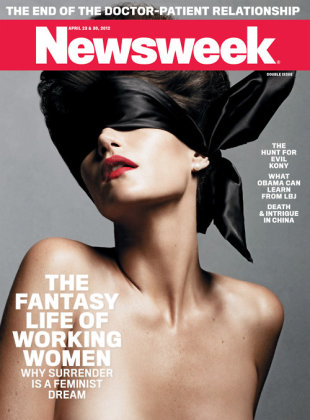
Have you seen the cover of Newsweek?

5 or 10 years ago, it was a routine, almost daily practice for me to wander around a bookstore and so I always knew what was on the covers of the usual magazines like Newsweek. You could catch my eye. Nowadays, my daily glancing about is done on line, and crafty editors can't grab me with striking covers. But I did notice this:


Now, that's really silly. Who is this "working woman"? I guess by "working woman," Newsweek means a fashion model. And for all the striving to convey sexuality, the particular woman — with her plank chest and clothes-hanger shoulders — epitomizes abstemiousness, not lust of any kind. Anyway, had I seen that on the newsstand, I would have laughed at the embarrassingly striving effort to lure me into checking out the article. Don't I want to know "Why Surrender Is a Feminist Dream"? Uh, no. I was with the radical feminists back in the late 1980s/early 1990s when it seemed very important to take "The Story of O" seriously. And to despise Katie Roiphe, by the way. Who is the author of the Newsweek cover story, though her name isn't on the cover.

Why did the feminists attack Roiphe back then? The daughter of a famous feminist, she'd come out with a book "The Morning After: Fear, Sex and Feminism" when she was only 26, undermining the work of feminists who'd strained to expand the category of behavior to which the term "rape" attaches:
Writing for The New Yorker, Katha Pollitt delivered a scathing review of The Morning After, writing, "It is a careless and irresponsible performance, poorly argued and full of misrepresentations, slapdash research, and gossip. She may be, as she implies, the rare grad student who has actually read 'Clarissa,' but when it comes to rape and harassment she has not done her homework."
Oh, but that was nearly 20 years ago. I haven't been keeping track of Katie Roiphe since then, though I see I have a tag for her. I don't remember mentioning her on the blog before, but obviously I have. Anyway, she's getting cranked through the Tina-Brownified Newsweek that I'm not going to read, but I did notice the Virginia Heffernan attack on Roiphe's cover story:
Tina, my onetime boss, from whom in the late 1990s I learned the dark arts of buzz production...
Were vibrators involved?
... loves to seduce and betray female writers. And she's got skills. As she once proudly told the editorial team at her short-lived magazine Talk, she likes to ask lady writers to deliver humiliating "personal histories" that feature self-loathing and lurid intimate disclosures, on the promise that they can publish anonymously.

Once the droning, predictable, scandalous articles are done—Daphne Merkin likes to be spanked!!!!!—Tina appeals to the writer's vanity. The article is terse and fearless and elegant! You're Joan Didion! (always Joan Didion). You must put your name on this!

Disgrace. You want to know about gender politics during this trumped-up "war on women"? That's one way power is wielded between women—the alpha girl feigns sympathy to get her henchwoman to confess or act out and then sits back and sneers—and it's no joke. 
I'm cutting a lot here. Please read the whole thing. Roiphe, per Heffernan, "sneers" at the "older, suburban, possibly Midwestern woman" who is titillated by this popular new porn book "Shades of Grey," and this supposedly entertaining sneering is leveraged by Roiphe's own sexual confessions:
Tina has forced Roiphe into this uncomfortable pose, and in public (does any woman really want to boast, "I'm more twisted and accustomed to sexual violence than anyone!"), and Roiphe comparably trusses up Newsweek readers. Over a series of bad-faith and gibberish paragraphs, she sets up the reader as a hayseed who is turned on by lite porn because she's never seen how they do it in Berlin or whatever; or—worse still—so unsuccessfully feminine and so outside of the charmed circle of female literary power that she's satisfied by regular guys who don't hit her. 
The real sadism, it seems, comes from the powerful editor (Brown) who once oppressed Heffernan, who longs to get the upper hand at long last. Now, that's lurid (but not at all sexy, unless you're way more into the world of publishing newsrags than I am).

Anyway, I'm reading Heffernan, because I wandered by Slate this morning and saw a piece that successfully caught my eye with the title "Why Is Virginia Heffernan Being Sexist Toward Katie Roiphe?" It was written by a character with the silly name J. Bryan Lowder. He says:
Heffernan suggests that Roiphe has been “humiliated” by the article, but, by my reading, it’s the former who’s actually out to humiliate the latter in some twisted form of victim-blaming. It’s as if Heffernan is saying, “Tina Brown editorially raped you, Katie Roiphe, so why don’t you just slink away in disgrace!”
Key words: by my reading. Heffernan had her reading and you, J. Bryan, have yours. And your reading is that her reading is not the right reading. Readings, readings, readings. If it's all readings, we can choose which one to read, can't we? And Heffernan is more readable. And she's got the inside experience with Brown. Meanwhile — I just got to the end of J. Bryan's cryin' and I see he's "a former student and research assistant of Roiphe’s." Ha. I stand by my choice of readings.

১৫ ডিসেম্বর, ২০০৮

"Admitting my mistakes, when I have been cheated or taken advantage of -- a luxury that should be rarely indulged."

"People may seem to sympathize, really they despise you a little. Weakness is a contagion, strong people rightly shun the weak."

That's a note in a private journal. How would you describe the writer?

1. Someone who is trying very hard "to transcend her limitations, to imagine a different way of existing," who "seems to harbor a secret image of herself as sloppy, idle, and weak."

2. Someone who has decided to exercise power over others.

Obviously, I think #2. #1 is Katie Roiphe, fawning annoyingly over Susan Sontag.