Jeff Koons लेबल असलेली पोस्ट दाखवित आहे. सर्व पोस्ट्‍स दर्शवा

१६ जानेवारी, २०२५

The World Monuments Fund "warns that more than 90 important sites on the moon could be harmed."

"In particular, some researchers are worried about Tranquillity Base, the Apollo 11 landing site where the astronaut Neil Armstrong first stepped onto the moon’s surface.... Beyond the lunar orbiters and rangers scattered across the moon’s surface that express scientific achievements, there are also artifacts of human culture. Apollo 11 astronauts left a golden olive branch to symbolize peace, while a SpaceX rocket lifted a lander that carried 125 miniature sculptures by the artist Jeff Koons to the moon’s surface last year." 


If you follow the link about Koons, you'll see that his sculptures were small steel spheres — "moons" — each named after a famous Earthling, e.g., Ada Lovelace, Plato, and Billie Holiday. I guess they must all have some connection to the moon. Plato, for example, I learned from Grok, wrote that "the moon, along with the sun and the planets, are part of the visible gods, designed to move in a circular orbit, which reflects the eternal and perfect nature of the cosmos."

I asked Grok "What would Plato think about travel to the moon, particularly travel that leaves behind a small steel ball with his name inscribed on it?" The answer, to put it briefly, was that he would have mixed feelings. Really? I didn't think of Plato as a mixed feelings kind of guy.

१ जानेवारी, २०२५

"I do not work with AI at this time directly other than to produce options. Here’s this table: could I see this table in a wood? And then..."

"... could I see this shape in, you know, a marble? I’d like to see it in reflected steel. Only in that scenario. I’ve been using AI as a tool, not as an agent. Now, people speak very much about AI at this moment, being an agent in that it has its own, you know, thoughts, its own ability to create, and I’m sure that at some point that I will be moving in that direction in some manner, but I’m very embedded at this moment in biology."

Said Jeff Koons, quoted in this Guardian article with a headline that doesn't square with that quote: "Jeff Koons on why he has drawn a red line on AI in art: ‘I don’t want to be lazy’/World’s most expensive artist, who is exhibiting at the Alhambra in Granada, sees his work as embedded in biology."

ADDED: I read the headline to mean that he said he would not use AI in his art, but obviously he's not against using it. One might try to defend the headline by saying that he has drawn a red line — one that distinguishes some uses from others. But even if you can see that distinction — don't use it "directly other than to produce options" — he's only observing the distinction "at this time," and he's "sure that at some point that I will be moving in that direction in some manner."

I'm not criticizing Koons. I'm criticizing The Guardian.

१७ डिसेंबर, २०२३

"There is a certain tension that reads as the aftereffect of the violence that prompted the memorial, latent in the way Koons’ arm juts out diagonally from its base."

"It is this remarkable mix of benevolence and tension in Koon’s gesture that marks his ‘Bouquet’ as an important artwork."

In an email message, the artist’s representative, Lauran Rothstein, wrote to Golan: “You refer to Jeff’s passive gesture of offering as one of violence.” She added that Golan’s essay had aligned Koons “with extremely negative connotations.”

Golan, the author of “Modernity and Nostalgia: Art and Politics in France Between the Wars,” which explored the interaction of art and ideology, said she was surprised that the Koons studio had not understood that her essay was complimentary. “What I say about Koons is actually positive,” she said.
Legal angle: To interview Koons, Golan had signed a release that gave Koons the right to “view and approve any footage, still images and/or promotional material that are proposed for use.” Would that include this essay?

Whether it does or not, it was enough to motivate the journal to require her to share her essay with Koons and to decline to publish it when Koons rejected it. It was not enough to stop the NYT from embarrassing the art journal and Koons by writing the article I've linked. 

How stupid of Koons — on so many levels.

१९ फेब्रुवारी, २०२३

Why was this thing in a position to be knocked into and shattered? Seems like a publicity stunt and it's working.

I'm reading "Art Fair Visitor Breaks a Jeff Koons Balloon Dog Sculpture/A woman accidentally knocked over a bright blue dog sculpture at Art Wynwood in Miami, causing the $42,000 artwork to shatter, witnesses said" (NYT).

The small, $42,000 version of the famous dog art isn't unique, is it? Aren't there as many of these as the artist chooses to authorize? Placing the damn thing unsecured on a pedestal in a gallery where people walk all around it answers those questions. The only unanswered question is whether they actively sought this publicity.

The NYT article doesn't ask my questions. It's padded with cute crap about sweeping up the shards and selling them as if the destruction is more art — unique art, publicized in the NYT.

The Koons balloon sculptures look like they're made of balloons, but, as the breakage attests, they're not. Nevertheless, I'm giving this post my "balloon" tag, because balloons have been in the news lately, and there's a frisson of delight in the variation on a theme. 

ADDED: "Erased de Kooning" was interesting — 70 years ago. Shattered Koons is bullshit.

२८ डिसेंबर, २०२०

"Successfully making art requires accepting yourself, in Mr. Koons’s philosophy, so that you can pursue your interests without shame."

"'Everything about your past is perfect,' he says. 'Everything up to this moment about you is spectacular.' ... I found myself mindlessly nodding along, as he compares an ashtray that he remembers loving as a child, with a reclining woman holding her legs aloft, to Michelangelo’s 'Pietà.' 'How can that be any less than this masterpiece by Michelangelo?' he says. 'It’s equal.'... He asks himself, 'What have I been pulled to? What have the interests been lately?' He believes this will work for you, too.... "


I subscribed to MasterClass a while ago. I think I watched 3 courses. Really enjoyed David Sedaris and David Mamet. Both Davids taught about writing. The only other one I watched was Bobbie Brown teaching about makeup. That was sort of okay. I think the overall experience is one of encouragement: You can do it too. 

But are you really encouraged? Do you go on to do the things that are supposedly being taught, or are you only feeling something called encouragement, admiring somebody whose work you like, and nothing more?

२८ मे, २०१९

"Several household employees also made allegations of neglect, including that Ms. [Peter] Max withheld food from her husband and sometimes put 'large Brazil nuts' in his smoothies, on which he might choke."

"Not everyone agreed with the portrayal of an abusive marriage. One court-appointed lawyer testified that Mr. Max 'stated several times, without prompting, how much he loved his wife' and that removing him from their home could be 'highly detrimental' to Mr. Max’s mental well-being... Mr. Max continued to travel to the studio... and sign works of art, even as his condition steadily worsened....  The artist’s dementia, [a gallery employee said], made Mr. Max even more creative and prolific... Luke Nikas, a top art lawyer in New York... did not dispute that Mr. Max suffered from dementia, and noted that the 20th-century Dutch-American artist Willem de Kooning also had the ailment and remained productive. He compared Mr. Max to Warhol and conceptual artists like Jeff Koons and Damien Hirst, who exert creative control but typically rely on others to paint or construct the art. 'Not a single work goes out the door without being hand signed by Peter Max,' Mr. Nikas said... One Wednesday evening in April, I showed up at Peter Max’s apartment.... I told Mr. Max that I was a Times reporter... He just shrugged, asked me several times what year it was and then told me that he had spent his childhood in Shanghai.... I wanted to ask him directly about his career and the drama of recent years, but now that I saw his confusion for myself, I didn’t attempt an interview. So I thanked him and turned to leave...."

From "Dementia Stopped a Major Artist From Painting. For Some, That Spelled a Lucrative Opportunity/Now Peter Max’s associates are trading lurid allegations of kidnapping, hired goons, attempted murder by Brazil nut and art fraud on the high seas" by Amy Chozick (NYT).

Did you know that paintings with the Peter Max signature are sold on all of the major cruise lines, including Royal Caribbean, Carnival and Norwegian, and Norwegian has a Peter Max-themed ship?

Didn't you love Peter Max 50 years ago? If you were around back then. If so, now you are old, and maybe you go on cruises and it would feel nice to go on a cruise on ship painted with Peter-Max-style art and to buy a painting that was signed "Max," and you'd hate to learn that not only was the painting done by someone else but that the signature was accomplished because the demented Mr. Max was "instructed to hold out his hand, and for hours, he would sign the art as if it were his own, grasping a brush and scrawling Max."

Oh, the happy cheerful bright colors! Peter Max was the picture of our youth. His art epitomized youthful optimism and energy. There's no going back, and now it seems he's the epitome of age. How old we all are! His decline reminds us. What year is it? We spent our childhood in Maxland.

ADDED: Here's CBS touting Max 4 years ago....


You do see him painting and hear him talking there. Do you detect dementia? There's something horribly phony about the "CBS This Morning" presentation. The pinchedly smiling face of Michelle Miller made me queasy.

१९ मे, २०१९

"Trump is a lightning rod, and has been for some time. It is fashionable and easy to hate his work. In certain quarters, it seems to be required..."

"His badness is a foregone conclusion, but so was that of George W. Bush a decade or two ago, when many people saw his work as lightweight, and Reagan was also viewed with disdain.... The hate is more vehement these days because there is so much hate all around us, so many problems to assign blame for and so much pain and desperation."

I'm reading "Stop Hating Jeff Koons/Why 'Rabbit,' the perfect art for the roaring mid-80s, continues to speak to us" by Roberta Smith in the NYT and playing with the text, which actually reads:
Mr. Koons is a lightning rod, and has been for some time. It is fashionable and easy to hate his work. In certain quarters of the art world it seems to be required — collectors, many dealers and museum curators excepted. Its badness is a foregone conclusion, but so was that of David Hockney a decade or two ago, when many people saw his work as lightweight, and the late work of Picasso was also viewed with disdain. (It’s fashionable for the art world young to dismiss Picasso entirely, which, if you want to be an artist, is sort of like cutting off one of your legs and not admitting what the other one is standing on.) The hate is more vehement these days because there is so much hate all around us, so many problems to assign blame for and so much pain and desperation.
I'm interested in the idea that there is so much hate all around us and a particular person is "easy to hate." And then what? Do the sophisticated people examine their own tendency to hate and get especially hard on themselves when their hate settles on someone who's easy to hate? Is the idea that you will hate, but it's lowly to hate what is easy to hate. Show some discernment, and stop and look at yourself if what you are hating is what is fashionable to hate and you're acting like you're following a requirement to hate this particular target, accepting a foregone conclusion.

I have this theory that it's not enough to be likable, not enough to make it very big — having your artwork sell for the highest price for any living artist, getting elected President of the United States. You've got to also be hateable.

Here's something I wrote a couple weeks ago (prompted by a NYT piece about likability (and the disparate impact of likability on females):
[I]f you're going to study "likability," you ought to also study hateability. It seems to me, the guys who've been winning the Presidency also have hateability. Speaking of trying too hard, maybe female politicians try too hard to expunge or hide any hateability, and that's what makes them seem to lack qualities — [like] "intelligence, expertise and toughness" — that we sense are crucial in the Leader of the Free World. We're not electing a Friend. We're electing a Protector. 
The NYT headline about Koons tells us to stop hating him. I'd put it a different way: Understand how hating Jeff Koons is why he really is better than the artists you like.

The art critic writes:
The various curved forms of the “Rabbit” — head, torso and legs — function as a cascade of concave mirrors. Often compared to an astronaut, the creature is at once alien and cute, weirdly sinister and innocent, weightless and yet armored. The idea that something is inside, or nothing is, is equally disturbing. “Rabbit” is intractable, a little warrior, yet it also vanishes into its reflections, which are full of us looking at it.
And, indeed, the various curved forms of Trump — head, torso and tiny hands — function as a cascade of concave mirrors. Often compared to a Cheeto, the creature is at once alien and cute, weirdly sinister and innocent, weightless and yet armored. The idea that something is inside, or nothing is, is equally disturbing. Trump is intractable, a little warrior, yet he also vanishes into his reflections, which are full of us looking at him.

ADDED: As many commenters (beginning with DimWhit) are saying, the curved forms of "Rabbit" are not "concave" as the NYT art critic has it. They are convex. So vexing!

२३ एप्रिल, २०१८

An art collector has paid $6.4 million over the years for a Jeff Koons sculpture called “Balloon Venus Hohlen Fels (Magenta)" that may not even be in the process of getting made.

Now, he's suing, saying things like "'Ponzi meets The Producers" in the complaint, reports Courthouse News Service.
“Defendants’ enterprise of ostensible civil corruption bleeds collectors of deposits and payments, drawing on their funding without supplying a product in exchange therefor,” the complaint states. “While the design, manufacture and completion of the so-called Jeff Koons sculptures wallow at best and are continually and fraudulently postponed by a factor of years and contracted collectors wait interminably for delivery, Larry Gagosian and Jeff Koons live extravagant lifestyles financed in part by inappropriate and highly questionable practices underwritten by plaintiff and other collectors.”

Tananbaum says the refusal of Gagosian and Koons to identify the foundry that is purportedly manufacturing the sculptures keeps collectors in the dark as they manufacture false hope. Meantime the money Gagosian and Koons leech from collectors through “brutal payment plans” is used to fulfill a host of other obligations including “the manufacture of sculptures or other contracted “artistic” obligations commissioned at an earlier date by similarly duped collectors and/or to line the pockets of defendants.”

“The ‘estimated completion dates’ supplied by defendants to the collectors are a sham from the very outset,” the complaint states. “Defendants have and had no intention of completing the sculptures according to a completion and delivery schedule. At heart, this interest-free loan system – unbeknownst to the collectors – is less about creating timeless works of art and more about creating an ouroboros by which defendants maintain a never-depleting source of funds at the expense of eager and trusting collectors.”
My questions are: What were the terms of the contract you signed, you rich knucklehead? And: Is the complaint a work of art? And: Why can I never remember what an ouroboros is and have to look it up every damned time?

४ ऑक्टोबर, २०१६

"In the old days we had these communal fireplaces. And then we had cathedrals, and so the arena is kind of the communal fireplace of the 21st century. It’s the new cathedral."

Oh, I think in the old days, we had arenas...


The quote is from Vivek Ranadivé, the majority owner of the Sacramento Kings, who have a enormous new arena with a newly unveiled Jeff Koons sculpture. The sculpture is 18 feet tall and looks not like a king, but sort of like a teddy bear. It's brightly and messily (but very expensively) colored and is called "Coloring Book." The Kings only paid $8 million for the large object, even though Ranadivé proclaims Koons "the 21st-century Michelangelo."

Here's how the NYT article follows though with  Ranadivé's cathedral theme:
Mr. Koons offered a slightly homier take on civic religion. He recalled visiting the top of City Hall in Philadelphia as a child, and being inspired both by the sweeping view and Alexander Milne Calder’s 37-foot-tall statue of William Penn.

“It made me feel tied to history, tied to my community,” he said. “I think it changed my life. Now, ‘Coloring Book’ is not that William Penn sculpture,” he said, “but if in some way you can touch the life of somebody, and add just a little bit of curiosity, a little bit of wonder — you can’t ask for more.”
Koons also concedes: “I’ve never followed sports.”

After reading the whole NYT article and writing everything you see above, I had to Google "what animal is koons' 'coloring book' supposed to be." I found this in the Sacramento Bee:
“Coloring Book,” Jeff Koons’ artwork chosen for outside the new downtown arena, is based on Piglet, a cute animal appropriated from A. A. Milne via Walt Disney. And he’s covered with bright colors as if a child had colored outside the lines in a coloring book. How sweet. Or is it an ironic put-on?
Not according to Koons, who once said, “A viewer might at first see irony in my work ... but I see none at all. Irony causes too much critical contemplation.”
Ha ha. But of course the remark is ironic... right? And therefore the sculpture is ironic... or... whatever. It doesn't really matter. It's art looking like the art of a child, which is the sort of thing that's been around for a long time. I associate it with Jean Dubuffet, who made my #1 favorite piece of public art, "Group of 4 Trees" at the Chase Manhattan Building in NYC.

It's funny that the New York Times didn't mention that the sculpture represented a character created by A.A. Milne when it referred to Alexander Milne Calder. Alexander Milne Calder should not be confused with his grandson, the 20th century sculptor Alexander Calder, who, unlike Alexander Milne Calder, was another one of those sculptors who indulge in playful childishness.

What's with all the sculptors wanting to be like little children? Is it not discordant with the rich man's burbling that his arena is like a cathedral and his artist is like Michelangelo? Michelangelo and cathedrals are quite the opposite of anything childlike.

But Jesus said: "Truly I tell you, unless you change and become like children, you will never enter the kingdom of heaven."

८ जानेवारी, २०१५

The Kiss — a 10-item list.

1. After writing the last post — focusing on 2 magazine covers depicting a kiss — made me want to write a blog devoted to the kiss. It would be easy to keep a Google alert on the word "kiss" and blog every day on whatever miscellany relating to kissing happened to come up. I considered starting a new blog, but kiss.blogspot.com, kissblog.blogspot.com, and thekissblog.blogspot.com were all taken, so this post is a rough draft of what that blog would have been.

2. A Google news search on "kiss" brings up something I should already have blogged: Joe Biden, swearing in a Senator (Chris Coons) and wrangling various family members into good photo-op positions, got a little too cozy with a modest/nervous little girl and guessed wrong when he decided that a little cheek nuzzling would loosen her up. Reactions varied from "Holy Hell Would Be Unleashed On 'Handsy' Joe Biden If He Were Conservative" to "Awesome Little Girl Rejects Biden's Kiss At Senate Swearing-In." Hey, Joe, no means no... Mr. Violence Against Women Act.

3. Remember your first kiss? Kid Rock does — or is able to strain his voice Jack-and-Diane style in various assertions to that effect in this new video "First Kiss":


"And now these days when I drive through a small town/I turn my stereo up and roll my windows down/’Cause it reminds me of my first kiss/And those days that I always miss/Tom Petty on the radio." Tom Petty gets a big shout-out. Seems like John Cougar Mellencamp deserves a nod (or a peck on the cheek).

4. Kiss cam variations... including the deepest deep kiss:


5. "KISS frontman Gene Simmons... is as ubiquitous as ever with a reality-television show and a recent book on his business philosophy called 'Me Inc'" and a new restaurant in Oviedo called Rock and Brews. Quote: "You are alive, and you are supposed to keep moving... I'm 65, and, boy, do I look great."

6. "Tell me about the Root kiss. Was that a big gift for the fans?... Did you think it was a 'Goodbye forever' kiss, or a 'Shut up, I’ll be back' kiss?" Apparently, there's a TV show called "Person of Interest" and there was a kiss that made a big impression — "a much-anticipated kiss between the show’s electrifying women." What was so big about it? It can't just be that 2 women kissed on TV or even that 2 electrifying women kissed on TV. In the first nonplatonic 2-woman kiss the women were electrifying: Sharon Stone Mariel Hemingway and Rosanne Barr. "Television critic Frank Rich of The New York Times called 'Don't Ask, Don't Tell' 'a small step forward for the stirring of homosexuals into the American melting pot' and a 'sophisticated half-hour [that] turned homophobia on its ear.'" The year was 1994.

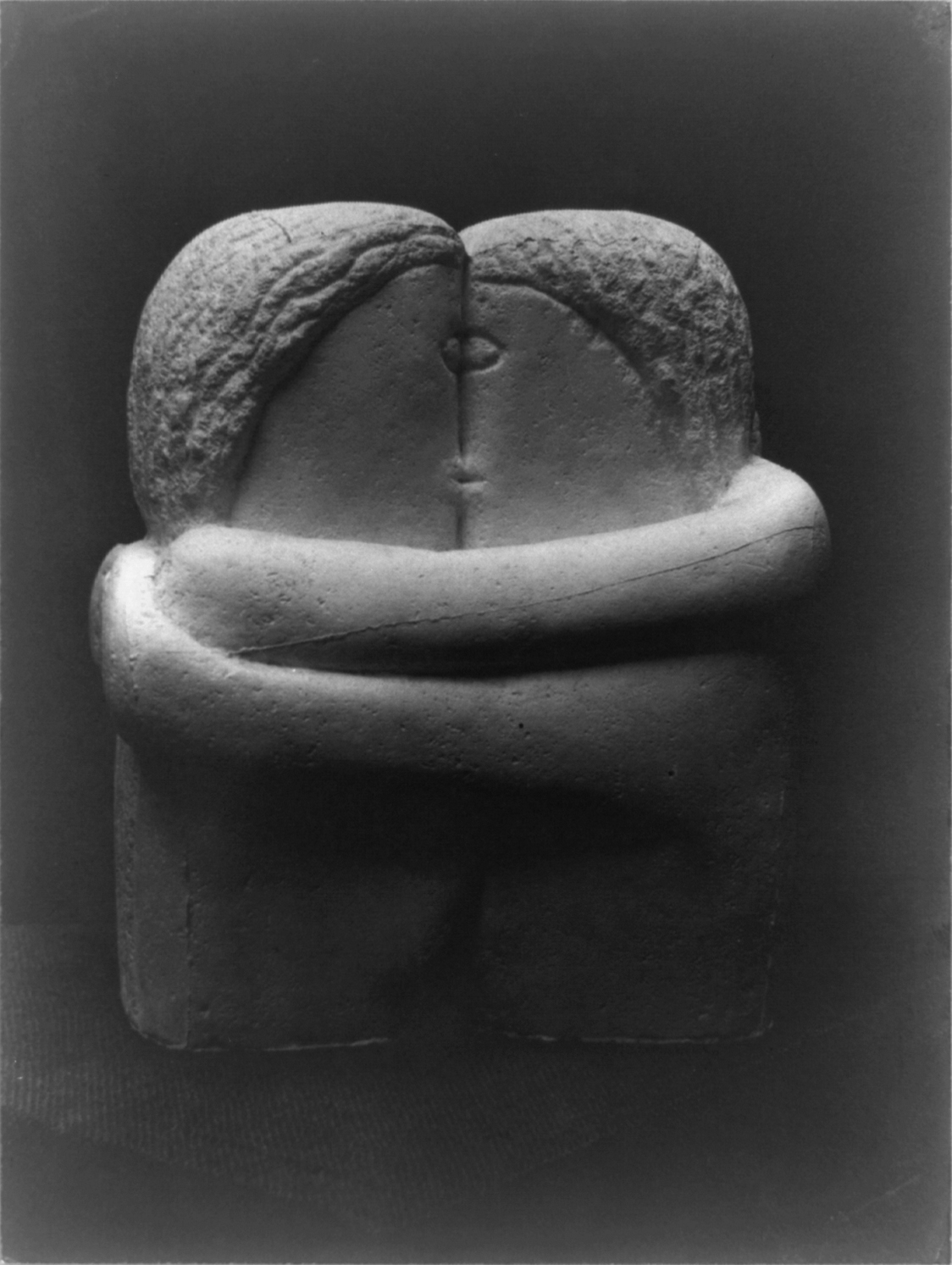
7. The previous post — the post that got me started on this list — discussed a Charlie Hebdo cover showing 2 men kissing which I assumed was an intentional allusion to the famous New Yorker cover showing a Jewish man and a black woman kissing, and Meade said: "You know what else you should have included?" I said: "Brancusi's 'The Kiss'?"


No, he was thinking of the famous photograph of a sailor kissing a nurse: "V-J Day in Times Square" by Alfred Eisenstaedt. Scanning my Google image search results, I saw Gustav Klimt's "The Kiss" and said: "As ubiquitous as Gene Simmons." No, I said: "How many dorm rooms have you seen this in?" And "There's also that Rodin."

8. For a less famous, less over-liked artwork called the kiss, consider Tino Sehgal's "The Kiss": "On the [Guggenheim Museum's] ground floor, a man and woman entwine in a changing, slow-motion amorous embrace.... As choreography it will hold no surprises for anyone familiar with contemporary dance. Taken as living sculpture, it has amusing moments: every so often, the performers strike erotic poses derived from Courbet, Rodin, Brancusi and Jeff Koons." I'd already thought of Rodin and Brancusi, but let's check out the Courbet and the Koons.

9. Hey, Koons (#8) and Coons (#2). It's like the stars are in alignment. Is there a constellation called The Kiss? No, but The Arctic Monkeys sang: "And her lips are like the galaxy's edge/And her kiss the color of a constellation falling into place."

10. "Kiss" is a very old word in English. The OED — giving the first meaning as "A touch or pressure given with the lips... in token of affection, greeting, or reverence; a salute or caress given with the lips" — has the oldest appearance of the word circa 1000:
Ælfric Homilies II. 32   Ic hine to minum cosse arærde.
I don't read English well enough to understand that, but the language becomes more recognizable by the 1380s, when a translated Bible had: "Kisse he me with the cos of his mowth." And here's a great poet: "Ah why refuse the blameless bliss? Can danger lurk within a kiss?"

१९ ऑगस्ट, २०१२

"My job was simple: Paint by numbers."

"The most intricate sections required miniature brushes, sizes 0 and 00, their bristles no longer than an eyelash. The goal was to hand-fashion a flat, seamless surface that appeared to have been manufactured by machine, which meant there could be no visible brush strokes, no blending, no mistakes."

The tribulations of an art worker, paid $14 an hour to make a painting "by" Jeff Koons that sold for $501,933. Koons does the ideas and he makes far more money. Do you have a problem with that?

२ मार्च, २००५

"Artstar."

I love the idea of a reality show for artists.
"In the 1970's when I started in the art world, no self-respecting artist would have stood in line to try to get on a television show," said Jeffrey Deitch, whose gallery, Deitch Projects, is helping to create an art-reality show called "Artstar." "It never would have happened."
Back in the 50s and 60s, ordinary people got excited about art and followed the celebrity artist like Jackson Pollock and Andy Warhol. And Picasso was still around, with all his star quality. But ordinary people haven't followed art in recent decades. So art needs a reality show to make it relevant again. Artists lining up in SoHo to participate in the show is a nice follow up to the big Christo stunt in the park. Even if the art isn't all that great, it's good to make art popular again!

And maybe the show is good for the artists. Why assume the current system for selecting artists is better than a contest?
[M]any of the artists who were braving the icy wind on Wooster Street Monday morning said that if trying to break into the art world through television was a little silly, it was no sillier than many of the other ways that artists try to attract attention in the highly competitive New York art world.

"It's so much about luck," said Arnulfo Toro, 28, who recently quit a job working as a painter for Jeff Koons's studio, where he said he was dissatisfied by the pay. "You can be really bad and get the go-ahead and be really good and go nowhere. We all need a godfather to give us a start." But despite camping out in sleeping bags beginning at 6 in the morning to get a place in line, neither Mr. Arnulfo, a painter, nor his friend, Peter Knutson, 30, a sculptor, made the cut yesterday to a group of 32 semifinalists.
Finally, just as a matter of good TV: art gives us something to look at and TV is a visual medium. I note that the best episode ever of "The Apprentice" involved selecting and promoting an artist.