30 నవంబర్, 2025
I opine on the snow — before and after.
13 మే, 2025
"Biden's physical deterioration — most apparent in his halting walk — had become so severe that there were internal discussions about putting the president in a wheelchair, but they couldn't do so until after the election."
28 మార్చి, 2024
"Mr. Trump ended the first day of public trading $4.6 billion richer on paper...."
8 మార్చి, 2024
Why I didn't watch the State of the Union address live last night and why I probably will never watch the recording of it.
I wasn't feisty. I was lying down in my sleep position — a complicated arrangement involving 4 down pillows — and planning to more or less listen, listen until I entered the world of dreams — a place not necessarily more pleasant that the House chamber (last night I woke up screaming at nonexistent crocodiles) — but a place where I sojourn for 7 hours rebuilding the strength of a body that naturally rises at 4 a.m., maybe 3.
Despite hit filmed programs such as I Love Lucy, both William S. Paley of CBS and David Sarnoff of NBC were said to be determined to keep most programming on their networks live. Filmed programs were said to be inferior to the spontaneous nature of live television.
Take away the magic of live television, and what is the State of the Union address? We are perfectly free to watch the entire thing on YouTube the next day. Or never. Or in sliced out snippets — a highlight reel or a collection of verbal slips or biggest applause lines. Or we can just read about it. Did anything happen? Did some grieving mother hear her daughter's name said aloud? Was the name precisely correctly pronounced? Did the President hold up a button? Did he recharge his campaign?
Was he feisty?
***
"Feisty," the OED tells us, is based on the familiar word "fist." It's a punch-in-the-nose concept. Fisty. Definition: "Aggressive, excitable, touchy." We're told it's American slang, originally dialect, and the OED has the quotes to prove it:
1913 Feisty means when a feller's allers wigglin' about, wantin' ever'body to see him, like a kid when the preacher comes. H. Kephart, Our Southern Highlanders 94
1926 That-there feisty bay mare jumped straight upwards and broke the tongue outen the plow. E. M. Roberts, Time of Man 152
1965 Luther gets a little feisty after a few drinks, and he began to argue with him. ‘D. Shannon’, Death-bringers (1966) xiii. 162
1968 He couldn't shake her loose—she hung on to his arm, feisty as a terrier. J. Potts, Trash Stealer xiii. 148
***
Post-sunrise opinion: The morning after, it is possible to see that the SOTU was a campaign speech. Every morning, there was a campaign speech yesterday.
In the comments: I'm getting a lot of pushback on the etymology of "feisty." It's not the fist that is the hand in an aggressive clench? It's a dog, you say? Well, let's go back to the OED. I see I made an assumption. What I was seeing at the OED entry "feisty" was:
I had not clicked on the boldface "fist." But if I had, I would not have gone to the entry for the kind of "fist" that is the clenched hand. I'd have gone to a separate entry, with 3 things together: a fart, a puffball fungus, and a dog:
1. A breaking wind, a foul smell, stink. Obsolete....
2. The fungus usually known as puff-ball.... Obsolete....3. U.S. dialect. A small dog....
The etymology pointed us to #3, so — no matter how much we might enjoy thinking "feisty" means farty — we must accept that the comparison is to a small dog. Yappy, hopping around, over-excited. Still farty though. You see the connection. It's always the dog.
10 జులై, 2023
"Since my ship came in in 2008, when 'Iron Man' had that big weekend, I have been a self-described expert on the ways of the world of creativity and commerce."
Says Robert Downey Jr., after the NYT interviewer asks if he's able to "make sense of the business right now."
8 డిసెంబర్, 2021
"We’re an employer too, the state of Michigan is... I know if that [vaccine] mandate happens, we’re going to lose state employees."
22 నవంబర్, 2021
"If something can be destroyed by truth, it should be" — Part 2.
Yesterday, I blogged:
I was surprised to run across this aphorism on Facebook the other day: "That Which Can Be Destroyed By the Truth Should Be." There were lots of comments celebrating this abstraction. I considered delivering truth that would destroy their bullshit celebration of a principle I doubt they believe.
Today, I must destroy my own statements with truth. I'm going to give this post my rarely used "I was wrong" tag!
I wasn't wrong about running across the aphorism on Facebook the other day, but I was wrong to remember "lots of comments celebrating" it. I merely imagined that other people would read it and celebrate it. My son John had reposted something he'd originally posted 8 years ago that passed along a post from Humans of New York. The Humans of New York post had a photograph of a young man with a purple notebook and this conversation between the photographer and the man:
"If you could give one piece of advice to a large group of people, what would it be?"
"If something can be destroyed by truth, it should be."
"I like that. Where'd it come from?"
"I'm not sure exactly. But it's really just another way of stating the scientific method. We shouldn't be clinging to hypotheses that are contradicted by observation.
John quoted "If something can be destroyed by truth, it should be" and he added it to a Facebook "album" of his that he calls "Intellectual Honesty." I'd say John is expressing some admiration for the adage. I have some admiration for it myself, but when you talk about destruction, don't you know that you can count me out in the abstract, I get suspicious.
There were 2 comments on John's repost. The first one, "Topical quote," is slightly celebratory, possibly satirical, possibly partisan. The second one "R'amen" is a joke that I get: It's "amen" for believers in The Flying Spaghetti Monster.
So, clearly, truth has destroyed "There were lots of comments celebrating this abstraction."
15 మే, 2020
Health experts.
IN THE COMMENTS: Chanie said, "Shouldn't the tag be 'A Michael Moore'?" Ah, yes! It's not the Michael Moore. Tag removed. I'll give you a real celebrity making the same point:
Not the greatest optic to have your Health Director moonlight as a Walking Dead extra... pic.twitter.com/dBZSVgezbl— James Woods (@RealJamesWoods) May 15, 2020
UPDATE: I put up this post because I believed it was from the filmmaker Michael Moore, whom I follow on Twitter. But it was from someone I've never heard of who tweets under the same name. It appeared in my Twitter feed because someone else that I follow had retweeted him. The gist of the tweet, like James Woods's tweet, was that there's something wrong or funny about an unhealthy-looking person serving as a health adviser. But, in fact, an unhealthy person could be a great expert! Health problems might lead a person into the field. And, certainly, anybody at any point in any career could develop a health problem, and it has nothing to do with whether they have expertise. And then there's the problem of simply looking unhealthy, whether you are unhealthy or not. It would be ridiculous, stupid, and unfair to pick your health expert based on whether they look healthy. Image means something in politics, and an expert needs to inspire confidence, but we're trying to ground ourselves in science and rational policy, and it's a mistake to judge expertise by looks and to assume that an unhealthy person lacks expertise.
6 ఆగస్టు, 2019
The NYT changes a headline.
FWIW (certainly better to do this than not IMO) they changed their headline between the 1st and 2nd print edition. pic.twitter.com/DOSAMFbvq0— Nate Silver (@NateSilver538) August 6, 2019
ADDED: I'm not sure I understand the headline "Trump Urges Unity vs. Racism." I see 2 interpretations.
One would be clearly expressed if the "vs." were translated into English and written as the word "against." (Many judges and law professors say the names of cases with the "v." changed to the word "against.") If it's "Trump Urges Unity Against Racism," then Trump's idea is that we should unite to oppose racism. That's respectful and supportive toward Trump.
But because I expect hostility toward Trump, I'm not sure the headline doesn't mean that Trump is urging 2 ideas — unity and racism — and these ideas are in conflict with each other.
To use parenthesis as in a math equation: Trump Urges (Unity vs. Racism).
That is, unity is in an endless struggle with racism, and Trump pushes this struggle upon us, and he's a big troublemaker, jerking us around by rooting for unity some of the time and at other times rooting for racism.
BUT: I don't want to be confusing about what Nate Silver is highlighting, which is the editorial opinion shoehorned into a news headline. What Trump talked about is the news and that's what the headline should say. There's an infinite number of things that Trump didn't talk about, and headlines shouldn't report what didn't happen. The choice to put one thing that didn't happen in a headline — embracing gun control — turns it from news into opinion. The necessary implication is that he ought to have embraced gun control.
CORRECTION: When I wrote all of the above, I believed that "Trump Urges Unity vs. Racism" was the second headline! Silver thinks "Assailing Hate But Not Guns" is an improvement. Well, it's more clearly written. That is true.
ALSO: I saw on Twitter that #CancelNYT was trending. It was a reaction to the first headline, "Trump Urges Unity vs. Racism." And the NYT apparently changed the headline to appease people who expected a better demonstration of hostility toward Trump.
The collective #CancelNYT response to this headline is rather revealing. Extremes of the party paradigms only support #FreePress so long as its a pseudo PR arm of their political ideology
— Gracie Nunyabiz @RNRTennessee (@GracieNunyabiz) August 6, 2019
The monster you feed, is the monster that will consume you.
Take note if #journalismmatters pic.twitter.com/hiIgZQ1e8I
18 జులై, 2019
Ihan Omar takes to the high ground — the Maya Angelou high ground.
You may shoot me with your words,— Ilhan Omar (@IlhanMN) July 18, 2019
You may cut me with your eyes,
You may kill me with your hatefulness,
But still, like air, I’ll rise.
-Maya Angelou https://t.co/46jcXSXF0B
Very well played by Omar.
Here's the full text of "Still I Rise," which is not to be confused with "On the Pulse of the Morning," the poem — often mocked by Rush Limbaugh — that Angelou performed at Bill Clinton's inauguration, the one that begins with "A Rock, A River, A Tree" and the "dry tokens" (petrified droppings?) of dinosaurs:
From the Wikipedia article, "On the Pulse of the Morning":
The popular press praised Clinton's choice of Angelou as inaugural poet, and her "representiveness" of the American people and its president. Critic Mary Jane Lupton said that "Angelou's ultimate greatness will be attributed" to the poem, and that Angelou's "theatrical" performance of it, using skills she learned as an actor and speaker, marked a return to the African-American oral tradition of speakers such as Frederick Douglass, Martin Luther King, Jr. and Malcolm X. Poetry critics, despite praising Angelou's recitation and performance, gave mostly negative reviews of the poem....I think the move to poetry is good! Trump does poetry too. Famously, "The Snake"!
CORRECTION: The original headline for this post was "Ihan Omar takes to the high ground — the Maya-Angelou-at-the-Clinton-inauguration high ground." That lets you see that I myself confused "Still I Rise" with "On the Pulse of the Morning." I'd discovered my mistake as I put the post together, but I forgot to change the post title until after publication. Fixed!
30 ఏప్రిల్, 2019
Oops!

Who knows what a long strange trip can do to your mind? I don't know all the things, but about an hour ago, 3 days after returning home, I noticed one thing.
I'd completely forgotten about the older-than-one-day comments that sit around in my "awaiting moderation" file! I'm not sure what jogged my memory, but I suddenly remembered. I think it was the ridiculous spam that was getting published in today's posts. Yes, that made me think about the moderation function.
There were hundreds of comments just sitting there, some fretting that they were doing something wrong and getting rejected. I'm really sorry. When you forget, you forget. Moderation is something that happens when I remember. I generally do it often throughout the day, but when traveling, I don't sit with my computer too much, and I don't go into the sort of idle mode where I poke around for more things to do.
I apologize! I genuinely value your comments. I was reading new comments as I traveled, but I really did lose track of the day-old-and-older comments that came in.
The photograph of the tree that symbolizes my twisted-up travel-mind is from the Realization Point trail near Boulder.
18 సెప్టెంబర్, 2018
I think the answer is evolution.
I wonder the same thing every time a tweet like this crosses my feed— Cathy Young (@CathyYoung63) September 18, 2018
⬇️ https://t.co/80S9mcpopm
The women Roberts posits did not survive to reproduce. And assuredly, much of the reproduction that did take place began with rape and many of the babies who survived to go on to reproduce had mothers who had the psychological wherewithal to go on despite rape. Women are not hotheads, freaking out about rape, attempted rape, and the burdens of avoiding rape. That's why it's taken so long to reach #TimesUp. But time is up, and it should be.
IN THE COMMENTS: Meade wrote:
I don't think David Roberts was being sarcastic with his tweet but Cathy Young was with hers.I said:
I sure thought he was, but I see he's at Vox, so.... do I need to break out my rarely used "I was wrong" tag???Meade said:
Young was snarking on his tweet signaling how woke he is.
7 మే, 2018
"Clear Channel Radio never banned any songs after 9-11."
I wanted to make sure readers see this material, which corrects something I wrote in a post a week ago about the song "Walk Like an Egyptian": "It's one of the songs Clear Channel banned after the September 11, 2001 attacks." I'm reposting the correction because I want to get out this story of fake news that became fake history:
I got that from Wikipedia, where the information is presented like this:
"Walk Like an Egyptian" was one of the songs deemed inappropriate by Clear Channel following the September 11, 2001 attacks[9] and was also included in a "list of records to be avoided" drawn up by the BBC during the Gulf War.[10][11][clarification needed]I have an informant — a person I have strong reason to trust and who I believe has first-hand knowledge — who wrote to me:
This is a battle I no longer fight; it’s been lost. I even saw it mentioned in a recently published college textbook of American history. But for you, here’s the real story:
Clear Channel Radio never banned any songs after 9-11. A day or so after the attack, one program director in San Diego sent an e-mail to other PDs with a short list of songs they might want to think twice about for a short time, purely for reasons of taste and sensitivity. I doubt that Walk Like An Egyptian was on the list then.
Now, you have to recall the typical bad-boy snotty attitude of the typical FM rock program director of 2001. Immediately, for their own entertainment, many of them started adding to the list, coming up with increasingly ridiculous suggestions, and trading the list back and forth.
The later, ridiculous list is the one that that made its way to the press, to the early forms of social media, and eventually to history books. Clear Channel was already being bashed for its size and its destruction of local radio, so this story fit right in.
The Bangles determine who gets to be American Idol's quirky cute girl.
But the week before, I told you my favorite was Maddie Poppe. Remember? I was utterly charmed by her performance of the old Bangles song "Walk Like an Egyptian":
Here's the old Bangles video for comparison.
Last night, Catie Turner chose that other great Bangles song "Manic Monday." It was Prince night on "American Idol," so I don't have my usual complaint that the show presents songs as if they were written by the most familiar performer. Prince got full credit for writing "Manic Monday," but those of us who love Prince and love that song also know it's a Bangles song. (Here's the old Bangles video for that.)
We'd just seen Poppe distinguish herself 2 weeks ago bringing a Bangles tune back to life, so what did Catie Turner do with what seemed to be the perfect song to compete in the niche of quirky cute girl?
Sorry, but Deer in the Headlights is not the right kind of cute. "America" voted and Catie did not make the final five.
What Prince song did Maddie sing?, you might ask. "Nothing Compares to You." Sweet. Final 5. What did other people do with Prince? Oh, if you cared, you'd have devoted last night to watching the whole damn 2 hours, like I did. But if you want to laugh or you understand something about country music that escapes me, here's Caleb Lee Hutchinson doing "When Doves Cry." He's been hogging the country boy niche all season.
By the way, back in the post about "Walk Like an Egyptian," I said something I now think is wrong: "It's one of the songs Clear Channel banned after the September 11, 2001 attacks."
I got that from Wikipedia, where the information is presented like this:
"Walk Like an Egyptian" was one of the songs deemed inappropriate by Clear Channel following the September 11, 2001 attacks[9] and was also included in a "list of records to be avoided" drawn up by the BBC during the Gulf War.[10][11][clarification needed]I have an informant — a person I have strong reason to trust and who I believe has first-hand knowledge — who wrote to me:
This is a battle I no longer fight; it’s been lost. I even saw it mentioned in a recently published college textbook of American history. But for you, here’s the real story:
Clear Channel Radio never banned any songs after 9-11. A day or so after the attack, one program director in San Diego sent an e-mail to other PDs with a short list of songs they might want to think twice about for a short time, purely for reasons of taste and sensitivity. I doubt that Walk Like An Egyptian was on the list then.
Now, you have to recall the typical bad-boy snotty attitude of the typical FM rock program director of 2001. Immediately, for their own entertainment, many of them started adding to the list, coming up with increasingly ridiculous suggestions, and trading the list back and forth.
The later, ridiculous list is the one that that made its way to the press, to the early forms of social media, and eventually to history books. Clear Channel was already being bashed for its size and its destruction of local radio, so this story fit right in.
24 ఏప్రిల్, 2018
"American Idol is shedding contestants like an Agatha Christie whodunit. There goes Effie Passero through a trap door."
Louis Virtel is doing a fabulous job of recapping "American Idol" at Vulture, with snappy sentences and full, commercial-free, clips of every performance. That link goes to the recap of last night's results show, where my favorite, Maddie Poppe, sang "Walk Like an Egyptian":
And here's the link to the Sunday episode recap, with each performance ranked by Virtel, including #1, Maddie Poppe, doing "Homeward Bound":
ADDED: Here's what Virtel wrote about that "Walk Like an Egyptian" performance:
I’m all for Maddie Poppe’s calmed-down, twee’d-up renditions of songs... “Homeward Bound”? Sure. “Brand New Key”? Absolutely. But after Ryan Seacrest announced she was safely in the top ten, Maddie gave her first baffling performance of the season: an undanceable take on “Walk Like an Egyptian.” It’s as if she wanted us to pay attention to the Bangles’ lyrics, which are … well, they’re stupid. Let’s talk a look at “Foreign types with the hookah pipes say / Ay oh whey oh, ay oh whey oh / Walk like an Egyptian.” That’s offensive, senseless, and then back to offensive. And she didn’t even throw us the saucy Susanna Hoffs side-eye to soften the embarrassment! I’m worried now. Soon, Maddie with perform “Kokomo” as a piano ballad or add marimba to “Tears in Heaven”! Here’s hoping she’s back on track with an angora-warm version of “You’ve Got a Friend” or something next week.Ha ha. Ask Meade if I didn't say out loud, "The lyrics to this song are actually pretty offensive."
AND: Here's the old Bangles video featuring the ancient mystery of Susanna Hoffs's inability to position her irises in the center of her eyeballs. As for the idea of "the Bangles' lyrics," I've got to object. They didn't write the song. It was written by music producer Liam Sternberg, who, Wikipedia tells us, "wrote the song after seeing people on a ferry walking awkwardly to keep their balance." The only connection to Egypt is that Sternberg thought the people looked like the figures in the ancient Egyptian paintings.
Is the song offensive? It's one of the songs Clear Channel banned after the September 11, 2001 attacks. [CORRECTION: That statement is wrong, as explained here.] It's got that casual, silly attitude toward ethnicity found in many old songs — "Ahab the Arab" ("There he saw Fatima layin' on a zebra skin rug with rings on her fingers and bells on her toes and a bone in her nose ho, ho"), "The Sheik of Araby" ("At night when you're asleep/Into your tent I'll creep"), "Midnight at the Oasis" ("You won't need no camel/When I take you for a ride"). I'm just naming ones about Arabs that spring immediately to mind. There's also Sam the Sham and the Pharaohs...

You wouldn't do that today. Domingo "Sam" Samudio was Mexican American, and he just enjoyed Yul Brenner as Pharaoh in "The Ten Commandments." As for Yul Brenner, he was a combination of Swiss-German, Russian, and Buryat, but it was accepted back then that he could play an ancient Egyptian. And he also got to play the King of Siam.
I'd branch out to other ethnicities, but I'll just say "Turning Japanese," and I'll leave it to you to come up with some other silly songs that would steam people up if they came out today (but maybe we can still love because they are old).
"Turning Japanese" was just a way of saying I feel like a foreigner in my own culture. The lyrics had nothing to do with Japanese people:
No sex, no drugs, no wine, no womenBut the video (and that musical riff)... just comically leaned into Japanese stereotypes (back in 1980, when not letting anything offend you was kind of the culture):
No fun, no sin, no you, no wonder it's dark
Everyone around me is a total stranger
Everyone avoids me like a cyclone ranger
8 మార్చి, 2018
"Since 1851, The New York Times has published thousands of obituaries: of heads of state, opera singers, the inventor of Stove Top stuffing and the namer of the Slinky."
From "Overlooked/Since 1851, obituaries in The New York Times have been dominated by white men. Now, we're adding the stories of 15 remarkable women." (NYT). Among the omitted are Diane Arbus, who died in 1971. You'd think by 1971, the NYT would have caught up to the idea that women are people. But perhaps the fame of Diane Arbus was slow-developing, mostly post-death. I was, at first, struck by the failure to do an obituary for Sylvia Plath, but she died in 1963, and I think it's pretty clear in that case that her fame arrived posthumously, perhaps because women's-movement proponents were working to elevate stories about women.
Yes, we the general public got to know Arbus because of a book of her work that came out in 1972 (a year after her death), and Sylvia Plath got big because of "The Bell Jar," which was published in 1971, 8 years after her death. And both Arbus and Plath committed suicide. As the NYT says in its late-arriving obituary for Plath, "Because the death was a suicide, Plath’s family did not much advertise it...." If someone who is not already quite famous commits suicide, I'm guessing, obituaries are rare, even for white men.
As for obituaries like the one for the man who invented Stove Top stuffing and the man who named the Slinky, they don't stand for the proposition that men don't have to do much to get a NYT obituary. They stand for the NYT practice of doing quirky obituaries for people with interestingly specific accomplishments. These are a wonderful sub-genre in the NYT, some of the most fun reading the newspaper offers. Don't diminish these obituaries as evidence of sex discrimination. I love those things, and they're often about women.
Here's an article from last year about a documentary about writing obituaries in the NYT:
8 సెప్టెంబర్, 2016
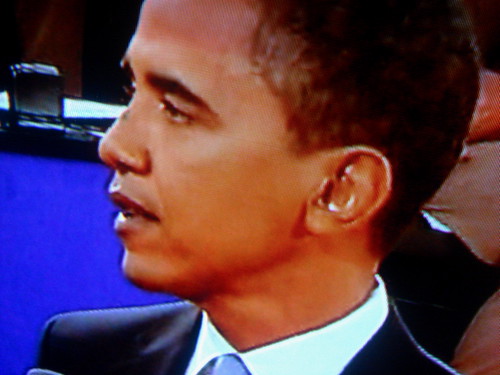
Was Hillary wearing an earpiece at the Commander-in-Chief forum last night?
But be careful. I once thought I saw an earpiece in Obama's ear during a debate — and I posted my own screen shot here — but I was wrong.

You've got to look at different shots and angles. Why would she wear something visible? Unlike men, women can completely cover their ears, and an earpiece can be made invisible.
10 మే, 2016
"In the end, however, your answer is the only one that will count."
ADDED: I couldn't understand how the author could say that a bike he bought last year had lasted "far more than twice as long" as "some comparable models." How short a life span do those other bikes have — like 3 months?
It's very easy to imagine that you're doing — as he puts it — "a little mental math" as you look at something expensive and decide it will last a long time and provide more enjoyment. You can spend a lot of money after you liberate yourself to think in those terms.
OH: The mystery of the long-lasting-1-year-old bike is solved if — and only if — you click through to his earlier article, which begins "Eleven years ago, I needed a new bike...." The article I read just says "Last year, I wrote about a $5,000 road bike that I bought." There's something about those 2 verbs in sequence — I wrote... I bought — that makes it look like the same time period. The reader shouldn't have to generate questions and research them to get through the reasoning of the essay at hand.
The older article contains the assertion "It replaces five other bikes." I still wonder what's wrong with those other bikes that they only last 2 years, but it seems he's comparing his bike to the "plastic bikes (carbon fiber)" used by the "guys I ride with." So the other guys have unusually transitory bikes, which is what makes them comparable, presumably. Not those aluminum bikes ordinary people buy. Actually, it's not that the other guys' "plastic" bikes are wearing out. It's just that they're the kind of guys who spring for a new model of bike every 2 years.
So it's the psychology of the mind that doesn't buy the $5,000 bike that causes the "comparable" bike not last: "[W]hen you buy cheap stuff, you get bored with it. I do not get bored with this bike, and that is why it is saving me money."
Do you get bored with cheap stuff? The newer article refutes that assertion, since it goes on to talk about a $9 ice cream scoop that works really well and that gives pleasure in part because of it was so cheap: "what makes it memorable to me is that it feels like a steal."
18 మార్చి, 2016
I was wrong.
In a post 2 days ago, I took 2 commas out of a sentence written by Scott Adams. He wrote "Trump is well on his way to owning the identities of American, Alpha Males, and Women Who Like Alpha Males." For what I thought was clarity, I changed it to "Trump is well on his way to owning the identities of American Alpha Males and Women Who Like Alpha Males."
I missed the first commenter who showed my mistake, but noticed, just now, Kristo Miettinen, who said: "Ann, by taking out the commas you changed Scott's meaning. In Scott's taxonomy of identities 'American' and 'alpha male' are two separate things."
I still thought I was right and said:
... I think, in one sense, "male" is the noun and "American" and "alpha" are adjectives, which would make putting a comma between "American" and "alpha" the conventional punctuation. But, like you, I see "alpha male" as a single entity, really a noun. Then "American" modifies "alpha male." Taking out the comma makes that clearer. The picture were supposed to have is of one of the alpha males of America. Think of the animal called the American Water Spaniel. You wouldn't even consider writing "American, water spaniel."I noticed the earlier commenter, frose, who'd said:
Professor,Because I didn't reread the full Adams quote, I still thought I was right and said:
You're usually spot-on with grammar and punctuation questions, but I think you erred this time in removing the commas in the Scott Adams statement. I believe Adams is using Oxford commas to delineate three distinct "identities" -- American[s], Alpha Males, and Women Who Like Alpha Males. I believe Adams erred in leaving off the "s" in "Americans" and that "Americans" is in contrast to "immigrants," which is one of the identities "owned" by Clinton."
Adams quote: "Trump is well on his way to owning the identities of American, Alpha Males, and Women Who Like Alpha Males. Clinton is well on her way to owning the identities of angry women, beta males, immigrants, and disenfranchised minorities."
I understand that idea, but I don't think that's what Adams meant to say. He's got 2 groups, not 3. One group is male and the other is female. The males are alpha and the females are the females who love them. There's no reason to dump "Americans" into that discussion. And the idea makes so little sense that I'm contemplating whether you're doing humor. If so, I get it.Finally, reading that second sentence — "Clinton is well on her way..." — I said:
Okay, I looked back at the context, and I can see that both of these commenters are making the same point.Seriously, thanks. And thanks to all readers who've been interested enough in commas and meaning to read this whole post. Hello to all who've come this far — all you commas-and-meaning enthusiasts.
"Trump is well on his way to owning the identities of American, Alpha Males, and Women Who Like Alpha Males. Clinton is well on her way to owning the identities of angry women, beta males, immigrants, and disenfranchised minorities."
"American" is one of the identities that Trump "owns." And he owns 2 others: Alpha Males and Women Who Like Alpha Males.
The identities Clinton owns are people who may be American citizens, but they don't have "American" as their identity.
I concede the point. I think you are right and didn't see it that way before.
Thanks for commenting!
AND: Was an "s" was needed on "American"?, as frose said. The identity is "American." But everything else Adams lists is put in the plural. Parallelism would have helped me see "American" as a separate identity. And, of course, "Americans" could not be mistaken for an adjective, which was my original mistake. I think I'd like the 2 sentences best if all the identities were singular, so that each thing on the list calls up a specific archetype — the Angry Woman, etc.
26 ఫిబ్రవరి, 2016
"What does this headline mean?"
What does this headline mean? pic.twitter.com/AvMw9zXCm6— Sam Stein (@samsteinhp) February 26, 2016
Without reading the article, I'm going to assume it means conservative women are not really women. They should be counted as men.
Okay, here's the article. Let's see. The author, Julie Baird, is an Australian journalist who worked at Newsweek during the 2008 presidential campaign. At one point they were doing a cover, using a photo of Sarah Palin and the close-up crop revealed "some untended lip and eyebrow hair." They ran it because they don't do retouching, and because they'd certainly show a male candidate's closeup facial flaws. Newsweek was accused of bias. It was “mortifying,” “a clear slap in the face.”
The NYT doesn't show the cover, annoyingly enough. Here it is:
I don't think Newsweek covers normally crop in that close, but Baird insists: "The truth was, we’d portrayed Ms. Palin just the way we did male candidates." But aside from the cropping, the lighting was harsh, and that was precisely because the photoshoot was set up by technicians who did not know who McCain's running mate was going to be, so they had "man lighting," which is harsher than the "female lighting" they would have used if they'd known they'd be photographing a woman. And we're told that the close-up crop is something that's normally done to men and not women:
“Close-up photos of men are used all the time without being touched up — men, particularly our political leaders, are expected to have lines and wrinkles. In fact, the cragginess of a man’s face is thought to express character.”Baird prods us to like comparable photographs of women: "Why are male blemishes signs of authority while women’s are signs of shame?" And, beyond that, why do we even regard female facial hair as a bad thing? Baird presents three examples, all from Victorian literature, portraying a women's mustache in a not completely negative light, e.g.:
In Victoria Cross’s 1903 novel “Six Chapters of a Man’s Life,” the heroine has a mustache “so perceptible that you can see it all across the room.” The male narrator is charmed: “It would spoil most women I know, but it doesn’t seem to spoil her.”Baird asks:
Why do we consider a mere hint of the hirsute such a disgrace for women when men can mooch about our cities with goatees, mutton-chop whiskers, navel-skimming beards and even “man buns” with little comment? We think of ourselves as liberated, yet it is still considered embarrassing and shameful for a woman’s upper lip to be imperfectly depilated.So my guess was wrong. Baird didn't say conservative women aren't real women. She said liberate yourself, ladies. Be out and proud with that hair.


