Flaubert लेबलों वाले संदेश दिखाए जा रहे हैं. सभी संदेश दिखाएं

5 दिसंबर 2025

"In his satirical 'Dictionary of Received Ideas'... Flaubert offered up a range of definitions embodying the stupid notions that silly people too readily accept."

"...  'Art': 'Leads to poorhouse. What use is it, since machines can do things better and quicker?' ... 'Bird': 'Wish you were one, saying with a sigh: "Oh, for a pair of wings!" This shows you have a poetic soul.'... By mocking these thoughts, we push ourselves past them. From this perspective, our sense that we’re getting stupider may simply reflect our determination to be smart."

Writes Joshua Rothman, in "Are We Getting Stupider? Stupidity is eternal—and more complex than we think" (The New Yorker).

"Dictionary of Received Ideas' — link goes to full text — is one of the few books that has its own tag on this blog: here. It's long been one of my favorite books, and you may have noticed my various proposals for entries in a new Dictionary of Received Ideas. If you get Flaubert's idea, maybe you can help me write this volume for my shelf of Unwritten Books

Actually I don't think Rothman conveys Flaubert's idea accurately. Here's a new New Yorker piece from 2013 (by Teju Cole), which explains the "Dictionnaire des Idées Reçues" like this:  "What galls Flaubert most is the inevitability, given an action, of a certain standard reaction. We could learn from his impatience: there are too many standard formulations in our language. They stand in place of thought, but we proclaim them each time—due to laziness, prejudice, or hypocrisy—as though they were fresh insight."

Anyway, what's Rothman's point about our possibly becoming stupider? He writes: 

4 सितंबर 2023

"What is distraction? Maybe it is just the need to be diverted: from the direction you originally set out on, from what it was you thought you wanted to do."

"After all, to desire something requires projecting yourself into the future—how do you know you’ll still want it when you get there? And along the way there are so many attractions, way stations, spots of time.... Now that I no longer work a forty-hour-a-week job, I tell many people I am writing a book. It is going along, I say, but slowly. How is it that so many chores, parties, trips, assignments, and plainly wasted hours intervene? Not everyone is distracted from their most cherished goals. But I think everyone is distracted from something—it is desire’s shadow, trailing behind our self-presentations. By beginning anything, we create the possibility of detours.... Research easily becomes its own distraction. Fiction writers are not unfamiliar with this crisis, having placed their character under a tree, then specifying what kind of tree it is, then wondering if that tree would be in flower at this particular time of year, whether it grows in the particular geographical region where the story takes place. We can become masters of rationalizing the inessential.... A common idea of distraction presupposes that you’re turning away from something more important that you ought to be paying attention to instead...."

Writes David Schurman Wallace in "In This Essay I Will: On Distraction" (The Paris Review).

That essay is also about Flaubert. I wasn't going to mention that, but there's a section about one of my all-time favorite books, a Flaubert book, "The Dictionary of Received Ideas."

22 मार्च 2023

"We tend to overstate the poverty of the style that precedes a style we admire..."

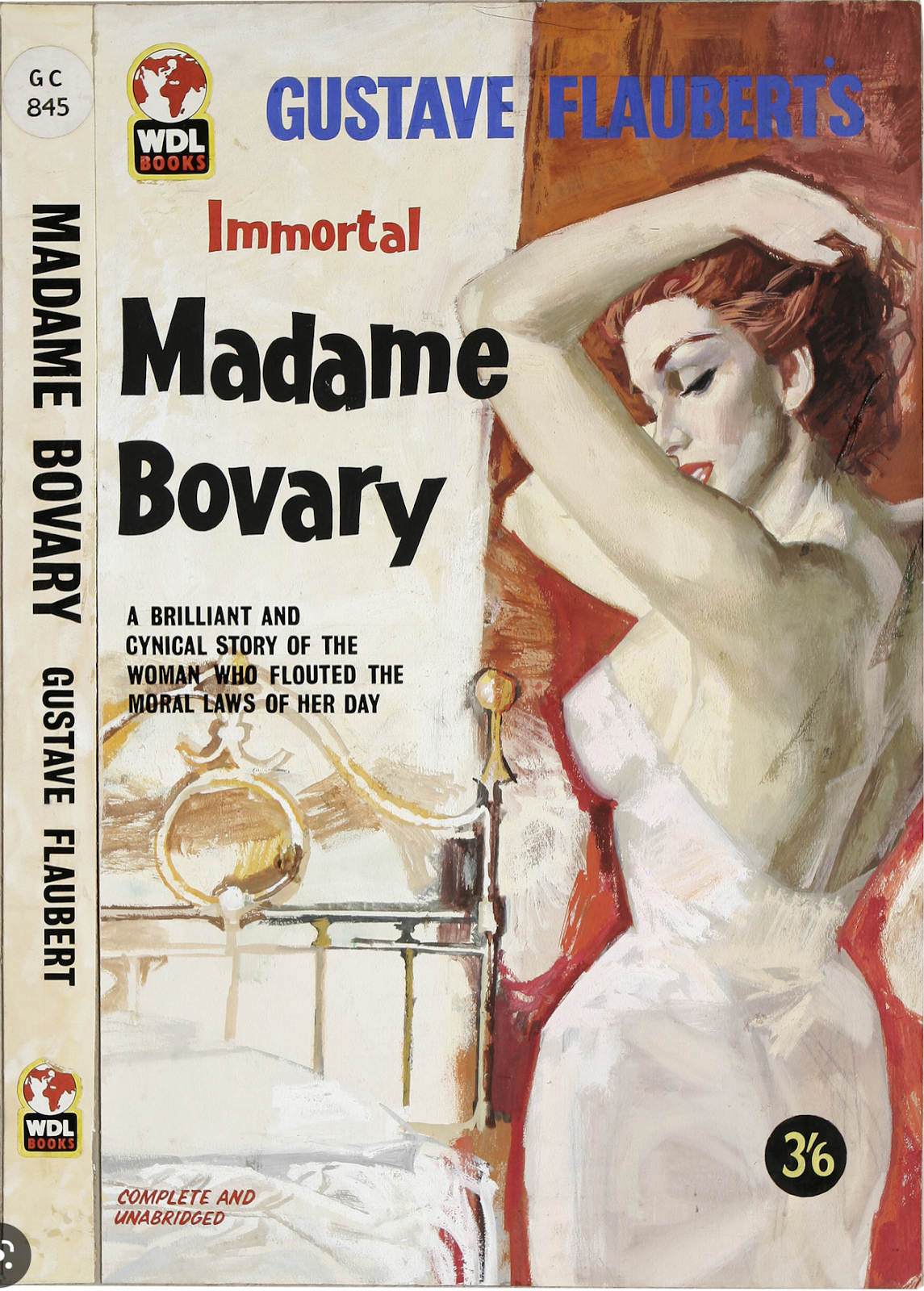
"... histories of rock and roll treat what accompanied it on the airwaves of the fifties as if the music were all 'Sing Along with Mitch' and 'How Much Is That Doggie in the Window?,' when it was also Sinatra’s concept albums, Sarah Vaughan’s collaborations with George Treadwell, and Dave Brubeck’s million-selling recording of a jazz instrumental in five-four time. And so we remember paperback books, pre-Push Pin, as either clinically bare, as with Modern Library editions, or outlandishly lurid, as with an edition of 'Madame Bovary' featuring an Ava Gardner-style femme fatale, complete with slipping negligee....There was, in truth, much ambitious 'art' illustration in those years, including Ben Shahn’s covers for S. J. Perelman and Kauffer’s cover for Ralph Ellison’s 'Invisible Man.'"


Here are those Ben Shahn covers.

Here's that Kauffer cover.

And I think this might be the referenced "outlandishly lurid" "Madame Bovary" cover:


Or... this fits the description better (but it's a British edition):

24 जनवरी 2022

"Be regular and orderly in your life like a bourgeois, so that you may be violent and original in your work."

Said Gustave Flaubert.

I'm reading that this morning because it popped up in the end of a New Yorker article about — of all things — Led Zeppelin:

If the predetermined task of rock gods and goddesses is to sacrifice themselves on the Dionysian altar of excess so that gentle teen-agers the world over don’t have to do it themselves—which seems to be the basic rock-and-roll contract—then the lives of these deities are never exactly wasted, especially when they are foreshortened. Their atrocious human deeds are, to paraphrase a famous fictional atheist, the manure for our future harmony.... [S]urely all kinds of demonic and powerful art, including many varieties of music, both classical and popular, have been created by people who didn’t live demonically. What about Flaubert’s mantra about living like a bourgeois in order to create wild art? In Led Zeppelin’s case, the great music, the stuff that is still violently radical, was made early in the band’s career, when its members were most sober. The closer the band got to actual violence, the tamer the music became.

Yes but who is the "famous fictional atheist" and how can I reverse the paraphrase "atrocious human deeds are... the manure for our future harmony"? Oh, I managed to do that.

9 मई 2021

"I was accustomed to thinking of most novels the way Nabokov wanted me to, or as Flaubert did—he once wrote that the most beautiful books depend 'on nothing external . . . just as the earth, suspended in the void, depends on nothing external for its support.'"

"Then something happened to change my thinking. I realized that the real world is full of people who, presumably, have feelings about being appropriated for someone else’s run at the Times best-seller list.... Is moving someone down the existence scale from 'human person' to 'character' anything like murder?... I thought that I recognized my past in a stranger’s words... Yet perhaps I was exaggerating the similarities, getting paranoid, self-absorbed.... Who owns a story? In writing my original piece, I lifted the lives of my parents and sister.... If Hall did use my text in some way, perhaps she only turned me from a superpowered narrator back into a character... 'My'... ends up a desiccated, unlovable, insect-like creature; her twin sister dies young.... Interrogating [my] anger now, I find it fascinating. It scans as an authorial fury. My essay was not just a personal history; it was an attempt to reckon with literary and societal representations of anorexia..."

From "Who Owns a Story? I was reviewing a novel. Then I found myself in it" by Katy Waldman (in The New Yorker). This article is from 2019. It came up in a search I was doing this morning (about a book that's mentioned in a different part of the essay).

In asking "who owns a story," Waldman isn't asking for a discussion of copyright. It's about art and ethics. Personally, I've been somebody else's fictional character. More than once. It's a complex matter to be used like that. You may enthusiastically support it, at least some of the time. You might want your story told... but perhaps not quite like that. And if it's told once, is it still there for you to tell it? 

21 मई 2019

"I’ve noticed that the relationship jokes you made earlier in your career were a little nastier and less playful than the ones you make now. Why do you think that is?"

The NYT asked Wanda Sykes, who answered:
It just speaks to being in a bad relationship with my husband. I was being honest. I wanted to get away. Like: “God, there’s his stupid face, and he’s chewing. Ugh, does he have to breathe? Make him stop breathing.” Now I’m in a great relationship, and I’m happy, so my wife’s chewing doesn’t annoy me.
From "Wanda Sykes on ignoring Michelle Obama and the ‘Roseanne’ debacle."

ADDED: That made me think of "Madame Bovary":
Besides, she was becoming more irritated with him. As he grew older his manner grew heavier; at dessert he cut the corks of the empty bottles; after eating he cleaned his teeth with his tongue; in taking soup he made a gurgling noise with every spoonful; and, as he was getting fatter, the puffed-out cheeks seemed to push the eyes, always small, up to the temples.
He made a gurgling noise with every spoonful because she didn't like him.

13 दिसंबर 2013

"When it comes to writing about anorexia, the only truly radical move, as far as I can tell, would be to show clearly just how profoundly boring it is..."

"... not sad or prurient or overdetermined," writes Alice Gregory in "Anorexia, the Impossible Subject," in The New Yorker (reviewing "How to Disappear Completely: On Modern Anorexia").
The very premise is an unappealing one: we’d like to believe that such unhinged myopia would have psychological roots in trauma or in some sinister personal history, but usually it doesn’t.... [A] voluntarily isolated person choosing not to eat until she’s addicted to not eating doesn’t make for a very good story....

If we really wanted to protect our supposedly susceptible youth, we’d paint anorexics as they are: slowly suicidal obsessives who avoid other people and expend ninety-five per cent of their mental energy counting the calories in green vegetables. We wouldn’t see them as worth reading about at all.
But readers choose books because they are interesting, and so whatever is written about well enough to attract readers is going to make the subject absorbing, exciting, glamorous. What things other than anorexia are actually quite boring but written about in books as if they were not boring? When else do we worry that readers will be tricked into doing things they should not do because the book failed to depict the activity as boring?

And yet... isn't Gregory is falling prey to the imitative fallacy?

16 नवंबर 2013

"In the days when success in life had depended on marriage, and marriage had depended on money, novelists had a subject to write about."

"The great epics sang of war, the novel of marriage. Sexual equality, good for women, had been bad for the novel. And divorce had undone it completely. What would it matter whom Emma [Bovary] married if she could file for separation later?"

Says a character in the Jeffrey Eugenides’ novel "The Marriage Plot," reviewed here.
Eugenides, speaking for himself, made a virtually identical argument in Slate several years ago, substituting “Anna Karenina” for “Madame Bovary”: “You can’t have your heroine throw herself under a train because she left her husband and ruined her life. Now your heroine would just have a custody battle and remarry.”
Oh, yeah? And what about cell phones? They're wreaking havoc on hack plots. Of course, the answer is to throw in some bit about how there's no signal or the battery is dead.

There must be a stock list of reasons why a modern-day woman cannot divorce. 1. Make her religious, 2. Inheritance, 3. Children, 4. Husband gives access to some needed social or business network, 5. Hey, I'm not a writer of plots! You figure it out, writer man.

28 अगस्त 2013

A new "Dictionary of Received Ideas."

I've been threatening to write a new "Dictionary of Received Ideas" for years — as clicking on the "Dictionary of Received Ideas" tag will prove — so a reader sent me the link to this new New Yorker piece, by Teju Cole, which is exactly that, beginning with an explanation of the original "Dictionnaire des Idées Reçues," by Gustave Flaubert:
What galls Flaubert most is the inevitability, given an action, of a certain standard reaction. We could learn from his impatience: there are too many standard formulations in our language. They stand in place of thought, but we proclaim them each time—due to laziness, prejudice, or hypocrisy—as though they were fresh insight.
The great thing about pinning down these things is that now, anyone serving up the received idea can be forced to acknowledge that their insight is totally stale. If the book isn't written however, you're forced to say things like: If I were writing a new "Dictionary of Received Ideas," I would put [whatever you just said] next to [name the topic that had come up in conversation]. For example, to draw on a topic discussed earlier today on this blog: Travel. My entry for "Travel" would be: It broadens the mind. 

ADDED: Here is my collection, gathered from old posts. I could generate many more using my tags, but here are the 11 entries I've literally said belong in a new "Dictionary of Received Ideas," arranged alphabetically:
Action: When referring to the government, assert that it shouldn't be taken "unilaterally."
Alito: refer to him as Scalito.
Blackmun: Quote "Poor Joshua!"
Barbie: Imagine how she'd look if her proportions matched those of a real woman.
Contradiction: If accused of contradiction, quote Walt Whitman: "Do I contradict myself?/Very well then I contradict myself/(I am large, I contain multitudes.)" Shorter form: say you "contain multitudes."
David Brooks: Impressed by the crease in Barack Obama's pants.
Federal Jurisdiction: Arcane.
Mark Madoff: Hanged himself with a dog leash.
Opposed: Always add "unequivocally."
Presidential nominating conventions: Be sure to use the phrase "tightly scripted."
Weather: When cold, make wry comment about global warming.
NOTE: The entry for "Action" was written in 2004. It would need to be updated to account for the Obama years: 
Action: When referring to the government, assert that it shouldn't be taken "unilaterally." If desired action can only be taken unilaterally, say that your opponents are "obstructionist."
The "Contradiction" entry should have "see 'Consistency,' and there should be an entry:
Consistency: "The hobgoblin of little minds." Emerson said that.

UPDATE:

Bernardo Bertolucci: Say something about butter.
Justin Trudeau: His father must be Fidel Castro.
Naked President:  Quote Bob Dylan ("Even the President of the United States sometimes must have to stand naked").
Mike Nesmith: His mother invented Liquid Paper.

5 फ़रवरी 2013

"The blog is also now unending: you can scroll down indefinitely if you so wish..."

A nice feature at Andrew Sullivan's newly independent blog. This means that the blog is set to have a  number of posts on the page when you click there, but if you want more, you don't have to click to an "older posts" page (as you do here), it automatically provides new posts as you scroll. This gives a vivid depiction of what a blog really is: a pile of posts one on top of the other. For example, my blog is a stack of 32,381 posts.

Sullivan has also moved his archive, which goes back to January 2001: "I have given a sharp dagger for anyone who wants to make me look foolish – so have at it." I don't think the archive makes him look foolish. I read him all the time back then, when he called himself conservative and tried to define conservatism in new ways. Or is the appearance of foolishness not in what those old opinions were, but in the later deviations? Would you read the sort of person who would go 12 years without contradicting himself?

The Dictionary of Received Ideas — my imagined modern American version of it — has this under "contradiction":
Do I contradict myself?
Very well then I contradict myself,
(I am large, I contain multitudes.)
That's the reflexive quotation but you can keep scrolling in that poem, Walt Whitman's tall stack of lines:
I concentrate toward them that are nigh, I wait on the door-slab.

Who has done his day's work? who will soonest be through
with his supper?
Who wishes to walk with me?

Will you speak before I am gone? will you prove already too
late?
I wait on the door-slab....

15 नवंबर 2012

David Foster Wallace's essays "could have done with a little judicious pruning."

I laugh out loud at that notion, expressed by Michiko Kakutani, reviewing the new collection "Both Flesh and Not."

Meade asks me what's so funny, I explain, and he cites "too many notes":


"Just cut a few, and it'll be perfect!"

Back to "Both Flesh and Not" — which I just downloaded into my Kindle app. The title seems to grind into our heads that Wallace is not flesh anymore, having hung himself. Anticipating the first or second comment to this post will point that out, I'm pointing it out along with all the references to suicide that appear in the book. There are 4:

1. "What if we chose to accept the fact that every few years, despite everyone’s best efforts, some hundreds or thousands of us may die in the sort of terrible suicidal attack that a democratic republic cannot 100 percent protect itself from without subverting the very principles that make it worth protecting? Is this thought experiment monstrous?"

2. "It’s not just that there are [in 'Uncle Petros and Goldbach's Conjecture: A Novel of Mathematical Obsession'] long and irrelevant footnotes on, e.g., Gödel’s method of suicide, Poincaré’s theory of the unconscious, or the novel properties of the number 1,729.25." [Gödel’s method was refusing all food for a month, under the delusion his doctors were trying to poison him, which doesn't really sound like suicide, unless you believe "suicide" does not mean self-murder. ]

3 & 4. "... [Edwin] Williamson sometimes presents Borges’s stories and poems as 'evidence' that he was in emotional extremities. Williamson’s claim, for instance, that in 1934, 'after his definitive rejection by Norah Lange, Borges… came to the brink of killing himself' is based entirely on two tiny pieces of contemporaneous fiction in which the protagonists struggle with suicide. Not only is this a bizarre way to read and reason — was the Flaubert who wrote Madame Bovary eo ipso suicidal?— but Williamson seems to believe that it licenses him to make all sorts of dubious, humiliating claims about Borges’s interior life: '"The Cyclical Night," which he published in La Nación on October 6, reveals him to be in the throes of an acute personal crisis'; 'In the extracts from this unfinished poem… we can see that the reason for wishing to commit suicide was literary failure, stemming ultimately from sexual self-doubt.' Bluck."

ADDDED; I only searched for "suicide," and, reading the book, I encounter "suicidally" -- a self-regarding "suicidally" -- and the premise of my 4-point list, above, is radically undermined.

7 मार्च 2012

"Can you concentrate on Flaubert when your cute cat is only a few feet away, or give your true devotion to Mr. Darcy when people are swimming in a pool nearby?"

"People who read books on paper are realizing that while they really want to be reading Dostoyevsky, the real world around them is pretty distracting with all of its opportunities for interacting with people, buying things in stores, and drinking coffee."

Alex Madrigal lampoons that NYT article about ebooks that we were talking about a couple days ago.

12 दिसंबर 2010

"I feel against the stupidity of my epoch waves of hatred that choke me.''

What calls a man to write novels?

"There's no satisfaction to any Madoff loser that the son committed suicide."

"It's just tragedy on tragedy."

ADDED: All the newspapers have to say that Mark Madoff hanged himself with a dog leash. It's like "all the papers had to say was that Marilyn was found in the nude."

When does a single a death detail become irresistibly mentionable?

If only Flaubert were still here, adding entries to his "Dictionary of Received Ideas." At "Mark Madoff," we'd have "hanged himself with a dog leash."

I see Flaubert has an entry for "suicide": "Proof of cowardice."

27 मार्च 2006

Hamdan and the arcana of jurisdiction stripping.

Linda Greenhouse writes about the Hamdan case, to be argued in the Supreme Court Tuesday:
In the face of a measure that Congress passed and President Bush signed into law in late December to strip the federal courts of jurisdiction over cases brought by detainees at the United States naval base at Guantánamo Bay, Cuba, where Mr. Hamdan has been held since 2002, the court must decide whether it retains the right to proceed with this case at all.

For a court that has been highly protective of its own prerogatives, but at the same time notably attentive to the often arcane limits on federal court jurisdiction, the question is one of great delicacy, infused with historical resonance.
In my modern "Dictionary of Received Ideas," the entry for "Federal Jurisdiction" is: call it arcane. Being arcane, it's can be a good way to dispose of pesky problems. If you want to do a little sleight of hand, jurisdiction is a good move. We Federal Jurisdiction lawprofs make it our business to detect the fakery. But it's not all fakery, and the Constitution gives Congress some powers to check the courts, including the power to cut back their jurisdiction. The questions here are whether this statute cuts even pending cases, like Hamdan's, and whether that cut back goes beyond the scope of the power.

If there is jurisdiction, then the Hamdan case will deal with the validity of using military tribunals for the Guantanamo detainees.

More on Hamdan after the oral argument.

ADDED: SCOTUSblog has a good preview, including details about a possible 4-4 split vote and what it would mean. (John Roberts has recused himself, because he participated in the case at the Court of Appeals level. There's also a controversy about whether Antonin Scalia should recuse himself, given some remarks he made about the issue recently.)

MORE: Captain Ed is pretty hard on Scalia. You know, what bothers me the most about Scalia's statement is: "I had a son on that battlefield and they were shooting at my son, and I'm not about to give this man who was captured in a war a full jury trial." Much as I respect the son's service and the father's pride in it, the interests or activities of your friends and family should have absolutely no effect on how you decide a case. Are we to think that if the enemy were only shooting at someone else's sons, he'd take a different view of the issue?

CORRECTION: I've corrected the original text to show that the argument is on Tuesday, not Monday.