લેબલ Edmund Burke સાથે પોસ્ટ્સ બતાવી રહ્યું છે. બધી પોસ્ટ્સ બતાવો

29 ડિસેમ્બર, 2021

"Russia’s Supreme Court ruled on Tuesday that the nation’s most prominent human rights organization must close..."

"Shutting down Memorial is also another step in Mr. Putin’s effort to recast Russia’s legacy as a series of glorious accomplishments and soften the image of the often-brutal Soviet regime. While the state opened a comprehensive Gulag history museum in Moscow and Mr. Putin laid flowers at a new monument to the victims of Soviet repression, the increasingly emboldened Kremlin has moved aggressively to remove alternative interpretations of Russian history by organizations it does not control.... In recent years, Mr. Putin has shown a keen interest in shaping interpretation of Russia’s history, publishing his views in lengthy articles about the Soviet Union’s key contribution to the victory over Nazism and 'the historical unity of Russians and Ukrainians.' His viewpoint includes a renunciation of the democratic steps taken in the 1990s, which included reforms, self-criticism and social and economic upheaval.... 'There’s an old, banal formula that whoever doesn’t know the past is doomed to repeat it,' [said Jan Z. Raczynski, chairman of the board of Memorial International.] “The situation of the past decade shows we are moving in that direction.... The general prosecutor said we try to portray the Soviet Union as a terrorist organization... Well, we don’t have to try. The Soviet Union was a terrorist organization. In no other country were so many citizens imprisoned under false political accusations.'"


ADDED: The formula is "banal" because it's oft-repeated. It's a repetition about repetition. Yes, but who said it first?
Variations on the repeating-history theme appear alongside debates about attribution. Irish statesman Edmund Burke is often misquoted as having said, “Those who don’t know history are destined to repeat it.” Spanish philosopher George Santayana is credited with the aphorism, “Those who cannot remember the past are condemned to repeat it,” while British statesman Winston Churchill wrote, “Those that fail to learn from history are doomed to repeat it.”

AND: What are we doing now that is a repetition of the past that we don't know is a repetition because we haven't learned history?

17 ફેબ્રુઆરી, 2018

"To the extent that there is a generational divide, it may have to do with the fact that many older women are still wary about the internet, which leads them to not only miss the context of a longstanding feminist internet tradition of ironic misandry..."

"... but also to overlook the more nuanced chatter happening among younger women on social media and digital sites.... And yet most of the disagreement has to do with age-old ideas about sex, power and the function of social movements...

Writes Nona Willis Aronowitz in "The Feminist Pursuit of Good Sex" (NYT). Aronowitz is the daughter of Ellen Willis, "who in a 1981 essay in The Village Voice asked a question that now looms over #MeToo 40 years later: 'Is the Women’s Movement Pro-Sex?'"

Aronowitz says:
My connection to this complex intellectual heritage is at the heart of why I find the prevailing narrative about #MeToo’s generational split baffling and harmful. Here’s how the story goes: Older critics, flattened into “Second Wave feminist has-beens,” are accusing the movement of becoming increasingly anti-sex, anti-agency and anti-nuance. Younger women, also known as “Twitter feminists,” are accusing these critics of being bitter establishmentarians, unable to cede ground to new ideas. They’re both wrong, but so is this tired mothers-and-daughters framing, which threatens to derail substantive debate in favor of a catfight narrative.
I note the assertion that both sides are missing nuance. The older women think the younger ones are "increasingly anti-sex, anti-agency and anti-nuance." And the younger ones think the older ones don't follow "the more nuanced chatter" of the internet so they don't grok "the feminist internet tradition of ironic misandry."

If only we could be more nuanced, maybe we could meet in the middle. But everybody's always only seeing the lack of nuance on the other side. You get the self-flatterer imperiously telling other people to compromise. But Aronowitz seems to be more of an onlooker, trying to mediate. I look at  Memorandum's River and see there's no significant internet talk about her column. I look at the NYT's own "most-emailed," "most viewed," and even "recommended for you" lists and don't find it. Even with "Good Sex" in the title, it's not getting traction.

From the Wikipedia article on Ellen Willis:
Willis was known for her feminist politics and was a member of New York Radical Women and subsequently co-founder in early 1969 with Shulamith Firestone of the radical feminist group Redstockings.... Starting in 1979, Willis wrote a number of essays that were highly critical of anti-pornography feminism, criticizing it for what she saw as its sexual puritanism and moral authoritarianism, as well as its threat to free speech. These essays were among the earliest expressions of feminist opposition to the anti-pornography movement in what became known as the feminist sex wars. Her 1981 essay, Lust Horizons: Is the Women's Movement Pro-Sex? is the origin of the term, "pro-sex feminism."

Willis was the first popular music critic for The New Yorker, between 1968 and 1975... In 2011, the first collection of Willis’s music reviews and essays, Out of the Vinyl Deeps (University of Minnesota Press), arrived. It was edited by her daughter Nona Willis-Aronowitz. Ellen Willis "celebrated the seriousness of pleasure and relished the pleasure of thinking seriously," a review in The New York Times said.
Is anyone celebrating the seriousness of pleasure anymore? Even Nona Willis-Aronowitz — seemingly dedicated to her mother's legacy — left off the "Lust Horizons" part of the title of that 1981 essay. She calls it simply "Is the Women’s Movement Pro-Sex?" — perhaps because few readers get the reference to "Lost Horizon" these days...
... but I think it's because "lust" — a popular and positive word in the 1970s — has become ugly again — returned to its stature as one of "The 7 Deadly Sins"....
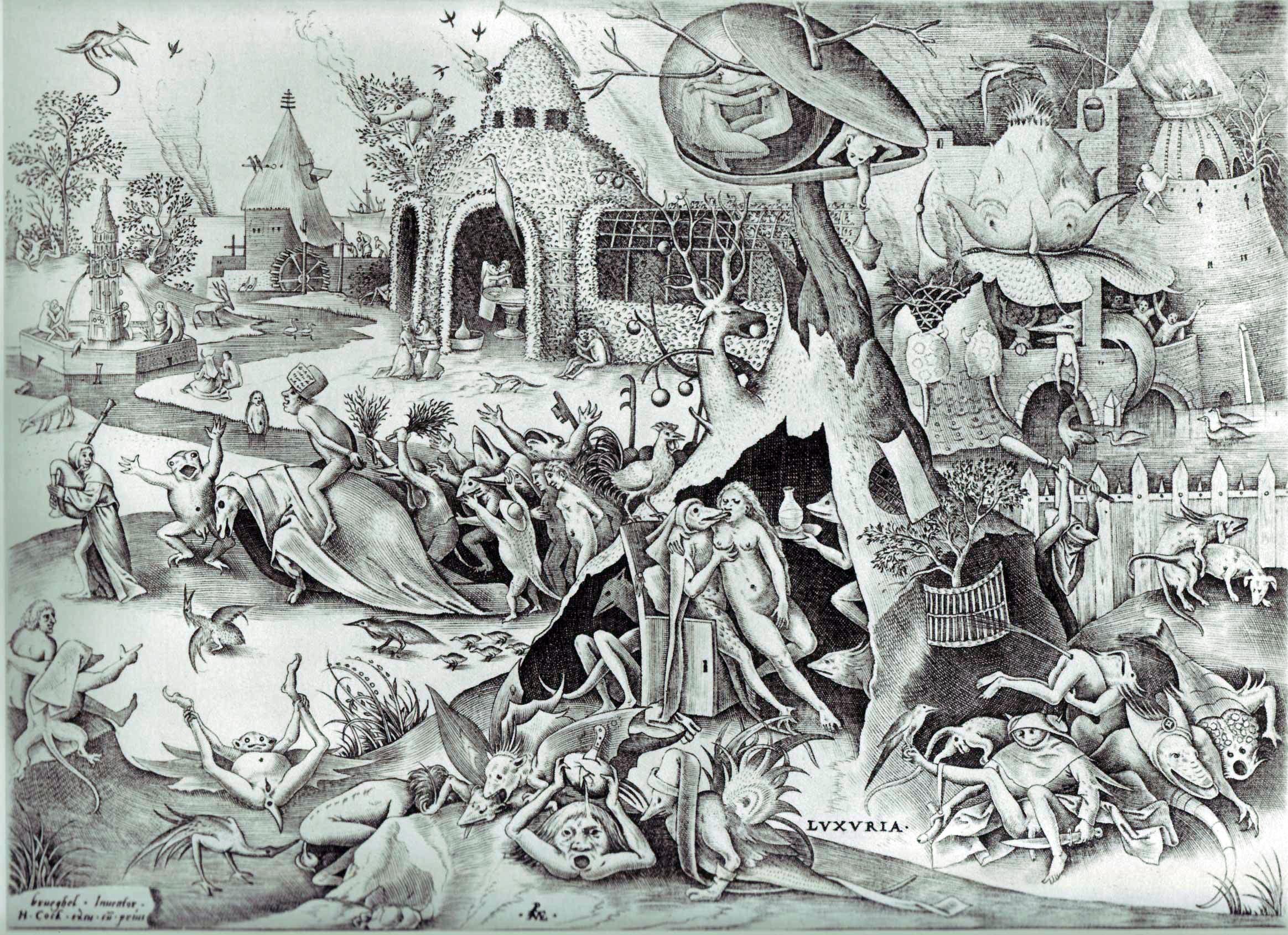


The question are feminists pro-sex? becomes — with nuance —are feminists pro-good-sex? The easy answer then is yes, but we're left with the difficult question is how to find good sex when her own daughter edits out Ellen Willis's word "lust"?

ADDED: To be fair, Aronowitz does, in her first paragraph, call herself "lusty," but she's speaking of herself in the past and "before I’d learned much about feminism." She was, she says, "fascinated by what we now call the 1970s 'golden era' of pornography... Being a lusty, modern woman, I was enthralled."

But "lusty" doesn't mean "lustful." It means merry and cheerful or hearty and vigorous. "The Turk... gave him two or three lusty kicks on the seat of honour," wrote Edmund Burke in his memoir.

The word that means "Full of, imbued with, or characterized by, lust or unlawful desires; pertaining to, marked by, or manifesting sensual desire; libidinous" (OED) is "lustful."

18 સપ્ટેમ્બર, 2017

Google celebrates the birthday of Samuel Johnson.


"As a popular search engine marks the great lexicographer’s birthday, it’s a good time for some defining questions. Can you get them right without googling?" (The Guardian). ("What is Johnson defining here? 'To deprive a dog of something, nobody knows what, under his tongue, which is said to prevent him, nobody knows why, from running mad.'") I got 5/10.

"Who was Samuel Johnson? The father of the modern dictionary's funniest entries" (The Telegraph). ("Lexicographer: A writer of dictionaries; a harmless drudge that busies himself in tracing the original, and detailing the signification of words.")

"Samuel Johnson: Who is this literary figure, what did he do and why is he so important?"
(Independent).
The primary reason for Johnson’s enduring appeal though, outside of his own remarkable achievements in print, is surely the ongoing popularity of James Boswell’s fantastically detailed Life of Samuel Johnson (1791).... Boswell recalls such delightful comic incidents as Johnson good-naturedly dismissing Burke as “a vile Whig”, rebuking Goldsmith for being “loose in his principles” and declining a repeat visit backstage to visit Garrick at the theatre because, “the silk stockings and white bosoms of your actresses excite my amorous propensities.” His opinions on everything from remarriage ("the triumph of hope over experience") to women vicars* and the merits of Alexander Pope are preserved for the ages in a work whose value cannot be overstated.
Don't forget Johnson's "Grammar of the English Tongue." That's the one I keep in my Kindle. Sample:

19 જૂન, 2014

"The word 'innovate' — to make new — used to have chiefly negative connotations..."

"... it signified excessive novelty, without purpose or end. Edmund Burke called the French Revolution a 'revolt of innovation'; Federalists declared themselves to be 'enemies to innovation.' George Washington, on his deathbed, was said to have uttered these words: 'Beware of innovation in politics.' Noah Webster warned in his dictionary, in 1828, 'It is often dangerous to innovate on the customs of a nation.'"

From "The Disruption Machine/What the gospel of innovation gets wrong," an excellent New Yorker article by Jill Lepore.

12 જૂન, 2013

"[W]hen David Brooks complains that Edward Snowden is an unmediated man, I must note that in the civil society Brooks invokes..."

"... Presidents and other leaders were also mediated; they were not merely checked by Congress, courts, etc., but they were also checked by themselves, and a sense of what was proper that went beyond 'how much can I get away with now?' Obama, too, is unmediated in that sense. That Brooks couldn’t see beyond his sharply-creased pants to notice that when it was apparent to keen observers even before the 2008 election is not to his credit. If the system of civil society has failed, it is in no small part because its guardians — notably including Brooks — have also failed."

So writes Instapundit, linking to my post yesterday, which links to David Brooks's new column "The Solitary Leaker."

The reference to Brooks falling for Obama's pants crease is such a big meme that it can be the entry for "David Brooks" in the new Dictionary of Received Ideas. I tracked down a substantial discussion of it from August 2009 in The New Republic:
In the spring of 2005, New York Times columnist David Brooks arrived at then-Senator Barack Obama’s office for a chat. Brooks... had never met Obama before. But, as they chewed over the finer points of Edmund Burke, it didn’t take long for the two men to click. “I don’t want to sound like I’m bragging,” Brooks recently told me, “but usually when I talk to senators, while they may know a policy area better than me, they generally don’t know political philosophy better than me. I got the sense he knew both better than me.”

That first encounter is still vivid in Brooks’s mind. “I remember distinctly an image of--we were sitting on his couches, and I was looking at his pant leg and his perfectly creased pant,” Brooks says, “and I’m thinking, a) he’s going to be president and b) he’ll be a very good president.” In the fall of 2006, two days after Obama’s The Audacity of Hope hit bookstores, Brooks published a glowing Times column. The headline was “Run, Barack, Run.”
Here's "Run, Barack, Run." Does Brooks deserve to be derided endlessly over the fixation on the pants crease? It is hilarious. It's like Rich Lowry getting "little starbursts" from Sarah Palin's wink. You can't not bring it up. But let's remember, Brooks's vision of perfection, seen in a pant's crease, came after they conversed, in depth, about Edmund Burke. That is, the 2 men were talking, in all likelihood, about the importance of civil society.

Does Obama deserve to be called an unmediated man?

ADDED: Speaking of Brooks and legs and feelings and the summer of 2009, remember this? ("I sat next to a Republican senator once at dinner and he had his hand on my inner thigh the whole time.")

1 ઑક્ટોબર, 2012

"Anyone who values truth should stop worshiping reason."

"We all need to take a cold, hard look at the evidence and see reasoning for what it is."

Said the psychologist Jonathan Haidt, quoted by Michael P. Lynch, who says:
According to Haidt, not only are value judgments less often a product of rational deliberation than we’d like to think, that is how we are supposed to function. That it is how we are hardwired by evolution. In the neuroscientist Drew Westen’s words, the political brain is the emotional brain.

Often “reasoning” really seems to be post-hoc rationalization...
That reminds me: new Supreme Court term starts today.
... we tend to accept that which confirms what we already believe (psychologists call this confirmation bias). And the tendency goes beyond just politics....
Lynch thinks Haidt goes too far:
Critics of reason, from Haidt to conservative intellectuals like Burke and Oakeshott, see reason as an inherently flawed instrument. As a consequence, they see the picture of politics I’ve just suggested — according to which democracies should be spaces of reasons — as unfounded and naïve. Yet to see one another as reason-givers doesn’t mean we must perceive one another as emotionless, unintuitive robots. It is consistent with the idea, rightly emphasized by Haidt, that much rapid-fire decision making comes from the gut. But it is also consistent with the idea that we can get better at spotting when the gut is leading us astray, even if the process is slower and more ponderous than we’d like.
Haidt's new book is "The Righteous Mind: Why Good People Are Divided by Politics and Religion."

1 સપ્ટેમ્બર, 2012

David Brooks heard no "talk of community and compassionate conservatism" at the GOP convention.

It's embarrassing. He really let his bias show when he said:
[T]here is a flaw in the vision the Republicans offered in Tampa. It is contained in its rampant hyperindividualism. Speaker after speaker celebrated the solitary and heroic individual. There was almost no talk of community and compassionate conservatism. There was certainly no conservatism as Edmund Burke understood it, in which individuals are embedded in webs of customs, traditions, habits and governing institutions.
As Roger L. Simon points out (via Instapundit):
Hello, where were you, David? On Thursday evening, one after the other private citizen came forth to testify to Mitt Romney’s extraordinary personal charity and deep community spirit. I have never seen anything like it at a convention, Republican or Democrat. I don’t know if you would call it Burkean, but you would certainly call it eminently decent and highly laudable. The culmination was Ted and Pat Oparowsky of New Hampshire who recounted how much time and attention the young Mitt Romney gave their son, a child he did not know, when the boy was dying of cancer.
Maybe Brooks skitters away from the part of the web of customs, traditions, habits and governing institutions that is religion.

I'd love to see Brooks write another column and explain — if this is what he thinks — that the compassionate, communitarian activities done within religion don't count as part of a political party's vision for America. Perhaps these activities are like the good things you do for your family and friends. It's a group of insiders, and someone operating within government needs a "vision" that relates to the whole community, not to groups that give each other special treatment.

But I don't think he'll be able to prop up his old Edmund Burke ventriloquist doll to say that. Brooks will need to come out and say it on his own. And then we can judge whether David Brooks represents conservatism (even for NYT op-ed page purposes).

24 સપ્ટેમ્બર, 2011

Righties and lefties get together at Harvard Law School to make common cause over the notion of a constitutional convention.

Boston Herald reports:
Speakers representing a broad swath of American political thought are coming from the Green Party, the Cato Institute, Progressive Democrats of America and the American Freedom Agenda, among others.

Agenda items will include term limits, expanding state rights and limiting private money in politics.

Attendees aren’t likely to agree on many of those issues, said keynote speaker Glenn Reynolds, a University of Tennessee law professor and founder of the influential conservative libertarian blog Instapundit. But, he said, “There is a widespread sense that things aren’t right and we should talk about fundamental changes instead of incremental changes — sort of like a reboot.”
That makes me want to dig out my favorite quote from Edmund Burke's "Reflections on the Revolution in France":
In states there are often some obscure and almost latent causes, things which appear at first view of little moment, on which a very great part of its prosperity or adversity may most essentially depend. The science of government being therefore so practical in itself, and intended for such practical purposes, a matter which requires experience, and even more experience than any person can gain in his whole life, however sagacious and observing he may be, it is with infinite caution that any man ought to venture upon pulling down an edifice, which has answered in any tolerable degree for ages the common purposes of society, or on building it up again, without having models and patterns of approved utility before his eyes.
Plus I'm having a flashback to 1980...

9 ડિસેમ્બર, 2010

"Palin is still talking about how much she loves C. S. Lewis."

"What is up with this? Chunky Bobo is always talking about C. S. Lewis too. Is he the new Edmund Burke? I read a bunch of C. S. Lewis books when I was a kid and I don’t see what makes them so conservative, aside from all the Jeebus stuff."

Sayeth DougJ. For a couple of seconds, I was all "who's Chunky Bobo?" but I figured it out.

***

Here's there underlying story about Palin. (She's on Barbara Walters' "10 Most Fascinating People of 2010." Ah, but how influential is she in Madison ?)

Here's a really nice — giftable — book collecting the works of C.S. Lewis. And here's a "daily readings" collection. And here's "The Portable Edmund Burke."