I've watched that movie many times, but not in the last 10 years. I should watch again. I think it might feel like scrolling in TikTok, which could elevate scrolling in TikTok and maybe explain why, on any given day, I'd rather scroll in TikTok than watch a movie on television. I like the fragmentation!
Dostoyevsky लेबल असलेली पोस्ट दाखवित आहे. सर्व पोस्ट्स दर्शवा
Dostoyevsky लेबल असलेली पोस्ट दाखवित आहे. सर्व पोस्ट्स दर्शवा
११ जुलै, २०२६
"Who’s ever written a great work about the immense effort required in order not to create? Could it be that in this passivity, I shall find my freedom?"
Says the character identified as "Dostoyevsky Wannabe" in the credits to the sublime 1991 film "Slacker," quoted in a Daily Texan article, "Linklater’s Austin, 35 Years Later."


२६ ऑक्टोबर, २०२५
"Reckless and intense: we are headed straight to the point of the matter, and there is no time."
"This urgency, this wildness, the seeming unruliness of his style, which is echoed in the many abrupt twists and turns in the action toward the end of the chapters—the reader must be kept in a state of suspense until the next installment—runs against something else, something heavier and slower, a patiently insistent question that is related to everything that is happening: What are we living for?"
Writes the great novelist Karl Ove Knausgaard, in "The Light of 'The Brothers Karamazov'/Although Fyodor Dostoyevsky wrote with wildness and urgency, he patiently insisted on asking an essential question: What are we living for?" (The New Yorker).
Writes the great novelist Karl Ove Knausgaard, in "The Light of 'The Brothers Karamazov'/Although Fyodor Dostoyevsky wrote with wildness and urgency, he patiently insisted on asking an essential question: What are we living for?" (The New Yorker).
Dostoyevsky was rushing because he was writing installments and needed the money. His wife observed
२७ सप्टेंबर, २०२५
"Who is your favorite fictional hero or heroine?"/"Cleopatra, of course."
"I was 15 when I read “Antony and Cleopatra.” I desperately wished for a gorgeous general who was willing to die for me and say, as he’s dying, 'I am dying, Egypt, dying.' I’ve always wanted a lover who would consider me an entire country.
A question to and answer from Rabih Alameddine, in "Rabih Alameddine Is Done With Dostoyevsky/Then: His favorite writer. Now: 'So earnest, so didactic, so humorless.' His own new novel is 'The True True Story of Raja the Gullible (and His Mother)'" (NYT).
A question to and answer from Rabih Alameddine, in "Rabih Alameddine Is Done With Dostoyevsky/Then: His favorite writer. Now: 'So earnest, so didactic, so humorless.' His own new novel is 'The True True Story of Raja the Gullible (and His Mother)'" (NYT).
Speaking of wanting to be considered an entire country, I also liked "My queen-size bed is divided into quadrants; I sleep in one, my two cats get one each, and one is for books."
२ ऑक्टोबर, २०२३
2 things at The New Yorker this morning resonated, and I took these screenshots.
That first article, the one about Trump (I'll get to the second article in another post):
 The 4th clue in in today's "Name Drop" game:

The 4th clue in in today's "Name Drop" game:२५ जानेवारी, २०२३
"[I]t wasn’t hard to spot Russian literature in the discourse surrounding the war—particularly in Vladimir Putin’s repeated invocations of the 'Russian World' ('Russkiy Mir')..."
"... a concept popularized by Kremlin-linked 'philosophers' since the fall of the Soviet Union. The Russian World imagines a transnational Russian civilization, one extending even beyond the 'triune Russian nation' of 'Great Russia' (Russia), 'Little Russia' (Ukraine), and 'White Russia' (Belarus); it is united by Eastern Orthodoxy, by the Russian language, by the 'culture' of Alexander Pushkin, Leo Tolstoy, and Fyodor Dostoyevsky—and, when necessary, by air strikes.
In early March, I wasn’t altogether surprised to learn that a number of Ukrainian literary groups, including pen Ukraine, had signed a petition calling for 'a total boycott of books from Russia in the world!'—one that entailed not just cutting financial ties with publishers but ceasing to distribute or promote any books by Russian writers. Their rationale was similar to the one I’d encountered in 2019: 'Russian propaganda is woven into many books which indeed turns them into weapons and pretexts for the war.'..."
Writes Elif Batuman in "Rereading Russian Classics in the Shadow of the Ukraine War How to reckon with the ideology of 'Anna Karenina,' 'Eugene Onegin,' and other beloved books" (The New Yorker).
१० एप्रिल, २०२२
Square pasta and don't get me started on the praying mantis.
Nicolas Cage just did what some say was the best Ask Me Anything ever. Here's the whole thread at Reddit.
Asked "What's your favourite pasta shape?," he said:
I once went to an Italian restaurant in San Francisco about 25 years ago with Charlie Sheen because they had square tube pasta and he was very interested in trying square tube pasta and we did and we loved it so much we went back the next day to try it again.
And everyone Googled "square tube pasta."
Asked "Do you like bees?," he said:
Yes. I would have to say they’re my favorite insect. They make us honey. Bees, and then the firefly. And ants are interesting. Bumble bees are quite adorable. Don't get me started on the praying mantis. I told David Cronenberg once that the praying mantis was the most ferocious of the insects and he so said no, and I said what is, and he said the dragon fly larvae and he said that the beast in the Alien movies was designed after the dragon fly larvae because it shoots its teeth out and when it attacks.
And somebody said, "I think we might need to put 'Don't get me started on the praying mantis' on the banner of the subreddit."
Asked a more apt question for actor — "Who is your favorite character in all of literature and film?" — he said:
That is so hard to answer. I will say that James Dean’s performance as Cal in East of Eden is largely the reason I became a film actor. His role in that is one of my favorite characters in cinema. But then we can go all the way to Rasputin...
I presume he meant Raskolnikov...
... or we can go to Dmitri Karamazov. Dmitri Karamazov is one my favorite characters in literature. I love him so much because he’s so happy and he has no money. He’s just living it up. He spent all his money trying to get the girl. I did the same thing once. I was very Dmitri Karamazov in high school. The most beautiful girl in high school who was a grade older than me invited me to the prom but I had no money. My grandmother gave each of us a little bond. My older brother bought a car. My second oldest brother bought some stereo equipment. And I splashed out on a chauffeur-driven limousine, a tuxedo and a four course meal at Le Dome on Sunset blvd. The car was $2000, the stereo was $2000, and my prom night was $2000 and man, that was money well spent. THAT’s Dmitri Karamazov.
His favorite movie of all his movies?
२४ जानेवारी, २०२२
"Be regular and orderly in your life like a bourgeois, so that you may be violent and original in your work."
I'm reading that this morning because it popped up in the end of a New Yorker article about — of all things — Led Zeppelin:
If the predetermined task of rock gods and goddesses is to sacrifice themselves on the Dionysian altar of excess so that gentle teen-agers the world over don’t have to do it themselves—which seems to be the basic rock-and-roll contract—then the lives of these deities are never exactly wasted, especially when they are foreshortened. Their atrocious human deeds are, to paraphrase a famous fictional atheist, the manure for our future harmony.... [S]urely all kinds of demonic and powerful art, including many varieties of music, both classical and popular, have been created by people who didn’t live demonically. What about Flaubert’s mantra about living like a bourgeois in order to create wild art? In Led Zeppelin’s case, the great music, the stuff that is still violently radical, was made early in the band’s career, when its members were most sober. The closer the band got to actual violence, the tamer the music became.
Yes but who is the "famous fictional atheist" and how can I reverse the paraphrase "atrocious human deeds are... the manure for our future harmony"? Oh, I managed to do that.
२९ ऑक्टोबर, २०२१
"I have no interest in litigating the specific reviews I’ve gotten or the capable writers who wrote them. My interest lies more in how segregated reviews and..."
"... by extension, a prescriptive vision about race in art, has placed an obstructive framing across the face of work by minority writers.... Is an Asian American, for example, seen as fit to review another Asian American’s book with the full assumption that those very important 'lived experiences' match up in some meaningful way?... [T]he rules of review segregation rarely ask any questions beyond 'What box did you check on the census?'... One of the first lessons a writer is taught is that the specific is the universal. We may not fully understand the filial dynamics of the 19th-century Russian households depicted in 'The Brothers Karamazov,' but we do know something about bad fathers, irredeemably broken men and undying crises of faith.... Some of the most illuminating conversations I’ve had have been with Black, South Asian, Latino and Jewish readers who take [my] book for what it is and then forcefully argue their own reads... A more sincere commitment to diversity requires a breadth of intellect not only from the editors of the review pages but also from readers in the public. Right now, the book landscape seems to have migrated into dozens of caravans plodding along on separate identity tracks. There’s a question that’s rarely asked: Where are we going?"
From "The Reductive Practice of Assigning Book Reviews by Identity" by Jay Caspian Kang.
From "The Reductive Practice of Assigning Book Reviews by Identity" by Jay Caspian Kang.
२२ फेब्रुवारी, २०२१
"Each novel takes him around five years: a long build-up of research and thinking, followed by a speedy first draft, a process he compares to a samurai sword fight."
"'You stare at each other silently for ages, usually with tall grass blowing away and moody sky. You are thinking all the time, and then in a split second it happens. The swords are drawn: Wham! Wham! Wham! And one of them falls,' he explains, wielding an imaginary sword at the screen. 'You had to get your mind absolutely right and then when you drew that sword you just did it: Wham! It had to be the perfect cut.' As a child, he was mystified by swashbuckling Errol Flynn films when he first came to the UK, in which the sword fights consisted of actors going 'ching, ching, ching, ching, for about 20 minutes while talking to each other,' he says. 'Perhaps there’s a way of writing fiction like that, where you work it out in the act, but I tend towards the "Don’t do anything, it’s all internal" approach.'"
From "Kazuo Ishiguro: 'AI, gene-editing, big data ... I worry we are not in control of these things any more'" (The Guardian). Ishiguro won the Nobel Prize in Literature in 2017.
२९ मार्च, २०१८
"In his fifteenth satire, Juvenal had scoffed at Egyptians for allegedly worshipping onions..."
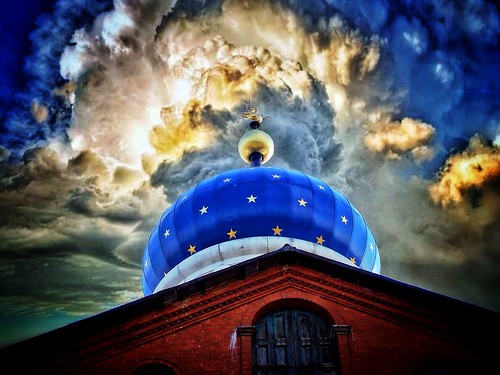
"... 'What a holy race (o sanctas gentes) to have such divinities springing up in their gardens.'* Sir Walter Raleigh, in an anti-Catholic mood, compared such worship of food to the sacrament of Holy Communion, where Christians munch on their god. John Donne, George Herbert, and Robert Herrick all followed Raleigh’s lead, joking, as Herbert wrote, of anyone 'who makes a root his god.' Thus, [the scholar Tom] Tashiro notes, 'the lowly onion was touched with divinity and thereby entered into the works of a few great poets.' When Rome seemed less of a threat, onions seemed less ripe for poetry. 'Only with the passing of time,' Tashiro concludes, 'in the nineteenth century, on the Continent, would the onion again receive the attention of great writers—of the Scandinavians and of the Russians—for whom it became a symbol of the self and would have moral virtues.' Tashiro is presumably alluding to Grushenka’s parable in The Brothers Karamazov: a guardian angel gives a wicked woman in hell one last chance at salvation. Did she ever do one good deed? Yes, she once gave an onion to a beggar. The angel appeals to God who says, fine, take that onion and yank her out of the lake of fire with it. Other sinners hold onto her feet, hoping for a free ride, but she kicks them off. 'I’m the one who’s getting pulled out, not you,' she says. 'It’s my onion.' At that very moment, the onion breaks. For some reason, I think of this parable whenever I drive by the Colt Armory, on Interstate 91 in Hartford, with its incongruous onion dome, bright blue and studded with gold stars.** It’s my Second Amendment, I imagine someone saying."
From "Renoir’s Onions" by Christopher Benfey (in The New York Review of Onions).
Here are Renoir's Onions, in case you're wondering how Benfey got from Egypt to The Brothers Karamazov to the Second Amendment:

These are crazy times, but a man once took that much time to paint 6 onions, and now we have Trump... and no hell.
________________
* Juvenal wrote, "Who knows not... what monsters demented Egypt worships? One district adores the crocodile, another venerates the Ibis that gorges itself with snakes. In the place where magic chords are sounded by the truncated Memnon, and ancient hundred-gated Thebes lies in ruins, men worship the glittering golden image of the long-tailed ape. In one part cats are worshipped, in another a river fish, in another whole townships venerate a dog; none adore Diana, but it is an impious outrage to crunch leeks and onions with the teeth. What a holy race to have such divinities springing up in their gardens! No animal that grows wool may appear upon the dinner-table; it is forbidden there to slay the young of the goat; but it is lawful to feed on the flesh of man!"
** Here's an image of that dome (cc Onasill ~ Bill Badzo):
From "Renoir’s Onions" by Christopher Benfey (in The New York Review of Onions).
Here are Renoir's Onions, in case you're wondering how Benfey got from Egypt to The Brothers Karamazov to the Second Amendment:

These are crazy times, but a man once took that much time to paint 6 onions, and now we have Trump... and no hell.
________________
* Juvenal wrote, "Who knows not... what monsters demented Egypt worships? One district adores the crocodile, another venerates the Ibis that gorges itself with snakes. In the place where magic chords are sounded by the truncated Memnon, and ancient hundred-gated Thebes lies in ruins, men worship the glittering golden image of the long-tailed ape. In one part cats are worshipped, in another a river fish, in another whole townships venerate a dog; none adore Diana, but it is an impious outrage to crunch leeks and onions with the teeth. What a holy race to have such divinities springing up in their gardens! No animal that grows wool may appear upon the dinner-table; it is forbidden there to slay the young of the goat; but it is lawful to feed on the flesh of man!"
** Here's an image of that dome (cc Onasill ~ Bill Badzo):
२५ जानेवारी, २०१८
"People who lie to themselves and listen to their own lie come to such a pass that they cannot distinguish the truth within them, or around them, and so lose all respect for themselves and for others."
Wrote Dostoyevsky, quoted yesterday by Pope Francis, as reported by the NYT in "For Pope Francis, Fake News Goes Back to the Garden of Eden."
१६ मार्च, २०१७
"Let me teach you about love, Jesus — tough love!... You need a sustainable pro-business model."
"And you need to give people freedom, Jesus, the freedom to suffer misery and poverty."
So said "Pious Paul of Ryan" in a conversation with Jesus, as imagined by Nicholas Kristof in the NYT.
ADDED: For comparison, here's Dostoyevsky's "Grand Inquisitor."
So said "Pious Paul of Ryan" in a conversation with Jesus, as imagined by Nicholas Kristof in the NYT.
ADDED: For comparison, here's Dostoyevsky's "Grand Inquisitor."
१२ मे, २०१६
"Identity politics, of a different brand from Trump’s, is also gaining strength among progressives."
"In some cases, it comes with an aversion toward, even contempt for, their fellow-Americans who are white and sinking. Abstract sympathy with the working class as an economic entity is easy, but the feeling can vanish on contact with actual members of the group, who often arrive with disturbing beliefs and powerful resentments—who might not sound or look like people urban progressives want to know. White male privilege remains alive in America, but the phrase would seem odd, if not infuriating, to a sixty-year-old man working as a Walmart greeter in southern Ohio. The growing strain of identity politics on the left is pushing working-class whites, chastised for various types of bigotry (and sometimes justifiably), all the more decisively toward Trump."
From "Head of the Class/How Donald Trump is winning over the white working class" by George Packer in The New Yorker.
That reminded me of the wonderful old passage from "The Brothers Karamazov":
From "Head of the Class/How Donald Trump is winning over the white working class" by George Packer in The New Yorker.
That reminded me of the wonderful old passage from "The Brothers Karamazov":
"I love mankind... but I am amazed at myself: the more I love mankind in general, the less I love people in particular, that is, individually, as separate persons. In my dreams... I often went so far as to think passionately of serving mankind, and, it may be, would really have gone to the cross for people if it were somehow suddenly necessary, and yet I am incapable of living in the same room with anyone even for two days, this I know from experience. As soon as someone is there, close to me, his personality oppresses my self-esteem and restricts my freedom. In twenty-four hours I can begin to hate even the best of men: one because he takes too long eating his dinner, another because he has a cold and keeps blowing his nose. I become the enemy of people the moment they touch me.... On the other hand, it has always happened that the more I hate people individually, the more ardent becomes my love for humanity as a whole."
१४ एप्रिल, २०१६
२१ फेब्रुवारी, २०१५
Arcade Fire's Will Butler adopts the blogging method of songwriting.
He's not saying it's like blogging. I am. He's saying it's like Bob Dylan:
So, anyway, Will Butler is interested in politics, interested enough to have applied to Harvard’s Kennedy School of Government. He got in, but he didn't go. Which says something about where he was in the development of political sophistication — a process that began when he was a teenager, when he read Dostoevsky and Kafka.
Bob Dylan has no songs with Dostoevsky and Kafka (though he does have Ezra Pound and T.S. Eliot fighting in the captain's tower and he sneers at a man who thinks he's something for having been through all of F. Scott Fitzgerald's books). It's hard to rhyme Kafka, who drinks vodka with his latka, not to mention Dostoevsky (are you kidding me?).
Will Butler says:
Arcade Fire’s Will Butler will be writing a song a day based upon a news story in the Guardian for a week from 23 February. Each original track will premiere on the Guardian’s website.Yeah, William Zantzinger could have sued Bob Dylan for the defamation in that song:
“It was partly inspired by Bob Dylan, who used to announce that certain songs were based on headlines,” Butler says of the project. “It would be a song he wrote in two weeks or something, such as The Lonesome Death of Hattie Carroll, which is one of the greatest songs ever. So I’ve set myself an impossible bar.”
"The Lonesome Death Of Hattie Carroll" got famousBack to Will Butler:
And Bob Dylan became the most honored of rock stars
Zantzinger kept quiet and wouldn't talk to the press
He just lived through the decades with that song on his head
And he probably cried for himself and for Hattie
And what did he think of that songster Bob Dylan?
"I should have sued him," he finally said later...
“I’ve been reading the Guardian every day, perusing the different sections."Oh, perusing! I've been perusing and excusing and infusing and accusing. Overusing. Now, I'm oozing, all while you sing. (All I really want to do is be friends with Will Butler.)
"Some of them possibly lend themselves to songs. It’s a cruel thing..."An uncool thing... a damned fool thing....
"... but sometimes you read something and think, ‘Uh oh. I could make something really meaty out of that.’"Uh oh. I could make something really meaty out of that. Uh oh. You could make something really cool and cruel out of "Uh oh. I could make something really meaty out of that." Perhaps"Uh Oh, Love Comes to Town" infused (and confused) with "Meaty Beaty Big and Bouncy." I'm thinking of a graffiti entreaty in Tahiti, sweetie.
"Something like the Dominique Strauss-Kahn trial – my God, that’s the gnarliest story in the world, but it’s interesting."See? It's like blogging. The standard is that standard of standards: interestingness. Back to Butler:
"Or you might read a science headline and think, 'The universe is so much bigger than I thought it was.' There’s something really beautiful in that.""Big and small" is one of my favorite tags, and it's because — and I cannot figure out why — I invariably visualize everything smaller — often far smaller — than it really is. I'm a minimizer. A minimalist. So I'm with Butler, except no mere science headline can correct my mind's distortion. The universe will always be much bigger than I think it is. And "always" will always be far longer.
So, anyway, Will Butler is interested in politics, interested enough to have applied to Harvard’s Kennedy School of Government. He got in, but he didn't go. Which says something about where he was in the development of political sophistication — a process that began when he was a teenager, when he read Dostoevsky and Kafka.
Bob Dylan has no songs with Dostoevsky and Kafka (though he does have Ezra Pound and T.S. Eliot fighting in the captain's tower and he sneers at a man who thinks he's something for having been through all of F. Scott Fitzgerald's books). It's hard to rhyme Kafka, who drinks vodka with his latka, not to mention Dostoevsky (are you kidding me?).
Will Butler says:
"On the one hand, the government is – in a country like America or Canada or the UK – the expression of the people. It’s not freedom from things but its freedom to govern, which is a beautiful concept. But there’s a sense that modern government almost takes the place of the Old Testament God. Things happen because governments cause them to, but people are like, 'No. This is how the world is. It’s a world of pain.' There’s something very Old Testament about that – yet we’re on our knees to them about policy as well."After that quote, The Guardian scurries to tell us that Butler is "an Obama fan." You could write a song about the lefty newspaper's need to assure its larval readers that the artist they've been reading about and whose music they're getting primed to receive is properly on the left even though he just said that modern government almost takes the place of the Old Testament God.
२८ नोव्हेंबर, २०१४
"Then He rolled his big sleeves up/And a brand-new world began..."
ADDED: In the comments JSD said:
I only remember him because a musician friend of mine pointed him out on the street one day. He was very emphatic about his legendary stature. I still have the Les McCann Eddie Harris “Swiss Movement” record. “Compared to What” was a pretty incendiary song in the 70’s. The Roberta Flack “Feel Like Makin Love” was good too. Not many black people in Maine, so I thought it was unusual but cool.Here's Eugene McDaniels, acknowledging that he's a "hermit" in Maine and reminiscing about "Compared to What":
Here are Les McCann and Eddie Harris doing "Compared To What":
McDaniels died in 2011. From the obituary:
His hits of the early 1960s... cast him as a suave performer of upbeat pop songs aimed at white teenagers; in his last years he would occasionally take the stage to deliver standards with all the graceful inventiveness of the great jazz singer he might have been.Here are the lyrics to "Compared to What." Excerpt:
In between came the event that changed his life, when his protest song Compared to What became an unexpected hit after being released on an album recorded at the 1969 Montreux jazz festival by his first employer, the pianist Les McCann, and the saxophonist Eddie Harris. The song went on to be covered more than 270 times by other artists, including Ray Charles, Della Reese and John Legend. Its success enabled McDaniels to stop performing in night-clubs, an environment he detested because of the lack of respect he felt was shown towards the music by their audiences....
His later years were spent by the ocean in Kittery Point, Maine. In 2010, he performed an acoustic version of A Hundred Pounds of Clay to a group of teenage girls attending an arts outreach programme....
Slaughterhouse is killin' hogsAND: The same commenter, JSD, had wondered "why this is being posted today." Perhaps he thought it might have some connection to the racial discord in the news lately, but that's not why. As I answered in the comments, it came up in the context of a conversation with Meade that I wasn't able to reconstruct for the post. I remember where I was standing and where Meade was sitting when I brought up the old song.
Twisted children killin' frogs
Poor dumb rednecks rollin' logs
Tired old lady kissin' dogs
I hate the human, love that stinking mutt (I can't use it!)
Try to make it real — compared to what? C'mon baby now!
Meade was analogizing something to the wedging of clay (and activity he's done much of in times past), and he seemed to remember that we were discussing the phrase "ashes to ashes, dust to dust." That makes me think it was part of our discussion of this BBC article about Fyodor Dostoyevsky, who was subjected to a staged fake execution, and years later said: "I cannot recall when I was ever as happy as on that day." And that might have come up in connection with the subject of the U-shaped — smile-shaped — curve of happiness, which depicts the puzzling/understandable phenomenon of happiness increasing at the end of life.
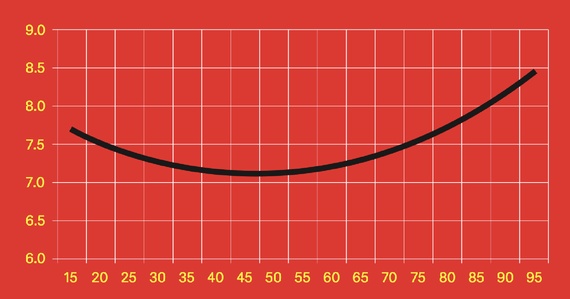
So maybe there was something about the closeness to death, something about endings and new beginnings, perhaps, as one returns to earth and becomes subject to wedging into clay.
१० मे, २०१४
"'My mouth is full of decayed teeth and my soul of decayed ambitions'..."
"... James Joyce wrote in a letter to his brother at the beleaguered age of 25.... Martin Amis... and Vladimir Nabokov... suffered 'catastrophic tooth-loss' while in their 40s... Virginia Woolf['s] teeth were pulled on the bizarre theory that they caused her mental disorders.... Dostoevsky's Underground Man masochistically glories in the 'malignant' pain in his mouth. Handsome Count Vronsky is deformed by toothache after Anna Karenina's [SPOILER ALERT] suicide. Abscesses and botched extractions mark the decline of the Buddenbrook clan. John Updike's 1955 short story 'Dentistry and Doubt' places a seminary student in the dentist's chair and carries out a primer on theodicy. 'Even his toothbrush,' thinks the young cleric, his mouth filled with metal instruments, 'which on good days presented itself as an acolyte of matinal devotion, today seemed an agent of atheistic hygiene, broadcasting the hideous fact of bacteria. Why had God created them . . . ?'"
The beginning a Wall Street Journal piece about a novel where the main character is a dentist.
The beginning a Wall Street Journal piece about a novel where the main character is a dentist.
२४ जुलै, २०१३
२५ मे, २०१३
१० एप्रिल, २०१३
"Let's face it, who does not love this music?" asked Obama, referring to Memphis soul...
... which apparently includes Justin Timberlake. Oh, I am cynical enough to think that Obama really wanted to bring Timberlake over to the house to sing for his young daughters, and the Memphis soul business was constructed around that project to give it the needed air of dignity, worthiness, and tribute.
How much could that cost, anyway? I loved the live unedited feed, like when Queen Latifah had to realign herself after some technician pointed out the tape marks on the floor, and how Malia and Sasha looked stone-faced on either side of their parents (who were incessantly bopping their heads), and how some aide came in to lean over and consult with the frowning, deep-in-thought Obama (in political theater that made me say out loud "A plane has struck the second tower").
I want the feed. Feed us!
"Make us your slaves, but feed us."
Obama said the unique blend of musical styles created in segregated Tennessee in the 1960s was special because it "played an important part in our history." He also noted the music sought to bridge racial divides and "create a little harmony with harmony."I was impressed by how smoothly the webstream flowed. It looked crisp and utterly unhinky on my desktop monitor. I know that costs money, presumably taxpayer money, and that's inconsistent with the suffering-under-the-sequester political meme pursuant to which White House tours have been cancelled. But if they're going to have these concerts at all, in these days of the internet, they owe a quality stream to us, the people.
How much could that cost, anyway? I loved the live unedited feed, like when Queen Latifah had to realign herself after some technician pointed out the tape marks on the floor, and how Malia and Sasha looked stone-faced on either side of their parents (who were incessantly bopping their heads), and how some aide came in to lean over and consult with the frowning, deep-in-thought Obama (in political theater that made me say out loud "A plane has struck the second tower").
I want the feed. Feed us!
"Make us your slaves, but feed us."
याची सदस्यत्व घ्या:
पोस्ट (Atom)


 पोस्ट्स


