Ipinapakita ang mga post na may etiketa na Dobie Gillis. Ipakita ang lahat ng mga post

Pebrero 12, 2024

"I'm so sorry if the Super Bowl advertisement caused anyone in my family pain."

"The ad was created and aired by the American Values Super PAC without any involvement or approval from my campaign. FEC rules prohibit Super PACs from consulting with me or my staff. I love you all. God bless you."

Tweets RFK Jr., about this ad, which I'm seeing because he has it pinned in his Twitter feed: Do you have a problem with the ad? Should RFK Jr. refrain from trading on his name entirely or is there just some line that he should not cross? But where is that line? And how can he force his supporters to stay behind it? It's one of the many travails of being a Kennedy.

Enero 10, 2022

The star of my all-time favorite TV sitcom has died.

I'm sad to hear that Bob Saget has died. He was only 65. But this post is about Dwayne Hickman, who died yesterday at the age of 87.

His show, "The Many Loves of Dobie Gillis," was on TV from 1959, when I was 8, to 1963, when I was 12.

From the NYT obituary:
For all its well-scrubbed chastity, the series marked a quietly subversive departure from the standard television fare of the day. It was among the first to place the topical subject of teenagerhood front and center by recounting the story from a teenager’s point of view. It broke the fourth wall weekly, opening with a monologue in which Mr. Hickman, seated in front of a replica of Rodin’s “Thinker,” gave viewers a guided tour of his gently angst-ridden soul.

Many well-known actors received early exposure on the series, notably Bob Denver as Dobie’s best friend, Maynard G. Krebs, a scruffy junior beatnik who yelps “Work!” at the merest suggestion that he seek gainful employment.... Tuesday Weld was seen regularly as the beautiful, avaricious Thalia Menninger, the financially unattainable object of Dobie’s affections; Warren Beatty had a recurring role early in the run as a blue-blood classmate. 
Dobie’s cantankerous, tightfisted father and sweet, harebrained mother were played by the characters actors Frank Faylen and Florida Friebus. His deeply intellectual classmate Zelda, aflame with unrequited love for Dobie, was portrayed by Sheila James. (Under her full name, Sheila James Kuehl, she became, in 1994, the first openly gay person to be elected to the California state legislature.)

They forgot to mention Chatsworth Osborne Jr., the ridiculously snobby rich kid. 

And why did they call Zelda "deeply intellectual"?! Seems to me Zelda was sexually harassing Dobie, failing to accept that no means no, insisting that he'd end up with her because their names on the alphabetized class roster were right next to each other — Gillis and Gilroy. Thalia was at least as smart — and much more rational. 

I really don't think anyone on that show was intellectual, and certainly not "deeply intellectual." Deeply! Where does the NYT get that? From the fact that the actress turned out to be gay? Here's the Wikipedia article on Zelda:

Zelda especially irritated Dobie by wrinkling her nose at him. He always wrinkled back; he claimed it was a reflex action (often admonishing her "Now cut that out!"), while she took it as proof that he loved her but didn't realize it yet. Zelda assured Dobie that he would eventually come to realize his love for her through the influence of "propinquity": because he was Gillis and she was Gilroy, they were always going to be seated together through high school and college and would eventually fall in love.
Here's a full episode — complete with opening theme, musing by "The Thinker," and plenty of Thalia:

Disyembre 1, 2020

Zelda!

Post title explanation:

Setyembre 1, 2020

"The idea was for the new series to be soothing and nonviolent, an answer to the moral panic about violence in the media in the wake of Senator Robert F. Kennedy’s assassination..."

"[They wrote] an adorable half-hour comedy-mystery with a lovable and hapless Great Dane — a character modeled, they often said, on the character Bob Hope played alongside Bing Crosby in the 'Road' movies. After 15 or so drafts, they realized that the dog, Scooby-Doo, was the star.... A half-century later, episodes of 'Scooby-Doo' are still being broadcast.... It has inspired fans in every decade, who cleaved to characters like the beatnik slacker Shaggy (based on Maynard G. Krebs from 'Dobie Gillis') and the bespectacled brainiac, Velma, who would become a lesbian heroine."

From "Joe Ruby, a Creator of ‘Scooby-Doo,’ Is Dead at 87/Charged with creating an animated mystery series, Mr. Ruby and his writing partner, Ken Spears, came up with a show that endures more than 50 years later" (NYT).

Hulyo 3, 2019

In 1964, when I was 13, I went to the movies to see "A Hard Day's Night," and it was a double feature.

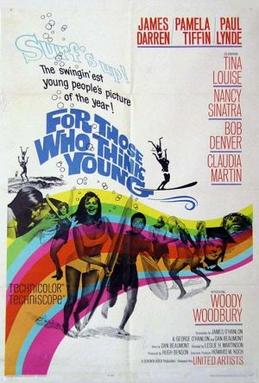
The other movie — the movie I've chosen for 1964 in my "imaginary movie project" — was "For Those Who Think Young."


That poster says it's "The swingin'est young people's picture of the year," and I saw it immediately after that other "young people's picture," "A Hard Day's Night." Two entirely different visions of "young."

Compare Pamela Tiffin (who was was 22 in 1964) with Pattie Boyd (who was 20):


I made both of those screen grabs, and I can tell you Tiffin was done up like that for a day at the beach. Tiffin oozed maturity. Movies like this were called "beach party" movies, but her character was a college student who was continually attending to her studies and she was insistent that her boyfriend, the rich kid (James Darren), treat her with complete respect. Boyd played a schoolgirl whose role was to gawp at the Beatles and say her one line, "Prisoners?!"

Why didn't I pick "A Hard Day's Night" for my project? It fits the requirement that I need to have seen it in the theater when it came out. But I'd already rewatched "A Hard Day's Night" a time or 2, and I want to compare my original response with what I feel now, so... too much static. And there's something specific I remember about seeing "For Those Who Think Young" when I was 13: I enjoyed it more than "A Hard Day's Night."

But why? That's a mystery to solve. First, I loved Bob Denver. The show "Gilligan's Island" debuted in the fall of that year, but I knew him from my favorite TV show, "The Many Loves of Dobie Gillis," which was on from 1959 to 1963. I had a 8"x10" glossy photo — I'd sent in for it — of Denver as Maynard G. Krebs. I loved the beatnik character who questioned all of society's conventions — especially work.

Let me show you about 10 minutes of "For Those Who Think Young," beginning with the Bob Denver character. He's meditating, and this is 4 years before The Beatles took up Transcendental Meditation. This segment continues with some Tiffin/Darren interplay and reaches a peak with Bob Denver buried in the sand using his mouth in a way that I found gut-bustingly hilarious in 1964. And don't miss Nancy Sinatra:


Did you see that early #MeToo wokeness? Nancy hits Bob for kissing her in an entirely nonphysical way. The meditation is so strong.

The Bob Denver character, Kelp, is employed as Darren's assistant, and we see him running over to serve him and Tiffin some drinks in tall glasses. Before running off, Kelp then slips one of those glasses into his swimsuit pocket, where it bulges like an erection I didn't notice in '64.

Mayo 9, 2016

"I may take a swipe at you myself," says the teacher, Mr. Pomfritt, walking into the classroom....

... just as Milton Armitage (Warren Beatty) is telling Dobie "I'll kill ya":


From my all-time favorite TV show "The Many Loves of Dobie Gillis." What kind of teacher could insult the kids like that. Oh, I loved Mr. Pomfritt — along with Maynard and Thalia and Dobie and the rest. And I'm sad to see that the actor who played him, William Schallert, has died (at the age of 93). He was also Patty Duke's father, and "Star Trek" fans know him as Nilz Baris, the under secretary in charge of agricultural affairs for the United Federation of Planets in “The Trouble With Tribbles.”

Mayo 17, 2014

The NYT calls it "Pedigree vs. Policy," but I disagree.

On one side in this race for County Board of Supervisors, you've got Bobby Shriver, a Kennedy family person, so I'll accept "pedigree" for that. But on the other side, you've got Sheila Kuehl.
Ms. Kuehl, under the name Sheila James, played Zelda on “The Many Loves of Dobie Gillis,” a situation comedy that ran from 1959 to 1963, and she went on to become the first openly gay member of the California Legislature. “I have a lot of, can I say, good will because of my TV work,” she said. “I don’t believe a day goes by that someone doesn’t come up to me and say, ‘I know you are running, I wish you luck, but I loved that TV series.’ ”
I call that pedigree. (And I loved that TV series.)

Oktubre 20, 2013

Soshoku danshi — "grass-eating men" — "a heterosexual man for whom relationships and sex are unimportant."

"The phenomenon emerged a few years ago with the airing of a Japanese manga-turned-TV show. The lead character in Otomen ('Girly Men') was a tall martial arts champion, the king of tough-guy cool. Secretly, he loved baking cakes, collecting 'pink sparkly things' and knitting clothes for his stuffed animals. To the tooth-sucking horror of Japan's corporate elders, the show struck a powerful chord with the generation they spawned."

This comes from the article "Why have young people in Japan stopped having sex?," which I linked to earlier today for some different purposes. I wanted to break this out separately. I may not be understanding the Japanese phenomenon accurately, but I'm interested in the way a television show can begin with a character who is supposed to be laughed at but who ends up inspiring some viewers, who legitimates and activates feelings that they have about themselves, and shows them new ways to behave, openly and without shame.

The example that occurs to me in American culture is Maynard G. Krebs, the best friend of the main character on the old Dobie Gillis show (which was on from 1959 to 1963). It was assumed that viewers would identify with Dobie. That's why he was the main character. He dressed and acted like a conventional teenaged boy of that time. He wanted girlfriends, and he had struggles with his parents and teachers, but he mostly tried to satisfy them even as he pursued his overarching goal: relationships with females.

The Maynard character wasn't supposed to call American teenagers into another way of living. Maynard (played by Bob Denver) was less good-looking, dressed grubbily, wore a goatee, was dumb about or uninterested in a lot of typical teenager things. He wasn't interested in girls. He rejected work and other conventions of middle class American life. His only interest was jazz, and he was — we were expected to understand — a beatnik. But we didn't fulfill the expectation that we would read this character as a clown. We got the idea: We could live in a new way.

Blah blah blah... we became hippies.

Setyembre 2, 2013

Did "Free to Be You & Me" imply getting a lot of work done to one's once perky face?

When did you first encounter Marlo Thomas? Did she look like this?


That is indeed her, in 1960, on an episode of "The Many Loves of Dobie Gillis," but you're more likely to know her from the late-60s show, which was infectiously popular when I was in high school, "That Girl":


(Look at the image on the kite at 0:38 and you'll see what got me onto this topic: the question, raised in the previous post, of what the Lululemon logo looks like. Sidenote: those opening credits were totally ripped off by Mary Tyler Moore, who kind of also stole Marlo's whole concept of the modern woman.)

Obviously, she needed to get some work done to look like "That Girl" and not that girl that was on "Dobie Gillis." Look at her father:


I grew up watching his show, "Make Room for Daddy." Anyway, Marlo went on to that "Free to Be You & Me" project, which began in 1972, when I was 21 and not interested in that sort of thing, and not just because it was for children and parents, but because it was square and middle class. I don't think I have ever listened to a single track on that record, but I know it had a huge impact on younger people. (I wonder if Obama's mother played it for him. I'll bet she thought it was too square, too middle class.)

Here's an example of a blogger — Melissa at On the Rag Mag — who idolized Marlo Thomas:
I grew up worshiping her because of her involvement with Free to Be You & Me. OH MY! How I loved that album and the show. To say that I was obsessed with it would be an understatement. To tell you that pretty much anyone associated with the project brings tears to my eyes, warmth to my heart, and a tingle to my nether regions would not be a lie.
For someone who loves Marlo not because of "That Girl" (or "Dobie") but because of "Free to Be," it's stressful to look at what she's done to herself:


Melissa says:
Marlo Thomas is a woman of her generation, and the way she chooses to age is up to her. I was really sad to see her stretched and snipped beyond recognition, but that is her choice. No one can stay young forever, and we all deal with the aging process in different ways. It’s a mind fuck no matter how you go at it, and it’s her face so who am I to say anything?
Oh, bullshit! You did say something. Quit pretending you didn't. It may be "up to" Marlo to decide what to do, but she did it precisely to affect what we see. She did it to us as well as to herself. We can complain. We can try to influence others not to make the same awful mistake. And there's just so much hypocrisy, or at least that's what I would say if I had any familiarity at all with the songs on "Free to Be You & Me."

As to whether "the aging process" is "a mind fuck no matter how you go at it," if that's the level of wisdom you've reached, that doesn't speak well for the foundation you acquired from "Free to Be You & Me." One more reason why I will continue to refrain from ever hearing "Free to Be" and to believe that it's drivel.

Agosto 31, 2012

Goodbye to Chatsworth Osborne Jr.

The comically irritating rich kid on my all-time favorite sitcom "Dobie Gillis" was played by an actor named Steve Franken, who has died, at the age of 80. The original rich jerk on the show was Milton Armitage, played by Warren Beatty, but he left the show early and Chatsworth stepped in to be totally unlikeable and ridiculous.

I wish I could find a good clip of him as Chatsworth on YouTube. But here's Franken playing a drunken waiter in the 1968 movie "The Party" (with Peter Sellers). It's not a silent movie, but Franken's role is silent (and very funny).

Mayo 1, 2010

"A panic surged through me as I realized there were only two weeks until taping — and over two hundred countries whose capitals and major geographical landmarks had to be committed to relatively long-term memory."

My colleague Shubha Ghosh writes about his experience on "Jeopardy":
I also had to start watching the show again. The program guide on the Jeopardy web site indicated that the show aired at the same time accident attorneys, payday loan makers, and diet doctors advertise on the airways, and I set the DVR accordingly. The show used to be on after dinner, a nice way to end the day and begin the evening.  Re-engaging with Jeopardy, I asked myself: What had I committed to by agreeing to be a contestant? Was I a part of a desperate franchise?  Such thoughts were put aside quickly as I worked through, among other lists, the countries in the Commonwealth of Independent States and the names of people who would succeed President Obama.  VP, Speaker of the House, Secretary of State, and so forth....
That's from part 1. The series continues, but the show aired yesterday, so we already know what happened. I won't spoil it for you, but it set my thoughts flowing back to my junior high school guidance counselor, Mr. Hannan. He was on "Jeopardy" in the early 1960s, and it was horrifying when he lost because he confused cirrus and cumulus clouds — probably on a big "Double Jeopardy" bet. We'd all learned the different kinds of clouds, and Mr. Hannan had even taught science! How could it be! But he was good natured about it, and we accepted that you've got to understand what it's really like trying to think and remember things when you're caught in the bright camera lights. [CORRECTION: The teacher I'm remembering wasn't Mr. Hannan, but a science teacher whose name I've forgotten. The material that follows, however, about Mr. Hannan, is, as far as I know, correct.]

The coolest thing about Mr. Hannan — Joseph Hannan — was not that he went on "Jeopardy." It was that he wrote a novel about being a teacher — "Never Tease a Dinosaur" — and it was made into a TV pilot — "Hey, Teacher" — that starred Dwayne Hickman. Dwayne Hickman was Mr. Hannan. So, practically, Mr. Hannan was Dobie Gillis!

It's sad that there's so little trace on line of the things from that era. I wish I could find the full text of "Never Tease a Dinosaur." I wish I could find a video clip of "Hey, Teacher." (The pilot aired in1964 — back when the networks filled in the summer schedule with pilot episodes of shows that never got sold.) I did find a tiny obituary for my old guidance counselor. The obit spells his name 2 ways — Hannon and Hannan — and makes me wonder now if I got it right.
Author Joseph Hannon died at age 84. Mr. Hannan wrote the book 1961 "Never Tease a Dinosaur." The book dealt with his experiences as an elementary school teacher in the 1950s. His observation of a man working in what was then a mainly woman's job. The book was the basis for the 1964 "Vacation Playhouse" TV pilot "Hey, Teacher." Dwayne Hickman starred as Mr. Hannan. Mr. Hannan served his country in the US Coast Guard during WWII.
So I don't have a clip of Shubha missing his shot on "Jeopardy," and I sure don't have a clip of Mr. Hannan fluffing the cloud names on "Jeopardy," and I don't have a clip of Dwayne Hickman playing Mr. Hannan in "Hey, Teacher," but I do have a clip of Dwayne Hickman screwing up on "The Match Game":


Teachers and TV quiz shows. It's all good.

ADDED: A reader sends me the  January 13, 2008 obituary in The Record (nicely written by Jay Levin). This isn't otherwise available on line, so I can't give a link. Text after the jump:

Setyembre 5, 2009

It's a personal, portable radio!

1. "Dobie Gillis" is my all-time favorite TV show. 2. In 6th grade, I sneaked a transistor radio (with an earplug) into school to listen to during class had it confiscated by the teacher.

Abril 17, 2009

YouTube is adding a big page of full-length movies and TV shows.

Info about the new show.

To watch, go to Youtube dot com slash shows.

I check out the classic TV, hoping for my favorite show, "Dobie Gillis." It's not there (yet), but — check it out — here's the first episode of "I Spy." Not embeddable, but nice and sharp.

Very cool.

Oktubre 23, 2007

"I assume there are dragons and griffins and werewolves and homosexual Frankensteins throughout these novels..."

"...but I honestly don't give a shit if my assumption is true or false."

Chuck Klosterman is not reading the Harry Potter novels.
I find it astounding that the unifying cultural currency for modern teenagers are five-hundred-page literary works about a wizard. We are all collectively underestimating how unusual this is. Right now, there is no rock guitarist or film starlet as popular as J. K. Rowling. Over time, these novels (and whatever ideas lie within them) will come to represent the mainstream ethos of our future popular culture. Harry Potter will be the only triviality that most of that coming culture will unilaterally share.

And I have no interest in any of it.

And I wonder how much of a problem this is going to become.
If it's the only shared thing, that means, in the future you won't get any of the references.
... I will not grasp the fundamental lingua franca of the 2025 hipster. I will not only be old but old for my age. I will be the pterodactyl, and I will be slain. It is only a matter of time.
ADDED: The word "hipster" is vastly overused these days. Anyone with a tinge of youth and a shred of knowledge of fashion and pop culture trends seems to be a hipster — at least to people who notice they're aging and don't want to bother with the trends. Hipster — the category should be more elite. Or it seems completely absurd.

We could try to think deeply about the word "hip." For example, why aren't hipsters and hippies the same thing? What is the -ster relationship to "hip" that is different from the -ie relationship? To me, -ster seems to make you more of a knowledgeable proponent or an obsessive devotee, and -ie suggests you're having fun with it. Other -ster words that come to mind: mobster, roadster. Is a mobster's relationship to the mob and a roadster's relationship to the road the same as a hipster's relationship to hip?

Other -ie words I think of easily: foodie, groupie. See? More fun.

AND: A little musical accompaniment to this postscript: here. In the comments, Trooper York brought up The Orlons, but then he didn't quote "South Street." The first time I ever heard the word "hippie," it was in that great early 60s song. Let's check out the etymology:
During the jive era of the late 1930s and early 1940s, African-Americans began to use the term hip to mean "sophisticated, fashionable and fully up-to-date". The term hipster was coined by Harry Gibson in 1940, and was used during the 1940s and 1950s to describe jazz performers. The word evolved to describe Bohemian counterculture. Like the word hipster, the word hippie is jazz slang from the 1940s, and one of the first recorded usages of the word hippie was in a radio show on November 13, 1945, in which Stan Kenton called Harry Gibson "Hippie". This use was likely playing off Gibson's nickname, "Harry the Hipster."

In Greenwich Village, New York City, young counterculture advocates were named hips because they were considered "in the know" or "cool", as opposed to being square. Reminiscing about late 1940s Harlem in his 1964 autobiography, Malcolm X referred to the word hippy as a term African Americans used to describe a specific type of white man who "acted more Negro than Negroes."

In a 1961 essay, Kenneth Rexroth used the term to refer to young people participating in African American or Beatnik nightlife.

In 1963, the Orlons, an African-American singing group from Philadelphia, Pennsylvania released the soul dance song "South Street", which included the lyrics "Where do all the hippies meet? South Street, South Street...The hippest street in town".[9][10]....

The more contemporary sense of the word "hippie" first appeared in print on September 5, 1965. In an article entitled "A New Haven for Beatniks," San Francisco journalist Michael Fallon wrote about the Blue Unicorn coffeehouse, using the term hippie to refer to the new generation of beatniks who had moved from North Beach into the Haight-Ashbury district of San Francisco. Fallon reportedly came up with the name by condensing Norman Mailer's use of the word hipster into hippie. Use of the term hippie did not catch on in the mass media until early 1967, after San Francisco Chronicle columnist Herb Caen began referring to hippies in his daily columns.
Nothing there about the more recent transition to "hipster," though there is a section about the pejorative use of the word "hippie." Basically, "hippie" ended up meaning not hip at all. That's certainly the way I use it (almost always in self-deprecation).

"Beatnik" is a cool word, but I think it's solidly anchored in the 1950s... or to refer to Maynard G. Krebs, the Bob Denver character in my all-time favorite TV show "Dobie Gillis." He also did his beatnik role in a cool movie called "Surf's Up," which came out the same year as "Hard Day's Night." What a contrast between those two movies. I must confess that I saw them in a double feature at the time... and much preferred "Surf's Up." I found this hilarious:


CORRECTION: The movie title is actually "For Those Who Think Young." I went through a long period of thinking it was pathetic of me to have liked this movie more than "Hard Day's Night," but now, much as I know "Hard Day's Night" is better, I think it's perfectly acceptable to enjoy an old surf movie. Look at the cast:
James Darren ... Gardner 'Ding' Pruitt III
Pamela Tiffin ... Sandy Palmer
Paul Lynde ... Uncle Sid
Tina Louise ... Topaz McQueen
Bob Denver ... Kelp
Robert Middleton ... Burford Sanford 'Nifty' Cronin
Nancy Sinatra ... Karen Cross

POSTSCRIPT: If we called monsters "monnies," would we be less afraid?

Nobyembre 29, 2006

Catchphrases, caught and uncaught.

100 Greatest TV Quotes & Catchphrases -- via Throwing Things -- currently arranged in alphabetical order.... Well, so, have your fun: Put them in the right order. I'll just pick a few I like:
Here's Johnny! (Ed McMahon, The Tonight Show)
How sweet it is! (Jackie Gleason, The Jackie Gleason Show)
I want my MTV! (MTV)
I'm not a doctor, but I play one on TV. (Vicks Formula 44)
Jane, you ignorant slut. (Jane Curtin and Dan Aykroyd, Saturday Night
Live)
The tribe has spoken. (Jeff Probst, Survivor)
Yabba dabba do! (Fred Flintstone, The Flintstones)
You rang? (Lurch, The Addams Family)
Hey, wait a minute! Just a darn minute. Where is "Dobie Gillis"? "You rang" gets a Lurch credit?

Nobyembre 22, 2004

TV on DVD.

Tomorrow the new "Seinfeld" DVD collection comes out and Entertainment Weekly is recommending it because you'll get to see the full-length original show (the syndicated version shaves off a minute or so), there are commentary tracks (with Julia Louis-Dreyfus partaking of episode one for the first time), there are deleted scenes, additional stand-up material, and there's a 60-minute documentary.

EW also has some recommendations about what other TV shows ought to come out in disc form. But they don't seem remember any shows before 1965, so they fail to mention the show I really want: "Dobie Gillis"! Oh, how I love that show! Warren Beatty was even in it--a minor character, but it's fun to see him as a high school student. There are all these people who love "Gilligan's Island," so there must be a fan base for Bob Denver: he was unforgettably great as the beatnik high schooler Maynard G. Krebs ("You rang?"). And no one has ever been more beautiful and funny at the same time than the brilliant Tuesday Weld (who played Thalia Menninger).

UPDATE: I picked up the first "Seinfeld" collection on Tuesday. Couldn't resist.

Mayo 6, 2004

Are you going to watch the finale episode of Friends?

No, I don't care about Friends. I watched an early episode once and wondered about how they had such a nice apartment. Then once TiVo recorded one for me and it had Brad Pitt in it, so I watched it. Other than that, I'd have to be forced to watch a show like that. Lots of canned wisecracks. Pretty people with neat little sitcom-y problems. Let's just say I watched a lifetime's worth of sitcoms by the time I was 18. I'd watch reruns of my favorite old shows if they would only run them (especially Dobie Gillis), but, though I did have a Seinfeld phase and I watch some things on HBO, I'm just not interested in any post-1970 network sitcoms.

Abril 17, 2004

Video on Demand ... "The Dalton Girls" ... "Born Rich" ... The Apprentice. I caught the documentary "Born Rich," which is playing on HBO on Demand. And let me just pause to say I love the whole video on demand technology--except the way on my service if you leave it on pause too long a too-happy female voice booms "Welcome to video on demand!" Since I pause a lot, leave the room, enter into conversations and so forth, that "Welcome!" voice is the least welcome thing on TV. But a little video on demand and you can't help wanting the future of TV to arrive quickly. Right now some of HBO, Cinemax, and Showtime is available free and some other things are available for a price, but why isn't every movie and TV show ever made available? Why isn't TV more like the Internet? Why can't I just watch any old episode of, say, Dobie Gillis or I'm Dickens, He's Fenster whenever I want? Why can't I sit down any night and call up, say, "The Dalton Girls"? (Althouse trivia experts should know that was the first movie I ever saw in the theater. According to an IMDB user summary it's "Just another 'B' western, except the outlaws are babes." I see the plot was "After the Dalton boys are killed by the law, one of the Dalton girls is forced to kill a lecherous mortician who tries to rape her. Being branded a murderess, the sisters follow in their brothers tracks and take up a life of crime." Hey, this was some 1950s "Thelma and Louise"! Hmmm ... I wonder if that shaped my whole life. And how bad were my parents to let me see that when I was six? Ah, don't worry, she's not going to get the mortician rape part. She'll just see a bunch of cowgirls. Like Sally Starr! She loves Sally Starr!)

"Born Rich" was a nice documentary, made by a born-rich guy who had access to other born-rich kids, because (as I learned in the documentary), born-rich people are an inbred subculture. They hang out with each other and interact with each other, in part because only another rich kid can understand the sorrows of inherited wealth. The rest of us can look on with horror, amusement, sympathy, or whatever we like, now that we have this film to watch.

There's a nice variety of rich kids to react in different ways to. And I must say one of the nicest ones was Ivanka Trump, which has to remove a layer of loathsomeness from Donald Trump. And here's a good article in today's NYT on the aftermath of The Apprentice, for those who are still wondering if Bill Rancic is actually going to be trusted to run that billion dollar Chicago construction project. ("This is a large and sophisticated project, and the job is like being the conductor of an orchestra ... I don't know how somebody can conduct the Chicago Symphony Orchestra if they've never gone to a concert before, and if they've never played any of the instruments.") Read about the complexity of the project, and consider how absurd it would be to only make $250,000 (Bill's new salary) for running it. So why didn't Trump pick a more practical project to put Bill in charge of? Are you kidding?
"I felt that this was a great opportunity to promote a great project," Mr. Trump said.

Well, isn't the whole TV show an infomercial for Trump's projects? He features one project or another not because it makes for a good prize or competition, but because he needs to advertise it, as the end of the finale show on Thursday made crashingly obvious.

Pebrero 15, 2004

Unrelated observations to get the blog started this morning:

1. The NYT Book Review leads off with a nice review of the book I've been reading this week, Sam Kashner's "When I Was Cool." The review includes some funny stuff (about Sam and the Beatniks).

2. My favorite old, old TV show, which I wish they'd release on DVD, especially since they haven't run it on cable in years as far as I can tell, is "Dobie Gillis." (Wait, that is related. Ignore this post ... unless you're in the DVD business.)

3. As you can see from the last post from yesterday, I've decided to start capitalizing the V in TiVo. It was hypocritical of me not to, because I love TiVo and because I've complained about people who are lazy about using the shift key. Also, it really does look better capitalized that way, because the V reaches over, above the i and nearly touches the T, making TV quite visible.

4. Even though I took a swipe at The White Stripes the other day, I've got nothing against them. They remind me of some things in the 70s that I liked a lot, and my favorite TV fictional character, Joan Girardi, seems to like them as well, judging from this week's episode, which I finally got around to watching yesterday.

5. Speaking of Joan of Arcadia, and going un-random again, I note that Friday's episode would be of interest to those who are following the Tennessee v. Lane case in the Supreme Court: a character who uses a wheelchair is faced with a broken elevator just as he has his first date with his beautiful co-worker who lives on the second floor. She's with him at the time and the two of them work out a way to get up the stairs. The actress is Sidney Poitier's daughter (Sydney Tamia Poitier), by the way, and the actor is John Ritter's son (Jason Ritter).

6. When I was making my link for White Stripes above, I typo'd "white strips." I wonder if The White Stripes are annoyed about Whitestrips, though I note that if you Google "white strips"--with the space in the middle--you actually do get The White Stripes, so actually it should be Crest annoyed with The White Stripes, not the other way around.

7. Why do people say "I was thinking to myself"? Is there some way of thinking to someone other than yourself?

8. Now, I've got to finish reading the Sunday NYT, which I left on the dining room table half an hour ago to go online to find out when Border's opens. I want to get to Border's early, because I want to get a table in the cafe. I've got to isolate myself from household temptations so I can get through checking the edit on my law review article. I'm quite happy with the job they did on it though so I'm no longer in the dread phase described here.