Breaking Bad लेबलों वाले संदेश दिखाए जा रहे हैं. सभी संदेश दिखाएं

30 जुलाई 2022

"Bronze statues of mythical methamphetamine cookers Walter White and Jesse Pinkman were installed at a convention center in Albuquerque on Friday..."

"... to celebrate the 'Breaking Bad' TV series.... Local politicians including Albuquerque Mayor Tim Keller mixed with 'Breaking Bad' stars Bryan Cranston, Aaron Paul and director Vince Gilligan to help unveil the artwork, donated by Gilligan and Sony Pictures.... Gilligan said he recognized that the statues of 'two fictional, infamous meth dealers' won’t be universally cherished in New Mexico. 'In all seriousness, no doubt some folks are going to say, "Wow, just what our city needed." And I get that,' Gillian said. 'I see two of the finest actors America has ever produced. I see them, in character, as two larger-than-life tragic figures, cautionary tales.'... Republican state Rep. Rod Montoya of Farmington said... 'I’m glad New Mexico got the business, but really?... We’re going down the road of literally glorifying meth makers?' He also questioned the logic of the tribute after Albuquerque in June 2020 removed a statue of Spanish conqueror Juan de Oñate. Demonstrators tried to topple that bronze artwork in denunciation of Oñate’s brutal treatment of Native Americans roughly 500 years ago. A fight that broke out at the protest resulted in gunfire that injured one man."

It's questionable to put up a sculpture showing fictional characters who were not virtuous. I'm trying to think of other public monuments to fictional characters. There's the Rocky statue at the steps of the Philadelphia Museum of Art. Various Paul Bunyan statues. There's Eleanor Rigby somewhere in Liverpool. They've got Don Quixote at the Kennedy Center in Washington. These are more or less good guys. Nothing like meth dealers. 

How different is a real historical figure? What Oñate did actually happened (way back in 1599):

7 फ़रवरी 2017

"A 'Breaking Bad' fan who killed a man he met on a popular gay dating app and, like the crime drama's protagonist, dissolved the remains in a bathtub full of acid..."

"... was found dead Sunday," WaPo reports.

But in "Breaking Bad," the bathtub method of body disposal failed spectacularly:

5 नवंबर 2016

Jay Z, performing at a concert for Hillary, said the words that everyone knows are in his songs.

Business Insider writes it out enough so you can see what people heard and what Hillary had to know would be heard:
The rapper repeatedly used the n-word and dropped the f-bomb as he performed “F—WithMeYouKnowIGotIt” and his hit “Dirt off Your Shoulder” song at a Cleveland rally.

"You're tuned into the motherf----- greatest," a voice said as Jay Z appeared onstage.

“If you feelin’ like a pimp n----, go and brush your shoulders off,” Jay Z rapped. “Ladies is pimps too, go and brush your shoulders off. N----- is crazy baby, don’t forget that boy told you. Get that dirt off your shoulders."

Jay Z also performed the song "Jigga My N----," in which he boasted that he was "Jay-Z, motherf-------!"
I'd say this is why artists should maintain their separation from politics, but Jay Z chooses to be involved and Hillary's campaign chooses to use him as a tool to access a segment of the population that seems to be hard for her to reach.

At the link, there's video of Jay Z's performance, with the words uncensored. I'd like to see that video spliced into this much-played Hillary Clinton ad:


Use the same children, the same innocent, sweet faces, watching Jay Z and ending with Hillary's solemn intonation: "Our children and grandchildren will look back at this time -- at the choices we are about to make, the goals we will strive for, the principles we will live by -- and we need to make sure that they can be proud of us."

IN THE COMMENTS: AReasonableMan said "Artists get a lot of leeway in how they express themselves that is not open to most other professions." And I say:
Yes, but the criticism is of Clinton. Should she be attaching these words to herself? I think an edgy artist ought to stay separate, but I don't know that Jay Z cares about being a rebellious social critic. The words he uses have been the norm in his genre for decades, so his using them says nothing. I'd have to read more about him to know if he's talking about anything that I'd have to disapprove of.
So that made me go over to Rap Genius and read the lyrics to "Dirt off Your Shoulder." An annotator explains: "Brushing dirt off your shoulder is just a 'pimp' gesture, it shows that yeah, you got knocked down, but you don’t care." So, I get it. It's the same message as the corny old song "Pick Yourself Up" — "Nothing's impossible, I have found/For when my chin is on the ground/I pick myself up/Dust myself off/And start all over again." Same idea. Here, listen to Nat King Cole. You want to say, no, it's not the same as "Pick Yourself Up" because Jay Z is talking about being a drug dealer? Well, then check this out:


UPDATE: Trump talked about it today:
"[Jay-Z] used every word in the book last night... He used language last night that was so bad and then Hillary said, 'I did not like Donald Trump's lewd language.' My lewd language. I tell you what, I've never said what he said in my life. But that shows you the phoniness of politics and the phoniness of the whole system."

17 अक्टूबर 2015

"I even turned around to Bernie Sanders at one point and said, ‘Bernie, say my name, will you? Say my name.'"

"In that kind of environment, I was either going to be Mr. Angry or I was going to be a potted plant. That was the only way to try to get into the conversation," said Jim Webb, complaining about the "rigged" debate.

I love the "say my name" business. So "Breaking Bad"...

1 अक्टूबर 2015

"We try to get people more aware of the importance of having disabled characters on television, and changing the mind-set of how you see disability."

"We’re trying to bring normality to what it is, and bringing truthful and honest characters to the screen."

Said R.J. Mitte, who played Walt Jr. on "Breaking Bad," in a lecture here at the University of Wisconsin last night. Mitte has cerebral palsy.

Here's a scene with him from the show (complaining about veggie bacon).

ADDED: Video taken out because it wasn't just the scene but some other comic stuff that isn't good enough. Watch the first 35 seconds to see the relevant part, here.

29 दिसंबर 2014

"I was discussing this topic, specifically in reference to The Comeback with a friend of mine who is a straight, male television critic."

"I said to him that I feel like with straight white men, it does not occur to them that maybe not everything in the world is for them. Which isn’t to say that there aren’t plenty of straight white men who love The Comeback, because there are.... But when you’re a woman or something other than a straight, white man, you actually do get — because you must — that not everything is for you. And that’s OK. You’re used to it. The Comeback is not more dark or unrelatable than Breaking Bad. But a high school teacher who becomes a crystal meth kingpin? That is unrelatable. And that is dark!"

From "'The Comeback' Completes Its Perfect Comeback/Lisa Kudrow discussed the finale, the second season as a whole, and addressed important questions (i.e., is Valerie Cherish Jewish?) with BuzzFeed News."

ADDED: For those who don't click through, the quote comes from the interviewer, not Kudrow.

1 दिसंबर 2014

Are you excited about the "Breaking Bad" spin-off "Better Call Saul"?

Here's a taste:


I'll keep my mouth shut about whether that's promising, since my initial take on "Breaking Bad" was — after a 22-minute taste — was that it fit the interests and emotional needs of people who are not me.
[Walter White is] an entirely listless, enervated man with nothing to live for, utterly empty and bland and beaten down with no love for anything (except maybe chemistry)... He's had it with his bland old life which wasn't worth living even before he was dying. He's energized to go bad. He's finally alive.

This is a classic melodrama plot point: man who is about to die finally learns how to live.

He's been emasculated and suddenly he embraces manhood, which is saying "no" to all the crap he's had to eat, like vegetarian fake-bacon strips that taste like Band-Aids.

20 अक्टूबर 2014

"The Americans who went to the moon before us had computers so primitive that they couldn’t get e-mail or use Google to settle arguments."

"The iPads we took had something like seventy billion times the capacity of those Apollo-era dial-ups and were mucho handy, especially during all the downtime on our long haul. MDash used his to watch Season Four of 'Breaking Bad.' We took hundreds of selfies with the Earth in the window and, plinking a Ping-Pong ball off the center seat, played a tableless table-tennis tournament, which was won by Anna.... Steve Wong had cued up a certain musical track for what would be Earthrise but had to reboot the Bluetooth on Anna’s Jambox and was nearly late for his cue. MDash yelled, 'Hit Play, hit Play!' just as a blue-and-white patch of life — a slice of all that we have made of ourselves, all that we have ever been — pierced the black cosmos above the sawtooth horizon. I was expecting something classical, Franz Joseph Haydn or George Harrison, but 'The Circle of Life,' from 'The Lion King,' scored our home planet’s rise over the plaster-of-Paris moon. Really? A Disney show tune? But, you know, that rhythm and that chorus and the double meaning of the lyrics caught me right in the throat, and I choked up. Tears popped off my face and joined the others’ tears, which were floating around the Alan Bean. Anna gave me a hug like I was still her boyfriend. We cried. We all cried. You’d have done the same."

From a New Yorker story by Tom Hanks (which you can read or listen to Tom Hanks read at the link).

17 जून 2014

In the context of the (arguably) destroyed IRS email, let's revisit an old question: Why didn't Richard Nixon destroy the Watergate tapes?

I've taught the Watergate Tapes case — United States v. Nixon — for 20 years, and I think I always include what I believe is a central question about that case and about law more generally: Why didn't Richard Nixon destroy the Watergate tapes?

Nixon had possession of the tapes, and no physical force prevented his people from starting an "accidental" fire or causing a chance encounter with magnets... Yeah, bitch, magnets....


Here's the description in the book "The Brethren" of how Nixon reacted to the news of the Supreme Court's decision:
His Chief of Staff, Alexander M. Haig, told him that the Supreme Court decision had just come down. Nixon had seriously contemplated not complying if he lost, or merely turning over excerpts of the tapes or edited transcripts. He had counted on there being some exception for national security matters, and at least one dissent. He had hoped there would be some “air” in the opinion. 

“Unanimous?” Nixon guessed.

“Unanimous,” Haig said. “There is no air in it at all.”

“None at all?” Nixon asked.

“It’s tight as a drum.”

After a few hours spent complaining to his aides about the Court and the Justices, Nixon decided that he had no choice but to comply. Seventeen days later, he resigned.
So, why didn't Richard Nixon destroy the Watergate tapes? 3 ideas for an answer:

1. Nixon was part of the American culture of the rule of law that had grown and deepened over the years. We were long past the days when Andrew Jackson (supposedly) said: "John Marshall has made his decision; now let him enforce it!" This is the answer I've always liked, and I can see that if I like it too much I'm falling prey to the age-old human foible of believing what you want to believe.

2. Nixon knew that if he said the tapes were destroyed, no one would accept any attempt to explain it away as a mishap, and he'd be impeached forthwith. It was nothing other than the best self-serving political move he could make at that point.

3. Nixon was, in fact, a fool not to destroy the tapes.
"I had bad advice, bad advice from well-intentioned lawyers who had sort of a cockeyed notion that I would be destroying evidence," Nixon said years later in a videotaped interview. "I should have destroyed them."
Let's compare the IRS email story. There are some differences:

1. Nixon was more hated and people weren't apt to cut him any slack, and Obama, whatever he does, is relentlessly liked.

2. The press was bearing down hard on Nixon — "They're after me! The president. They hate my guts. That's what they're after." — and the press is ever ready to give Obama a boost.

3. Nixon seemed tricky and shifty, unlike Obama, whose lies seem less... lie-like.

4. Tapes are bigger, bulkier objects, and email is evanescent.

5. Nixon, actually, at some level, felt shame about transgressing what another branch of government says is the law, and Obama has great confidence in asserting his view of the law and sticking to it. 

6. The Watergate scandal was about unlawful actions intended to help reelect the President, and... oh, wait... that's not a difference.

12 मार्च 2014

"Don’t get me wrong: I love a nice bouncy rack. And if a show has something smart to say about sex, bring it on."

But Emily Nussbaum has "turned prickly, and tired of trying to be... the Cool Girl: a good sport when something smells like macho nonsense."

She's writing about "True Detective," in a New Yorker piece titled "Cool Story, Bro/The shallow deep talk of 'True Detective.'" That's from March 3rd, before the season finale, which she writes about a week later in "The Disappointing Finale of 'True Detective.'"

I was reading those 2 things this morning after getting halfway through the second episode last night. I'd watched episode 1 in it's entirety a few days before. I'd noticed the critical attention the show was getting, and Matthew McConaughey had just won the Oscar, so I gave it a chance. Why did I stop midway through episode 2? It wasn't the sex. It was the mumbling. Between McConaughey and the other guy who looks too much like him (Woody Harrelson), it was way too much 2 guys mumbling. This show could not fill the aching gap left by "Breaking Bad," which we watched, all 60 episodes in just about exactly 60 days. In "Breaking Bad," not only was it easy to tell Aaron Paul and Bryan Cranston apart, but the 2 actors frequently spoke quite clearly.

10 मार्च 2014

7 मार्च 2014

"Better Call Saul!" is fiction. "Thanks, Dan!" is real.


Throwing Things says, "You know me well enough to know that I don't blog about every attorney's publicity-seeking web ad, but this one is special," and he's absolutely right.

2 मार्च 2014

"'Breaking Bad' Remix."

(NSFW)

11 फ़रवरी 2014

"Many of you probably know me as a comedian... but this is a real business I plan to get rich from..."


"The owner of a parody coffee shop in Los Angeles called 'Dumb Starbucks' has been revealed to be Canadian television comedy personality Nathan Fielder."

"We are evaluating next steps and while we appreciate the humour, they cannot use our name, which is a protected trademark," a Starbucks spokesperson said in a statement.
Part of the comedy is this straightfaced assertion about law: "By adding the word dumb, we are legally allowed to use the coveted Starbucks name and logo, because we've fulfilled the minimum requirements to be considered a parody under U.S. law." That's transcribed from the video. What I like about this is that the comedian is making fun of law, and he's also perplexing Starbucks, which probably doesn't want the image of humorless and litigious. But I guess they have to protect their trademark. I predict quiet arrangements and Fielder closing down the place with no consequences. He's actually helping Starbucks, and I assume Starbucks wants whatever good can come of this, while squelching the bad.

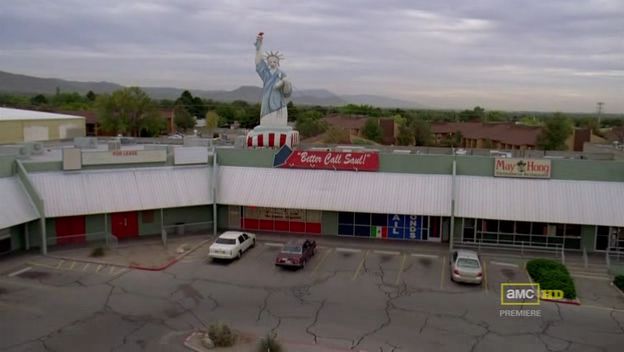
By the way, in the video, doesn't the exterior shot of the place, showing the strip mall, look like where Saul Goodman had his law offices on "Breaking Bad"?

6 फ़रवरी 2014

It's easy to make fun of these women, but I do think it's fair to say that the art folk here are exploiting people.

The sculpture is out in the open where it can be seen from a distance and it really does look like a strange man stumbling about in his underwear.


Whether you're afraid of "him" or simply think he has a problem — after all, it's winter — and needs help, you're drawn into a real emotional response before you realize it is art. You're out there, living your life, in the public space — here, at a college that has drawn you in through gestures of welcoming and has taken your money — and suddenly you see a problem that you must respond to. But — ha ha — it's only a statue. You're silly. You were afraid of a statue. So it's an unsettling prank. Why? Is that good art? It has appropriated your peace of mind, your comfort in a public space, for what? To challenge and intrigue you, perhaps. The art people on campus would like to reach out — like this fake man groping forward nakedly sleepwalking — because the youngsters need to be contacted, against their will, and if they don't like it, they're to be publicly derided for their lack of sophistication.

(Originally posted as an update here.)

ADDED: Now, I'm not saying the petition was the best response. I think the kids should fight back in various ways. Here's a young woman doing a selfie with the guy. If you can get someone else to take the picture, the arms are in a good position for pretending to be dancing with him. He could be dressed up. It's possible that the art people imagined that the students would just laugh and play, but if so, they were unsophisticated. They were unable to see things through the eyes of others.

AND: Let's realize that throughout history statuary has been used to intimidate people. What's all that ancient Egyptian sculpture about if not to cow people into abject submission?


Think of all the Lenin and Stalin statues. And how about Saddam Hussein's despicable "Victory Arch"?


Is the Wellesley "Sleepwalker" in this tradition? Yes, the idea of a mighty oppressor seems like a dream to us now.  Perhaps it's a joke bouncing off the tradition of the intimidating colossus.

Look on my works, ye Mighty, and despair!


Who can be afraid anymore? We've been tweaking Ozymandias for centuries. We've laughed at the imposing males and their sculptural representations for so long that it should be the men — not the women, putting the "tit" in petition — who cry out at the long-running, long-stumbling humiliation of the puny fake man in saggy panties.

1 जनवरी 2014

"Apple denies it helped build the NSA's iPhone backdoor."

"Either [the NSA] have a huge collection of exploits that work against Apple products, meaning they are hoarding information about critical systems that American companies produce, and sabotaging them, or Apple sabotaged it themselves."

Via commenter Lemondog.

Mobile phones have transformed our world by seducing and delighting us. We installed bugging and tracking devices into our most intimate places, into ourselves. We did, willingly, what we could have resisted if we'd only known. Now, knowing, we can throw away these devices, but we won't. We love them too much.

I wanted to find a little video clip from "Breaking Bad," showing one of the many times a character on that show broke a cell phone. Of course, it wasn't an iPhone. Good luck twisting an iPhone in half with your bare hands. On that show, they always had the old clamshell-style phones, which are good for the drama/comedy of snapping open or shut or twisting into an untraceable shambles. I did find this clip showing "What Walter White Sold Before Meth" and I'll let you write the punchline for this post:

[Defective video removed.]

"It accelerated absorption of pure oxygen...." Pure oxygen. I love Walter's connection to purity. His meth was 99.1% pure.

22 दिसंबर 2013

"Apropos of nothing, you have never seen a man in shorts until you have seen Bill Murray in 'The Lost City.'"

Writes Bob Boyd, in the only comment on yesterday's Amazon post. (Here's "Lost City" on Amazon, in case you've got a yen to see Bill Murray in shorts, perhaps wandering lost in some city or perhaps knowing exactly where he is in a city that somehow finds itself lost.)

This makes me realize that I need to make a list of men in shorts movies (and TV shows). I think of "The Big Lebowski," but what else? There's "Fear and Loathing in Las Vegas," where Johnny Depp plays the role of Hunter S. Thompson. Help me out here. Don't cite examples of men in bathing suits. Despite the similarity of men's bathing suits to shorts, it's not what we're looking for here. And don't include movies where the men are wearing sports uniforms/gear, e.g., "Hoosiers" and "Breaking Away." It must be a major character who is opting to go about in shorts in a situation in which women like me would think: That man should put on a pair of pants because those shorts make him look like a large boy.

By the way, speaking of titles that begin with "Breaking," the TV series "Breaking Bad" begins with the image of an empty pair of pants flying through the air. We never see the main character, Walter White, wearing shorts. Even when we see him with his pants off, in his underpants, the underpants are not undershorts but tighty whities. When not naked or in his underpants, he's wearing long pants like the long pants seen in that opening empty-pants shot. I think the series is a man's search for his lost masculinity. The lost masculinity is symbolized by the flying empty pair of pants.

So let's also work on a list of men-in-pants movies (and TV). Simply wearing pants is not enough for a pants-wearing-man to make this list, nor is looking great in pants enough. There needs to be some Walter-White-level importance to the pants, the kind of meaning expressed in phrases like "wearing the pants in this family" or "put on your big-boy pants."

13 दिसंबर 2013

Enclothed cognition.

A term for "the mental changes that we undergo when we wear certain clothing."
"It’s all about the symbolic meaning that you associate with a particular item of clothing," [Northwestern researcher Hajo] Adam said. And he thinks the study’s results can be applied to many more fields, including activewear and fitness. "I think it would make sense that when you wear athletic clothing, you become more active and more likely to go to the gym and work out."
The linked article is almost entirely about athletic clothing, and there's almost nothing about the researchers' study and the term "enclothed cognition" which amused me enough to start this post. The insight seems so obvious — dressing the part will help you play the part — that it seems funny to have a term for it.

What I think would be fun to talk about is articles of clothing that you have used to alter your perceptions. And have you rejected items of clothing that you thought would skew your perceptions in ways you didn't like? Remember to exclude the idea of how others perceive you and how their response to you will affect you. It's just you. You and that item of clothing. Like this:


ADDED: Here's an Amazon link to a page where you can buy a nice porkpie hat, like the one Walter White uses to achieve enclothed cognition in "Breaking Bad." I searched only for "porkpie hat" and did not mention anything more "Breaking Bad"-related than that, but the Amazon page showed not only other elements for a Walter White costume (jacket, glasses, yellow coveralls) but also packets of blue raspberry rock candy.