લેબલ Bob La Follette સાથે પોસ્ટ્સ બતાવી રહ્યું છે. બધી પોસ્ટ્સ બતાવો

27 ફેબ્રુઆરી, 2015

What's so bad about Scott Walker's "If I can take on 100,000 protesters, I can do the same across the globe"?

"I think the bust of Fighting Bob La Follette is kind of Soviet-like," says Meade, reading the previous post about the Islamic iconoclasm in Mosul and anti-Soviet iconoclasm in the former Soviet states (and the preservation of Soviet sculptures in Lithuania).

Here's a picture I took of the monumental head on February 25, 2011, a little over a week after the big protests had begun in and around the Wisconsin capitol:
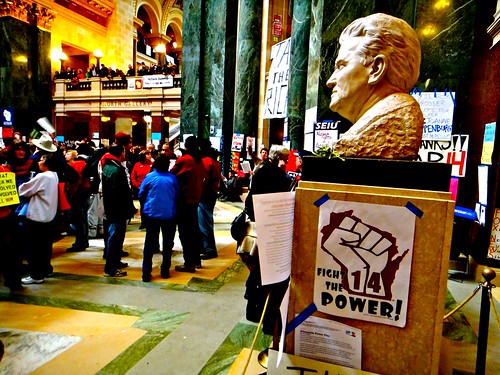
Bust of Bob La Follette

I originally blogged that here, with other photographs, including one showing how some protesters had used the back of the Veterans Memorial as a component of what they called their "Information Station." 

And let me use this post to comment on something Scott Walker said at the end of his CPAC speech yesterday. What would he do about ISIS? "If I can take on 100,000 protesters, I can do the same across the globe." That was bad, obviously, and Walker has sent his spokeswoman to rephrase what was supposedly in The Head of Walker. (I'm saying "The Head of Walker" because I'm picturing a "Soviet-like" head of Walker some day, in the capitol, eye-to-eye with Bob La Follette, which would be the "more speech" alternative to iconoclasm.) The spokeswoman said:
Governor Walker... was in no way comparing any American citizen to ISIS. What the governor was saying was when faced with adversity he chooses strength and leadership. Those are the qualities we need to fix the leadership void this White House has created.
There's still a problem. How would the form of leadership demonstrated during the protests transfer to the war on terrorism? Scott Walker's approach to the protests was to let them play out — replete with loud chanting and drumming and lots of taped up signs in the capitol and huge marches outside — all the while knowing he had the votes in the legislature to pass the law that the protesters were protesting. He chose silent inaction, putting up with it, in a situation where he knew he'd win in the end, and, in fact, when the legislation finally passed, the protests ended. There was still the recall effort, and there was plenty more speech lambasting Walker, but Walker knew all along he had the upper hand, and instead of trying to counter the speech of the protesters (or even to get them cleared out of the capitol), he sat back and let them have what probably looked to most Wisconsinites like a big tantrum. He knew that the protesters knew that they could not cross the line from semi-organized protest to anything like violence or the threat of violence. The no-response response was therefore effective.

Is that the kind of leadership he's proposing to use in the war on terror? It can't be. The relevant component of leadership that I'm seeing is something I associate with George W. Bush: silent acceptance of abuse from his critics. Walker said "If I can take on 100,000 protesters," but he didn't take them on. He let them carry on. That may have been wise under the circumstances, but it tells us close to nothing about what he would do with enemies who won't limit themselves to protesting and when he can't control the outcome through partisan domination of a legislature. Sheer cockiness won't do the trick — "If I can take on 100,000 protesters, I can do the same across the globe." And that was a cockiness beyond what we saw — and got tired of — in George Bush.

24 જૂન, 2014

"David Brock has a message for liberal millionaires: Don’t sweat being called hypocrites."

"Brock, a former 'right-wing hit-man'-turned-top-big-money-Democratic-operative, is part of a behind-the-scenes campaign to convince donors it’s OK to attack the Koch brothers for spending millions of dollars while doing the exact same thing for the left."

Presumably, Brock makes money saying stuff like this. Koch Brocking.

His idea is: Since the Democrats are in politics to do what is good and the Kochs want what is bad, there's a "false equivalence." Seeing the false equivalence — I observe — requires that you look at the end and not the means.

And, of course, you have to believe that your end is good and theirs is bad... or at least you have to be willing to portray your end as good, which is making the ostensible end only a means. And that's common in politics where the true end is often power, control, and perpetuation of one's own job. Seeming ends like immigration reform or marriage equality can easily be means to those ends.

In any case, let me congratulate Brock for getting these speaking gigs and for the hair. That's political hair par excellence. That's beyond Teddy Kennedy hair. That's outright Bob La Follette hair.

22 જૂન, 2014

6 Californias, The Home of the Rave, the Ham-and-Eggs Theory, the original meaning of "brainstorm," and The Gnomes of the Future.

California is too big to be just one state, and bigness begets bigness. The request, in splitting it up, is to split it in 6.

I remember talk in the 60s and 70s about splitting California into 2 states. And I see a NYT report from 1941:
Talk of splitting California into two States along the line of the Tehachapi Mountains has been revived....

This is a recurring discussion, due to the different temperaments and clashing personalities of the two sections.
What was the difference between southern and northern California back in 1941?
To Northern California Southern California is "the home of the rave," where hamburgers and brainstorms alike are super-colossal.
I'm just going to guess that "the rave" is a play on "brave" (as in "the home of the brave"), that it just means that people are raving lunatics, and that "brainstorm" had a more negative meaning at the time.
In the North "screwball" is a satisfactory description of the South — after successive campaigns to defeat such Southern-born notions as End-Poverty-in-California, Utopianism, the Townsend Plan and the Ham-and-Eggs Theory.
Imagine how absurd it would be if states were split up whenever people in one section of a state thought the people at the other end were deranged. I'd be living in a state, in the southern half of what is now Wisconsin, and I believe that state would be named La Follette.

If your state were bisected according to different temperaments, clashing personalities, and food preferences, which direction — north/south, east/west, diagonal? — would the line be drawn and what do you think the 2 parts would be named?

Anyway, I take it you also want to know what was the Ham-and-Eggs Theory. It was, apparently, a Depression Era proposal to give $50 a week to everyone 50 and older. It all started when...
On July 25, 1938, Archie Price swallowed poison and died in Balboa Park. He had notified the local press two years earlier that he would kill himself when his savings were depleted, because, as he put it in a letter found in his pocket with his last two cents, he was "too young to receive an old-age pension and too old to find work." Price was buried, without ceremony, in a pauper's grave...
And I looked up "brainstorm" in the (unlinkable) OED and my guess that the original meaning was much more negative than the current usage is correct. Traced as far back as 1861, it meant "A fit of rage, melancholy, etc.; a sudden change of mood or behaviour; (also) a sudden and severe attack of mental illness; an epileptic seizure." That 1861 quote was from S. B. Hemyng's "Dark Cloud with Silver Lining":
Then a fierce brain-storm swept over her. There was a gloom on her brow, clothing the dimly visible gnomes of the future in dark, shapeless shadows.
Gnomes of the future... I love that phrase. I googled it, and I can't describe my fortuitous path, but I ended up with this, which is too delightfully almost relevant not to show you:

16 એપ્રિલ, 2012

Let's review the newest ads in the Wisconsin recall race.

Tom Barrett — the Milwaukee mayor who is running in the Democratic primary — has an ad in which state senator Jon Erpenbach — who, we hear, "helped lead the fight" in the "war" that Scott Walker started —  does all the talking:


We see pictures of the protesters filling the state capitol rotunda. Erpenbach is being used to vouch for Barrett's fidelity to the ideals and agenda of the protesters.

Next is Kathleen Falk — the former Dane County executive, also running in the Democratic primary:


Like Barrett's ad, this one begins with a black and white photograph and a female voiceover. Barrett had a picture of mean-looking Scott Walker and an unnamed script-reader telling us about the "war in Wisconsin." Falk's ad has a super-cute picture of Falk as a little girl, and the voice is Falk's — she grew up in Milwaukee and Waukesha county. There's tinkling piano music. Then we see, in color, Kathleen Falk, sitting in a warmly sunlit room, her hands clasped around a warm yellow mug. She's murmuring about "simple Wisconsin values" — "work hard, be honest" — "trust," "truth." She brings people together: "That's the Wisconsin way."

Isn't the comparison interesting? Barrett — over there in Milwaukee — needs to connect himself to the protests in Madison, and he employs the handsome Erpenbach to assure us he's down with the struggle. Falk — who really was here during the protests and is a Dane County politician — relocates herself to Milwaukee and Waukesha, Barrett's neck of the state. There are no views of the protests or even of anyplace that reminds us of Madison. She represents "Wisconsin values" and "the Wisconsin way," which "our leaders" have "lost sight of." She doesn't even name Scott Walker.

Here's Doug La Follette. He's Wisconsin's Secretary of State, also running in the Democratic primary. He begins with a little mechanical cow, representing Wisconsin. It used to work, but it has stopped working, "because Scott Walker has betrayed the Wisconsin idea." The mechanical cow walks, then stops walking, at which point we see some unpleasant-looking protesters:


"It's time for a steady hand," says the voiceover, as we see La Follette's hands winding up the little cow and sending it to continue walking again. Okay.

The other candidate in the primary is Kathleen Vinehout, who's a state senator. Here's her YouTube channel, which doesn't seem to have any ads. I started looking at this video, because it seemed like the closest thing to an ad over there:


When I clicked through to get the code to embed that video, I saw it had "0 views"! I was the first view on that, which I'm not really even sure she wants people to see. She's giving a speech in some dark bar or casino-like place. I don't know if anyone is listening, but at 1:12, somebody off-camera drops something metallic. A pan, perhaps. Apparently, La Follette's campaign is just not modest enough to embody Wisconsin values. Undercutting the minimalism of La Follette — it's not easy!

13 માર્ચ, 2011

Meade and I arrive at the Capitol to find it mostly back to normal.


We see the nearly empty rotunda, climb to the first floor where we stop by the security desk in front of Gov. Scott Walker's office and check out the Veterans Memorial and the bust of Robert La Follette. Back in the rotunda, Meade interviews a hunger striker and sings "On Wisconsin," and I improvise the first take of my "We Won" poem. Outside, I talk to a Capitol policeman about politics, Meade interviews some runners, and we admire a baby in a Bucky Badger hat.

25 ફેબ્રુઆરી, 2011

At the Capitol today... there were signs taped up everywhere..

"Dick move."

DSC00306

Signs and junk...

DSC00300

... and even some people sleeping (at midday)...

DSC00245

Many signs depicted Jesus. Jesus says, "Tax the rich," and Scott Walker ignores our Lord:

DSC00169

The displays at the mezzanine level had become — like all the walls and pillars — places to tape signs. Here's the bust of Robert M. La Follette:

DSC00234

I don't know if you can see it. Look closely: that is the replica of the Liberty Bell under all those signs:

DSC00255

This is the back of the Veteran's Memorial, with all sorts of notices taped onto it and junk piled up against it.

DSC00277

Meade and I confronted the protesters who maintained what they called their "information station." That's Meade in the baseball cap during the confrontation:

DSC00290

I'll have video of the Veterans Memorial confrontation on YouTube and this blog very soon. The video includes a protester telling me that Meade and I are the first — "literally the first" — persons to object to their treatment of the memorial.

ADDED: Here's the post with the video up now.