Balthus లేబుల్‌తో ఉన్న పోస్ట్‌లను చూపుతోంది. అన్ని పోస్ట్‌లు చూపించు

3 జులై, 2018

The brown spot.

From "Through a Glass Darkly" by Lev Mendes (New York Review of Books):
I recently discussed [the Balthus painting] Thérèse Dreaming with an older woman, an architect and former museum conservator. She told me that one thing she disliked about the painting was the brown spot on the girl’s underwear, which guided the viewer’s attention in a way that felt manipulative. I wasn’t sure if she was bothered by the brownness of the spot—with its possible menstrual or scatological connotations—or just the spot’s function as a focal point that drew one in, that narrowed one’s attention (like the punctum of a photograph, in Roland Barthes’s phrase—the point of interest, “that accident which pricks me”). Whatever the case, I was highly skeptical—in fact, in complete denial. I had looked carefully at the painting and had never noticed a brown spot. The whole thing struck me as absurd. The spot, I told myself, must be a projection of her imagination onto the painting.

Feeling unsettled, however, about my own dismissiveness, I returned again to the Met and to Thérèse Dreaming. This time, I saw it, a sort of brown triangular shadow across the bottom of the girl’s panties and the slip of her skirt. I had been wrong after all about the absence of the spot. Still, it remained for me a rather incidental detail. I experienced no “prick”; it did not draw me in; it barely registered at all. Certainly I did not feel that I had been manipulated by Balthus.
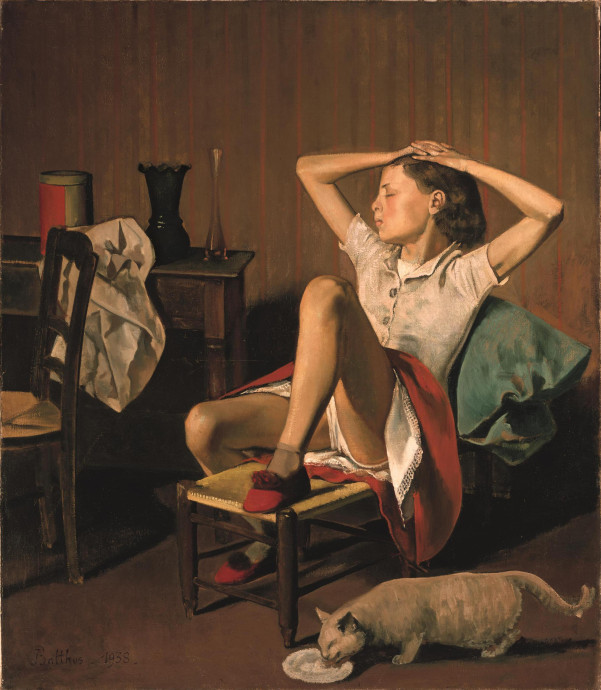
Here's the painting...


... seen previously on this blog, last December, in "The Metropolitan Museum of Art declines to remove a painting that is — according to a petition — 'undeniably romanticizing the sexualization of a child.'"

ADDED: What's great about the painting is that it makes you aware of your own mind: What is it about this painting that is making me uneasy — that's making think strange things that I don't ordinarily think? 

You study the painting. You try to find what the artist did to inspire these sensations. You may think: It can't be me. It must be the artist. 

That's what so interesting about people like that architect lady who decided it was the brown spot.

You might wonder: Is this artist a genius for doing what he did to me with this image? Or is there something about me?!! 

And perhaps you get to this sort of reasoning: He must be a great artist or there's something wrong with me. So then... he's doing it, and that's so wrong of him! Punish him! You must punish him so that I may go free and get back to my comfortable life!

But art should make you uncomfortable, and it would be wrong to help you find your way back.

4 డిసెంబర్, 2017

The Metropolitan Museum of Art declines to remove a painting that is — according to a petition — "undeniably romanticizing the sexualization of a child."

The painting, by Balthus, is “Thérèse Dreaming." The NY Post has the article, showing the painting (which shows a young girl posed so we get a good look at her underpants).

From the petition: "I am simply asking The Met to more carefully vet the art on its walls, and understand what this painting insinuates. Ultimately, it’s a small ask in consideration of how expansive their art collection is… how overtly sexual the painting is, and the current news headlines highlighting a macro issue about the public health and safety of women."

The NY Post informs us not only that Bono sang at Malthus's funeral, but that Elle Macpherson was also in attendance. Does that vouch for him somehow or is it just a way to nudge us idiots to understand that Balthus was famous? (Not famous enough for my spellchecker to lay off changing his name to Malthus.)

Anyway, the museum's spokesperson shows no empathy for the feelings of our era — The Reckoning  — but loftily informs us that its "mission is to collect, study, conserve, and present significant works of art across all times and cultures in order to connect people to creativity, knowledge, and ideas." And "Moments such as this provide an opportunity for conversation, and visual art is one of the most significant means we have for reflecting on both the past and the present."

So here's the painting:


Let's have the conversation.

I'll just start by saying that I saw the Robert Mapplethorpe exhibit in Boston in 1990, and one of the photographs showed a young girl — younger than "Thérèse" — and she was posed so that we could look up her skirt and there were no underpants. I remember that the elite media portrayed those who said this was wrong as unsophisticated. The photograph conveyed the charming innocence of a child, we were told.

Ah, yes, here's a NYT article, from 1996, "PHOTOGRAPHY VIEW; The Child, the Adult Within and the Blur Between," by Vicki Goldberg, talking a bit about that photograph, "Rosie."
The fact that, though clothed, [4-year-old Rosie] unwittingly displays her genitals puts the spectator in a slightly uneasy position; besides, her expression could be read as wariness.

Mapplethorpe had an agenda: "Children are sexual beings," he said, "but it's an area that makes most people feel uncomfortable."...

[In the 19th century, c]hildren were not yet considered sexual beings, which is why Lewis Carroll could get away with taking nude shots of little girls, at least for a while, and why Freud would later encounter such resistance to his theories of infantile sexuality....
Speaking of Lewis Carroll, here's an excellent New Yorker article from 2015, "Go Ask Alice/What really went on in Wonderland," by Anthony Lane. Excerpt (beginning with a letter from Carroll):
I have a little friend here, Lily Gray, child of Dr. Gray, and one of my chief beach friends at Sandown this year. She is 5, a graceful and pretty child, and one of the sweetest children I know (nearly as sweet as Gertrude)—and she is so perfectly simple and unconscious that it is a matter of entire indifference to her whether she is taken in full dress or nothing. My question is, are you going to allow Gertrude (who I think is also perfectly simple and unconscious) to be done in the same way?
It is impossible to read this now without horror. The politesse, the pointing up of sweetness, and the ascribing of “entire indifference” to the child evoke the classic stratagems of the pedophile, planning his campaign and convincing others (and, more important, himself) that he is doing no wrong—that there is no victim but merely a willing collaborator....