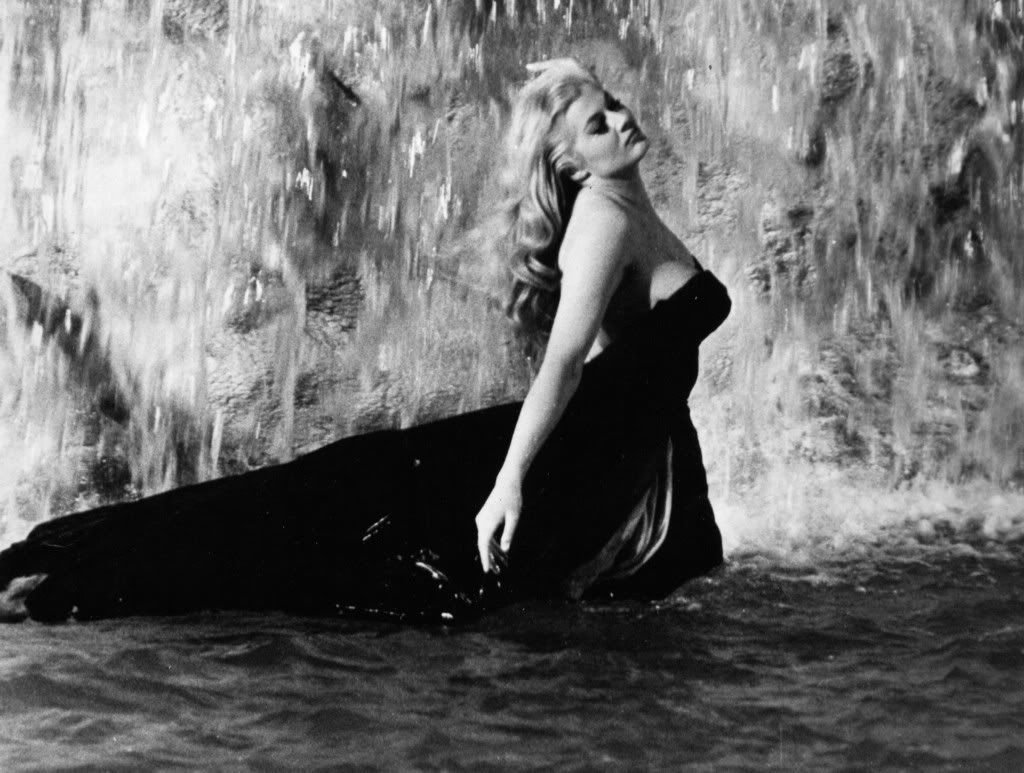
... Anita Ekberg and Taylor Negron.
They seem quite different but both appeared in an iconic movie scene — a scene so utterly memorable that when the death is announced, everyone seems compelled to put that scene first.
Who else can you say that about? I'm not looking for a third person to die. I hope everyone lives a good, long time. But... who among the living could complete this triad?
ADDED: Here's a NYT piece timesplaining that "No, Celebrity Deaths Do Not Come in Threes."
Anita Ekberg లేబుల్తో ఉన్న పోస్ట్లను చూపుతోంది. అన్ని పోస్ట్లు చూపించు
Anita Ekberg లేబుల్తో ఉన్న పోస్ట్లను చూపుతోంది. అన్ని పోస్ట్లు చూపించు
11 జనవరి, 2015


"By 1965 there'll be total depravity. How squalid everything will be."
A line spoken in the 1961 movie, "La Dolce Vita," starring the woman the director, Federico Fellini called "the most wonderful woman created since the beginning of time." About herself, she said "When you’re born beautiful, it helps you start in the business. But then it becomes a handicap."
About Fellini, she said "they would like to keep up the story that Fellini made me famous, Fellini discovered me... So many have said they discovered me.'' She said she stood out in Italy, because she was blonde:
In real life, it was a dog — one of her Great Danes — that brought her down, breaking her hip, leaving her in a wheelchair. And now she has died, at the age of 83 — the most wonderful woman, born beautiful, Anita Ekberg.
And 1965 — the year when, in the reasoning of "La Dolce Vita," we would descend into total depravity — is half a century ago.
ADDED: 4 more things about Anita Ekberg.
1. She's important to me as the first of the icons of feminine beauty in my father's record collection, deeply embedded in my psyche:
2. "A really cool thing about the movie ['Divorce Italian Style'] is that at one point everyone in town — a small, claustrophobic place in Sicily — goes to see the movie 'La Dolce Vita.' 'La Dolce Vita' came out in 1961, one year before 'Divorce Italian Style.' We see the whole population of the small town watching Anita Ekberg on the big screen, and we never see Marcello Mastroianni as he appears in Roman form in 'La Dolce Vita.' We just see the Sicilian Marcello Mastroianni, in the audience, trying to work out his miserable little murder scheme." That's from a 2005 post of mine called "The attorney ... was brilliant, impassioned and sarcastic...."
3."The telephone rang, it would not stop, it was President Kennedy calling me up. He said, 'My friend, Bob, what do we need to make the country grow?' I said, 'My friend, John, Brigitte Bardot, Anita Ekberg, Sophia Loren.'" At least we still have Brigitte Bardot and Sophia Loren.
4. Only last November, I transcribed a dialogue that began with MEADE: "I just watched a movie called 'Valerie.' Starring Anita Ekberg. What rock star was she married to?" ME: "No. No. No. You're thinking of Britt Ekland." MEADE: "It had everything: betrayal, justice, frontier justice..."

About Fellini, she said "they would like to keep up the story that Fellini made me famous, Fellini discovered me... So many have said they discovered me.'' She said she stood out in Italy, because she was blonde:
"On the Piazza di Spagna, in the 50's, I was completely mashed by paparazzi. And the public. My blond hair.... Now everybody is blond here. Have you seen a news presenter on television that is not blond? I mean, there are more blondes here, especially on Italian television, than in the whole of Scandinavia. Really. And they are all dark Mediterranean. But they all want to bleach their hair. Blond, blond, blond.''Everyone wants to talk about her splashing in that fountain:
''Oh my God, her splendor was incredible, her outsized, totally exaggerated beauty,'' Tullio Kezich, a well-known Italian film critic and Fellini biographer, recalled.... "She was a horse. She plunged into that cold fountain in 'La Dolce Vita' without hesitation or a fuss. She was so Swedish and healthy; she never caught cold. Marcello was terrorized at the idea of getting wet.''But I think of the image of her strolling aimlessly with a little white kitten carried on her head:
In real life, it was a dog — one of her Great Danes — that brought her down, breaking her hip, leaving her in a wheelchair. And now she has died, at the age of 83 — the most wonderful woman, born beautiful, Anita Ekberg.
And 1965 — the year when, in the reasoning of "La Dolce Vita," we would descend into total depravity — is half a century ago.
ADDED: 4 more things about Anita Ekberg.
1. She's important to me as the first of the icons of feminine beauty in my father's record collection, deeply embedded in my psyche:
2. "A really cool thing about the movie ['Divorce Italian Style'] is that at one point everyone in town — a small, claustrophobic place in Sicily — goes to see the movie 'La Dolce Vita.' 'La Dolce Vita' came out in 1961, one year before 'Divorce Italian Style.' We see the whole population of the small town watching Anita Ekberg on the big screen, and we never see Marcello Mastroianni as he appears in Roman form in 'La Dolce Vita.' We just see the Sicilian Marcello Mastroianni, in the audience, trying to work out his miserable little murder scheme." That's from a 2005 post of mine called "The attorney ... was brilliant, impassioned and sarcastic...."
3."The telephone rang, it would not stop, it was President Kennedy calling me up. He said, 'My friend, Bob, what do we need to make the country grow?' I said, 'My friend, John, Brigitte Bardot, Anita Ekberg, Sophia Loren.'" At least we still have Brigitte Bardot and Sophia Loren.
4. Only last November, I transcribed a dialogue that began with MEADE: "I just watched a movie called 'Valerie.' Starring Anita Ekberg. What rock star was she married to?" ME: "No. No. No. You're thinking of Britt Ekland." MEADE: "It had everything: betrayal, justice, frontier justice..."

8 నవంబర్, 2014
MEADE: "I just watched a movie called 'Valerie.' Starring Anita Ekberg. What rock star was she married to?"
ME: No. No. No. You're thinking of Britt Ekland.
MEADE: It had everything: betrayal, justice, frontier justice...
ME: The telephone rang, it would not stop, it was President Kennedy calling me up. He said, "My friend, Bob, what do we need to make the country grow?" I said, "My friend, John, Brigitte Bardot, Anita Ekberg, Sophia Loren."
(I was quoting Bob Dylan's "I Shall Be Free," and Meade knew it.)
ME: Britt Ekland was married to Rod Stewart.
MEADE: Yeah, so the movie is called "Valerie."
ME: Did you watch the whole thing? You never watch movies.
MEADE: It's only an hour long. The theme is: War on Women.
ME: Why did you start watching that?
MEADE: Because Valerie Jarrett.
(We'd both seen the Politico article "Fire Valerie Jarrett" and had talked about it, so I didn't need more info about how the search got started.)
MEADE: And on YouTube, I saw this movie "Valerie," and I just got drawn in. It's very cheesy, but it's also very good for its time. And then the other thing that got me is: It has Italian subtitles, and some of the Italian words were great. Like a guy says "yeah," and it's "sim," not "si." It also had a theme of xenophobia. It's a Hollywood movie made after World War II and a lot of people were still dealing with their fear of foreigners.
ME: Yeah, but what was War on Women about it?
MEADE: The husband was an evil man. He hits her, he tries to drug her, he rapes her on the wedding night, and when he finds out she's pregnant, he basically tries to cause an abortion by whipping the horses, and that doesn't work. He's a hard drinker. And he tortures her. He has this whole evil plan.... And there's a scene where he literally gives her the back of his hand. Remember when Debbie Blabbermouth Schultz said that about... who did she say that about?
ME: Scott Walker!
MEADE: So, anyway, there's a trial, and you get 3 testimonies.
ME: Like "Rashomon"!
MEADE: And the final testimony is Valerie's, so that's the true testimony. The truth is revealed. It ends very abruptly.
MEADE: It had everything: betrayal, justice, frontier justice...
ME: The telephone rang, it would not stop, it was President Kennedy calling me up. He said, "My friend, Bob, what do we need to make the country grow?" I said, "My friend, John, Brigitte Bardot, Anita Ekberg, Sophia Loren."
(I was quoting Bob Dylan's "I Shall Be Free," and Meade knew it.)
ME: Britt Ekland was married to Rod Stewart.
MEADE: Yeah, so the movie is called "Valerie."
ME: Did you watch the whole thing? You never watch movies.
MEADE: It's only an hour long. The theme is: War on Women.
ME: Why did you start watching that?
MEADE: Because Valerie Jarrett.
(We'd both seen the Politico article "Fire Valerie Jarrett" and had talked about it, so I didn't need more info about how the search got started.)
MEADE: And on YouTube, I saw this movie "Valerie," and I just got drawn in. It's very cheesy, but it's also very good for its time. And then the other thing that got me is: It has Italian subtitles, and some of the Italian words were great. Like a guy says "yeah," and it's "sim," not "si." It also had a theme of xenophobia. It's a Hollywood movie made after World War II and a lot of people were still dealing with their fear of foreigners.
ME: Yeah, but what was War on Women about it?
MEADE: The husband was an evil man. He hits her, he tries to drug her, he rapes her on the wedding night, and when he finds out she's pregnant, he basically tries to cause an abortion by whipping the horses, and that doesn't work. He's a hard drinker. And he tortures her. He has this whole evil plan.... And there's a scene where he literally gives her the back of his hand. Remember when Debbie Blabbermouth Schultz said that about... who did she say that about?
ME: Scott Walker!
MEADE: So, anyway, there's a trial, and you get 3 testimonies.
ME: Like "Rashomon"!
MEADE: And the final testimony is Valerie's, so that's the true testimony. The truth is revealed. It ends very abruptly.
21 ఆగస్టు, 2008
Here's the part where we talk about Madonna.
Pay special attention to how concerned Bob is about Madonna's bra:
Here's the album cover that made such an impression on Bob:

Here's another album cover we talk about (which may evoke fond/embarrassing memories for some of you):

And I'll see if I can find that old album of my father's that had Anita Ekberg on the cover. BTW, a Google search for Anita Ekberg will give you a NSFW result, so if you want to see a picture, look here.
UPDATE: I made a little video showing those old album covers from my father, beginning with "You're My Thrill," showing Anita Ekberg.
Here's the album cover that made such an impression on Bob:
Here's another album cover we talk about (which may evoke fond/embarrassing memories for some of you):

And I'll see if I can find that old album of my father's that had Anita Ekberg on the cover. BTW, a Google search for Anita Ekberg will give you a NSFW result, so if you want to see a picture, look here.
UPDATE: I made a little video showing those old album covers from my father, beginning with "You're My Thrill," showing Anita Ekberg.
29 మే, 2005
"The attorney ... was brilliant, impassioned and sarcastic..."
"... moving and moved. He played the entire scale of emotions with confident precision."
If you're keeping a list of movies about law, be sure to include "Divorce Italian Style." There are only a couple courtroom scenes, but law frames the entire movie, about a man who only needs a divorce, but because the law does not provide that escape, plots to murder his wife in a way that will count as the "heat of passion," punishable by only a short sentence. To do this, he's got to cause her to have an affair and then catch her in the act.
I remember seeing this movie many years ago on a small black and white TV and thinking it was funny but not well photographed. The new Criterion Collection DVD amazed me. The photography is actually quite beautiful, very dark and detailed. Just the thing to get lost entirely on a television from the 1960s.
Even though lately I've grown tired of watching actors act, I loved watching Marcello Mastroianni and Daniela Rocca. Mastroianni is a ridiculous baron, in love with his 16-year-old cousin and tired of his wife, played by Rocca. Why is it funny that he wants to murder her? See the movie. It's funny. The two actors make it funny. I particularly like the way Mastroianni's FeFe endears himself to us even though Rocca's Rosalia has done nothing remotely hateful. What's wrong with her? Just her incredibly annoying desire for love!
Rocca is perfect. She's not ugly or a big nag. She does have a mustache and a monobrow, but the main thing is how irritatingly she begs for love. She not only insists that her husband tell her he loves her every night, but she's ravenous for information about how much he loves her. Since he doesn't love her at all, he's quite put upon. And Mastroianni's a genius at looking put upon.
There's one scene where she brings him coffee, then insists on sipping from his cup. Why not pour her own cup? That's FeFe's weary question. But Rosalia imagines she's doing something sexy and charming.
A really cool thing about the movie is that at one point everyone in town -- a small, claustrophobic place in Sicily -- goes to see the movie "La Dolce Vita." "La Dolce Vita" came out in 1961, one year before "Divorce Italian Style." We see the whole population of the small town watching Anita Ekberg on the big screen, and we never see Marcello Mastroianni as he appears in Roman form in "La Dolce Vita." We just see the Sicilian Marcello Mastroianni, in the audience, trying to work out his miserable little murder scheme.
If you're keeping a list of movies about law, be sure to include "Divorce Italian Style." There are only a couple courtroom scenes, but law frames the entire movie, about a man who only needs a divorce, but because the law does not provide that escape, plots to murder his wife in a way that will count as the "heat of passion," punishable by only a short sentence. To do this, he's got to cause her to have an affair and then catch her in the act.
I remember seeing this movie many years ago on a small black and white TV and thinking it was funny but not well photographed. The new Criterion Collection DVD amazed me. The photography is actually quite beautiful, very dark and detailed. Just the thing to get lost entirely on a television from the 1960s.
Even though lately I've grown tired of watching actors act, I loved watching Marcello Mastroianni and Daniela Rocca. Mastroianni is a ridiculous baron, in love with his 16-year-old cousin and tired of his wife, played by Rocca. Why is it funny that he wants to murder her? See the movie. It's funny. The two actors make it funny. I particularly like the way Mastroianni's FeFe endears himself to us even though Rocca's Rosalia has done nothing remotely hateful. What's wrong with her? Just her incredibly annoying desire for love!
Rocca is perfect. She's not ugly or a big nag. She does have a mustache and a monobrow, but the main thing is how irritatingly she begs for love. She not only insists that her husband tell her he loves her every night, but she's ravenous for information about how much he loves her. Since he doesn't love her at all, he's quite put upon. And Mastroianni's a genius at looking put upon.
There's one scene where she brings him coffee, then insists on sipping from his cup. Why not pour her own cup? That's FeFe's weary question. But Rosalia imagines she's doing something sexy and charming.
A really cool thing about the movie is that at one point everyone in town -- a small, claustrophobic place in Sicily -- goes to see the movie "La Dolce Vita." "La Dolce Vita" came out in 1961, one year before "Divorce Italian Style." We see the whole population of the small town watching Anita Ekberg on the big screen, and we never see Marcello Mastroianni as he appears in Roman form in "La Dolce Vita." We just see the Sicilian Marcello Mastroianni, in the audience, trying to work out his miserable little murder scheme.
22 అక్టోబర్, 2004
Coming to terms with the "La Dolce Vita" DVD.
I've complained about subtitles before. I like to fixate on the photography of a movie and constantly moving my eyes to the bottom of the screen is quite irritating. I don't mind reading. I spend much of the day reading. But I go to the movie theater to look at the moving pictures. If the pictures are worth looking at, they are worth feeling resentful about being compelled to look away from. There is a special problem with DVD if you have a widescreen television and a widescreen movie. The subtitles are placed on what would be a black band on an ordinary TV. On a widescreen TV, they are off the screen unless you size the movie image so that it has fairly wide black bands on the sides as well as the top and bottom!
I was trying to watch my new DVD of "La Dolce Vita" yesterday. The photography is very beautiful, and I just wanted to stare at it, so I was already annoyed by having subtitles, but it's also a very widescreen picture, and I was forced to watch it sized way down to be able to read the subtitles. I was losing the beauty of the images. And the subtitles are yellow, which was atrocious under the black and white photography. The DVD has no dubbed English track. The assumption must be that the kind of people who watch Fellini movies are the kind of people with the hostile attitude toward dubbing. The only English track is commentary by film critic and historian Richard Schickel, and I tried putting that on. It's not bad, but it brings you down a bit. Plus, he mostly talks about what we're seeing, not what they are saying, so who needs him?
Maybe the best option is just to keep the subtitles off and listen to the original soundtrack, which includes some English along with the primarily Italian dialogue. I do understand a little Italian. "La Dolce Vita" lines like "Ciao, Marcello!" are easy enough to pick up, and it's a sprawling, episodic story, where the images may contain most of the meaning. The spectacle is the thing here: the grand city of Rome, the wonderful face of Marcello Mastroianni, and the entire physical presence of the human divinity Anita Ekberg. Whether you understand the Italian or not, the sound of the language is beautiful (and, of course, dubbing would deprive us of that) and the music soundtrack, by Nino Rota, is perfect. What will be missed by watching the film without understanding the dialogue? Lines like: "By 1965 there'll be total depravity. How squalid everything will be."
And let me add this, since I've been thinking about Bob Dylan, whose "Chronicles" I just finished. I know Dylan took a lot of inspiration from films, so let me point out the two references to "La Dolce Vita" in Bob Dylan songs. The first is from "I Shall Be Free":
UPDATE: The problem with the subtitles was cured by going into the DVD settings and adjusting it to correspond to a wide-screen TV.
I was trying to watch my new DVD of "La Dolce Vita" yesterday. The photography is very beautiful, and I just wanted to stare at it, so I was already annoyed by having subtitles, but it's also a very widescreen picture, and I was forced to watch it sized way down to be able to read the subtitles. I was losing the beauty of the images. And the subtitles are yellow, which was atrocious under the black and white photography. The DVD has no dubbed English track. The assumption must be that the kind of people who watch Fellini movies are the kind of people with the hostile attitude toward dubbing. The only English track is commentary by film critic and historian Richard Schickel, and I tried putting that on. It's not bad, but it brings you down a bit. Plus, he mostly talks about what we're seeing, not what they are saying, so who needs him?
Maybe the best option is just to keep the subtitles off and listen to the original soundtrack, which includes some English along with the primarily Italian dialogue. I do understand a little Italian. "La Dolce Vita" lines like "Ciao, Marcello!" are easy enough to pick up, and it's a sprawling, episodic story, where the images may contain most of the meaning. The spectacle is the thing here: the grand city of Rome, the wonderful face of Marcello Mastroianni, and the entire physical presence of the human divinity Anita Ekberg. Whether you understand the Italian or not, the sound of the language is beautiful (and, of course, dubbing would deprive us of that) and the music soundtrack, by Nino Rota, is perfect. What will be missed by watching the film without understanding the dialogue? Lines like: "By 1965 there'll be total depravity. How squalid everything will be."
And let me add this, since I've been thinking about Bob Dylan, whose "Chronicles" I just finished. I know Dylan took a lot of inspiration from films, so let me point out the two references to "La Dolce Vita" in Bob Dylan songs. The first is from "I Shall Be Free":
Well, my telephone rang it would not stop,The second is from "Motorpsycho Nightmare":
It's President Kennedy callin' me up.
He said, "My friend, Bob, what do we need to make the country grow?"
I said, "My friend, John, Brigitte Bardot,
Anita Ekberg,
Sophia Loren."
Then in comes his daughterI think we can see what kind of inspiration Dylan got from "La Dolce Vita." He thought Anita Ekberg was fabulous. And she was. More subtly fabulous is Marcello Mastroianni, who is reunited with Ekberg, much older, in "Intervista." There is a really nice little documentary about him called "I Remember." He's really quite hilarious. I recommend staring at his face the entire time he's on screen.
Whose name was Rita.
She looked like she stepped out of
La Dolce Vita.
UPDATE: The problem with the subtitles was cured by going into the DVD settings and adjusting it to correspond to a wide-screen TV.
దీనికి సబ్స్క్రయిబ్ చేయి:
పోస్ట్లు (Atom)


 పోస్ట్లు