The book that caught my eye and that I downloaded from Kindle is the one chosen for age 92:
“Nothing to be Frightened Of”The one chosen for my age, 68, is something I've already read, “The Year of Magical Thinking” by Joan Didion ("Grief can make you feel like you’re losing your mind. That’s normal").
BY JULIAN BARNES
Don’t avoid the big questions of life and death and faith: Tackle them straight on with help from some of the greatest thinkers.
And, no, I've never read "Atlas Shrugged." I tried a little, but I have to like the sentences. I'm a sentences reader.
That reminds me, I wanted to recommend this Malcolm Gladwell podcast that has a lot to say about the kind of people who are slow readers:
The Tortoise and the HareGladwell is himself a "tortoise" — a slow reader — and he doesn't like the way his kind are disadvantaged on the LSAT.
A weird speech by Antonin Scalia, a visit with the some serious legal tortoises, and a testy exchange with the experts at the Law School Admissions Council prompts Malcolm to formulate his Grand Unified Theory for fixing higher education.
A "tortoise"-type reader is not going to do well with "Atlas Shrugged"!
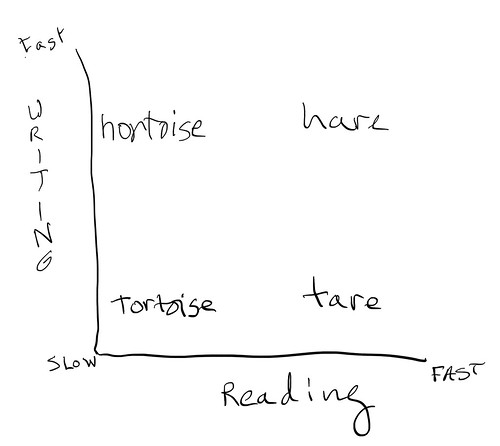
By the way, Gladwell talks about the condition of being a slow reader and a fast writer. I have that too. It's why blogging works well for me. I can find and isolate the sentences I find rich and readable — slowly readable — and I can flow very quickly writing about them. In this light, you can see that this tortoise/hare thing is not binary. There may be tortoises and hares, but there are also "hortoises" and "tares." If it's just tortoises and hares, it might be easy to say, yeah, it's just that some people are smarter than others. But if you see reading and writing (or reading and analyzing) as separate axes, with fast to slow on both, people are more complexly differently abled. Diagram to come....
ADDED: Oh, no, no, no... my idea of a diagram with axes and quadrants is defective. I had to try to draw it to see the problem!
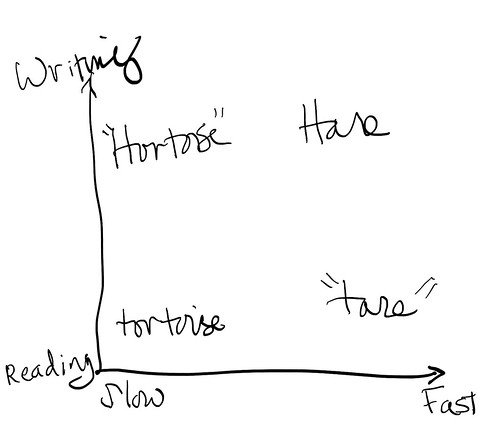
Reading does not progress to writing the way slow progresses to fast. Please suggest a way I can draw this idea!
AND: Allison explained the solution and, with her help, I easily got it right:


 పోస్ట్లు


