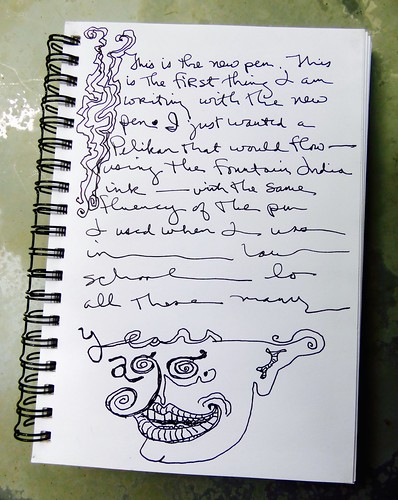
I'd said the other day, "I ordered the pen. I ordered the ink." The ink arrived yesterday and the pen today. I'm just so pleased with it. I'm getting back to my artistic proclivities. #Altexit.
Det. Rene Shade, an ex-boxer turned cop... with a 10-year-old daughter and a killer on his trail. There's poetry in Woodrell's mayhem, each novel—and scene—full of gritty and memorable Cajun details.I don't know enough about this to speculate about whether Obama identifies with Shade, but I will note that Sasha is 10.
No strain on the mind or the muscles. Seven and a half hours of mild, unexhausting labour, and then the soma ration and games and unrestricted copulation and the feelies. What more can they ask for? True... they might ask for shorter hours. And of course we could give them shorter hours. Technically, it would be perfectly simple to reduce all lower-caste working hours to three or four a day. But would they be any the happier for that? No, they wouldn’t. The experiment was tried, more than a century and a half ago. The whole of Ireland was put on to the four-hour day. What was the result? Unrest and a large increase in the consumption of soma; that was all. Those three and a half hours of extra leisure were so far from being a source of happiness, that people felt constrained to take a holiday from them. The Inventions Office is stuffed with plans for labour-saving processes: Thousands of them... And why don’t we put them into execution? For the sake of the labourers; it would be sheer cruelty to afflict them with excessive leisure.So... 1 + 2... the boxer and thinking outside the box.
During the cold war, Nineteen Eighty-Four seemed to have the edge. But when the Berlin Wall fell in 1989, pundits proclaimed the end of history, shopping reigned triumphant, and there was already lots of quasi-soma percolating through society. True, promiscuity had taken a hit from Aids, but on balance we seemed to be in for a trivial, giggly, drug-enhanced spend-o-rama: Brave New World was winning the race.Atwood's fear: We get both.
That picture changed, too, with the attack on New York's twin towers in 2001. Thoughtcrime and the boot grinding into the human face could not be got rid of so easily, after all. The Ministry of Love is back with us, it appears, though it's no longer limited to the lands behind the former iron curtain: the west has its own versions now.
On the other hand, Brave New World hasn't gone away. Shopping malls stretch as far as the bulldozer can see. On the wilder fringes of the genetic engineering community, there are true believers prattling of the gene-rich and the gene-poor - Huxley's alphas and epsilons - and busily engaging in schemes for genetic enhancement and - to go one better than Brave New World - for immortality.
"Zip! The rounded pinkness fell apart like a neatly divided apple. A wriggle of the arms, a lifting first of the right foot, then the left: the zippicamiknicks were lying lifeless and as though deflated on the floor."(Here's the line in it's chapter, which includes this sex talk: "'Hug me till you drug me, honey.'...'Kiss me till I'm in a coma. Hug me, honey, snuggly …'")
[H]ow close have we come, in real life, to the society of vapid consumers, idle pleasure-seekers, inner-space trippers and programmed conformists that it presents?...
We wish to be as the careless gods, lying around on Olympus, eternally beautiful, having sex and being entertained by the anguish of others. And at the same time we want to be those anguished others, because we believe... that life has meaning beyond the play of the senses, and that immediate gratification will never be enough.
As the Army’s suicide rate hits record levels in the Iraq war, there’s small wonder practically everyone in Congress wants to deal with the parallel emerging crisis of depressed veterans tempted to take their own lives. Everyone, that is, except Senator Tom Coburn, Republican of Oklahoma. He stands alone in blocking final passage of a suicide prevention bill in fear that the government’s record-keeping on troubled vets might somehow crimp their ability to purchase handguns.Why stop at soldiers? Let's have the government come around and check on everyone's sanity and then track those of us who don't meet the standard! To show we care for them as human beings.
Even the craven gun lobby should manage some shame over this absurd example of Second Amendment idolatry.
The House has unanimously approved a measure mandating the screening of all veterans for suicide risk, but Senator Coburn worries that veterans’ medical data might be appropriated by other agencies to deny that all-encompassing right to wield arms on the domestic front.
The senator’s office points to another bill near passage — prompted by the Virginia Tech gun massacre — that would encourage states to do a better job of listing mentally troubled individuals on the federal roll of risky gun purchasers. But tying these two measures together is itself evidence of defective reasoning, or at least scurrilous politicking. The Virginia Tech measure has nothing to do with veterans and affects only those Americans formally judged by a court to be mentally disturbed.
It is an eminently good thing that the anti-suicide measure would require medical specialists to keep track of veterans found to be high risks for suicide. But that’s to care for them as human beings, under that other constitutional right — to life, liberty and the pursuit of happiness. Respect for the grave sacrifices by veterans requires the Senate to strike down the Coburn ploy and hurry this vital measure to President Bush.
Before contracting for the embryos, clients can evaluate the egg and sperm donors, and can even see pictures of them as babies, children and sometimes adults....When you choose a husband or wife, you're picking the person you want to live with, not just the genetic material. If you've married, how much did you think about the quality of the genetic material you could procure for your offspring? But then, what genetic qualities would you select for your children that you wouldn't care about having in your adult companion? And are there some things you want in your spouse that you'd reject if you knew it was in that embryo you're about to have implanted?
"People have long warned we were moving toward a 'Brave New World,' " said Robert P. George of Princeton University, who serves on the President's Council on Bioethics. "This is just more evidence that we haven't been able to restrain this move towards treating human life like a commodity. This buying and selling of eggs and sperm and now embryos based on IQ points and PhDs and other traits really moves us in the direction of eugenics."...
"People can say, 'Oh, this is the new Hitler.' That's not the case," [said Jennalee Ryan of the Abraham Center of Life.] "I don't take orders. I say 'This is what I have' and send them the background. If they don't think it's right for them, they don't have to take them."...
"If I do discriminate, it's that I only want healthy, intelligent people," Ryan said. "People will say, 'You're trying to create the perfect human race.' But we've always done gene selection just by who women choose as their husbands and men choose as their wives. This is no different."
Stephen Greenblatt, a Shakespeare scholar at Harvard and a confessed “soft touch,” said the grade he would give [the Ophelia] paper “would depend, at least to some extent, on whether I thought I was reading the work of a green freshman — in which case I would probably give it a D+ and refer the student to the writing lab for counseling — or an English major, in which case I would simply fail it.”Hmmm... yeah, but you're thinking, I don't go to Harvard. Maybe I can still get by with it.
He added: “If I had paid for this, I would demand my money back.”
Thanks to search engines like Google, college instructors have become adept at spotting those shop-worn, downloadable papers that circulate freely on the Web, and can even finger passages that have been ripped off from standard texts and reference works.At least these search engines are causing the papers to get worse. If students know that -- and I'm trying to help here -- that's a disincentive.
A grade-conscious student these days seems to need a custom job, and to judge from the number of services on the Internet, there must be virtual mills somewhere employing armies of diligent scholars who grind away so that credit-card-equipped undergrads can enjoy more carefree time together.


 పోస్ట్లు


