Showing posts with label Jane Jacobs. Show all posts

May 7, 2017

Chelsea Clinton's dream literary dinner party: James Baldwin, Shakespeare, Franz Kafka, Albert Camus, Jane Jacobs, and Jane Austen.

That's what she said, when asked which writers, dead or alive, she'd like at a dinner party. She also imagined they'd talk about "the balance between social responsibility and individual freedom, and how people and communities can evolve to be more inclusive, more kind, have a greater and broader sense of solidarity, while still respecting individual liberties; what provokes or blocks those changes; and what stories might resonate today to encourage us toward kindness, respect and mutual dignity."

At The New Yorker, Josh Lieb provides the transcript. Excerpt:
Franz Kafka: I confess, I find this intriguing. What must the world be like outside those windows?

Clinton: Yes, it’s changed a lot since you were alive. But on a more interesting subject: What provokes or blocks the evolution of a community’s solidarity?...

Jane Jacobs: Please! Let me see my grandchildren!

Clinton: Maybe I will—after you tell me what the balance between social responsibility and individual liberty is.

Jacobs: Uh . . . forty-five per cent?

Clinton: Fascinating. What do you think, Franz Kafka?
ADDED: There are 2 completely different dimensions to the humor, and only one is about Chelsea Clinton — the ridiculousness of her topics and how out of place she'd be in the group she selected. The second one is something that's always a problem with these dinner party hypotheticals that involve bringing back the dead: You're expecting them to do dinner party conversation when they will have just had the mind-blowing experience of coming back from the dead and are also aware that it's only for this one dinner and then it's back off to death for you.

May 4, 2016

It's the 100th anniversary of the birth of Jane Jacobs, author of "The Death and Life of Great American Cities."

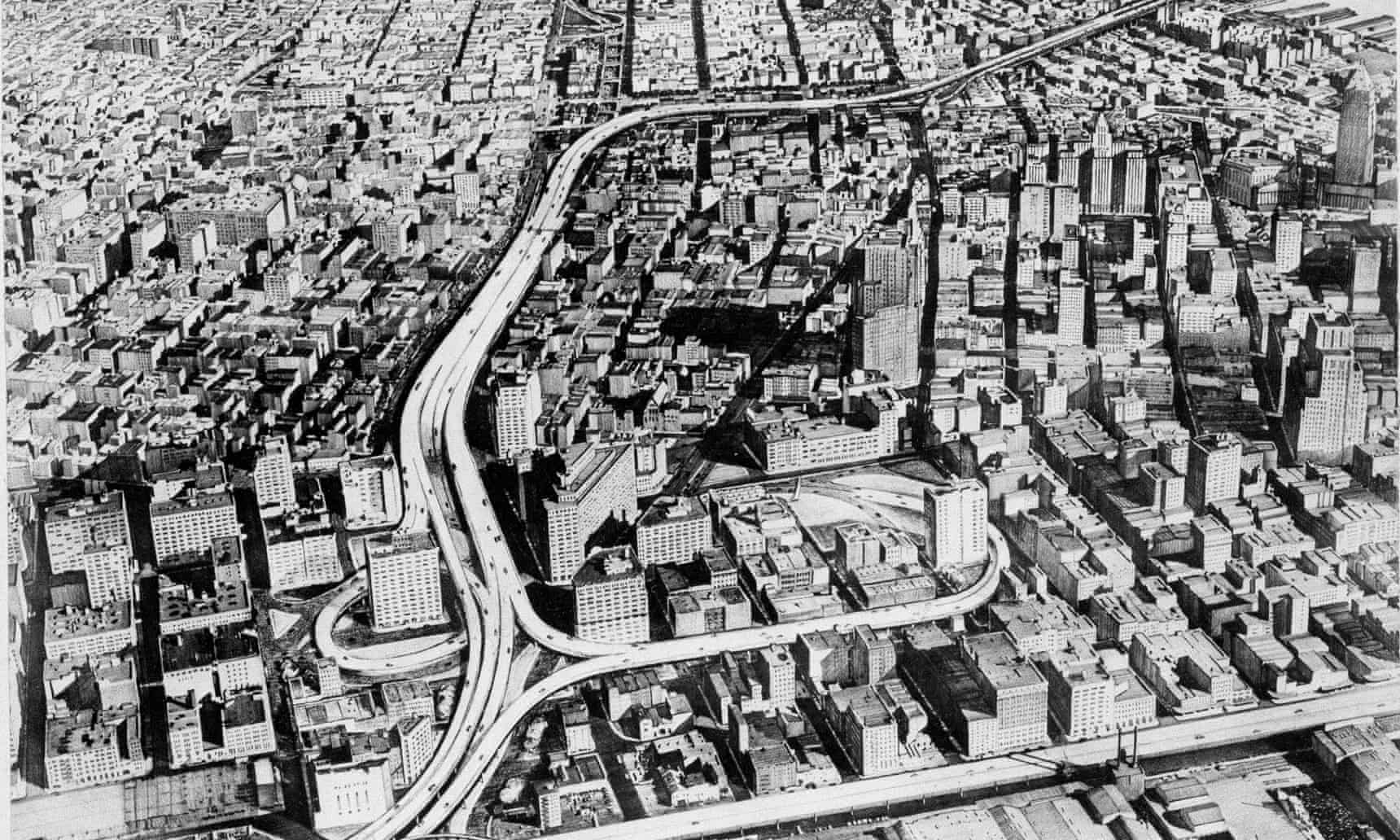
1. TIME: "Jacobs was not just a writer who had big ideas, she was also the champion of those ideas in the real world. At the time city planning aimed to make cities orderly, with tall buildings and open space, and had no qualms about demolishing large swaths of neighborhoods to make their ideas reality, as with New York City’s Cross Bronx Expressway. A similar highway was the subject of what remains perhaps her most famous battle: The Lower Manhattan Expressway, proposed by city planner Robert Moses, which would have been a 10-lane road cutting across what is now SoHo and Little Italy. At a public hearing on the proposed expressway in 1968, Jacobs was arrested and later charged with 'second-degree riot, inciting to riot and criminal mischief'...."

2. The Guardian: "Washington Square Park anchored the Village, offering 10 acres of green space to a steadily changing set of neighbours, from Edith Wharton to Bob Dylan. In 1880, Henry James wrote in Washington Square of its 'rural and accessible appearance' – a quality that had not entirely dimmed by the 1950s. Moses, however, upon looking at the park, was convinced that the amenity it most sorely lacked was a four-lane road through its centre." Below: "An artist’s sketch from 1959 of the proposed Lower Manhattan Expressway, a 10-lane highway through SoHo and Little Italy that required the demolition of 416 buildings."


3. HuffPo: "Even though Jacobs had no training in the field (let alone a college degree), she turned urban planning upside down and led cities to embrace mixed use development such as what transformed Baltimore’s Inner Harbor from urban decay to a major tourist attraction. Just as Rachel Carson’s Silent Spring in 1962 raised awareness over the misuse of pesticides and sparked the beginning of the ecological movement in the U.S., Jacobs’ book fueled the New Urbanism movement."

4. Treehugger: "Jane Jacobs did her research just by looking around and watching the sidewalk ballet, but others are now using more sophisticated methods to show that she was right. [Marco De Nadai] at the University of Trento and his team have examined six cities in Italy to test Jacobs' four conditions of multiple functions, small blocks, mixed age and relatively high density. Instead of eyes on the street, they used big data...."

5. Tech Insider: "6 ways the ‘Mother of Urban Design’ has transformed American cities.... 100 years after her birth, many urban dwellers are living in the kind of American cities she imagined and fought for."

6. Vox: "Her fight with [Robert] Moses has been turned into an opera called A Marvelous Order, drawn from a Jacobs passage about the logic under the chaos of urban life: 'Under the seeming disorder of the old city, wherever the old city is working successfully, is a marvelous order for maintaining the safety of the streets and the freedom of the city.'"


7. Slate: "Bulldoze Jane Jacobs/The celebrated urban thinker wrote the blueprint for how we revitalize cities. It’s time to stop glorifying her theories.... Thinking through how to make cities truly equitable is harder than uncritically reaffirming a small selection of the work of Jacobs. If Jacobs remains an almost-deific figure in urban planning, the profession will end up perpetuating what Jacobs fought so hard against: doing things to cities simply because they replicate the ways they’ve been done in the past. If we want to celebrate Jacobs, it’s time to move beyond her."

8. Gothamist: "Confirmed: Bob Dylan Did Co-Write Protest Song About Robert Moses With Jane Jacobs."

August 2, 2015

"Just as conservatives who hearken for a return to the ’50s are sure to be disappointed, urban advocates who suggest a 'return to the city' for middle class families will be as well."

"Both minorities and millennials, often thought of as spearheading a 'back to the city' drive, are, according to most indicators, moving out to the suburbs as they enter their thirties and start families. Dense urbanity, of course, remains a huge contributor to the nation’s economy and culture. Urban centers are great places for the talented, the young, and childless affluent adults. But for most Americans, the central city offers at best a temporary lifestyle. It does not fit with what people can afford and where they want to live. There is a reason why 70 to 80 percent of Americans in our metropolitan areas live in suburbs, and those numbers are not likely to change appreciably in the coming decade. Cities... have indeed experienced a renaissance, but not in the form [described in 'Death and Life of Great American Cities']. To be sure, this revival is a hell of lot better than the urban dystopia that developed [post-1960]. But it’s time to recognize that we are not seeing a renaissance of the kind of middle class urbanity that she loved and championed. That city has passed into myth, and, unless society changes in very radical ways, it is never going to come back."

From "What Jane Jacobs Got Wrong About Cities."

June 11, 2011

"Norman Redlich, Ex-Dean of N.Y.U. Law School, Dies at 85."

The NYT reports. Redlich was the Dean of the law school when I was a student there, and he was my teacher in Conlaw2 (a course I now teach). From the obituary:
He helped Jane Jacobs defeat Robert Moses’ plan to build a four-lane highway through Washington Square Park in the late 1950s — brokering an unlikely alliance between Ms. Jacobs, the urban theorist, and Carmine De Sapio, the Tammany boss, that eventually saw not only Moses’ plan killed, but all vehicular traffic banished from the park.
What a hero!
He negotiated the deal in which the City of New York bought and renovated Yankee Stadium in 1971, when the team’s owners had threatened to leave and Mayor John V. Lindsay resolved to make them stay.
Again, a hero.
[In 1963, Redlich became] executive assistant to the Warren Commission’s chief counsel, J. Lee Rankin. In that job, he and several other staff lawyers, including Arlen Specter, the future Pennsylvania senator, devised the single-bullet theory...

The widespread doubt cast on the theory in later years caused Mr. Redlich to tell a Congressional subcommittee reviewing the commission’s findings in 1977, “I think there are simply a great many people who cannot accept what I believe to be the simple truth, that one rather insignificant person was able to assassinate the president of the United States.”
A more ambiguous accomplishment. It resolved everything, but the resolution could never be fully accepted.

RIP.

May 2, 2010

Terrorism and T-shirt vendors.

"At 6:28 p.m.... a video surveillance camera recorded what was believed to be the dark green Nissan S.U.V. driving west on 45th Street. Moments later, a T-shirt vendor on the sidewalk saw smoke coming out of vents near the back seat of the S.U.V., which was now parked awkwardly at the curb with its engine running and its hazard lights on. The vendor called to a mounted police officer, the mayor said, who smelled gunpowder when he approached the S.U.V. and called for assistance. The police began evacuating Times Square, starting with businesses along Seventh Avenue, including a Foot Locker store and a McDonald’s."

Take a moment to appreciate street vendors. Think of the value of their alert eyes at street level in the busiest places. Let's reflect again on what Jane Jacobs wrote in her brilliant book "The Death and Life of Great American Cities":
A well-used city street is apt to be a safe street. A deserted city street is apt to be unsafe. But how does this work, really? And what makes a city street well used or shunned? ... A city street equipped to handle strangers, and to make a safety asset, in itself, out of the presence of strangers, as the streets of successful city neighborhoods always do, must have three main qualities:
First, there must be a clear demarcation between what is public space and what is private space. Public space and private spaces cannot ooze into each other as they do typically in suburban settings or in projects.

Second, there must be eyes upon the street, eyes belonging to those we might call the natural proprietors of the street. The buildings on a street equipped to handle strangers and to insure the safety of both residents and strangers, must be oriented to the street. They cannot turn their back or blank sides on it and leave it blind.

And third, the sidewalk must have users on it fairly continuously, both to add to the number of effective eyes on the street and to induce the people in buildings along the street to watch the sidewalks in sufficient numbers. Nobody enjoys sitting on a stoop or looking out a window at an empty street. ... Large numbers of people entertain themselves, off and on, by watching street activity.
The basic requisite for such surveillance is a substantial quantity of stores and other public places sprinkled along the sidewalks of a district; enterprises and public places that are used by evening and night must be among them especially. Stores, bars and restaurants, as the chief examples, work in several different and complex ways to abet sidewalk safety.
First, they give people -- both residents and strangers -- concrete reasons for using the sidewalks on which the enterprises face.

Second, they draw people along the sidewalks past places which have no attractions to public use in themselves... Moreover, there should be many different kinds of enterprises, to give people reasons for crisscrossing paths.

Third, storekeepers and other small businessmen are typically strong proponents of peace and order themselves; ... they are great street watchers and sidewalk guardians if present in sufficient numbers.

Fourth, the activity generated by people on errands, or people aiming for food or drink, is itself an attraction to still other people.
Thanks to the guardians of the street.

December 6, 2008

"She tried to 'catch people's eyes, but every person I walked by was listening to music.'"

Here's a story about a 14-year-old girl who, fortunately, saved herself from a kidnapper. But she went through a terrifying experience that could have ended a lot sooner if people on the street were more attentive to their environment instead of off in their own private iPod space.
Cops said it appeared that the man had randomly approached the teen as she walked into the lobby of the W. 180th St. building. The victim said her kidnapper dragged her outside by the arm, where he hailed a livery cab on Broadway. On the way, she said, she tried to "catch people's eyes, but every person I walked by was listening to music."

"I kept asking him, 'Why are you doing this? Where are you taking me?'" she said, sitting safely between her parents in their apartment.
We should be safe when the streets are crowded with people. That is the community that should be protecting us. But are all those people really there, or somewhere else? We're all abstracted.

In "The Death and Life of Great American Cities," Jane Jacobs writes:
Some of the safest sidewalks in New York City... at any time of day or night, are those along which poor people or minority groups live....

[T]he public peace -- the sidewalk and street peace -- of cities is not kept primarily by police, necessary as police are. It is kept primarily by an intricate, almost unconscious, network of voluntary controls and standards among the people themselves, and enforced by the people themselves... No amount of police can enforce civilization where the normal, casual enforcement of it has broken down.

April 30, 2006

Catching up on the NYT/taking a hot bath.

I want to read the three newspapers that came while I was away, but I don't want to spend all evening on the task. I've got a podcast to record, and "The Sopranos" and "Big Love" are on tonight. I'm also freezing on this damp, blustery day, in which I had to run around in the wind and rain twice -- once to get to an airplane. The solution is to run a hot bath and page through all the newspapers in the 15 minutes it takes to fill the tub. I'll speed-choose pieces to blog and set them aside to blog once I've soaked myself back to a normal temperature.

***

1. "Neil Young Is Angry About War and Wants Everyone to Know It" (on line title: "Neil Young's 'Living With War' Shows He Doesn't Like It") by Jon Pareles:
The songs on "Living With War" are straightforward and single-minded, setting aside the allusive, enigmatic quality of Mr. Young's rock classics. "These are all ideas we've heard before," he said. "There's nothing new in there. I just connected the dots."...

"We are the silent majority now, and we haven't done a damn thing," Mr. Young said. "We've stood by and watched this happen. But there's more of us than there is of them, and we have to do something. When people start talking and see they can get away with it, it's going to happen everywhere. It's going to be a landslide, it's going to be a tidal wave. This is just the tip of it."
The tip of the landslide... the tip of the tidal wave... damn... if only I could think of another metaphor...

Those "allusive, enigmatic" lyrics of long ago are far out of reach.

Blue, blue windows behind the stars/Yellow moon on the rise/Big birds flying across the sky/Throwing shadows on our eyes....


Oh, Neil... There are politics and there is art. I'll always love the Neil Young of the distant past.

The chains are locked and tied across the door/Baby, sing with me somehow...


2. "New York City as Film Set: From Mean Streets to Clean Streets," by John Clark:
David Thomson, author of The New Biographical Dictionary of Film, said: "There's been a sea change. I can remember well into the 70's films where there is the terrific sense of New York as being this adventurous place. Certainly if you go back to the 30's and think of a film like 'My Man Godfrey,' New York is a great, dangerous playground. Those films really had a sense of how jazzy and exciting it was to be in New York. I can't think of the last film I've seen that had that feeling."

Paul Mazursky, the Brooklyn-born director of New York films like "Next Stop, Greenwich Village" (1976) and "An Unmarried Woman" (1978), echoed this view: "I'm trying to think of the last good New York movie." (He's still thinking.)
How ironic that the gentrifiers make the city too beautiful to serve as the backdrop for the art they love, when they love art because it is beautiful.

He was as tough and romantic as the city he loved. Beneath his black-rimmed glasses was the coiled sexual power of a jungle cat. I love this. New York was his town, and it always would be...

3. "An Adjective for Cakes, but Not for Bill Gates," by Geoffrey Nunberg. I want to blog about this based on the title alone, and I have no idea what the article is about. Oh, it's about the word "rich." Ha, ha:
Asked in 2003 if he felt rich, Bill Gates would say only, "At this point I'm clearly not by some definition middle class."

Unlike "prosperous" or "affluent," "rich" implies a society divided into separate estates, a legacy of the word's origin in the Indo-European name for a tribal king.

People may disagree on exactly how much money it takes to be rich, but that only confirms that it's an absolute threshold, and that those who have crossed it are delivered from the cares that afflict the rest of us. (Nobody who wins the lottery cries "I'm affluent!")
One of my sons, when he was little, used to often ask me, "Are we rich?" There's a feeling we have about what it would be like to be rich. And it always seems as though we'd have to make at least twice as much as we do to have that feeling. Later, if you make that much money, you'll think you need twice that to feel rich. But if you look at yourself from the perspective of the vast majority of people in the world, shouldn't you be ashamed to say you're not rich? So how do you answer the child who asks "Are we rich?"

4. "Films of Infamy," by David Thomson.
... I can imagine a film other than "Munich" or "United 93," a greater film, a film about different kinds of courage. In this film, the courage of the passengers would be shown and honored, but there would be an equal effort to show the courage of the terrorists (without calling them simply "evil" or "insane")....

The really difficult film to make or offer in America will be the one that says no, the world did not alter its nature on 9/11, even if the worst politicians used that event to switch their reality. But on 9/11, we faced the first need to ask ourselves how other people — evil, alien, insane — could be so brave. The history of terrorism — and it includes the independence of this country — is that in the end you have to understand the grievance of the aggrieved, whether you agree with it or not. That film has still to come.
Well, films have shown the perspective of criminals and villains quite often. These characters, if the film is any good, have their motivations, grievances, and, of course, they are bold and daring enough to carry out their evil actions. But how can you think anyone should make such a movie about the enemy before the war is over? Filmmakers aren't cowards for declining to make a show of their own courage like that.

5. "Outgrowing Jane Jacobs and Her New York," Nikolai Ouroussoff.
The threats facing the contemporary city are not what they were when she first formed her ideas, now nearly 50 years ago. The activists of Ms. Jacobs's generation may have saved SoHo from Mr. Moses' bulldozers, but they could not stop it from becoming an open-air mall.

The old buildings are still there, the streets are once again paved in cobblestone, but the rich mix of manufacturers, artists and gallery owners has been replaced by homogenous crowds of lemming-like shoppers. Nothing is produced there any more. It is a corner of the city that is nearly as soulless, in its way, as the superblocks that Ms. Jacobs so reviled....

The lesson we should take from Ms. Jacobs was her ability to look at the city with her eyes wide open, without rigid prejudices. Maybe we should see where that lesson leads next.
Jacobs as a method, not a conclusion. Subtly and modestly stated.

***

Now it's time to do a podcast and then settle in for a strong dose of television. I have not watched enough TV in the last four days. It's time.