 Talk about whatever you want in the comments.
24 సెప్టెంబర్, 2022


"Vladimir Putin and Donald Trump, long entwined, continue on vile parallel paths: They would rather destroy their countries than admit they have lost."
"They have each created a scrim of lies to justify lunatic personal ambition.... As our ancestors did, the Ukrainians are fighting an abusive overlord, against all odds, for democracy. It’s especially inspiring as a split screen with Trump and his MAGA forces trying to bulldoze democracy and rip away women’s rights. The Ukrainians are battling for a luminous ideal — unlike Trump and Putin, who are smashing a luminous ideal for their own benefit, driven by their dread of being called losers.
Both thugs are getting boxed in, Trump by a bouquet of investigations into his chicanery and Putin by an angry public pushback against his bloody vanity war.... Both Putin and Trump are famous for accusing everyone else of their own sins.... It would be poetic justice to think the walls were closing in on Putin and Trump at the same time, because at some point, all this will become unsustainable...."
From Wikipedia:
Maureen Dowd, in "Solo Soulless Saboteurs" (NYT).
Would it be poetic justice for the walls to close in on Putin and Trump at the same time for the same reasons?
"[T]he incident once again highlighted the increasing man-animal conflict in India."
Economic Times reports on this viral video:
On Dehradun-Rishikesh Highway....
— Susanta Nanda IFS (@susantananda3) September 21, 2022
Both are lucky ☺️☺️ pic.twitter.com/NNyE4ssP19
"I don’t know that there should be a common Latinx identity. This identity is rooted in land and geography when it should..."
"... be rooted in understanding settler colonialism in the Americas. I would be invested in a political Latinidad that first and foremost fought for indigenous sovereignty and black liberation. If it doesn’t do that, I don’t see the purpose...."
Said Alan Pelaez Lopez, a Zapotec cultural critic, artist, and academic, one of the 6 participants in a conversation at "The Problem With Latinidad/A growing community of young, black, and indigenous people are questioning the very identity underpinning Hispanic Heritage Month" (The Nation).
"Racial preferences should now be thought of like chemotherapy, a cure that can cause side effects that should be applied judiciously."
"We’ve applied the cure long past that point, and have drifted toward an almost liturgical conception of diversity that makes less sense by the year. In a 2003 Supreme Court ruling, Justice Sandra Day O’Connor, writing for the majority, said, 'we expect that 25 years from now, the use of racial preferences' in the university admissions context 'will no longer be necessary.' That was considered resonantly wise at the time. But now we have only about six years to go. Folks, it’s time."
Writes John McWhorter in "Stop Making Asian Americans Pay the Price for Campus Diversity" (NYT).
McWhorter is anticipating the Supreme Court cases Students for Fair Admissions v. President & Fellows of Harvard College and Students for Fair Admissions v. University of North Carolina. Oral argument in those cases is scheduled for October 31st — Halloween.
"Has anyone ever won an Oscar for showing so little expression?"
"[Nurse Ratched as played by Louise Fletcher ] was not — as Nurse Ratched was in the book — an embodiment of matriarchy and women's repression of men. She was horrible, cold, and controlling, but she also had some humanity. She was in a predicament trying to deal professionally with some very trying individuals. She made all the wrong decisions, but she was recognizably human.
The actors who played those patients did a fine job portraying seriously ill men and making them dramatically effective and immensely entertaining. We felt free to laugh at them a lot without getting the nagging guilty feeling that we weren't showing enough respect for the mentally ill. There's bonus entertainment in the fact that two of them are actors we came to love in bigger roles: Danny Devito and Christopher Lloyd.
'If they made this movie today, they'd ruin it with music,' I said halfway through. There was scene after scene with no music, other than the occasional record that a character in the movie played.... There was never any of that sort of movie music that instructs us on how to think and feels our emotions before we get a chance to feel them for ourselves. When Nurse Ratched puts a syrupy, soporific version of 'Charmaine' on the record player for the ritual of dispensing the psychotropic drugs, what we feel is in counterpoint to the music...."
I wrote that on Christmas Day in 2006, the morning after the last time I watched "One Flew Over the Cuckoo's Nest."
Here's the scene where Nurse Ratched keeps the men from watching the World Series game (and McMurphy is an election denier):
I wrote that on Christmas Day in 2006, the morning after the last time I watched "One Flew Over the Cuckoo's Nest."
I'm reading that old post this morning because I see the news that Louise Fletcher has died. She was 88.
I understand why Biden said "We go back a long way. She was 12, I was 30."
I'm seeing the puzzlement — or feigned puzzlement and eager seizure of an opportunity to remind us, once again, of Biden's history of nuzzling young girls.
As an older person, I recognize what went on in the old President's head. It's something that used to be very common in the generation that preceded Baby Boomers. There was this deeply embedded cultural norm of acting as if older women are not actually old. There were expressions like "A lady never reveals her age" and "A woman of a certain age" and lighthearted misstatements of age. It was considered rude even to imply that a woman is old.
Within that ethic, Biden's statement "We go back a long way" created an awkwardness that prompted a joke to undo the implication that he had called a woman old. He'd suggested that they were contemporaries. They'd worked together long ago, so she must be about as old as he is. He wanted to cancel the implication, and, long ago, he was about 30, so he made her as much younger as he could — a ludicrously young age 12.
"As what one might call a celebrity emotion, empathy is often simplified and caricatured. It’s hardly an entirely positive attribute."
"Being able to feel what another person is feeling can also allow someone to manipulate or injure another person. Sadists can be as empathetic as therapists. Iago is the most empathetic figure in literature—he feels every nuance and degree of Othello’s insecurity and plays on them to destroy him.
Yet in a democratic society, where individual freedom abounds at historically unique levels, empathy is indispensable. In a dictatorship, it doesn’t matter if you’re aware of another person’s inner state; the regime regulates relations between people. In a democracy, however, the people themselves regulate the relations between them.... In a democracy, [Toqueville] writes, 'each [man] may judge in a moment of the sensations of all the others; he casts a rapid glance upon himself, and that is enough....' If it is true that the essence of a functioning democracy is the ability of its people to feel empathy for one another, then the widespread reliance on antidepressants.... is like some cruel joke. Add to the pharmacological cultivation of emotional blunting the emotionally blunting effect of lives lived increasingly online, and you have a democracy resting on a fundamentally anti-democratic way of life."
"While these are beautiful objects and tell important stories that need to be known, it's disappointing to see the MET giving legitimacy to Crystal Bridges Museum."
"The museum is open-to the-public storage for the personal art collection of some the Walton heirs of Wal-Mart fame — known for paying their employees so little that as of 2022 they are reported to be the biggest recipients of food stamps and Medicaid in most states."
That's a comment on the NYT article "The Magnificent Poem Jars of David Drake, Center Stage at the Met/Before the Civil War, an enslaved artisan from South Carolina created storage vessels that transcend ceramic traditions."
That's a comment on the NYT article "The Magnificent Poem Jars of David Drake, Center Stage at the Met/Before the Civil War, an enslaved artisan from South Carolina created storage vessels that transcend ceramic traditions."
From the article:
23 సెప్టెంబర్, 2022


The Menominee North Pier Lighthouse.

 "The Menominee North Pier lighthouse is located in the harbor of Menominee, Michigan. The station was first lit in 1877. The current structure and its still operational light was lit in 1927, and automated in 1972. It is also sometimes called the 'Menominee (Marinette) North Pierhead Light."
I took those photographs on September 19th.
"I’m attracted to things like pointillism or a Jasper Johns ‘numbers’ work because they come out of breaking something down into its components, like bytes or numbers..."
Said the late Paul Allen, who co-founded Microsoft, quoted in "Opening Paul Allen’s Treasure Chest/It’s been a closely guarded secret which masterworks in the Microsoft co-founder’s collection will be auctioned at Christie’s in November. Here, highlights of a billionaire’s bounty" (NYT).
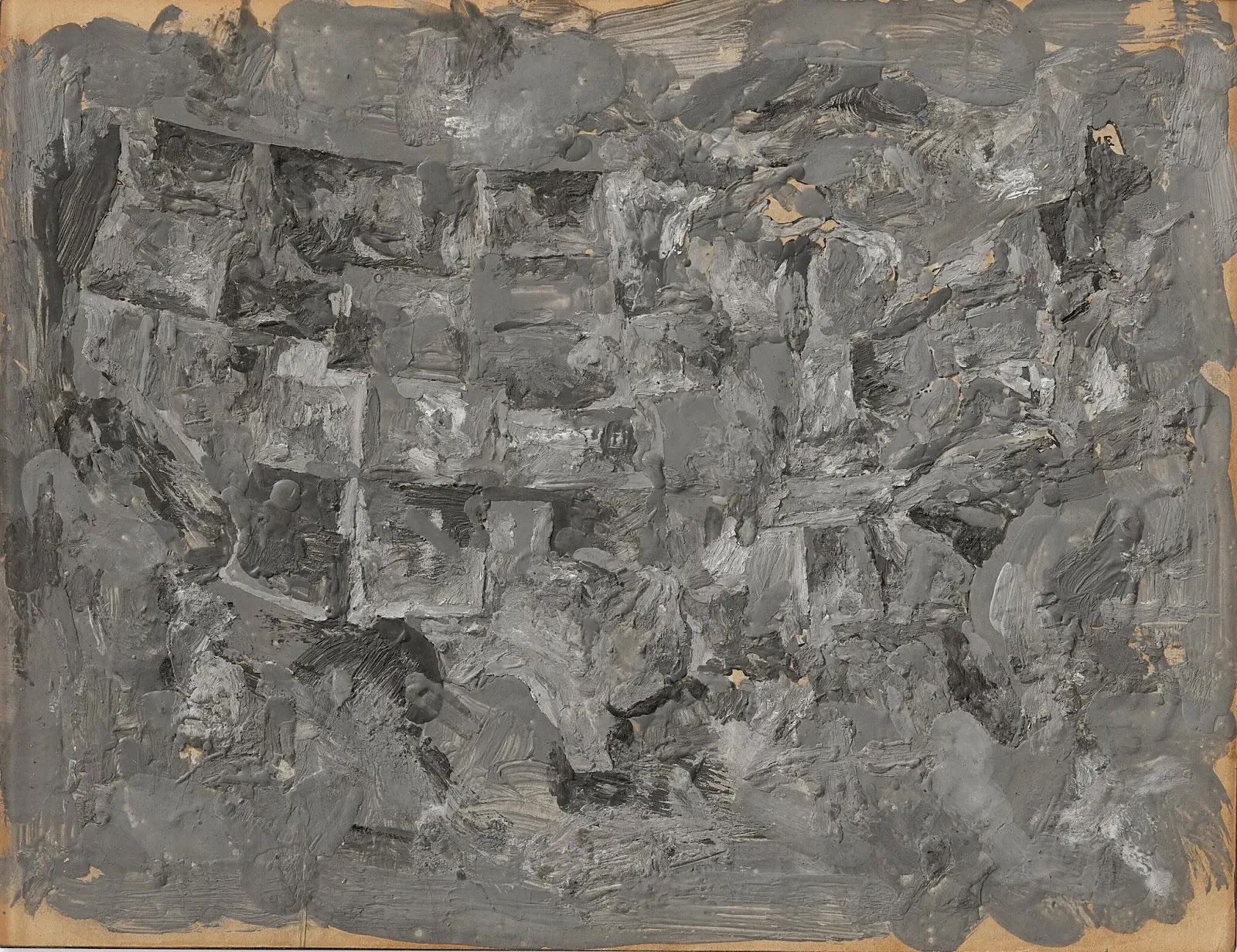
This isn't a Jasper Johns "numbers" work, but it is the Jasper Johns in the soon-to-be-auctioned collection. It's called "Map":
"Kripke challenged the notion that anyone who uses terms, especially proper names, must be able to correctly identify what the terms refer to."
"Rather, people can use terms like ‘Einstein,’ ‘springbok,’ perhaps even ‘computer,’ despite being too ignorant or wrong to provide identifying descriptions of their referents. We can use terms successfully not because we know much about the referent but because we’re linked to the referent by a great social chain of communication.”
Said philosophy professor Michael Devitt, quoted in "Saul Kripke, Philosopher Who Found Truths in Semantics, Dies at 81/A leading 20th-century thinker, he published a landmark work at 32. Known for lecturing extemporaneously without notes, he dazzled colleagues with the breadth of his ruminations" (NYT).
Similarly Errol Morris, the filmmaker, a friend of Kripke’s said: “Are we living in some subjective reality where truth is irrelevant, where truth is relative? Saul came up with this idea of ‘rigid designation.’ It sounds arcane. But he is saying our words attach to things in a way that is far more permanent than we ever thought.”
The philosopher Richard Rorty said: “Before Kripke, there was a sort of drift in analytic philosophy in the direction of linguistic idealism — the idea that language is not tuned to the world.... Saul almost single-handedly changed that.”
"Totenberg’s confounding book, subtitled 'A memoir on the power of friendships'... always comes back to friendships...."
"[A]s the pages go by, and Totenberg and her friends become more powerful, the theme becomes increasingly uncomfortable — and increasingly revealing.... [S]he seems to accept and share her insider friends’ worldviews. In this universe, it seems, we’re all on the same team.
The jurists Totenberg spent her career covering, for instance, are invariably portrayed as thoughtful stewards of the Constitution, even when they err.... One theory about Ginsburg’s decision to stay on the court was that, sharp as she was, she lived in a bubble that left her unable to appreciate how mean and extreme politics had become. If so, the convivial vibe depicted by Totenberg didn’t do much to clear things up. In fact, Totenberg became part of the RBG hype machine. As the justice became an unlikely celebrity, she and Totenberg developed a sort of stage act, conducting public interviews before ticketed audiences. Totenberg would share questions in advance. The responses were more thoughtful that way, which it seems was really what the evenings were trying to show.
With its odd, priestly culture, the court is particularly susceptible to this sort of veneration."
From "Nina Totenberg Had a Beautiful Friendship With RBG. Her Book About It Is an Embarrassment. Her memoir shows everything that’s wonderful about friendship — and awful about insider culture" by Michael Schaffer (Politico).
From "Nina Totenberg Had a Beautiful Friendship With RBG. Her Book About It Is an Embarrassment. Her memoir shows everything that’s wonderful about friendship — and awful about insider culture" by Michael Schaffer (Politico).
Totenberg's book is called "Dinners With Ruth."
"Could you imagine a congressional reporter doing a book called Dinners With Harry Reid, tracing shopping excursions and intimate family moments with the late majority leader, who died the year after Ginsburg?"
"You do your best, you know, and maybe people will agree. And maybe they don’t. And maybe you’ll win. And maybe you’ll lose."
"And then what you do is you think about it for a while. Go on to the next thing, so that you can do a decent job on the next thing. And just keep going."
Said the retired Justice Breyer, quoted in "Breyer warns justices that some opinions could ‘bite you in the back’ in exclusive interview with CNN’s Chris Wallace" (CNN).
Breyer seems to have adopted the catchphrase "And there we are." He's quoted using it 3 times in this short summary of the interview.
He used it after stating the he tried to change the outcome in Dobbs, describing the mood at the Court after the Dobbs leak, and after declining to criticize either Ginni or Clarence Thomas.
Breyer's "And there we are" made me think of Kurt Vonnegut's "So it goes." In "Slaughterhouse-Five":
[Vonnegut] uses it as a refrain when events of death, dying, and mortality occur or are mentioned; as a narrative transition to another subject; as a memento mori; as comic relief; and to explain the unexplained. The phrase appears 106 times.
Is Breyer's "And there we are" like Kurt Vonnegut's "So it goes"? "And there we are" feels lighter, more like "It is what it is" or "Whaddayagonnado."
"If I am simultaneously bankrupting and killing myself to make karate happen for one child, uptown, at 4pm, and French, downtown, for the other..."
"... I want to see results. Fun is an inadequate metric.... I want some kind of externalised measure of success. The business model for child activity centres in the city understands and exploits this intuitively.... What was this compulsion to furnish them with a suite of accomplishments like tiny Regency ladies in a Jane Austen novel? Why not needlepoint?
We quit violin. (Take the feeling you get when someone cancels a dinner and quadruple it.) We opted out of taekwondo (initial enthusiasm, followed by endless weekly foot-dragging). We’re about to exit dance (loved it, then didn’t love it). I put it into Google: 'What’s the opposite of a tiger?' Google suggests jellyfish. Jellyfish parenting – boneless, diaphanous, endlessly flexible. I’m almost there...."
దీనికి సబ్స్క్రయిబ్ చేయి:
పోస్ట్లు (Atom)


 పోస్ట్లు


