7 అక్టోబర్, 2018


Brewers on the verge of winning the division series! [UPDATE: BREWERS WIN!!]
Orlando Arcia & @KeonDDBroxton go back-to-back in the 9th to extend the lead to 6-0! #OurCrewOurOctober pic.twitter.com/1OAf8NgOm5
— Milwaukee Brewers (@Brewers) October 7, 2018
What does "Come Get Your People" mean?
I had to Google that question as I struggled to understand the NYT op-ed, "White Women, Come Get Your People," by Alexis Grenell. The phrase "come get your people" does not appear in the text of the column, only in the headline. There's a subheadline, "They will defend their privilege to the death." I guess "They" is the white women, not "your people." Is coming and getting your people another way to say defending your privilege?
We see photographs of Susan Collins and Lisa Murkowski, so I guess they're in the set of white women Grenell is addressing. Is Grenell white? It feels creepy to Google to check someone's race, but she made race relevant. The headline makes it seem as though she is not white, because why would you address a group as if they were other than you if they were not?
I've read the column already, and I found it strange and off-putting, so I'm going to read it again to examine my reaction and I'll also see if the meaning of the headline pops into clarity and, if not, examine what turned up in my Google search of the phrase "Come Get Your People."
It begins with melodrama and careless imagery:
We see photographs of Susan Collins and Lisa Murkowski, so I guess they're in the set of white women Grenell is addressing. Is Grenell white? It feels creepy to Google to check someone's race, but she made race relevant. The headline makes it seem as though she is not white, because why would you address a group as if they were other than you if they were not?
I've read the column already, and I found it strange and off-putting, so I'm going to read it again to examine my reaction and I'll also see if the meaning of the headline pops into clarity and, if not, examine what turned up in my Google search of the phrase "Come Get Your People."
It begins with melodrama and careless imagery:
"Democrats will never be pulled down so low that we hate folk. We can’t hate Republicans. We need each other as Americans."
"We’ve got to lead with love. You can’t lead the people if you don’t love the people – all the people."
Said Cory Booker, quoted in "Booker: 'We are not defined by a president who does not believe women'" (The Hill). I clicked through to that because the quote in the headline disturbed me a bit. As a woman, I felt otherized! It's weird to speak of "believing women." We're a huge group — the majority. How can you even think of the idea of "believing women" unless you first imagine us to be a different sort of animal from you, the men? We can't possibly all have the authority to command belief, so which ones of us are really getting the must-be-believed privilege? The ones with doctorates? The Democrats with doctorates? I really don't know, but I suspect that "does not believe women" is an insult and the real question is when do you use it?
I ended up selecting a different quote to feature in this post, though. The one I picked sounds nice. It's an aspiration. It's certainly not true that "Democrats will never be pulled down so low that we hate folk," but swap "will" for "should" and you've got something. "We can’t hate Republicans" is also literally false. You certainly can hate Republicans. You can and do. But to say that you shouldn't is a good idea.
I understand the rhetoric of making a simple declarative statement to express advice or desire. Maybe that's a notable feature of Cory Booker rhetoric. I associate it with adults training children how to act: We don't put our elbows on the table. If the child sees the potential to quip, Maybe you don't, but I do, he shouldn't say it, but if he does, the old-fashioned mother can respond, Children don't talk to their mothers like that, and he will get the message that a second quip in the same format is not a good idea.
Said Cory Booker, quoted in "Booker: 'We are not defined by a president who does not believe women'" (The Hill). I clicked through to that because the quote in the headline disturbed me a bit. As a woman, I felt otherized! It's weird to speak of "believing women." We're a huge group — the majority. How can you even think of the idea of "believing women" unless you first imagine us to be a different sort of animal from you, the men? We can't possibly all have the authority to command belief, so which ones of us are really getting the must-be-believed privilege? The ones with doctorates? The Democrats with doctorates? I really don't know, but I suspect that "does not believe women" is an insult and the real question is when do you use it?
I ended up selecting a different quote to feature in this post, though. The one I picked sounds nice. It's an aspiration. It's certainly not true that "Democrats will never be pulled down so low that we hate folk," but swap "will" for "should" and you've got something. "We can’t hate Republicans" is also literally false. You certainly can hate Republicans. You can and do. But to say that you shouldn't is a good idea.
I understand the rhetoric of making a simple declarative statement to express advice or desire. Maybe that's a notable feature of Cory Booker rhetoric. I associate it with adults training children how to act: We don't put our elbows on the table. If the child sees the potential to quip, Maybe you don't, but I do, he shouldn't say it, but if he does, the old-fashioned mother can respond, Children don't talk to their mothers like that, and he will get the message that a second quip in the same format is not a good idea.
"My son was born in 2002. I didn’t have an office job, so I was around a lot to get high and enjoy the cartoons."
"I opened a packet of Reefer’s peanut butter cups at his preschool fund-raiser and stunk up the place. But pot wasn’t just an occasional funny thing for me to do on weekends. I got stoned the day my son came home from the hospital and stayed that way, with few breaks, for a decade and a half.... In March of 2017, my mother died. The hour before she passed, I was outside the hospital, getting a shipment of medical gummies from a friend. I was high when I watched her die, I was high at her funeral, and I was high every day for the next eight months. To say I was 'self-medicating' to deal with grief would be too kind. My addicted self took grief as a no-limits license to get stoned...."
From "I'm Just a Middle-Aged House Dad Addicted to Pot/Cannabis should be legal, just as alcohol should be legal. But marijuana addiction exists, and it almost wrecked my life" by Neal Pollack (NYT). Despite the use of the present tense in the headline, Pollack quit ("cold turkey") and has stayed sober.
From "I'm Just a Middle-Aged House Dad Addicted to Pot/Cannabis should be legal, just as alcohol should be legal. But marijuana addiction exists, and it almost wrecked my life" by Neal Pollack (NYT). Despite the use of the present tense in the headline, Pollack quit ("cold turkey") and has stayed sober.
"Advise and consent" or "advice and consent"?
Which is it? I'm hearing "advice and consent" — the nouns — but I write "advise and consent" — the verbs. I prefer the sound of "the Senate's advise-and-consent role" (which I wrote here and here).
Kavanaugh, testifying, told the Senators, "You have replaced ‘advice and consent’ with search and destroy." He said "advice," even at the cost of losing parallelism. "Search and destroy" are verbs. If nouns and not verbs are called for, he should have said "You have replaced ‘advice and consent’ with searching and destruction."
A big reason to say "advice and consent" is that the Constitutional text — Article II, Section 2 s— ays:
Anyway, lest you think I'm a stickler for grammar, that's not why I've been preferring "advise and consent." I figured out the grammar after the fact, and I'm ready to hear anyone's explanation that I'm wrong about the grammar. I'm saying "Advise and Consent" because I read the 1959 best-seller "Advise and Consent" and I know the 1962 Otto Preminger movie!


Here's Wikipedia's plot summary of the book, which I'm setting out because there's some resonance with the recent activity in the Senate (boldface added):
Kavanaugh, testifying, told the Senators, "You have replaced ‘advice and consent’ with search and destroy." He said "advice," even at the cost of losing parallelism. "Search and destroy" are verbs. If nouns and not verbs are called for, he should have said "You have replaced ‘advice and consent’ with searching and destruction."
A big reason to say "advice and consent" is that the Constitutional text — Article II, Section 2 s— ays:
[The President] with the Advice and Consent of the Senate, shall appoint... Judges of the supreme Court....So maybe text should trump grammar, but if the text should so dominate how we speak, let's start saying "Judges of the Supreme Court." None of this "Justices" foolery.
Anyway, lest you think I'm a stickler for grammar, that's not why I've been preferring "advise and consent." I figured out the grammar after the fact, and I'm ready to hear anyone's explanation that I'm wrong about the grammar. I'm saying "Advise and Consent" because I read the 1959 best-seller "Advise and Consent" and I know the 1962 Otto Preminger movie!


Here's Wikipedia's plot summary of the book, which I'm setting out because there's some resonance with the recent activity in the Senate (boldface added):
"Physical assault definitely violates most society's [sic] idea of a moral order, which perhaps explains why aggression plays some kind of role in most humor."
"Freud theorized that humor serves as a way to dissipate sexual or aggressive tension in a socially acceptable way. Thomas Hobbes argues in the Leviathan that laughter arises from feeling superior, and that it's an extension of a feeling of 'sudden glory' arising from recognizing someone else's comparative defect or weakness.... The brain gets its wires crossed when confronted by someone else getting hurt. As a pain-filled situation unfolds, a witness doesn't experience the negative emotional valence that the person in pain does, but the brain still registers an emotional arousal. It can mistakenly categorize the sudden spike in emotion as positive....."
From "FYI: Why Is It Funny When A Guy Gets Hit In The Groin?" — a 2013 Popular Science article — which I'm reading this morning after blogging about last night's "SNL" cold open which featured "Joe Manchin" punching "Chuck Schumer" in the balls. There was a lot more in that sketch, and I didn't find any of it too funny, but in the comments to my post, Meade wrote: "in this era of That's Not Funny, at least we still have male-on-male sexual assault to laugh at."
Is hitting a man in the balls a sexual assault? It depends on the meaning of "sexual." I remember the definition of "sexual behavior" used by Rachel Mitchell (the prosecutor) in questioning Brett Kavanaugh. It specified the outward behavior and excluded intent. If you were doing the behavior — e.g., rubbing your clothed genitals against another person's clothed genitals — it didn't matter if you weren't doing it for sexual gratification. It could be mere "horseplay," and it would be "sexual behavior." That's adopting a broad view of "sexual," and that was done, I think, to take the perspective of the person on the receiving end of the behavior.
What about the man on the receiving end of a hit in the balls? First, are we talking about real life or a comedy scene? Getting hit in the balls is extremely common in comedy — it has a TV Tropes article* — and that's one reason to avoid it. But let's think about whether it should be avoided because it's not taking sexual assault seriously. We don't laugh to see a woman hit in the genitals. I don't think I've ever seen that used in comedy. It's not a cliché, but why isn't it a hilarious twist on the old cliché? We know it's not. Violence against women! And now, remember the 1970s feminist ideology about rape: It's a crime of violence, not sex. Rapists are not doing something sexual. See how that fits with Rachel Mitchell's definition of "sexual behavior."
Now, let's get back to the Popular Science article:
_____________________________
* It was all the way back in 1995, that "The Simpsons" was trying to instruct us that this form of humor is so bad that only Homer Simpson is laughing:
ADDED: A reader sends a link to this example of a woman getting kicked in the crotch:
"King of the Hill" felt it could get away with that, I suspect, because: 1. It's a cartoon, 2. The woman is portrayed as stronger than men (not having balls is a super-power).
From "FYI: Why Is It Funny When A Guy Gets Hit In The Groin?" — a 2013 Popular Science article — which I'm reading this morning after blogging about last night's "SNL" cold open which featured "Joe Manchin" punching "Chuck Schumer" in the balls. There was a lot more in that sketch, and I didn't find any of it too funny, but in the comments to my post, Meade wrote: "in this era of That's Not Funny, at least we still have male-on-male sexual assault to laugh at."
Is hitting a man in the balls a sexual assault? It depends on the meaning of "sexual." I remember the definition of "sexual behavior" used by Rachel Mitchell (the prosecutor) in questioning Brett Kavanaugh. It specified the outward behavior and excluded intent. If you were doing the behavior — e.g., rubbing your clothed genitals against another person's clothed genitals — it didn't matter if you weren't doing it for sexual gratification. It could be mere "horseplay," and it would be "sexual behavior." That's adopting a broad view of "sexual," and that was done, I think, to take the perspective of the person on the receiving end of the behavior.
What about the man on the receiving end of a hit in the balls? First, are we talking about real life or a comedy scene? Getting hit in the balls is extremely common in comedy — it has a TV Tropes article* — and that's one reason to avoid it. But let's think about whether it should be avoided because it's not taking sexual assault seriously. We don't laugh to see a woman hit in the genitals. I don't think I've ever seen that used in comedy. It's not a cliché, but why isn't it a hilarious twist on the old cliché? We know it's not. Violence against women! And now, remember the 1970s feminist ideology about rape: It's a crime of violence, not sex. Rapists are not doing something sexual. See how that fits with Rachel Mitchell's definition of "sexual behavior."
Now, let's get back to the Popular Science article:
Besides the Freudian implications of the aggressive and sexual tension in the situation, there's also the suddenness with which a blow to the 'nads can take down even an otherwise big, strapping man.... Add that to the theories already at play with physical humor—benign violations, mistaken commitments, aggression, emotional arousal....And you don't have women to tell you "That's not funny." It's male on male and the men are free to laugh fraternalistically.... until the women crack down on that too. And why wouldn't we? You're not taking sexual violence seriously. Or do you think it's not sexual? Maybe if we get you to think of it as sexual, you guys will stop laughing at other men's pain. And don't try to fend off the ire of women by purporting to take pride in man-on-man sexuality. The sexuality is on the rape continuum and therefore not funny in the Era of That's Not Funny.
_____________________________
* It was all the way back in 1995, that "The Simpsons" was trying to instruct us that this form of humor is so bad that only Homer Simpson is laughing:
ADDED: A reader sends a link to this example of a woman getting kicked in the crotch:
"King of the Hill" felt it could get away with that, I suspect, because: 1. It's a cartoon, 2. The woman is portrayed as stronger than men (not having balls is a super-power).
SNL's "Lindsey Graham" says: "Let's keep this horny male energy going 'til the midterms!"
The cold open shows GOP Senators celebrating their Kavanaugh victory in sports-locker-room style and "Chuck Schumer" weakly whining over the Democrats defeat and then getting punched in the balls by "Joe Manchin":


You can watch the whole sketch if you scroll back to the beginning, but I'm setting it to start at the depiction of Susan Collins, who, of course, can't be shown as a strong, principled woman who gave the best speech anyone can remember a Senator giving. No, she's a witless patsy, just vaguely realizing she's been had:
If it were funnier, I'd make a new tag, Kavanomedy. But it isn't funny. The main idea is that the American people were overwhelmingly opposed to Kavanaugh and are ferociously angry now and will let the clueless Senators feel their wrath in the midterm elections. If the Kavanaugh-haters who watch the show could really believe that, maybe they'd laugh, but there's no evidence that's what's happening out there in the real world. Oh, what am I saying? Who needs evidence?! Live within the fantasy for as long as you can, and "SNL" wants to be inside your bubble. Not much comic potential there, but who cares? It's the Era of That's Not Funny.
IN THE COMMENTS: gilbar — quoting my "SNL" wants to be inside your bubble — links to the "SNL" sketch that acknowledged the bubble within which it pictures its audience:
You can watch the whole sketch if you scroll back to the beginning, but I'm setting it to start at the depiction of Susan Collins, who, of course, can't be shown as a strong, principled woman who gave the best speech anyone can remember a Senator giving. No, she's a witless patsy, just vaguely realizing she's been had:
If it were funnier, I'd make a new tag, Kavanomedy. But it isn't funny. The main idea is that the American people were overwhelmingly opposed to Kavanaugh and are ferociously angry now and will let the clueless Senators feel their wrath in the midterm elections. If the Kavanaugh-haters who watch the show could really believe that, maybe they'd laugh, but there's no evidence that's what's happening out there in the real world. Oh, what am I saying? Who needs evidence?! Live within the fantasy for as long as you can, and "SNL" wants to be inside your bubble. Not much comic potential there, but who cares? It's the Era of That's Not Funny.
IN THE COMMENTS: gilbar — quoting my "SNL" wants to be inside your bubble — links to the "SNL" sketch that acknowledged the bubble within which it pictures its audience:
6 అక్టోబర్, 2018
"The crowd in front of the U.S. Supreme Court is tiny, looks like about 200 people (& most are onlookers)..."
"... that wouldn’t even fill the first couple of rows of our Kansas Rally, or any of our Rallies for that matter! The Fake News Media tries to make it look sooo big, & it’s not!"
Trump tweets.
Also at Twitter, I'm seeing Jordan Peterson promoting (but not necessarily endorsing) the idea that Kavanaugh, confirmed, should step down. Responding to him is Scott Adams, who says, "This feels like a terrible idea to me, but because smart people are saying it, I’m open to hearing the argument."
Peterson replies: "I'm not certain that is the right move. It's very complex. But he would have his name cleared, and a figure who might be less divisive might be put forward."
And Adams says, "Quitting would clear his name? I'm not connecting any of these dots."
I agree with Adams and would add that a "less divisive" figure is a fantasy. If the Democrats dream of stopping Kavanaugh were to come true, they would be fired up to use any means necessary to stop the new nominee. I'm reminded of this passage in the Susan Collins speech:
Trump tweets.
Also at Twitter, I'm seeing Jordan Peterson promoting (but not necessarily endorsing) the idea that Kavanaugh, confirmed, should step down. Responding to him is Scott Adams, who says, "This feels like a terrible idea to me, but because smart people are saying it, I’m open to hearing the argument."
Peterson replies: "I'm not certain that is the right move. It's very complex. But he would have his name cleared, and a figure who might be less divisive might be put forward."
And Adams says, "Quitting would clear his name? I'm not connecting any of these dots."
I agree with Adams and would add that a "less divisive" figure is a fantasy. If the Democrats dream of stopping Kavanaugh were to come true, they would be fired up to use any means necessary to stop the new nominee. I'm reminded of this passage in the Susan Collins speech:
The President nominated Brett Kavanaugh on July 9th. Within moments of that announcement, special interest groups raced to be the first to oppose him, including one organization that didn’t even bother to fill in the Judge’s name on its pre-written press release – they simply wrote that they opposed “Donald Trump’s nomination of XX to the Supreme Court of the United States.” A number of Senators joined the race to announce their opposition, but they were beaten to the punch by one of our colleagues who actually announced opposition before the nominee’s identity was even known.
"We need to legalize this plant, this life-saving plant.... It's medicine, natural medicine, and the old 2 parties want to throw you in jail for using it. Vote Libertarian...."
From the Marijuana Harvest Festival on the UW Library Mall today. The video ends abruptly when one of the men on the stage calls out to me, "Ann!" I put the lens cap on the camera.
Actually, the camera continues to run, so I had audio of my reacting to getting run into by a man in an electric wheelchair, who came up behind me, ran into my foot, and kept his motor running with his wheel ramming into my foot as if to say, move your foot, I'm coming through.
Transcription from the audio: "Oh! Oh! Oh! Hey! Hey! Don't run into me. That's a crime. Don't run into people with a motor vehicle. That's wrong! That's wrong! You could be arrested for that! You need to be careful! There are children! There are animals! Don't do that! Don't do that!"
I really cared about impressing him that he could not drive like that on the pavement. He was acting like someone that other people let get away with whatever he wants to do, which I also think is wrong and, frankly, dehumanizing. Either he's capable of driving a motor vehicle or he isn't.
We went down to the University of Wisconsin Library Mall because we saw the announcement from our local socialists: "We must show the ruling class we are not going anywhere."
"If Kavanaugh is approved tomorrow it will only be the beginning of sustained mass movement that will come for more than the rapists and misogynists they put and hold in power. Down with Trump, down with Kavanaugh, down with the GOP, down with the patriarchy and down with capitalism!"

There are a lot of people milling around downtown Madison. It's a Farmers' Market day on the square. It's a big football Saturday, and the game's not until this evening. And there was the big annual Marijuana Harvest Festival right on Library Mall.
And this is what the Socialist flooding of the street looked like.

It's not as if anyone was gravitating toward the Democratic Party. People cut a wide swath around this table:
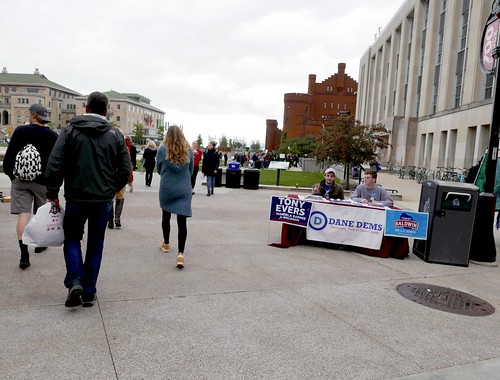
That's the Socialist crowd in the background. A few feet away the mall was teeming:

The Libertarians were there, hoping to divert the marijuana-oriented passers-by:

It wasn't hard to see what they had to offer:

There are a lot of people milling around downtown Madison. It's a Farmers' Market day on the square. It's a big football Saturday, and the game's not until this evening. And there was the big annual Marijuana Harvest Festival right on Library Mall.
And this is what the Socialist flooding of the street looked like.
It's not as if anyone was gravitating toward the Democratic Party. People cut a wide swath around this table:
That's the Socialist crowd in the background. A few feet away the mall was teeming:
The Libertarians were there, hoping to divert the marijuana-oriented passers-by:
It wasn't hard to see what they had to offer:
The Senate is about to call the roll on Kavanaugh...
... just as soon as these protesters can be cleared out of the gallery.
AND: That's it! Kavanaugh has survived the ordeal. 50-48, confirmation.
I was touched that Senator Murkowski withdrew her "no" vote in deference to Senator Daines who wanted — needed — to be present at his daughter's wedding, so that he did not need to rush back in the middle of the day to register the "yes" vote that was his to give.
AND: That's it! Kavanaugh has survived the ordeal. 50-48, confirmation.
I was touched that Senator Murkowski withdrew her "no" vote in deference to Senator Daines who wanted — needed — to be present at his daughter's wedding, so that he did not need to rush back in the middle of the day to register the "yes" vote that was his to give.
A new WaPo trend — giving Trump credit?
It takes 4 journalists to see it, but, apparently....
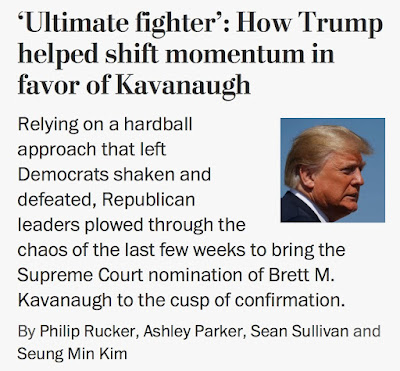
... Trump isn't an impetuous, wildly swinging idiot. What if he is what he says, a political genius?
Let's see how far the WaPo journalists go:
... Trump isn't an impetuous, wildly swinging idiot. What if he is what he says, a political genius?
Let's see how far the WaPo journalists go:
"Althouse: If you say 'Harumph' you must Link!"
Says Madison Man, in the comments to a post where I said "Harrumph!" He links to this:
Fantastic! My post has an embedded clip from "Putney Swope," because it has a line — "How many syllables, Mario?" — that I have held in my memory for half a century. But there's no chance that I'd have dragged up "Harrumph," because — can you believe it? — I have never seen "Blazing Saddles."
Is it "harrumph" or "harumph"? Double letters are the peskiest spelling problem. The OED says the double-r is correct. It's defined as "A guttural sound made by clearing the throat. Also fig. So as v., to make this sound; to speak in a rasping or guttural voice; to make a comment implying disapproval." One example is from The New Yorker in 1961, a cartoon, I'm guessing: "My goodness, Henry, you're much too young to be going har-rumph, har-rumph all the time!"
I put "Blazing Saddles" on my list of movies that came out during the period of my life when I pretty much went out and saw everything that was supposed to be excellent but that I never did see — not at the time and not in later years, when it became easy to see whatever I wanted on videotape or DVD. Also on my list: "Apocalypse Now" and "The Last Picture Show." I think of those 2 because they are DVDs that I bought as soon as they came out because I assumed surely I'd watch them and that my previous failure to watch them was nothing but a chance omission. They've sat on my shelf for way more than a decade.
And I still don't feel like watching "Blazing Saddles." Harrumph!!
Fantastic! My post has an embedded clip from "Putney Swope," because it has a line — "How many syllables, Mario?" — that I have held in my memory for half a century. But there's no chance that I'd have dragged up "Harrumph," because — can you believe it? — I have never seen "Blazing Saddles."
Is it "harrumph" or "harumph"? Double letters are the peskiest spelling problem. The OED says the double-r is correct. It's defined as "A guttural sound made by clearing the throat. Also fig. So as v., to make this sound; to speak in a rasping or guttural voice; to make a comment implying disapproval." One example is from The New Yorker in 1961, a cartoon, I'm guessing: "My goodness, Henry, you're much too young to be going har-rumph, har-rumph all the time!"
I put "Blazing Saddles" on my list of movies that came out during the period of my life when I pretty much went out and saw everything that was supposed to be excellent but that I never did see — not at the time and not in later years, when it became easy to see whatever I wanted on videotape or DVD. Also on my list: "Apocalypse Now" and "The Last Picture Show." I think of those 2 because they are DVDs that I bought as soon as they came out because I assumed surely I'd watch them and that my previous failure to watch them was nothing but a chance omission. They've sat on my shelf for way more than a decade.
And I still don't feel like watching "Blazing Saddles." Harrumph!!
"Banksy Painting Self-Destructs After Fetching $1.4 Million at Sotheby’s."
Nice PR.
The NYT reports:
Reminds me of the 2-year-old who put her parents' $1,060 in cash through the family paper shredder, which we were just talking about yesterday. But the girl had no artistic intention — or did she?!! — so that's not the old idea I'm talking about. I'm thinking about stuff like "Erased de Kooning":
"It's not a negation. It's a celebration!" UPDATE, October 16, 2021: "Banksy tried to destroy his art after it sold for $1.4 million. The shredded version just went for $25.4 million" (WaPo).
The NYT reports:
The work, “Girl With a Balloon,” a 2006 spray paint on canvas, was the last lot of Sotheby’s “Frieze Week” evening contemporary art sale. It was hammered down by the auctioneer Oliver Barker for 1 million pounds, more than three times the estimate and a new auction high for a work solely by the artist, according to Sotheby’s.Theater. It's all already been done, but it's a charming iteration of an old idea. It's not as though anyone really wants or needs a painting of a sentimental notion, a girl with a balloon! The art is something other than that, and it's cute to do the destruction at the auction, with the money (almost) in hand.
“Then we heard an alarm go off,” Morgan Long, the head of art investment at the London-based advisory firm the Fine Art Group, who was sitting in the front row of the room, said in an interview on Saturday. “Everyone turned round, and the picture had slipped through its frame.”
The painting, mounted on a wall close to a row of Sotheby’s staff members, had been shredded by a remote-control mechanism on the back of the frame....
As the artwork shredded itself, a seemingly unperturbed Mr. Barker, the auctioneer and Sotheby’s European chairman, said, “It’s a brilliant Banksy moment, this. You couldn’t make it up, could you?”
Reminds me of the 2-year-old who put her parents' $1,060 in cash through the family paper shredder, which we were just talking about yesterday. But the girl had no artistic intention — or did she?!! — so that's not the old idea I'm talking about. I'm thinking about stuff like "Erased de Kooning":
"It's not a negation. It's a celebration!" UPDATE, October 16, 2021: "Banksy tried to destroy his art after it sold for $1.4 million. The shredded version just went for $25.4 million" (WaPo).
A retired law professor just unseriously hoped that Vox has hit rock bottom.
Here's what I'm looking at:

Oh, isn't it interesting? There's a new essay that purports to see “troubling similarities” between Hitler's Germany and present-day America. And it's "different" from all the old essays that already claimed to see and be troubled by similarities. It's a choice to highlight similarities when there are also differences. For example I could say that there are similarities between Hitler's gesture in that screenshot and Melania's. There are also differences, and it would be a choice of mine to accuse Vox of juxtaposing those images as a way of saying Melania is like Hitler. I could just as well say those images were juxtaposed as a way to say Melania is different from Hitler. Or maybe there's no juxtaposing at all, and it's pure happenstance that Melania got tucked in over there, to the right of Hitler and underneath "Brett Kavanaugh’s confirmation will delegitimize the Supreme Court — and that’s good/It’s time America woke up to the radical right that’s run the Court for years."
That's some hyperventilating by Matt Yglesias, and I don't know where he gets the authority to "wake up" America to what's really going on at the Supreme Court. You know, Vox touted that new essay about America and the Nazis precisely because it is written by "one of America’s most eminent and well-respected historians of the Holocaust." And now here comes Matt Yglesias, who is not an eminent and well-respected Supreme Court scholar, and he's eager to wake us up to the "reality" of the "radical right" that's been "run[ning]" the Supreme Court and to explain why it's good for the Supreme Court to be "delegitimized."
When the Supreme Court gives lefties outcomes lefties like, they want conservatives to stand down and accept that the Court is doing proper, even brilliant, legal work. It's analogous to what I call "civility bullshit." You propound belief in something when it serves your interests, but you violate it without a care when your interests go the other way.
I'm interested in this word "delegitimize." I wonder, is it "delegitimize" or "delegitimatize"? The OED doesn't contain the word "delegitimatize," but "delegitimize" is only a subentry, under the entry for the prefix "de-" and without a definition, just 2 historical examples, the oldest of which is from 1969. What a year, 1969! I can't link to the OED, but let me cut and paste this telling quote:
"Legitimatize" is defined as "To make legitimate; to serve as a justification for (something); spec. to make (a child) legitimate by legal enactment or otherwise." The OED tells us it's rare, but John Cheever used it in 1961:
Oh, isn't it interesting? There's a new essay that purports to see “troubling similarities” between Hitler's Germany and present-day America. And it's "different" from all the old essays that already claimed to see and be troubled by similarities. It's a choice to highlight similarities when there are also differences. For example I could say that there are similarities between Hitler's gesture in that screenshot and Melania's. There are also differences, and it would be a choice of mine to accuse Vox of juxtaposing those images as a way of saying Melania is like Hitler. I could just as well say those images were juxtaposed as a way to say Melania is different from Hitler. Or maybe there's no juxtaposing at all, and it's pure happenstance that Melania got tucked in over there, to the right of Hitler and underneath "Brett Kavanaugh’s confirmation will delegitimize the Supreme Court — and that’s good/It’s time America woke up to the radical right that’s run the Court for years."
That's some hyperventilating by Matt Yglesias, and I don't know where he gets the authority to "wake up" America to what's really going on at the Supreme Court. You know, Vox touted that new essay about America and the Nazis precisely because it is written by "one of America’s most eminent and well-respected historians of the Holocaust." And now here comes Matt Yglesias, who is not an eminent and well-respected Supreme Court scholar, and he's eager to wake us up to the "reality" of the "radical right" that's been "run[ning]" the Supreme Court and to explain why it's good for the Supreme Court to be "delegitimized."
When the Supreme Court gives lefties outcomes lefties like, they want conservatives to stand down and accept that the Court is doing proper, even brilliant, legal work. It's analogous to what I call "civility bullshit." You propound belief in something when it serves your interests, but you violate it without a care when your interests go the other way.
I'm interested in this word "delegitimize." I wonder, is it "delegitimize" or "delegitimatize"? The OED doesn't contain the word "delegitimatize," but "delegitimize" is only a subentry, under the entry for the prefix "de-" and without a definition, just 2 historical examples, the oldest of which is from 1969. What a year, 1969! I can't link to the OED, but let me cut and paste this telling quote:
1969 C. Davidson in A. Cockburn & R. Blackburn Student Power 349 People will not move against institutions of power until the legitimizing authority has been stripped away... And we should be forewarned; it is a tricky job and often can backfire, de-legitimizing us.It looks like we're seeing the word coined right there! It works because we already know "legitimize." But is it "legitimize" or "legitimatize"? Both "legitimize" and "legitimatize" have been around since the 1600s.
"Legitimatize" is defined as "To make legitimate; to serve as a justification for (something); spec. to make (a child) legitimate by legal enactment or otherwise." The OED tells us it's rare, but John Cheever used it in 1961:
1961 J. Cheever Jrnls. (1991) 152 The most important thing he did for me was to legitimatize manly courage.Harrumph! Sounds right wing. Let's check "legitimize." The OED refers us to "legitimatize" for the definition but does not warn us that it's rare. I guess people don't like too many syllables.
దీనికి సబ్స్క్రయిబ్ చేయి:
పోస్ట్లు (Atom)


 పోస్ట్లు


