7 మే, 2018

Whatever happened to criticism?


"Four Women Accuse New York’s Attorney General of Physical Abuse/ Eric Schneiderman has raised his profile as a voice against sexual misconduct."

"Now, after suing Harvey Weinstein, he faces a #MeToo reckoning of his own," write Jane Mayer and Ronan Farrow in The New Yorker.
Eric Schneiderman, New York’s attorney general, has long been a liberal Democratic champion of women’s rights... Now Schneiderman is facing a reckoning of his own. As his prominence as a voice against sexual misconduct has risen, so, too, has the distress of four women with whom he has had romantic relationships or encounters. They accuse Schneiderman of having subjected them to nonconsensual physical violence. All have been reluctant to speak out, fearing reprisal. But two of the women, Michelle Manning Barish and Tanya Selvaratnam, have talked to The New Yorker on the record, because they feel that doing so could protect other women. They allege that he repeatedly hit them, often after drinking, frequently in bed and never with their consent. Manning Barish and Selvaratnam categorize the abuse he inflicted on them as “assault.” They did not report their allegations to the police at the time, but both say that they eventually sought medical attention after having been slapped hard across the ear and face, and also choked. Selvaratnam says that Schneiderman warned her he could have her followed and her phones tapped, and both say that he threatened to kill them if they broke up with him. (Schneiderman’s spokesperson said that he “never made any of these threats.”)...

In a statement, Schneiderman said, “In the privacy of intimate relationships, I have engaged in role-playing and other consensual sexual activity. I have not assaulted anyone. I have never engaged in nonconsensual sex, which is a line I would not cross.”
Role-playing. Was the role-playing the part where you were the champion of women's rights?

"If McCain retires before May 30, an election to replace him would (likely) be held this fall; if not..."

"... Arizona’s Republican governor will be able to appoint a reliably pro-Trump senator who would hold the seat until 2020. Which is to say: If McCain wishes to 'battle' Trump politically (as opposed to merely rebuffing him personally), he will give the voters of his state a chance to weigh in on his replacement in November."

From "Hatch: It’s ‘Ridiculous’ That John McCain Didn’t Invite Trump to His Funeral" (New York Magazine).

It's very strange — these statements coming from a dying man about what he wants at his funeral. I can't remember ever hearing anyone talking about his own funeral with the assumption the President of the United States wants to attend and then taking a shot at the President saying don't attend. I mean, how do you get to be the sort of person who, facing death, imagines everyone clamoring to attend your funeral and then telling some of them you don't want them there? It's similar to a Bridezilla, thinking everyone's so interested in attending her wedding and then being dictatorial toward these people.

I don't understand it, but then I'm the sort of person who would refrain from staging a big (or even a small) wedding because I can't imagine people genuinely wanting to participate in a Festival of Me. And a wedding is a happy occasion. But a funeral... good Lord! What would possess you to think your funeral is going to be such a hot ticket people will be put out if they can't attend and then letting it be known who you want on the outs?

I'd like to see more dignity and privacy around McCain as he plays his final scene. It's his brain that is wrecking him. Shouldn't his family enclose him and protect him?

Lava.


"Clear Channel Radio never banned any songs after 9-11."

I hope you didn't miss that, buried as it was at the end of a post that I think a lot of readers blew off because it's about last night's "American Idol." That post has only 13 comments right now, and a couple of the later posts have over 100 comments. I know my readers have interests that only somewhat overlap with mine, and I realize the number of comments has an unknown relationship to the number of readers. But still, I have to worry that things I want read do not get read.

I wanted to make sure readers see this material, which corrects something I wrote in a post a week ago about the song "Walk Like an Egyptian": "It's one of the songs Clear Channel banned after the September 11, 2001 attacks."  I'm reposting the correction because I want to get out this story of fake news that became fake history:
I got that from Wikipedia, where the information is presented like this:
"Walk Like an Egyptian" was one of the songs deemed inappropriate by Clear Channel following the September 11, 2001 attacks[9] and was also included in a "list of records to be avoided" drawn up by the BBC during the Gulf War.[10][11][clarification needed]
I have an informant — a person I have strong reason to trust and who I believe has first-hand knowledge — who wrote to me:
This is a battle I no longer fight; it’s been lost. I even saw it mentioned in a recently published college textbook of American history. But for you, here’s the real story:

Clear Channel Radio never banned any songs after 9-11. A day or so after the attack, one program director in San Diego sent an e-mail to other PDs with a short list of songs they might want to think twice about for a short time, purely for reasons of taste and sensitivity. I doubt that Walk Like An Egyptian was on the list then.

Now, you have to recall the typical bad-boy snotty attitude of the typical FM rock program director of 2001. Immediately, for their own entertainment, many of them started adding to the list, coming up with increasingly ridiculous suggestions, and trading the list back and forth.

The later, ridiculous list is the one that that made its way to the press, to the early forms of social media, and eventually to history books. Clear Channel was already being bashed for its size and its destruction of local radio, so this story fit right in.

"A day after pulling double-duty as both the host and musical guest on 'Saturday Night Live,' actor-writer-comedian-musician Donald Glover was garnering attention on Sunday for another reason."

Garnering.

Sorry. I had to get that out of the way.

Now: here's the video:


I watched it. Tell me what you think. My subjective impression is unavoidably affected by the Ta-Nehesi Coates essay — the subject of the previous post — which attacks Kanye West for wanting a kind of freedom Coates calls "white freedom." Presumably, Coates would approve of Glover. But how dare I, a white person, presume?

Here are the lyrics to "This Is America." I went to Urban Dictionary because I wanted to look up "celly" (cellphone?) and "hunid bands" (??) and I saw that that "caught slippin" is the featured word on the front page. That expression is in the song (repeatedly): "This is America/Don't catch you slippin' up." It was defined in '04 as "to be caught off guard, in a very bad way."

Actually, that lyrics page is full of annotations. No need to resort to Urban Dictionary. About "celly":
This line references the 18 March 2018 shooting of Stephon Clark, an African-American who was killed in Sacramento, California by police who presumed that he was responsible for local area robberies and was armed – only to be found with his iPhone....

"I want to tell you a story about the time, still ongoing as of this writing, when I almost lost my mind," writes Ta-Nehisi Coates.

"In the summer of 2015, I published a book, and in so doing, became the unlikely recipient of a mere fraction of the kind of celebrity Kanye West enjoys. It was small literary fame.... My life had been inconsequential, if slightly amusing. I had never stood out for any particular reason, save my height, and even that was wasted on a lack of skills on the basketball court. But I learned to use this ordinariness to my advantage. I was a journalist. There was something soft and unthreatening about me that made people want to talk. And I had a capacity for disappearing into events and thus, in that way, reporting out a scene..... Fame fucked with all of that... It was the oddest thing. I felt myself to be the same as I had always been, but everything around me was warping. My sense of myself as part of a community of black writers disintegrated before me. Writers, whom I loved, who had been mentors, claimed tokenism and betrayal. Writers, whom I knew personally, whom I felt to be comrades in struggle, took to Facebook and Twitter to announce my latest heresy.... I remember going with a friend to visit an older black writer, an elder statesman. He sized me up and the first thing he said to me was, 'You must be getting all the pussy now.' What I felt, in all of this, was a profound sense of social isolation. I would walk into a room, knowing that some facsimile of me, some mix of interviews, book clubs, and private assessment, had preceded me. The loss of friends, of comrades, of community, was gut-wrenching. I grew skeptical and distant. I avoided group dinners. In conversation, I sized everyone up, convinced that they were trying to extract something from me. And this is where the paranoia began...."

From "I’m Not Black, I’m Kanye/Kanye West wants freedom—white freedom" (The Atlantic). The headline seems off, based on that excerpt, doesn't it? A lot of the article is about Michael Jackson, and how fame wrecked him, and of course, the visible wreckage had something to do with whiteness. But Coates is using his own experience with fame to understand Kanye West, and what do Coates and West have to do with a desire to be white? I assume Coates didn't write the headline, but I did search the article for "white" to find something that was about Kanye. Here:
West calls his struggle the right to be a “free thinker,” and he is, indeed, championing a kind of freedom—a white freedom, freedom without consequence, freedom without criticism, freedom to be proud and ignorant; freedom to profit off a people in one moment and abandon them in the next; a Stand Your Ground freedom, freedom without responsibility, without hard memory; a Monticello without slavery, a Confederate freedom, the freedom of John C. Calhoun, not the freedom of Harriet Tubman, which calls you to risk your own; not the freedom of Nat Turner, which calls you to give even more, but a conqueror’s freedom, freedom of the strong built on antipathy or indifference to the weak, the freedom of rape buttons, pussy grabbers, and fuck you anyway, bitch; freedom of oil and invisible wars, the freedom of suburbs drawn with red lines, the white freedom of Calabasas.
Ooh! Wow. That's all one sentence. I had to read it out loud to try to absorb the part where we can understand why West's idea of freedom is specifically white. It didn't work. Maybe because I'm white and that's making me think that complete freedom is every human being's birthright and that it would be racist to tell black people to adhere to a prescribed black form of freedom.

Other questions: Who was the black elder statesman who said "You must be getting all the pussy now" to Ta-Nehisi Coates and how did Ta-Nehisi Coates react at the time and why? And how tall is Ta-Nehisi Coates and does he really believe that tallness is wasted if not used for basketball? There are so many uses for tallness, or maybe I only think so because I'm white.

When the women's studies professor offers to push the elevator button for you and you ask for the "women's lingerie department."

This really happened in an elevator at a San Francisco Hilton where an academic conference was going on. And the man who thought he could blurt out what is an old wisecrack was a political theory professor. He did not get shrugged off as pathetically old and out of step. He got taken to task, The Chronicle of Higher Education reports, and it was so brutal that he's provoked to fight back:
[Richard Ned] Lebow was told to write an "unequivocal apology" to [Simona] Sharoni and submit a written copy by May 15 to the... executive committee [of the International Studies Association]. The apology should focus on Lebow’s actions, rather than Sharoni’s perceptions of them, it said, adding that if he failed to comply, the executive committee would consider appropriate sanctions.

Lebow refused. He also sent an email to colleagues calling his treatment "a horrifying and chilling example of political correctness" that "encourages others to censor their remarks for fear of retribution." In an email to The Chronicle on Sunday, Lebow said he made the joke "to relieve the slight claustrophobia I felt in such a crowded lift."

CNN has served Trump well.


That's the click-bait headline on the front-page, written presumably by people who realize what they have done, hate it, and can't stop.


The linked to article is a column by Stephen Collinson with the headline, "Trump divines his own truth without consequences."

Let me rewrite that one too: CNN divines its own truth — with consequences.

The Bangles determine who gets to be American Idol's quirky cute girl.

As we head toward the end, there's little room for duplication. We've got to choose, and maybe there's not room in the top 5 for 2 female singers in the same niche. "American Idol" has forefronted Catie Turner since the first episode this season. And I forefronted her in a post about last week's show. She was the "Lisa Loopner" who sang the Disney song "Once Upon a Dream" so delightfully.

But the week before, I told you my favorite was Maddie Poppe. Remember? I was utterly charmed by her performance of the old Bangles song "Walk Like an Egyptian":


Here's the old Bangles video for comparison.

Last night, Catie Turner chose that other great Bangles song "Manic Monday."  It was Prince night on "American Idol," so I don't have my usual complaint that the show presents songs as if they were written by the most familiar performer. Prince got full credit for writing "Manic Monday," but those of us who love Prince and love that song also know it's a Bangles song. (Here's the old Bangles video for that.)

We'd just seen Poppe distinguish herself 2 weeks ago bringing a Bangles tune back to life, so what did Catie Turner do with what seemed to be the perfect song to compete in the niche of quirky cute girl?


Sorry, but Deer in the Headlights is not the right kind of cute. "America" voted and Catie did not make the final five.

What Prince song did Maddie sing?, you might ask. "Nothing Compares to You." Sweet. Final 5. What did other people do with Prince? Oh, if you cared, you'd have devoted last night to watching the whole damn 2 hours, like I did. But if you want to laugh or you understand something about country music that escapes me, here's Caleb Lee Hutchinson doing "When Doves Cry." He's been hogging the country boy niche all season.

By the way, back in the post about "Walk Like an Egyptian," I said something I now think is wrong: "It's one of the songs Clear Channel banned after the September 11, 2001 attacks."

I got that from Wikipedia, where the information is presented like this:
"Walk Like an Egyptian" was one of the songs deemed inappropriate by Clear Channel following the September 11, 2001 attacks[9] and was also included in a "list of records to be avoided" drawn up by the BBC during the Gulf War.[10][11][clarification needed]
I have an informant — a person I have strong reason to trust and who I believe has first-hand knowledge — who wrote to me:
This is a battle I no longer fight; it’s been lost. I even saw it mentioned in a recently published college textbook of American history. But for you, here’s the real story:

Clear Channel Radio never banned any songs after 9-11. A day or so after the attack, one program director in San Diego sent an e-mail to other PDs with a short list of songs they might want to think twice about for a short time, purely for reasons of taste and sensitivity. I doubt that Walk Like An Egyptian was on the list then.

Now, you have to recall the typical bad-boy snotty attitude of the typical FM rock program director of 2001. Immediately, for their own entertainment, many of them started adding to the list, coming up with increasingly ridiculous suggestions, and trading the list back and forth.

The later, ridiculous list is the one that that made its way to the press, to the early forms of social media, and eventually to history books. Clear Channel was already being bashed for its size and its destruction of local radio, so this story fit right in.

6 మే, 2018

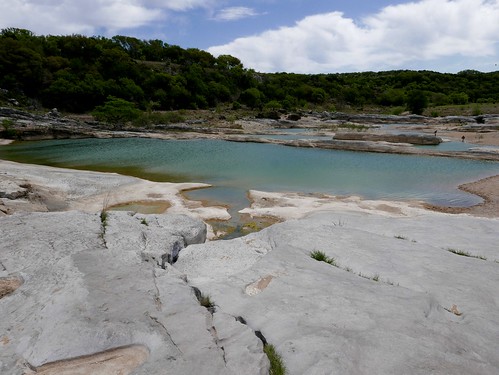
At the Blue-Green Café...

P1170055

... you can talk about whatever you want.

And please do think about using the Althouse Portal to Amazon.

The photo is from April 14th, in Pedernales State Park.

Dershowitz versus Mueller and Painter.

I'm seeing this billed as a Dershowitz "melt down," but I think Painter is the one who creates the tension by interrupting Dershowitz and introducing the accusation of lying.


Dershowitz wants to speak (with passion) about prosecutorial ethics, and he criticizes Mueller, but Painter insists on policing a don't-impugn-Mueller ethic that's incredibly aggravating. Painter also has a louder, clearer microphone. I don't know if that's by design, but it is MSNBC.

"One day [Trump] might walk to Marine One stark naked and we’ll all just say: 'This is the end. It has finally happened.'"

That quote from "Trump biographer Michael D’Antonio" ends Maureen Dowd's new column, "The Naked Truth About Trump."

Why all this talk about Trump naked? I'm not seeing the old Bob Dylan quote — "But even the president of the United States/Sometimes must have to stand naked" — so what is it?
Trump is an attention addict, and now he’s in a position to get all the attention in the world, as long as he keeps those sirens blaring. 
Mm. Yeah. So... are you going to say that Trump is so desperate for attention that if all else failed, he'd get naked?

I will keep reading, so you don't have to. Hang on.
CNN has been on a constant Breaking News Alert for months. And we are Trump addicts, hooked on the hyperventilating rush of wild stories and all the great things that accrue from playing Beowulf to Trump’s Grendel.

As we pat ourselves on the back, though, for the grueling hours and Pulitzer-quality scoops, we should remember one thing: Even if we vanished tomorrow, Trump would probably end up in the same place.

You could put a nanny cam on the guy and leave the room, and he would crash out of his high chair. He incriminates himself faster than we can incriminate him. And he surrounds himself, in the Trumpland of Misfit Toys, with playmates who have that same perverse gift for self-incrimination and immolation....
Well, that's kind of a word salad, and I don't know if that's Pulitzer quality, but you know Maureen Dowd did win a Pulitzer Prize. It was back in 1999: "For her fresh and insightful columns on the impact of President Clinton's affair with Monica Lewinsky."

Back to the "Naked Truth About Trump" column. I'm still waiting to see the justification for talking about Naked Trump:
“He needs the excitement,” says Trump biographer Michael D’Antonio. “Without the drama and the crisis and the powerful opponent, he’d be just another guy.”
Okay. That makes sense. What follows, the end of the column, is D’Antonio's comparison of Trump to Jimmy Piersall, a baseball player who had a mental breakdown and later wrote: "Probably the best thing that happened to me was going nuts. It brought people out to the ballpark to get a look at me.”

D'Antonio continues, and this is the last paragraph of the column:
“That may wind up happening with Trump,” D’Antonio says. “One day he might walk to Marine One stark naked and we’ll all just say: ‘This is the end. It has finally happened.’”
"That may wind up happening with Trump" — in other words, Trump might have a mental breakdown. The nakedness is just D'Antonio's idea of what a person having a mental breakdown might do. I don't like to see this kind of disrespect for people with mental illness. I think stripping off your clothes and walking in public is something that a person having a mental breakdown might do. In fact, I once saw that happen to a man (from my apartment window in NYC in the 1970s).

Trump's problems and quirks are not about the troubles of the truly mentally ill. The Jimmy Piersall business is just a pointless detour, and the word "naked" in the column title is the kind of desperate plea for attention that the column seems to want to deplore.

"I'm a very special human being. Noble. And splendid."

Says Burt Lancaster to Joan Rivers in "The Swimmer."


The movie came out 50 years ago — in May 1968. I saw it at the time, when I was 17 and interested in figuring out what the adults viewed as high-class film art.

And I DVR'd it when I saw that it was on Turner Classic Movies this week, and Meade and I ended up watching it straight through last night.

We laughed at it a lot — the Marvin Hamlisch music, the nature photography, the endless observation of the torso of Lancaster, the taking seriously of a type of man no one today takes seriously — but we've been talking about it seriously for a long time this morning, and I took the trouble to read the 1964 John Cheever story and a contemporaneous Roger Ebert review:
As "the swimmer" has a drink with his friends, it occurs to him that a string of other backyard pools reaches all the way across the valley to his own home. Why not swim every one -- swim all the way home, as it were?....

The movement of the film is from morning to dusk, from sunshine to rain, from youth to age and from fantasy to truth. It would also appear that the swimmer's experiences are not meant to represent a single day, but a man's life.

What we really have here, then, is a sophisticated retelling of the oldest literary form of all: the epic. A hero sets off on a journey. He has many strange adventures along the way, during which he learns the tragic nature of life. At last he arrives at his goal, older and wiser and with many a tale to tell. The journey Cheever's swimmer makes has been made before in other times and lands by Ulysses, Don Quixote, Huckleberry Finn and Augie March.
Joan Rivers has only a very small part, and this was her first acting role. She wrote in her autobiography:
"Frank [the director, Frank Perry] wanted a happy girl who then got hurt. Lancaster was going to be Mr. Wonderful who came up against a mean bitch, and was right not to go off with her. Trying to please both men, I was going back and forth between line readings, and nothing made sense."
That's quoted in Wikipedia, which also says:
After the film's restoration and re-release by Grindhouse Releasing in 2014, Brian Orndorf of Blu-ray.com gave the Blu-ray release five stars, commenting that "It's a strange picture, but engrossingly so, taking the viewer on a journey of self-delusion and nostalgia that gradually exposes a richly tortured main character as he attempts to immerse himself in a life that's no longer available to him", commenting that Lancaster gives a "deeply felt, gut-rot performance ... and communicates every emotional beat with perfection". Commenting on the same release, Ain't It Cool News reviewer Harry Knowles commented "This is also Burt Lancaster's journey to ... The Twilight Zone ... it is friggin brilliant! ... It is fascinating! Spectacular film!”

The aggregator site Rotten Tomatoes gives the film an approval rating of 100%, based on 22 critic reviews.
Amazing really, because it seems just as likely that everyone could say it's a ludicrous, terrible mess. Where's the line between reality and fantasy? It's never revealed. You'll have to puzzle over it, and reading the original story won't hand you the answer.

I am still working on the theory that "the swimmer" was a sperm cell (or salmon swimming upstream to mate). Don't you think a sperm cell — if it could think — would think, "I'm a very special human being. Noble. And splendid"?

Back in the 60s, it was understood that literary fiction revealed the complexities of the mind of wealthy suburban males. We the theater audience spent 2 hours gazing at the near-naked and naked body of a 54-year-old man. Nowadays, Harvey Weinstein/Louis C.K. begs an audience of one to please look at him naked, and the theater audience is captivated by a swimmer who isn't a very special human being. He's not a human being at all.


Noble and splendid!

Reuters/Ipsos reports a new poll "in the interest of transparency," but "will not be announcing the start of a new trend until we have more data to validate this pattern."

The new Reuters/Ipsos Core Political poll is "something of an outlier."
Every series of polls has the occasional outlier and in our opinion this is one....

The Reuters/Ipsos Core Political poll has a significant realignment this week across a number of metrics. Most pronounced is President Trump’s approval rating which currently sits at 48% with all Americans. His number with registered voters is essentially the same at 49%. Corresponding with Trump’s stronger approval rating, evaluations of his job performance across the board are stronger this week from 57% approving of his handling of the economy to 44% approving of the way he treats people like them.
Here's how Real Clear Politics displays the recent polling. I've framed the screen grab to highlight recent Reuters polls (click to enlarge):


There was a -19 spread between approval and disapproval in the second week of April. The spread a week ago was -14. It is now 0. The official Reuters position on that is: Sometimes you get an outlier. We'll show you the numbers, "in the interest of transparency," but our theory is, that's an outlier.

5 మే, 2018

It's the 200th anniversary of the birth of Karl Marx.

I'm not seeing a lot of celebrating, but here's Michael Moore:


The mainstream media stories I'm seeing tend to be about the Chinese statue: "Karl Marx’s German home town celebrates his 200th birthday with a Chinese statue — and a struggle" (WaPo):
The unveiling of a two-ton Chinese-funded sculpture to honor the German philosopher on the 200th anniversary of his birth brought scads of tourists to Trier, where his life began. While here, they took in Marx lectures, toured the Marx family home and bought vast quantities of marked-up Marx souvenirs....

The city is split over whether a democratic nation such as Germany should be erecting monuments that are paid for, designed and built by an authoritarian one such as China. The divide spilled into the streets Saturday with dueling demonstrations for and against the monolith, forming a noisy backdrop to the statue’s official dedication....

Not so long ago, Germany was tearing down statues of Marx. An icon of communist East Germany, his likeness was scrubbed from many a town square after the country’s reunification under democracy and capitalism in 1990....
I went back to Paul Johnson's book "Intellectuals: From Marx and Tolstoy to Sartre and Chomsky" and reread the chapter on Marx. Excerpt:
His angry egoism had physical as well as psychological roots. He led a peculiarly unhealthy life, took very little exercise, ate highly spiced food, often in large quantities, smoked heavily, drank a lot, especially strong ale, and as a result had constant trouble with his liver. He rarely took baths or washed much at all. This, plus his unsuitable diet, may explain the veritable plague of boils from which he suffered for a quarter of a century. They increased his natural irritability and seem to have been at their worst while he was writing Capital. ‘Whatever happens,’ he wrote grimly to Engels, ‘I hope the bourgeoisie as long as they exist will have cause to remember my carbuncles.’ The boils varied in numbers, size and intensity but at one time or another they appeared on all parts of his body, including his cheeks, the bridge of his nose, his bottom, which meant he could not write, and his penis. In 1873 they brought on a nervous collapse marked by trembling and huge bursts of rage.