Nobyembre 13, 2017

I love this photograph — Frances Benjamin Johnston's Self-Portrait (as "New Woman"), 1896:


I found that at the Wikipedia article for "New Woman":
The New Woman was a feminist ideal that emerged in the late nineteenth century and had a profound influence on feminism well into the twentieth century.... Independence was not simply a matter of the mind: it also involved physical changes in activity and dress, as activities such as bicycling expanded women's ability to engage with a broader more active world....

"The big step is empathy. Something I've had problems with, empathy. You know, when you have man brain..."

"... you are not capable of empathizing properly with women - which I don't think a lot of men are. And I'm not going to speak for all men, but I can speak for myself. To find that empathy it requires some sort of vigilance.... It's hard to understand that power dynamic is real and it exists because things have been the way they've been for a long time.... I'm 54 fucking years old and I'm surrounded by women in a work environment and it's not a problem for me to behave and it's not a problem for me to respect and appreciate and have boundaries and be in awe of the people I'm working with. I don't know that if it ever was necessarily a problem with me but I certainly have been a toxic male presence. I've been a very toxic male presence in my life. I think I operate now, it may be a 25 to 30 percent toxicity level but I've certainly been up around 90 in terms of being emotionally abusive, insensitive, angry, selfish, compulsive, and completely without empathy to the power structure that exists between men and women.... You know when you start to drift as a man into that the zone of like, yeah I don't see what the big deal is, [he] just jerked off in front of them, [he] jerked off on a phone, they could have left, [they] could have done this, they could have done that, you know he asked, that's not illegal. Yeah, but it's gross, it's creepy, it's massively inappropriate, it's potentially traumatizing.... To move from the toxic male, or just male disposition, of like what's the big deal, he didn't fuck em, he asked, he just jerked off, just kind of pathetic, it's like what's the big deal? Well the big deal is is that its boundary shattering, it is traumatizing, it is unexpected, it is shaming, and if you let yourself feel that, if you just let yourself feel what what all those women went through, even if it didn't seem violent to you, or like rape or any of that shit.... And look, I hope this doesn't come off as any sort of apology for anything, you know. I'm disappointed in my friend. He did some gross shit, some damaging shit, and people are like how are you gonna be friends with that guy? He's my friend. Now he fucked up and he's in big fucking trouble, so, well, what am I gonna do? I'm just - I'm gonna be his friend...."

Marc Maron monologues from his position as a comedian friend of Louis C.K., who has heard the rumors over the years and is under obvious pressure to explain himself.

Audio here. Transcript here.

Duterte sings to Trump: "You are the light of my world, a half of this heart of mine."


AND: The special Duterte handshake:

"A sixth woman has come forward with a story about former president George H.W. Bush groping her — and says that he did so when she was only 16 years old."

"Roslyn Corrigan told Time that the incident occurred in November 2003."
“As soon as the picture was being snapped on the one-two-three he dropped his hands from my waist down to my buttocks and gave it a nice, ripe squeeze, which would account for the fact that in the photograph my mouth is hanging wide open,” she said. “I was like, ‘Oh my goodness, what just happened?'... I don’t know, maybe it never really hit people that I was a child at the time and that goes beyond a guy being inappropriate in the workplace to a peer or somebody in his age range... I was a child.”

"Woman Says Roy Moore Tried to Rape Her When She Was 16 and Signed Her Yearbook."

Headline at The Daily Beast.
That night, Moore signed her high-school yearbook then offered to give her a ride home in his car, [Beverly Young] Nelson said. She accepted the offer, but instead of getting on the highway, she alleged, Moore parked in the back [of the restaurant where she worked]. Nelson said she asked Moore what he was doing.

“Instead of answering my question, Mr. Moore reached over and began groping me, putting his hands on my breasts,” Nelson said through tears. “I tried to open my car door to leave, but he reached over and locked it so I could not get out. I tried fighting him off, while yelling at him to stop, but instead of stopping he began squeezing my neck attempting to force my head onto his crotch. I continued to struggle. I was determined that I was not going to allow him to force me to have sex with him. I was terrified. He was also trying to pull my shirt off. I thought that he was going to rape me. I was twisting and struggling and begging him to stop. I had tears running down my face. At some point he gave up. He then looked at me and said, ‘You are a child. I am the District Attorney of Etowah County. If you tell anyone about this, no one will believe you.'... He finally allowed me to open the car door and I either fell out or he pushed me out. I was on the ground as he pulled out of the parking area behind the restaurant. The passenger door was open as he burned rubber pulling away leaving me laying there on the cold concrete in the dark.”

"My mother said that there are hairs from more than 10 generations in this."

Explains one of the Longhorn Miao:

Black- and bluebird.

Drudge can't get no respect.


"I keep seeing articles mentioning that Anita Hill accused Clarence Thomas of 'sexual harassment,' and lumping him in with Harvey Weinstein et al."

Writes David Bernstein (at Instapundit).
Hill accused Thomas of asking her out insistently, and making several lewd comments about porn movies, pubic hairs, and his own sexual prowess. Hill herself acknowledged that her allegations didn’t amount to “sexual harassment” as defined by law, just that they made her uncomfortable and she thought them inappropriate. I don’t want to relitigate the Thomas-Hill he said-she said, but even accepting Hill’s allegations at face value, they were nothing approaching what Weinstein or some of the others who have been in the spotlight lately, have been accused of–no assault, no battery, no exposing himself, no quid pro quo, no drugging victims, no shenanigans with minors. Surely we want to distinguish between those allegations and alleged rude and obnoxious behavior.
Bernstein only links to one article, "Anita Hill on Weinstein, Trump, and a Watershed Moment for Sexual-Harassment Accusations" by Jane Mayer at The New Yorker. It's a short article, but it mentions Trump 10 times. My first question was: Does it mention Bill Clinton? Because the Clarence Thomas hearings raised the national consciousness of sexual harassment, but it happened for political reasons at the time, and for equally political reasons the issue got suppressed again when it seemed more important — to the kind of people you'd think would want to forefront the issue* — to protect Bill Clinton. Even during the 2016 presidential campaign — the one Trump won — it was necessary to keep protecting the old President because his wife, who'd vigorously defended him against "bimbo eruptions," was (for some insane reason) the Democratic Party's candidate for President.

The answer to my question — does the New Yorker article mention Bill Clinton? — is no. I did my search of the page yesterday when I first noticed the article, and because of the Trump-but-not-Clinton focus, I declined to read it. I have been angry about the politicization of sexual harassment for 20 years. I'm trying to force myself to read Mayer's article now (because Bernstein linked to it), but it's almost impossible for me. Okay. You can do it....
In a phone interview, [Anita] Hill emphasized that sexual-harassment cases live and die on the basis of “believability,” and that, in order for the accusers to prevail, “they have to fit a narrative” that the public will buy....
So... essentially: politics. Hill was believed by the people who wanted to keep Clarence Thomas off the Supreme Court and not by those who wanted him on. Paula Jones was disbelieved by those who wanted to keep Bill Clinton in the White House, but believed by those who wanted him out.

Hill knows this:
Her case, like those of the women who accused Trump, she says, “was cast as a political story.” In such situations, “everything gets interpreted through a political lens, and it makes it almost impossible” for people to seriously consider whether the accused harasser “is the right person to represent you. It just becomes ‘This is our guy’ and ‘people are trying to bring him down.’ ”
_____________________

* Gloria Steinem in 1998: "We would not be doing our job if we didn't take into account that this president and his policies are crucial to the lives and welfare of the majority of women in this country. That's not bending over backwards: that's being sensible. Having said that, if Clinton had raped women, beaten up Hillary - real private sins would not be forgiven, no matter what the value of the public behaviour." Real sins? Real sins? What the hell?

"The leaks have renewed a debate over whether the N.S.A. should be permitted to stockpile vulnerabilities it discovers in commercial software to use for spying..."

"... rather than immediately alert software makers so the holes can be plugged. The agency claims it has shared with the industry more than 90 percent of flaws it has found, reserving only the most valuable for its own hackers. But if it can’t keep those from leaking, as the last year has demonstrated, the resulting damage to businesses and ordinary computer users around the world can be colossal. The Trump administration says it will soon announce revisions to the system, making it more transparent."

From a NYT article, "Security Breach and Spilled Secrets Have Shaken the N.S.A. to Its Core/A serial leak of the agency’s cyberweapons has damaged morale, slowed intelligence operations and resulted in hacking attacks on businesses and civilians worldwide."

"I don't know. I feel like Yoko's knitting could have been mic'd better."


The quote is the highest-ranked comment at YouTube. Made me laugh.

I'm listening to that song this morning because for some reason that I cannot remember, even though it was just a few minutes ago, I said "You better get yourself together" and Meade responded "Pretty soon you're going to be dead." I prefer the second-verse response: "Join the human race."

There was some discussion of why John wrote that song. Was it anti-Paul? These days such debates are short, because of Wikipedia:
[W]hile in Denmark [in 1970], the Lennons, [Yoko's former husband Tony] Cox and the latter's current partner, Melinde Kendall, discussed the concept of "instant karma", whereby the causality of one's actions is immediate rather than borne out over a lifetime. Author Philip Norman writes of the concept's appeal: "The idea was quintessential Lennon – the age-old Buddhist law of cause and effect turned into something as modern and synthetic as instant coffee and, simultaneously, into a bogey under the stairs that can get you if you don't watch out."

On 27 January 1970, two days after returning to the UK,Lennon woke up with the beginnings of a song inspired by his conversations with Cox and Kendall.... 
Nothing about hating Paul. It does say however that the song — like "All You Need Is Love" and "My Mummy's Dead" — has the chord structure of "Three Blind Mice." Also the Village Voice critic Robert Christgau said "Instant Karma!" is John Lennon's "best political song." I guess "political" is more debatable than "best."

Why in the world are we here/Surely not to live in pain and fear....

The knitting is kind of political, right?

"Tens of thousands of nationalist protesters disrupted Poland's independence day events Saturday, waving flags and burning flares as they marched down the streets of Warsaw."

"Demonstrators carried banners that read 'White Europe, Europe must be white,' and 'Pray for an Islamic Holocaust.' Some wore masks and waved red and white Polish flags, chanting 'Death to enemies of the homeland,' and 'Catholic Poland, not secular.' Police estimate that 60,000 people took part in the nationalist demonstration. While the vast majority were Poles, other protesters came from all over Europe."

CNN reports.

Monday morning words: disagreeability, fungate, springel, disafford.

On the Oxford English Dictionary's "recently published" list today (which doesn't seem to mean these words are newly recognized, but that the entries on the words have been redone).

Disagreeability obviously means the condition of being disagreeable, but it also used to refer to the thing that is disagreeable. For example: "Difficulties and disagreeabilities in carrying on a week's intercourse" from (1790 F. Burney Diary Oct. V. 163). I hope you see the difference (and that "intercourse" meant commerce or social communication back then).

Fungate sounds like the doorway to amusement, but you need to see the "g" is stuck to the "n." It is, unfunly, "A salt or ester of an acid... extracted from fungi." (And "unfunly" isn't recognized in the OED as word, nor is "funly" or "unfun.")

Springel. I want springels on my ice cream? No, but surprisingly close. It's an obsolete word for a particular type of sprinkler — a sprinkler for holy water. Sometimes old words are new in the OED. I think they're trying to help us read old books, like "Minor Poems Vernon MS" (c1390): "Siþen he wole wiþ springel-stikke Ȝiuen holy water a-bouten þikke."

Disafford is obsolete and rare. "To prevent from obtaining; to deny, withhold." Maybe you can think of a better sentence than "Let not my being a Lancastrian bred Without mine own Election, disafford Me right, or make my Cause disfigured" (1609).

Dating teenagers.


ADDED: The first thing I did after posting this was to search the NYT archive for the 2 names. The oldest article, published March 1, 1998, refers to the relationship in the past:
Shoshanna Lonstein, the 22-year-old Long Islander who once graced the gossip pages as Jerry Seinfeld's girlfriend, watched in amusement as her friend [the stylist Phillip] Bloch went to town on his favorite subjects.
From that we can infer that the NYT not only didn't "rave" about the relationship but saw the story of the relationship as beneath the level that should be reported. At most, you can criticize the NYT for not criticizing Seinfeld, but it certainly didn't cheer him on.

AND: Next I searched the Washington Post archive. Here:

"Modest fashion might come across as a humblebrag: You have to be a pretty stylish, pretty good-looking woman to claim ownership of such radical dowdiness...."

"It can also sometimes seem like an elitist project of sociocultural self-positioning: By embracing the covered-up look, you declare yourself part of a particular psychographic tribe, one whose members don’t just dress for other women, but for a particular subset of other women — those who get it, who are sophisticated enough to understand that opting out of conventional beauty standards makes for its own kind of conceptual, better-than-thou fashion. It also, however, has the feel of a real dare. Observing this version of feminist signaling, which conflates the rebel, haphazard spirit of a Bloomsbury Group-like smockishness with traces of early ’90s grunge and a dash of post-bellum Sunday best, we might begin to ask ourselves: What happens when women start dressing in ways that are less than conventionally flattering? Why are they doing it? And what does it look like when fashion choices that might have been linked to female oppression perform in the service of liberation?"

From "Modest Dressing, as a Virtue/What’s really behind fashion’s — and women’s — love of concealing clothes?" by Naomi Fry. The NYT published that article on November 2nd, but I only noticed it yesterday, when it was featured on the front page. I'm thinking that it has — in the last week and a half — become more timely, because of the sexual harassment/assault stories in the news. The author tries to answer her question by talking to some women to find out why they are clothing themselves in a manner that doesn't flaunt their body parts. Specifically "nonreligious women" are asked — because they are "trendier" and more likely to be deciding for themselves what they want to wear.
“I really disagree with women who think walking around naked is liberation. I’m like, ‘I’m sorry, too many people get to enjoy this for it to be liberation,’ ” [said Aminatou Sow, a 32-year-old digital strategist and podcaster], only half in jest. Instead, she cites figures like Mary-Kate and Ashley Olsen, who, first as actresses and street-style sensations and later as designers of the Row, made dressing in long, hobo-ish layers chic. “It was really jarring, and men didn’t like it,” Sow recalled to me. “But there was something disgusting and liberating about it. These were girls who didn’t care how anyone else was supposed to be dressing. It was the rejection of body politics.”
The last paragraph of the article begins with one hell of a sentence: "Navigating the world in a woman’s body remains a fraught proposition in the most quotidian and granular of ways."

Are you in there — in your body — navigating it? Are you not at one with your body? If not, why not? And, more importantly, what kinds of clothes and hats and shoes could reunify you with yourself?

Navigating the world in a woman’s body remains a fraught proposition.... The oldest meaning of the English word "fraught" is "Of a vessel: Laden" as in "The drowmound was so hevy fraught That unethe myght it saylen aught" (a1400 Coer de L. 2459)(OED).

Nobyembre 12, 2017

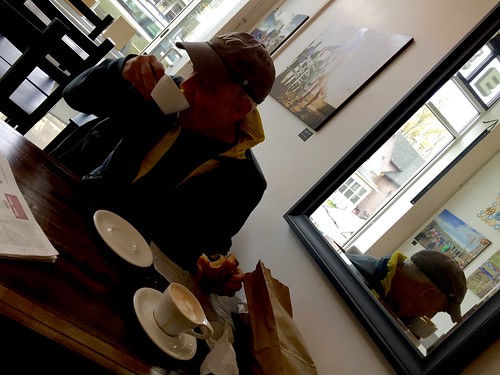
"You know people look glum when they're reading."/"Yeah. Good reason not to read."

IMG_1625

This is a café, so talk about anything you want, and buy whatever you want using The Althouse Amazon Portal. We were just looking at Oliberte Ngola boots. And — I am not kidding — Testosterone men's Ball Of Fire boots.