Disyembre 25, 2004

A Madison Christmas peace vigil.

A Madison man walked around the Capitol Square for six hours yesterday wearing sign that read "1,300" (the number of U.S. dead in Iraq):
"We're such a culture that is about doing. Are we such a busy, crazy, manic culture? Meditation says no," he said. "You start with being. You start with peace in your own heart. And then it spreads."

People have not yet gotten energized for the long fight ahead, he said. Circumstances will spur action, he said.

"Things haven't gotten bad enough. But they will."

Here's a man who is sure things will get much worse, yet believes there's a point to trudging around for six hours wearing a sign. Do you consider him an optimist or a pessimist or some weird blend -- an opti-pessimist?

UPDATE: The email is showing enough of a difference of opinion that I thought a blogpoll was in order.


ANOTHER UPDATE: Jim Lindgren at Volokh Conspiracy responds with a comparison of the number of Americans dead in Iraq to the number who died in Vietnam.

A white Christmas.

Only once all season had there been even a slight trace of snow on the ground, so the chances for a white Christmas seemed low. But at dawn, a pretty dusting of gently falling snow could be seen from the deck:

Image-49EF2ED0568B11D9

UPDATE: On looking at this picture again, I said it should be called a "blue Christmas," which touched off a round of Elvis impersonating.

AND: Now we're listening to various versions of "Blue Christmas" -- first Elvis (the best), then Ringo, then the Beach Boys (the second best), Jon Bon Jovi, Vince Gill, Willie Nelson (nicely zippy), Fats Domino, Low, Leon Redbone, the Platters, Chris Isaak, Dean Martin, Big Bad Voodoo Daddy, Harry Connick Jr., Sheryl Crow (the worst!), Booker T. & the MGs, John Holt (reggae does not fit this song), Tammy Wynette... I note that most artists try to sing the song like Elvis -- it's pretty much homage to Elvis for Ringo, Bon Jovi, and many others. Too many people make a big point of slowing the song way down (which is, apparently, a way of life for Low). Ah, now we're back to Elvis, with a different version, from the 1968 TV special. The greatness of Elvis really came through in that little exercise.

The topic of a spider in a urinal comes up on Christmas.

A dialogue on opening a present:
"This has the story of the spider in the urinal."

"Very few Christmas families are talking about a spider in a urinal.... Wait a minute."

"She's blogging."

"She stops Christmas to blog."
Here's how the chapter "Birth Death, and the Meaning of Life," in this book, begins, on page 208:
One summer more than ten years ago, when I taught at Princeton, a large spider appeared in the urinal of the men's room of 1879 Hall, a buiding that houses the Philosophy Department.

A liberal Christmas.

The erstwhile ascetic koan-blogger, R.L. Cohen, has used Christmas as an occasion to break into full out political blogging:
My support of the widespread and cheerful use of the word “Christmas” is not just a gesture of ecumenicism, it’s a protest against euphemism. A euphemism is always a coverup. Where there’s euphemism, there’s dishonesty. And to say “holiday” when the whole world knows you’re referring to Christmas is to engage in an especially silly kind of euphemism.

There are far too many people on the left who spend far too much of their time trying to compel others to use the approved euphemisms, and trying to invent new euphemisms to press upon the public. People who are seriously worried about whether other people are saying “autistic” or “person with autism” need to turn their attention to something else, if for no other reason than that the approved catchwords will probably change next year.

The euphemists practice a kind of sanctimony which is offputting to people in the center. I’m convinced it’s a large part of what moderate and conservative people visualize when they visualize a liberal: someone who is constantly trying to force a petty, humorless conformity upon us all.

R.C. points out that it costs the liberals votes! I note that "liberal" implies freedom, and this desiccated sanctimony is no fun at all.

McGovern and Santa Claus.

Former Democratic presidential candidate George McGovern has a letter in today's NYT:
I'm for keeping Donald H. Rumsfeld as secretary of defense because he is against increasing the number of American soldiers in Iraq. Sending more soldiers only means more targets for those Iraqis who don't want our army occupying their country.

I did not want any Americans to risk their lives in Iraq. We should bring home those who are there. So better Mr. Rumsfeld than some eager beaver who wants to double our army in the desert as we repeatedly did in the jungle to no avail in the 1960's and 70's. We toppled Saddam Hussein; as George Aiken, that wonderful old Republican senator, said of an earlier time of troubles, Declare victory and come home.

Once we left Vietnam and quit bombing its people, they became friends and trading partners. Iraq has been nestled along the Tigris and Euphrates for 6,000 years. It will be there 6,000 more whether we stay or leave, as earlier conquerors learned.

I tried to persuade Santa Claus to bring our troops home for Christmas, but he said, "No, Rumsfeld sees light at the end of the tunnel if we hang in there and don't listen to old veterans like McGovern."

Is there really a Santa Claus, Virginia? If so, why were 14 soldiers killed at lunch after a hard night searching for that light at the end of the tunnel?

I don't remember Santa Claus having the function of bringing us peace. But here we have McGovern talking with Santa, getting an answer, and then questioning his existence because he failed to give him what he asked for.

Even assuming McGovern was really praying to Jesus or God, since when have believers questioned their faith because soldiers have died fighting for a cause? How could any religious faith be left in the world if that is the way we think it works?

In the poem "Twas the Night Before Christmas," "The children were nestled all snug in their beds," and, according to McGovern, "Iraq has been nestled along the Tigris and Euphrates for 6,000 years." Oh, yes, it was having a sweet old time dreaming visions of sugar-plums before we came along. We should just stop fighting (for what those soldiers have already died for) and leave, McGovern tells us, and the Iraqis can go back to being the happy friends they've been for thousands of years. They've got those rivers to nestle alongside of, after all.

Aw, come on, George, admit it. You really do believe in Santa Claus.

Blogging on Christmas?

I don't know how old you are or how old your kids are, but, let me tell you, when you are as old as I am, and you have kids my kids' age, there's a substantial time gap between when you get up and when they get up.

Oh my gosh, stop giving away your age on your blog!!


Somebody emailed that to me in response to the photo in the previous post. Sorry. It's not that I'm above lying about my age or haven't thought of the idea, it's that I have too many stories to tell from the deep past and too many opinions that connect to social and political events that I lived through.

One thing about being older is that there are more things that any given thing reminds you of. That might make a person tedious -- why I remember when I was a little girl -- but it's a big source of blogging material. Having been around at the time is a source of authority. It's sometimes untrustworthy, but it may be interesting nonetheless, and at least it's not shared by the vast majority of bloggers, who tend to be young.

I'll bet those other bloggers didn't get out of bed at 5:30 a.m. this morning.

It's more likely that they have really little kids. When you're young and have really little kids, they get up before you on Christmas morning, and they prod you to get up, and you drag yourself out of bed way before you want to get up. But when your kids stay asleep, and you're the one that gets up early, you don't even make some extra noise to try to get them up. You just make some coffee, dash outside -- it's 14 degrees -- to pick up the New York Times, and sit down to read the paper. Will there be blogging? Of course! The daily pleasures are at least as enjoyable as the annual ones. At my age.

Merry Christmas!

Disyembre 24, 2004

First encounter with Santa Claus.

Here I am, the skeptical one in the center. I'm almost 3, and the year is 1953. My sister Dell is enjoying the moment, while I'm suspicious about that beard and the lack of convincing attachment around the mouth.

Image-CE0575AE560B11D9

"If I wanted to face insurgents I would've spent Christmas with my relatives."

Letterman goes to Iraq for a Christmas Eve show. Grinder Girl and Hula Hoop Girl go too and are much appreciated.

The article (in the Marine Corps News) points out that Letterman is "a staunch supporter of the Marine Corps":
On the Sept. 17, 2001, episode of "The Late Show," his first show after the attack on the World Trade Center, Letterman declared he had "three new heroes now. They are New York's bravest, the firefighters; New York's finest, the cops; and the United States Marine Corps because, as you know, before this thing is finished, it will be the Marine Corps that goes in and settles the score."

At the Blue Moon Café.

We celebrated Christmas Eve over cheeseburgers and beer at the Blue Moon Café, a local bar and grill. Chris and I had just gone to see "Finding Neverland," which we criticized all the way to the car: boring, badly directed, flat screenplay, some good acting, some nice set decoration and costumes.

"Well, you cried."

Yes, I can't help crying -- despite my aesthetic objections -- at certain sorts of melodrama.

We were hungry, and we called John to come meet us at the Blue Moon. When we pulled up I could see through the window that the Packer game was playing on about 10 TVs.

"Oh, there's a big Packer game."

We went in anyway. As we were finishing scarfing down the food in a booth upstairs, the game was 31-31 with a few minutes to play. We came down to pay the bill at the bar, and at that point the Vikings had taken their last time out with 3 seconds to go and the Packers within easy field goal range. So, I care enough about the local pleasure caused by football that I said hang out and wait for the last play. The Packers get their field goal, and the group of guys that were sitting at the bar cheer. One guy starts jumping around yelling: "Go home, Viking fans!" Then he turns around and sees us and I hear him say, "Oh, there actually are Viking fans here."

Outside, as we get into the car, I say to John and Chris, "We were so undemonstrative, he thought we were Viking fans."

I really don't care about football, but I am happy enough that the local folk are happy that the Packers won the game.

A Christmas disclaimer.

Richard Lawrence Cohen writes:
As a Jew, a liberal, a lover of the Constitution, and a loather of Fox News, I wish to declare that the word “Christmas” does not faze, throw, offend, upset, or disconcert me in the slightest...
More at the link.

The Time Tracker.

A few days ago, the NYT had an article about a new toy that was supposed to dismay us, the Time Tracker:
Shaped like a colorful peppermill, with a digital readout panel, lights that suggest a traffic intersection and an electronic male voice that booms "Begin" and "Time's up," the Time Tracker, which sells for a list price of $34.95, has turned into a surprise hit of the holiday season, according to some toy sellers. By using the tracker during playtime, homework or any other activity, children are supposed to develop a sense of passing time - 20 minutes, half an hour, an hour - that translates into better management during tests. Siren sounds indicate when a certain period has gone by, and the lights switch from green to yellow to red to demonstrate how close the child is to the end of the allotted time....

"It's obviously not the type of thing kids would want for themselves," said Andrea Galinski, product development manager at Chelsea & Scott, a Lake Bluff, Ill., company that owns Leaps and Bounds. But, she added, "We've had a very positive response from parents."

Supposedly, parents think the gizmo will help their kids adjust to a life of standardized tests. Duly dismayed Times readers weigh in today. A psychology professor writes that "the deepest and most creative thought often occurs outside clock time," so children ought to be left free of the awareness of time so they can tap this deep part of their potential. A professor of education writes that the toy won't help anyway, because "test preparation is not real learning." And the former editor of the Harvard Education Letter detects a political problem: politicians send their kids to private schools, which rely less on standardized tests, yet they "foolishly and cruelly" impose the standardized tests on other people's kids at the public schools.

Is a toy that teaches a sense of time really so bad? I sometimes set a timer as an incentive to get through a task quickly. Would it really be so bad to set a timer for 20 minutes and say, if you can get your toys picked up in this time, you can watch a TV show? It might be a good way to learn to get certain things done without dawdling and distraction. There are many little chores that children need to learn to do: life isn't all about dreamy, timeless, fantasy play.

I note that all the letter writers are men. I don't know anything about them as individuals, and I too like enhancing a child's capacity for deep thought, creative play, and true learning. But have these letter writers had to manage children trying to get ready for school in the morning, picking up their rooms, and helping with getting dinner on the table? Would these people who romanticize the child's ignorance of time abolish bedtime, that classic imposition of time upon the child? Do psychology professor dads call bedtime on their kids when they are duly engrossed in creative play?

Time awareness is a valuable thing to learn! It's not just about dealing with school. And even in the context of school, time awareness has many applications outside of the standardized test. The class period has a time limit (who has not watched the clock while a teacher speaks?), an essay test has a time limit, and many sports and games have time limits. Many people find competing against the clock stimulating and fun. And a deadline can unlock mental powers.

I wouldn't mind having a Time Tracker myself to push me on through a certain task that is piled up right next to my computer at the moment. Okay, if you grade exams for one hour, you can have 20 minutes to blog.

UPDATE: An emailer writes:
Had you ever heard that ADD or ADHD kids should use timers? Because they have such trouble focusing, the timer gives them structure and allows them to meet shorter-term goals. Thus, they do 5 min of homework (or whatever) and then they are permitted to do some other activity that they find pleasurable. And what's weird is, it works. My daughter is not diagnosed with ADHD, but has some of the symptoms (distractability being chief among them). The timer trick works like a charm. I can see where this gizmo would be a cooler way to do the same thing.

Disyembre 23, 2004

Cabbage-blogging.

An emailer, having read my last post, declares: Forget tire-blogging! The new thing is cabbage-blogging! I look into it the new trend. Hey! Just yesterday a head of cabbage was revealed as Fafblog's Man of the Year!

Well, maybe you are in the midst of making your Red Cabbage Christmas Salad. Maybe you are Croatian, celebrating a traditional Croatian Christmas, with some fine stuffed cabbage. Here's some Spanish Christmas cabbage. How many nationalities have a Christmas cabbage dish? Feel free to cabbage-blog!

Or maybe you have a Christmasy cabbage miracle to tell about.

Did you know broccoli is a type of cabbage?

Did you know "cole slaw" is just Dutch for sliced cabbage: koolsla?

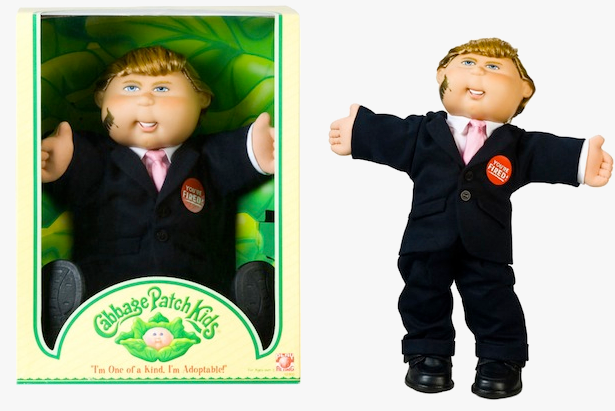
Did you know Cabbage Patch Dolls are back this year? Maybe you've got one wrapped under the tree right now. Did you know there was an urban legend that the CIA or President Reagan had Cabbage Patch Dolls designed to get people used to loving ugly babies so humanity could carry on after a nuclear war?

Speaking of ugly, did you know you can get a Donald Trump Cabbage Patch Doll?

And then there is the cabbage of fable:
It is said that no sort of food causes so much thirst as cabbage, especially that called colewort. Pausanias tells us it first sprang from the sweat of Jupiter, some drops of which fell on the earth. Cœlius, Rhodiginus, Ovid, Suidas, and others repeat the same fable.

Rabelais: Pantagruel, book iv. (Prologue). “Some drops of sweat happening to light on the earth produced what mortals call cabbage.”—
The poets have lavished their attention on the lowly cabbage. Yeats:
All his happier dreams came true
A small old house, wife, daughter, son,
Grounds where plum and cabbage grew,
Poets and Wits about him drew;
“What then?”sang Plato’s ghost, “what then?”
Lewis Carrol:
"The time has come," the Walrus said,
"To talk of many things:
Of shoes--and ships--and sealing-wax--
Of cabbages--and kings--
And why the sea is boiling hot--
And whether pigs have wings."
There is also the cabbage of politics. H.L. Mencken has good political wisdom framed in cabbage terms: "An idealist is one who, on noticing that a rose smells better than a cabbage, concludes that it will also make better soup."

And George Orwell begins his "1984" with the reek of cabbage:
The ideal set up by the Party was something huge, terrible, and glittering—a world of steel and concrete, of monstrous machines and terrifying weapons—a nation of warriors and fanatics, marching forward in perfect unity, all thinking the same thoughts and shouting the same slogans, perpetually working, fighting, triumphing, persecuting—three hundred million people all with the same face. The reality was decaying, dingy cities, where underfed people shuffled to and fro in leaky shoes, in patched-up nineteenth-century houses that smelt always of cabbage and bad lavatories.
Well, that reminds me what I don't like about cabbage. So maybe I won't get too carried away with the new cabbage-blogging craze. So don't hesitate to pick up the slack and cabbage-blog yourself.

A dialogue about food.

"What do you think is the best food? I mean, not taking health into account. If you had to pick one food and say that it is the best, what do you think it would be?"

"Ice cream."

"Really, because I had an idea..."

"Chocolate?"

"I was just thinking -- not because I really think it's the answer -- but it just came into my head as the answer ..."

"What?"

"Cole slaw."

UPDATE: The dialogue continues a half hour later:

"You know, I think cabbage is one of the most repulsive foods."

"I don't like cabbage either. It's cole slaw."

"If life gives you lemons, make lemonade. If life gives you cabbage, make cole slaw."

Another perspective on "Merry Christmas."

Here's a quote from J.B. Priestly:
Something in me resists the calendar expectation of happiness. Merry Christmas yourself! it mutters as it shapes a ghostly grin.

"Joy."

There's been a lot of talk lately about preserving the greeting "Merry Christmas." Some folks think the phrase has too much religion in it, and it's undeniable that "Christ" is right there in the word Christmas. Yet much of what makes Christmas tiresome to non-Christians is that it goes on for over a month, and this time-stretch ought to trouble Christians too. From a Christian perspective, this is not the Christmas season, it's Advent, a time of waiting and hope, not a time of merrymaking. But even if it were already Christmas, is "merry" the right word to express the religious meaning? The American Heritage® Dictionary defines "merry" this way:
1. Full of high-spirited gaiety; jolly. 2. Marked by or offering fun and gaiety; festive: a merry evening. 3. Archaic Delightful; entertaining. 4. Brisk: a merry pace.
E. Cobham Brewer's Dictionary of Phrase and Fable (1898) traces the history of "merry":
The original meaning is not mirthful, but active, famous; hence gallant soldiers were called “merry men;” favourable weather, “merry weather;” brisk wind, “a merry gale;” London was “merry London;” England, “merry England;” Chaucer speaks of the “merry organ at the mass;” Jane Shore is called by Pennant the “merry concubine of Edward IV.” (Anglo-Saxon, mœra, illustrious, great, mighty, etc.). (See MERRY-MEN.) ’Tis merry in hall, when beards wag all (2 Henry IV., act V. 3). It is a sure sign of mirth when the beards of the guests shake with laughter.
"Merry" has little to do with the message of Christianity. It connotes eating, drinking, dancing, joking, laughing, and horsing around. "Merry" turns Christmas into a generic winter festival. To express the spiritual happiness of Christmas, you would do better to say "Joyous Christmas." But the word "joy," standing alone, contains the meaning of Christmas. Why not make the one-word expression "Joy!" the seasonal greeting? It's both more inclusive and more Christian. UPDATE: "Merry" is only used in four places in the English translations of the New Testament that I checked. It is used in a positive way to describe the celebration of the return of the Prodigal Son and in this short passage, but it is used negatively in Revelation and in the context of the famous phrase "eat, drink, and be merry." "Joy," by contrast, appears in 60 verses in the New Testament, all of which seem quite positive, including the quintessential Christmas passage: "And the angel said unto them, Fear not: for, behold, I bring you good tidings of great joy, which shall be to all people." "Joy" is also a fine Old Testament word. "Merry," on the other hand, seems to have mostly to do with drinking a lot of wine. ANOTHER UPDATE: Nina says the Polish Christmas greeting -- "Wesolych Swiat" -- translates as "Merry Holi-days." (She seems to imply that the second word there is something in between our "holidays" and "holy days.") She titles her post "Eat, Drink, and Be Merry," but I note that the New Testament passage with that phrase provokes a rebuke from God ("Thou fool"). Note that I have nothing against partying, by Christians and others. I just don't think it's particularly religious.

Disyembre 22, 2004

A pile of books raises a question.

Books left on the chair by the last occupant of the table I was lucky enough to grab here at Borders café today:
Matter (serious looking book of poetry)

I Keep Falling in Love with You (cheesy looking poetry anthology)

Readings in Economic Sociology

Principles of Economic Sociology

Obsessive Compulsive Disorders: A Complete Guide to Getting Well and Staying Well

Obsessive Compulsive Disorder: New Help for the Family

Obsessive-Compulsive Disorder:The Facts

Tormenting Thoughts and Secret Rituals: The Hidden Epidemic of Obsessive-Compulsive Disorder

Wouldn't you think someone that interested in obsessive compulsive disorder would reshelve his books?